AI Chatbot Case Study: OpenAI + Gemini with Human Support & Lead Automation
In This Article
Customers increasingly expect answers immediately. But businesses face an important challenge: purely automated chatbots can handle repetitive questions, yet complex sales discussions, technical enquiries, project requirements, and sensitive customer conversations often still require a human.
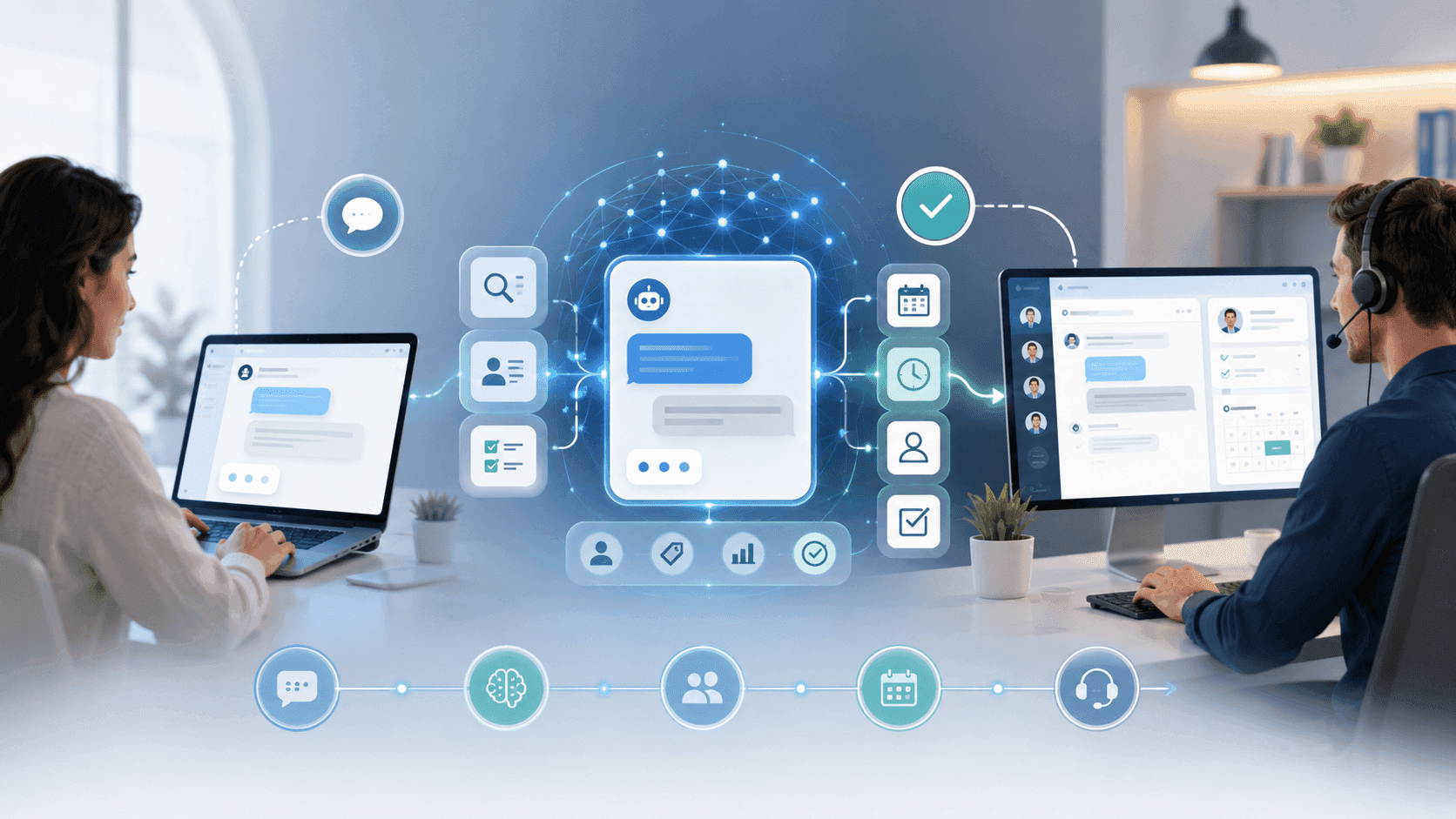
Murmu Software Infotech addressed this challenge by developing a custom AI chatbot and customer engagement platform powered by OpenAI and Google Gemini, combining conversational AI with human support, business automation, voice interaction, lead qualification, meeting scheduling, and analytics.
The goal was not simply to create another website chatbot. It was to build a hybrid AI + human engagement system capable of responding instantly while knowing when a conversation should move to an experienced human.
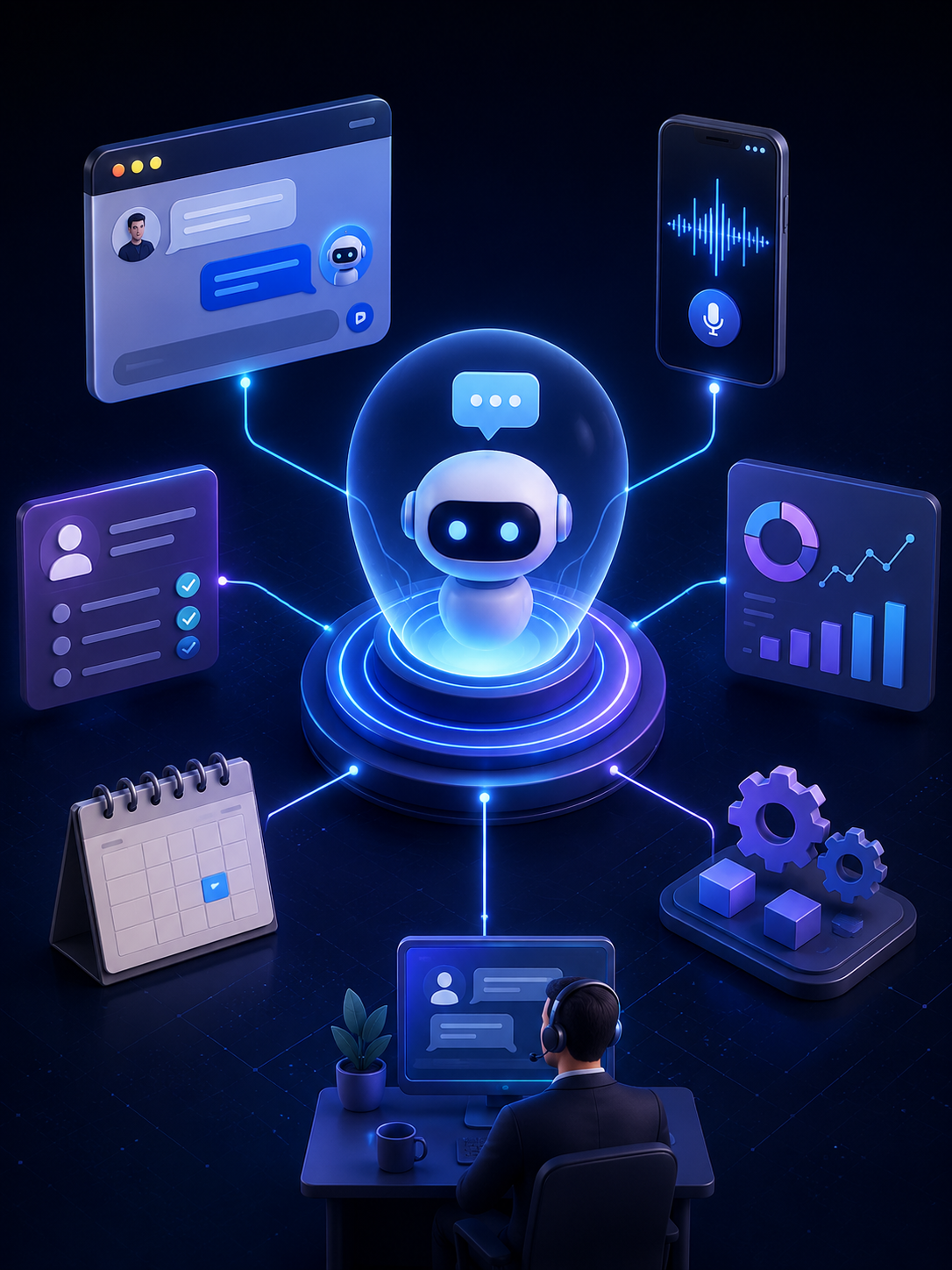
Turn Conversations Into Business Growth
Build a hybrid AI engagement platform that answers instantly, qualifies leads, automates actions, books meetings, and escalates complex conversations to humans.
The Business Challenge
Traditional website enquiry journeys often create unnecessary friction.
A prospective customer may visit after business hours, have a question about services or pricing, need help choosing a solution, or want to schedule a discussion. If that enquiry waits several hours for a response, the opportunity may already be lost.
At the same time, support and marketing teams repeatedly answer similar questions about services, capabilities, project costs, hiring, timelines, and business processes.
Basic scripted chatbots can automate some responses, but they frequently struggle when the user asks something outside predefined flows or requires personalised guidance.
The platform therefore needed to provide immediate AI assistance while preserving a clear path to human expertise when automation was no longer appropriate.
Turn Website Conversations Into Qualified Leads With Custom AI
The Solution: Hybrid AI + Human Engagement
Murmu Software Infotech developed a custom conversational platform integrating both OpenAI GPT models and Google Gemini models with business knowledge, custom APIs, support workflows, and internal business applications.
Instead of relying only on generic model knowledge, the chatbot can use business-specific context to deliver more relevant answers about services, solutions, processes, and customer requirements.
A better technical description than “training the chatbot on the knowledge base” is knowledge-grounded AI: the application supplies relevant business information as context so the model can generate answers based on approved organizational knowledge.
This architecture can also evolve further through retrieval, file search, databases, APIs, or other grounding mechanisms.
Intelligent Human Escalation
Human handoff became one of the most important parts of the solution.
When the AI does not have sufficient confidence, encounters a complex request, or the visitor asks to speak with someone directly, the conversation can be transferred to a live support expert.
The objective is to retain the conversation context so customers do not have to repeat everything after escalation.
A lightweight internal support application was also developed for the marketing and support team, allowing staff to manage live conversations efficiently.
This creates a practical operating model:
AI handles speed and repetition. Human experts handle judgement, complexity, negotiation, and high-value conversations.
AI That Can Do More Than Answer Questions
The platform was designed beyond conversational Q&A.
Custom business utilities were integrated into the experience, including project cost calculators, hiring estimators, workflow tools, and API-driven automation.
The chatbot can therefore become a pathway from question → qualification → business action rather than ending every interaction with a text response.
This approach aligns with modern LLM architecture. OpenAI function calling can connect AI models to application functions and external systems, while Gemini function calling supports actions such as scheduling meetings, querying databases, accessing business knowledge, and executing application workflows.
Meeting Booking and Microsoft Integration
For high-intent visitors ready to speak with the business, the platform incorporates meeting-scheduling capabilities through Microsoft Graph API, Azure authentication, and scheduling workflows.
Instead of asking the visitor to leave the conversation, find a calendar page, and restart the process, the engagement journey can move naturally toward scheduling a meeting.
This reduces friction between website enquiry and sales conversation.
Voice and Multimodal Engagement
Voice interaction was also incorporated to make the assistant more accessible and conversational.
Visitors can interact through voice input while AI-generated responses provide a more flexible alternative to conventional text-only support.
This architecture also establishes a foundation for future multimodal customer experiences involving speech, documents, images, tools, and real-time AI.
Build an AI Chatbot That Knows When Humans Matter
Technology Architecture
The frontend was developed using Next.js and React, supported by Node.js APIs. OpenAI and Google Gemini provide the core LLM capabilities, while Supabase supports data storage. Microsoft Graph API, Azure services, and custom REST APIs enable scheduling and business integrations.
Conversation analytics and monitoring provide visibility into customer questions, AI interactions, handoffs, and opportunities for continuously improving the experience.
Business Impact
The resulting platform provides a stronger customer engagement model by delivering immediate assistance around the clock, automating repetitive conversations, creating faster routes to qualified enquiries, and allowing human agents to focus on conversations where their expertise has the greatest value.
Rather than replacing customer-facing teams, the system augments them.
AI manages scale and responsiveness; humans remain available for relationship-building, detailed discovery, technical consultation, and commercial discussions.
The architecture can also scale beyond website support into customer portals, SaaS applications, healthcare systems, internal knowledge assistants, ecommerce experiences, and other business platforms.
Build an AI Engagement Platform Around Your Business
A successful AI chatbot should do more than generate impressive answers.
It should understand your business context, connect with useful systems, support customer actions, escalate intelligently, and create a measurable path from conversation to business outcome.
Murmu Software Infotech develops custom AI chatbots, conversational AI platforms, OpenAI and Gemini integrations, knowledge-grounded assistants, human handoff systems, AI automation, voice experiences, and business API integrations.
If your current website chatbot only answers questions, the next opportunity is turning it into an intelligent customer engagement and conversion platform.
Frequently Asked Questions
What is a custom AI chatbot with OpenAI and Gemini?
A custom OpenAI and Gemini chatbot is a conversational application that combines large language models with business-specific knowledge, APIs, workflows and user interfaces to answer questions, automate actions and support customer engagement.
Why use both OpenAI and Gemini in an AI chatbot?
Using multiple AI providers can give an application flexibility to route different workloads, evaluate model capabilities, manage availability and support different conversational or multimodal requirements according to the system architecture.
Can an AI chatbot transfer conversations to a human agent?
Yes. A hybrid AI chatbot can escalate a conversation when a user requests human help, the request requires specialist judgement or the application determines that automation is insufficient. Conversation context can be retained during the handoff.
Can an AI chatbot qualify website leads?
Yes. An AI chatbot can collect requirements, identify user intent, ask qualification questions, capture contact information, recommend relevant services and route qualified opportunities toward sales or meeting-booking workflows.
Can OpenAI and Gemini chatbots connect to business APIs?
Yes. Both platforms support tool or function-calling patterns that allow applications to connect AI conversations with external APIs, databases and business workflows such as scheduling, calculations, CRM actions or data retrieval.
Can an AI chatbot schedule customer meetings automatically?
Yes. A chatbot can connect with calendar or scheduling APIs to collect meeting requirements and initiate booking workflows. In this project, Microsoft Graph API and Azure-based authentication were used for scheduling integration.
Can a custom AI chatbot support voice conversations?
Yes. Voice input and AI-generated responses can be added to a conversational platform to provide a more accessible and natural interaction experience alongside traditional text chat.
How does an AI chatbot use company knowledge?
A business chatbot can ground responses using approved company content supplied through retrieval systems, databases, APIs, structured knowledge sources or other context mechanisms instead of relying only on general model knowledge.
What technology was used for this AI chatbot platform?
The implementation used Next.js and React for the frontend, Node.js APIs for the backend, OpenAI and Google Gemini for AI capabilities, Supabase for data storage, and Microsoft Graph, Azure services and custom REST APIs for integrations.
Who can build a custom OpenAI and Gemini chatbot for businesses?
Murmu Software Infotech develops custom AI chatbots, OpenAI and Gemini integrations, knowledge-grounded assistants, human handoff workflows, voice AI, business automation, API integrations and customer engagement platforms.