Sitecore CMS
Sitecore GEO, AEO & AI Digital Marketing Integration
PPrem M.5 Min Read
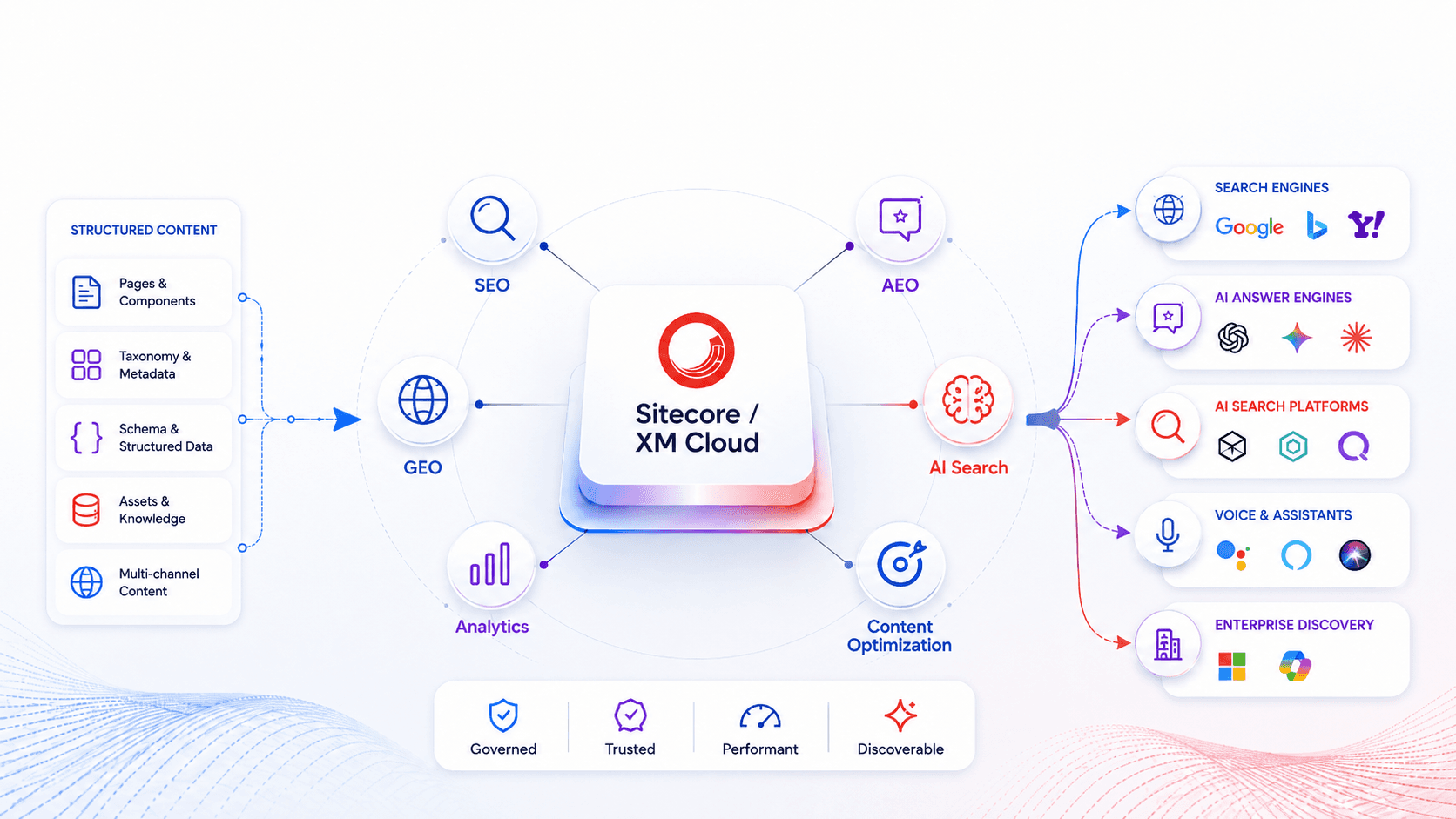
For years, enterprise digital marketing teams have focused on one primary objective: ranking higher on Google and Bing.
That goal still matters, but digital discovery is changing rapidly. Buyers are increasingly researching companies, products, technologies and service providers through AI-powered platforms such as ChatGPT, Gemini, Perplexity, Copilot, Grok and DeepSeek.
If your organization publishes valuable content in Sitecore but that content is difficult for search engines and AI systems to discover, understand and trust, your marketing team may be creating content without capturing its full business value.
Modern Sitecore platforms therefore need a connected SEO, AEO, GEO and AI digital marketing strategy.
The objective is simple:
Make your enterprise content discoverable by people, search engines, answer engines and AI platforms.
SEO helps Google and Bing crawl, understand, index and rank your website. Technical performance, metadata, internal linking, content quality, backlinks, structured data and site architecture remain essential.
But enterprise discovery now extends beyond conventional search results.
AEO prepares your content to answer specific questions clearly.
Instead of hiding the main answer inside several paragraphs, an AEO-ready Sitecore component can follow an answer-first structure:
Question → Direct Answer → Supporting Explanation → Evidence → CTA
For example, a page answering “What is Sitecore XM Cloud?” can provide a concise definition first and then expand into architecture, benefits, use cases and migration considerations.
This structure improves usability for visitors while making content easier for search engines and AI systems to interpret.
GEO focuses on helping generative AI platforms understand your organization, expertise, services, products and content.
The objective is not simply adding more keywords. It is creating a trustworthy digital content estate built around clear entities, structured facts, authoritative authorship, case studies, original expertise, supporting sources and contextual relationships.
Our Sitecore GEO and AEO Optimization Guide explores this strategy in greater detail.
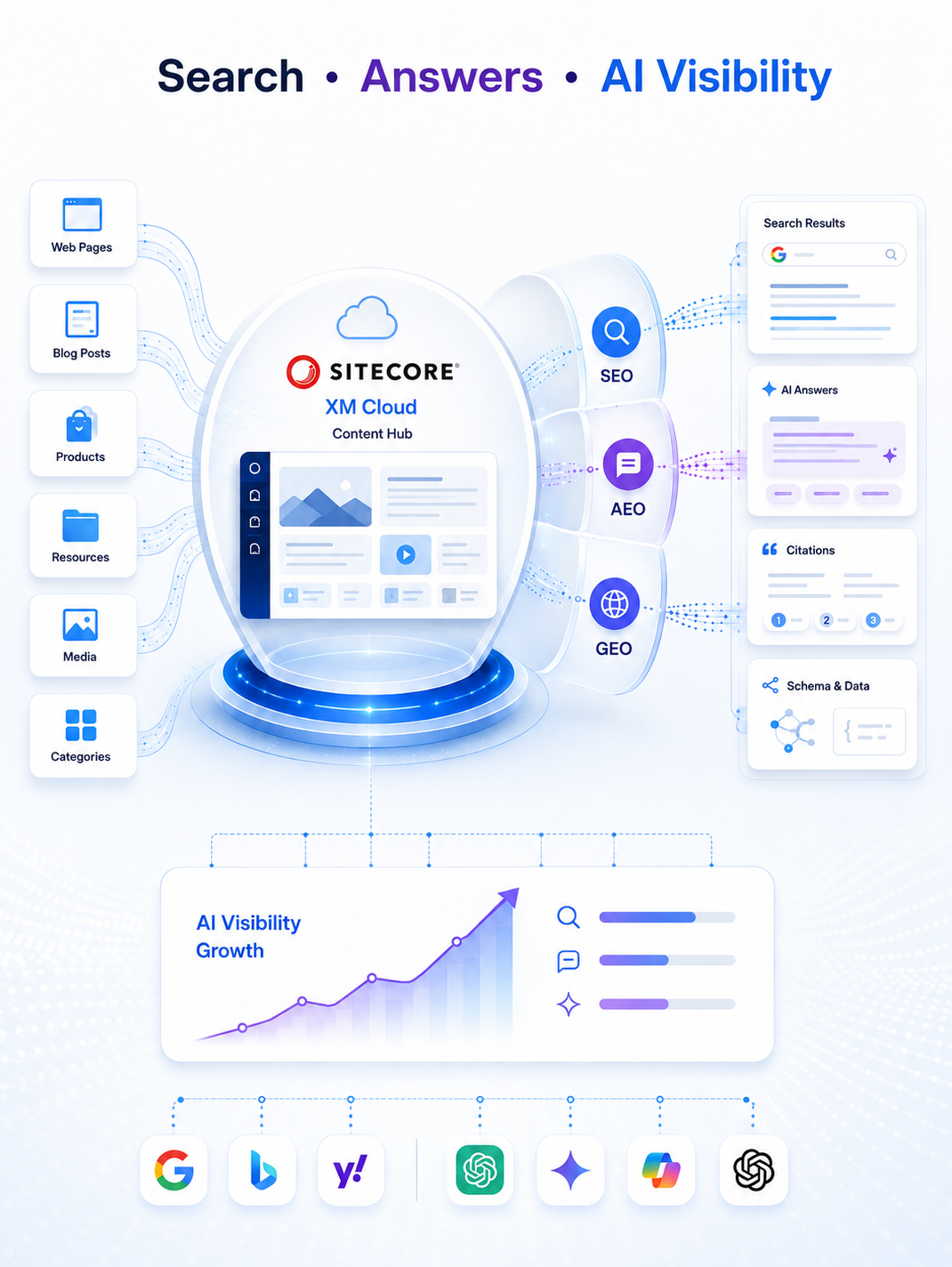
Transform Sitecore into an AI-ready marketing platform with structured content, technical SEO, AEO, GEO, schema, and scalable digital experiences.
Large Sitecore implementations may contain thousands of pages, multiple languages, service information, product data, documentation, case studies, FAQs, campaign pages and knowledge resources.
But publishing content does not automatically make it discoverable.
Common enterprise problems include information buried inside large rich-text fields, weak structured data, inconsistent metadata, poor internal linking, missing author information, duplicated content and pages heavily dependent on client-side rendering.
Another challenge is operational. Content teams may depend on developers whenever they need to change metadata, implement schema, publish FAQs or create new optimization fields.
A properly designed Sitecore SEO, AEO, GEO and AI digital marketing implementation makes optimization part of the CMS publishing workflow itself.
The strongest implementation begins with content architecture, not another standalone marketing plugin.
Sitecore templates can include reusable fields for:
This gives content teams structured information that can support website pages, FAQs, schema markup, internal search, APIs and other digital channels.
Instead of forcing AI systems to interpret one large block of text, the CMS provides clearly defined information with meaning and context.
Reusable Sitecore components can make answer optimization repeatable across the platform.
A pricing page, for example, could immediately answer:
How much does Sitecore XM Cloud migration cost?
The page can then explain variables such as website size, number of components, integrations, content volume, languages and redevelopment requirements.
This approach makes content easier to scan for humans and easier to extract for answer-based experiences.
Enterprise marketers should not require developer support for every optimization change.
Sitecore templates and components can provide governed controls for meta titles, descriptions, canonical URLs, robots directives, XML sitemaps, Open Graph data, Twitter/X metadata, breadcrumbs, hreflang and structured data.
For organizations using XM Cloud and Next.js, technical teams should also ensure that important page content is delivered in accessible, crawlable HTML.
Businesses modernizing their architecture can explore our Sitecore XM Cloud Development Services.
AI can also help accelerate enterprise content operations.
An AI-assisted workflow can identify missing FAQs, weak summaries, search-intent gaps, metadata opportunities, internal-link recommendations, topic gaps, outdated content and translation opportunities.
AI should support not replace experienced content managers, digital marketers and subject-matter experts.
Human review remains critical for factual accuracy, brand governance, regulatory requirements and enterprise-quality publishing.
Sitecore’s acquisition of Scrunch has also raised an important question:
Does an enterprise still need GEO and AEO implementation if AI visibility technology is available?
Yes, because they address different parts of the challenge.
Your Sitecore platform needs to optimize:
Content → Structure → Rendering → Schema → SEO → Answers → Authority
This creates the technical and editorial foundation required for search and AI discovery.
AI visibility platforms such as Scrunch focus more on understanding how a brand appears across generative AI experiences, measuring visibility, identifying competitive gaps and highlighting opportunities for improvement.
Think of it this way:
GEO/AEO integration makes your Sitecore content AI-ready.
AI visibility intelligence helps measure how that content performs across the AI discovery ecosystem.
One does not replace the other.
Murmu Software Infotech helps organizations assess and implement Sitecore SEO, AEO, GEO and AI digital marketing capabilities across Sitecore XP, XM Cloud and Sitecore AI environments.
Our approach can include technical SEO assessment, structured content modeling, answer-first components, schema implementation, Next.js optimization, content architecture, Sitecore Search, analytics, AI-assisted workflows and training for marketing and content teams.
Explore our Sitecore CMS Development Services or see how modern Sitecore capabilities can work in practice through our Sitecore XM Cloud Healthcare Platform with AI Search case study.
Your Sitecore content should do more than exist. It should be discoverable by search engines, understandable by AI, trusted by decision-makers and structured to support measurable business growth.
Sitecore GEO, AEO and AI digital marketing integration combines traditional SEO, Answer Engine Optimization, Generative Engine Optimization, structured content and AI-assisted workflows inside Sitecore or XM Cloud. The goal is to make enterprise content easier for users, search engines and AI-powered discovery systems to find, understand and reuse.
SEO helps Sitecore pages become crawlable, indexed and competitive in search results. AEO structures content around questions and concise answers, while GEO strengthens machine readability, entity clarity, topical authority and citation readiness for generative AI experiences. These disciplines complement rather than replace one another.
GEO and AEO can be integrated through structured Sitecore templates, AI summaries, key facts, questions, direct answers, author fields, source references, entity fields, schema-ready components, technical SEO controls, internal linking, crawlable rendering and governed publishing workflows.



XM Cloud supports component-based and structured content architectures that can separate FAQs, metadata, summaries, entities and answers into reusable fields. Combined with Next.js rendering, taxonomies, structured data, Sitecore Search and governed workflows, this creates a strong foundation for search and AI discovery.
Publicly accessible Sitecore content can potentially be discovered and referenced by AI-powered platforms when it is crawlable, useful, authoritative and relevant. GEO and AEO can improve machine readability and citation readiness, but no implementation can guarantee inclusion or citation by a particular AI platform.
Useful structured fields can include AI Summary, Key Facts, Questions, Direct Answers, Primary Entity, Author, Reviewer, Sources, Target Audience, Service Area, Last Reviewed Date and Recommended Schema Type. These fields can then support pages, FAQs, schema markup, search and APIs.
GEO and AEO integration improves the underlying Sitecore content estate through content structure, rendering, metadata, schema, direct answers, authority and technical SEO. AI visibility platforms such as Scrunch focus more on measuring how brands and content appear across generative AI discovery experiences. They are complementary rather than direct substitutes.
No. Structured data can help search systems understand page entities and relationships, but it does not guarantee rankings, AI citations or inclusion in generative answers. Structured data should accurately represent visible content and work alongside useful content, crawlability, authority, internal linking and technical SEO.
Enterprises can measure organic rankings, impressions, clicks and conversions alongside AI citations, cited URLs, grounding queries, AI referral traffic, brand mentions, content freshness and query coverage. Bing Webmaster Tools now provides AI Performance reporting for supported Microsoft AI experiences.
Murmu Software Infotech provides Sitecore and XM Cloud implementation support covering technical SEO, structured content modelling, answer-first components, schema integration, Next.js optimization, Sitecore Search, AI-assisted workflows, analytics and training for enterprise content and digital marketing teams.