Ecom & Retail / E-commerce Platforms
E-commerce Website Development Cost in India
PPrem M.6 Min Read
Indian retailers, manufacturers and D2C founders often begin with the same question:
How much does an e-commerce website cost in India?
The more important question is: What is the smallest commerce product capable of proving your business model?
A new brand may only need to validate whether
customers will discover its products, complete checkout and accept delivery. An established retailer may need real-time inventory, point-of-sale integration and multiple locations. A manufacturer entering direct-to-consumer commerce may need dealer-friendly pricing, warehouse integration and complete control over the customer journey.
Your e-commerce development budget should therefore follow the business model—not a generic feature list.
A D2C platform allows manufacturers and brands to sell directly to customers instead of relying entirely on distributors, wholesalers or marketplaces. This provides more control over pricing, brand presentation and the customer experience while creating direct access to customer behaviour and purchase data.
However, direct selling also transfers responsibility for product discovery, payments, inventory, fulfilment, returns and customer support to the business. A successful online store must therefore connect customer-facing commerce with reliable operational workflows.
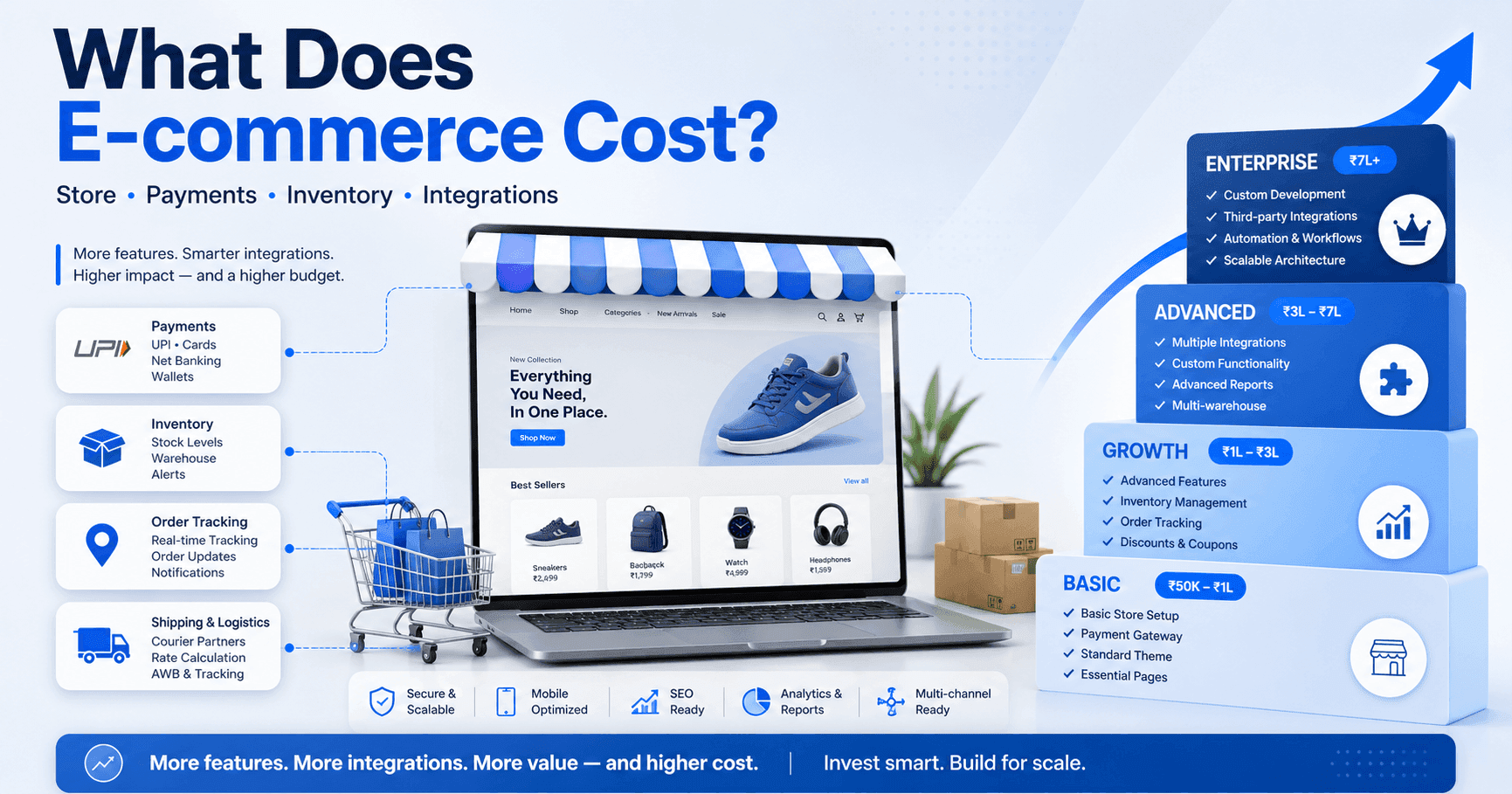
The cost of developing an e-commerce website in India depends on five major areas.
A basic storefront may include:
The budget increases when the platform requires product comparison, personalised recommendations, subscriptions, multilingual content, complex pricing or a completely custom interface.
For most Indian brands, the first release should focus on the shortest journey from product discovery to successful payment.
A store selling 30 products has different requirements from a manufacturer managing thousands of SKUs, variants, technical specifications and price tiers.
Cost is affected by:
Structured catalogue planning at the beginning can prevent expensive rework when the business expands.
Indian e-commerce platforms commonly require payment-gateway and UPI support, shipping rules, order notifications and analytics.
Advanced implementations may connect with:
Every integration adds configuration, API development, testing, security and error-handling requirements. The right approach is to launch with integrations essential to proving the business model, then expand after real orders reveal operational priorities.
Businesses needing connected offline and online operations can explore a unified retail and e-commerce growth platform with POS billing, order management, inventory visibility, payments and multi-store capabilities.
Inventory becomes a major cost factor when products are sold through stores, websites, mobile apps and marketplaces simultaneously.
A basic system may update stock after each website order. A connected commerce platform may require:
Centralised inventory and order processing are particularly important for D2C brands operating across multiple channels, where disconnected systems can create overselling, stockouts and delayed fulfilment.
Building an Android and iOS application increases the initial investment. New businesses should not automatically begin with a website, customer app, delivery app and multiple dashboards.
Start with a responsive web platform when it can validate demand. Add a mobile app when repeat purchases, loyalty, subscriptions, notifications or app-specific behaviour justify the investment.
The D2C Brand Commerce Platform case study demonstrates how a commerce foundation can later support a high-performance storefront, mobile shopping, loyalty, CMS integrations and API-first architecture.
Suitable for a new retailer, local brand or manufacturer testing direct sales.
It may include product management, categories, cart, checkout, payment integration, UPI options, customer accounts, order management, basic shipping, coupons, analytics and technical SEO.
Murmu Software Infotech’s current India-only E-commerce Starter Package begins at ₹85,000 for a predefined scope. Final pricing depends on catalogue size, payment methods, shipping workflows, inventory requirements and integrations.
Suitable for brands that have validated demand and need stronger operational control.
Possible additions include:
This requires a custom estimate because the cost depends on workflows and third-party systems rather than page count alone.
Retail chains, distributors and manufacturers may require a connected platform covering online sales, in-store billing, inventory, warehousing, delivery, mobile applications and multi-location operations.
These projects should be delivered in phases. The first phase should solve one measurable business problem—such as launching direct sales or synchronising stock—before adding the entire commerce ecosystem.
Shopify or WooCommerce can be suitable when speed, standard commerce features and lower initial complexity are priorities.
Custom development becomes more relevant when the business requires:
Murmu Software Infotech provides e-commerce website and application development for retailers, D2C businesses and manufacturers requiring conversion-focused storefronts and scalable commerce architecture.
The first version of an online store does not need every possible feature.
It needs to prove that:
Once those assumptions are proven, the platform can expand into inventory automation, loyalty, marketplaces, mobile apps, subscriptions or AI-powered recommendations.
E-commerce website development cost in India should be calculated around the customer journey, catalogue complexity, integrations and operational requirements—not only the number of webpages.
A retailer may begin with a focused online store. A D2C brand may prioritise customer data, retention and mobile commerce. A manufacturer may need inventory, pricing, ERP and fulfilment integrations.
The best investment is not necessarily the cheapest store or the largest platform.
It is the smallest scalable commerce product capable of generating real orders, validating demand and proving the business model.
Explore the current Digital Product Launch Offer 2026 for development costs, included features, portfolio examples and project showcases. The India-only offer, including e-commerce platforms starting from ₹85,000, is available until 6 August 2026, subject to predefined scope and project-slot availability.
Cost depends on catalogue size, design, payments, shipping, inventory, integrations and future scalability. Murmu Software Infotech's current E-commerce Starter Package begins at ₹85,000 for a predefined scope. Advanced D2C, B2B, marketplace and multi-store platforms require a custom estimate.
The starter scope can include a responsive storefront, product and category management, search, cart, secure checkout, payment-gateway integration, UPI options, customer accounts, order management, coupons, basic shipping, WhatsApp integration, analytics and technical SEO.
Important factors include product volume, variants, custom design, user roles, payment methods, shipping workflows, inventory management, warehouses, ERP or CRM integration, mobile applications, subscriptions, marketplace functionality, automation and security requirements.
The right platform depends on the business model. Shopify suits many standard online stores, WooCommerce supports WordPress-led commerce, and custom or headless development is suitable for businesses requiring specialised workflows, integrations, frontend flexibility or mobile-app expansion.
Yes. A compatible payment gateway can enable UPI, cards, net banking and wallets. Provider approval, transaction fees, settlement schedules and refund policies are managed according to the selected gateway.
Yes. An e-commerce platform can connect with inventory, POS, ERP, warehouses and retail locations. The available stock synchronisation, alerts, order routing and reporting depend on the selected systems and their APIs.
Yes. Shipping APIs can support rate calculation, courier selection, airway bill generation, shipment updates and tracking. Cancellation, return and reverse-logistics workflows may require additional implementation.
A mobile app is not always required for the first release. A responsive website can validate demand and generate initial orders. An app becomes more valuable when repeat purchases, loyalty, subscriptions and push notifications create measurable business value.
The best first version is the smallest scalable product that allows customers to discover products, complete payment and receive their orders while enabling the business to measure demand, conversion and fulfilment performance.
Common exclusions include domain registration, hosting, cloud services, business email, payment-gateway fees, shipping charges, paid plugins, third-party licences, messaging usage, advertising, ongoing SEO and new features requested after scope approval.