Enterprise CMS AI-Readiness Checklist: Is Your Content Platform Ready for AI?
In This Article
- Why Enterprise CMS AI Readiness Matters
- 1. Is AI Connected to a Measurable Business Goal?
- 2. Is Your Content Structured for Machines?
- 3. Are Your APIs and Integration Layers Reliable?
- 4. Can AI Retrieve Current, Approved Content?
- 5. Are Governance and Human Review Built In?
- 6. Can the CMS Support Multilingual and Omnichannel Operations?
- 7. Are Search and Personalization Ready for AI?
- 8. Are Teams Prepared to Operate the Platform?
- From Checklist to CMS Modernization Roadmap
- Start Your Enterprise CMS AI-Readiness Assessment
- Is Your Enterprise CMS Ready for AI?
Buying an AI content tool does not make an enterprise CMS AI-ready.
Even a headless CMS can struggle to support AI if its content is unstructured, metadata is incomplete, APIs are unreliable, approval workflows are manual, or security controls were designed only for human users.
An Enterprise CMS AI-Readiness Checklist helps leaders evaluate whether their current content platform can safely support AI-assisted publishing, intelligent search, personalization, RAG, content agents and automated workflows before investing in another disconnected pilot.
Enterprise AI-readiness research consistently highlights business alignment, reliable data, technical infrastructure, governance, skills, workflow adoption and measurable ROI. For CMS platforms, these organizational foundations must be combined with structured content, dependable APIs, real-time delivery and controlled access for AI systems.
Why Enterprise CMS AI Readiness Matters
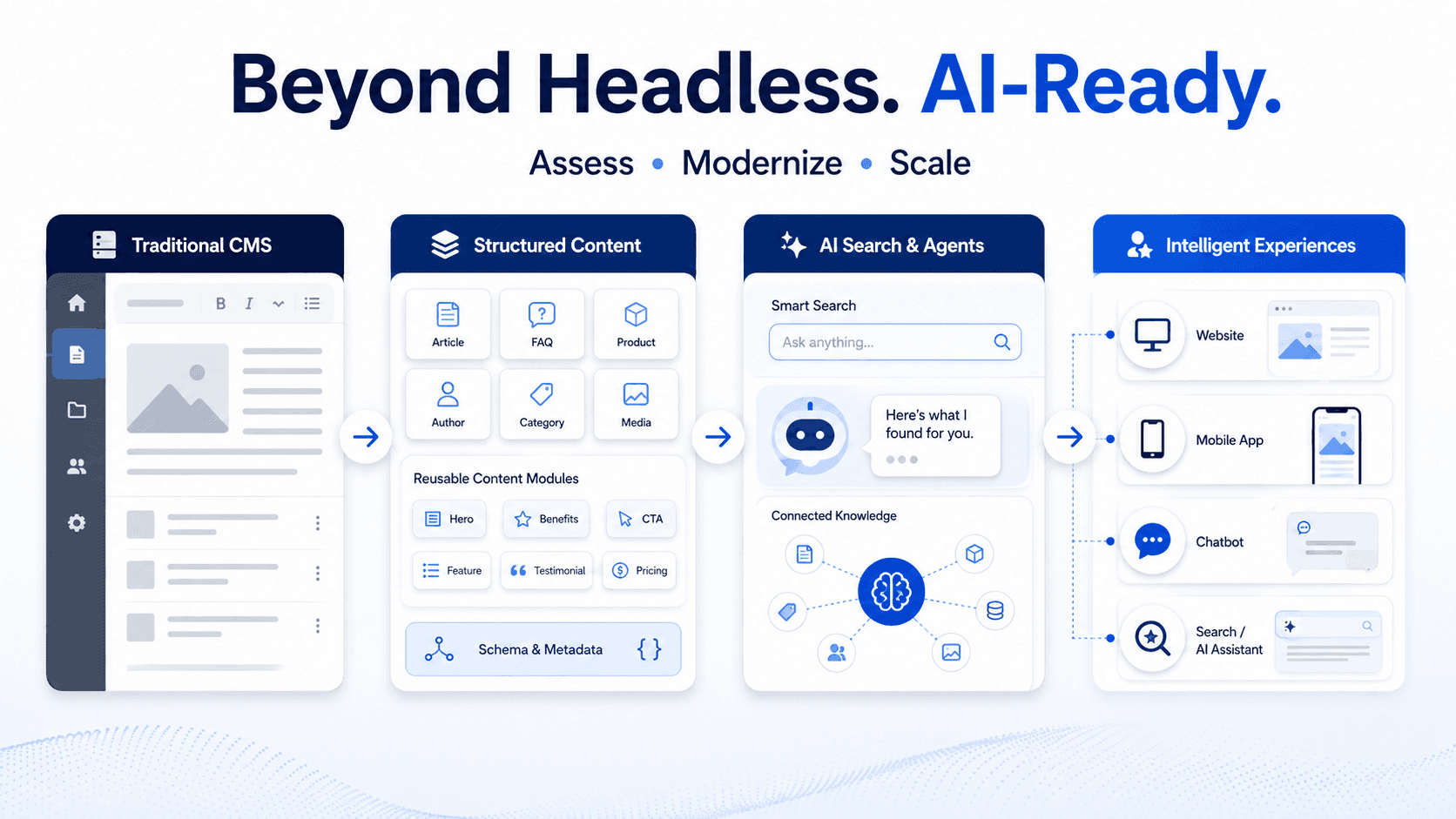
The CMS is no longer only responsible for publishing website pages. It may now supply information to mobile applications, customer portals, commerce platforms, internal search, AI assistants, campaign tools and generative search engines.
That makes the CMS a strategic digital platform connecting content, customer experience, data, personalization and omnichannel delivery-not simply a marketing tool.
However, “headless” does not automatically mean “AI-ready.” A platform can expose content through APIs while still having weak content models, inconsistent taxonomies, limited governance or content that is difficult for an AI system to interpret reliably.
Use the following checklist before planning an enterprise CMS migration or AI implementation.
Modernize Your Content Platform for Secure AI Adoption
1. Is AI Connected to a Measurable Business Goal?
Start with the problem, not the AI feature.
Determine whether AI should improve:
- Content-production speed
- Translation costs
- Search success
- Campaign time-to-market
- Customer self-service
- Lead generation
- Conversion rates
- Content reuse
- Editorial productivity
Every use case should have an executive owner, baseline measurement and defined KPI. AI initiatives without a connection to revenue, cost, risk or delivery speed are difficult to scale beyond experimentation.
2. Is Your Content Structured for Machines?
AI performs better when content is stored in clearly defined fields rather than large HTML blocks.
Review whether your CMS has:
- Reusable content models
- Defined relationships between content types
- Consistent metadata and taxonomy
- Product, service, location and audience attributes
- Structured FAQs and direct answers
- Clear publication and expiry dates
Structured content can be reused across websites, mobile applications, search results and AI assistants. Murmu Software Infotech’s Sanity CMS and Next.js migration case study demonstrates how structured models, GROQ queries and AI-driven workflows created a more scalable content foundation.
3. Are Your APIs and Integration Layers Reliable?
AI agents and external applications depend on APIs rather than the CMS user interface.
Assess:
- REST, GraphQL or GROQ availability
- API documentation and versioning
- Predictable schemas
- Clear error responses
- Authentication and rate limits
- CRM, DAM, PIM, commerce and analytics integrations
- Webhooks for event-driven automation
- MCP or tool-calling compatibility
Stable APIs and detailed webhooks are particularly important when AI agents need to retrieve content, update metadata, trigger reviews or coordinate workflows across multiple systems.
Explore our broader enterprise and headless CMS development services for API-driven content architecture and system integration.
4. Can AI Retrieve Current, Approved Content?
RAG systems, enterprise search and AI assistants must receive accurate and current information.
Confirm that the platform supports:
- Real-time or near-real-time content delivery
- Clear draft and published states
- Content freshness controls
- Version history
- Expiry and archival workflows
- Reliable indexing
- Source attribution
Outdated content can produce inaccurate AI answers even when the underlying model is powerful. Real-time delivery and clean context also reduce unnecessary token consumption and improve retrieval quality.
Our Sitecore XM Cloud healthcare platform case study shows how headless content delivery, GraphQL, Sitecore Search AI and personalization can support complex enterprise discovery experiences.
5. Are Governance and Human Review Built In?
Enterprise AI should not publish unrestricted content directly to production.
Your CMS should provide:
- Role-based permissions
- Approval workflows
- Human-in-the-loop checkpoints
- Audit trails
- Version comparison
- Rollback capability
- Agent-specific credentials
- Records of AI-generated changes
AI agents should receive only the permissions required for their assigned tasks. Shared administrator keys or unrestricted publishing access create security and compliance risks.
6. Can the CMS Support Multilingual and Omnichannel Operations?
Evaluate whether content can be translated, reviewed and delivered without duplicating entire pages.
The platform should support:
- Language-specific workflows
- AI-assisted translation with human approval
- Regional and cultural variations
- Shared global content
- Websites, apps, portals and emerging channels
- SEO, AEO and GEO fields
A scalable content platform should also support complex digital products. The DOC247 telemedicine platform case study illustrates the need for integrated web, mobile, appointment, notification and real-time healthcare workflows.
7. Are Search and Personalization Ready for AI?
For more advanced digital experiences, review whether the CMS can connect content with:
- Customer behavior
- Audience segments
- Location and language
- Search intent
- Campaign data
- Product or service interests
- Recommendation engines
Platforms such as SitecoreAI and XM Cloud and Optimizely can support broader DXP requirements involving search, experimentation, customer intelligence and personalization.
Assess Whether Your Enterprise CMS Is Truly AI-Ready
8. Are Teams Prepared to Operate the Platform?
AI readiness is also an operating-model issue.
Content, marketing, development, security and legal teams should understand:
- Where AI can be used
- Which outputs require approval
- Who owns generated content
- How exceptions are escalated
- How quality is measured
- How employees provide feedback
Role-specific training and change management are essential because AI adoption often stalls when tools are disconnected from daily workflows.
From Checklist to CMS Modernization Roadmap
After completing the assessment, classify each area as:
Ready: Can support controlled production use.
Partially ready: Requires configuration, governance or content improvement.
Not ready: Requires architectural modernization or platform replacement.
The outcome may be improving the existing CMS, introducing a headless content layer, implementing Sanity CMS development services, modernizing Sitecore, adopting Optimizely or building a composable architecture.
Review additional examples, including our healthcare marketing website case study and AI-powered Smart Billing Lite case study, to see how content, applications, marketing and AI capabilities can work as part of a connected digital ecosystem.
Start Your Enterprise CMS AI-Readiness Assessment
Do not begin with another AI tool or CMS migration.
Begin by understanding whether your content, architecture, governance, integrations and teams can support AI safely and at scale.
Request an Enterprise CMS and Headless CMS AI-Readiness Assessment from Murmu Software Infotech to identify readiness gaps, quick wins and a practical modernization roadmap.
Is Your Enterprise CMS Ready for AI?
Request the CMS AI-Readiness Checklist
Frequently Asked Questions
What is enterprise CMS AI readiness?
Enterprise CMS AI readiness is the ability of a content platform to support AI search, content generation, RAG, personalization, automation and AI agents securely and reliably. It depends on content structure, APIs, governance, integrations, workflows and team readiness.
Is a headless CMS automatically AI-ready?
No. A headless CMS may provide APIs, but it can still have weak content models, inconsistent metadata, outdated content, limited governance or poor integration readiness. AI readiness requires more than an API-first architecture.
How do you assess whether a CMS is ready for AI?
A CMS AI-readiness assessment reviews business goals, structured content, metadata, APIs, permissions, workflows, search, integrations, multilingual capabilities and AI governance. It should also identify risks, quick wins and modernization priorities.
Why is structured content important for AI?
Structured content separates information into reusable fields such as titles, summaries, FAQs, services, locations and metadata. This helps AI systems retrieve, understand, cite and reuse approved content more accurately across websites, applications and assistants.
What role do APIs play in CMS AI readiness?
Reliable REST, GraphQL or GROQ APIs allow AI systems, search tools, applications and agents to access approved content. APIs should include authentication, predictable schemas, documentation, versioning, rate limits and clear error handling.
Can an existing enterprise CMS be made AI-ready?
Yes. Many CMS platforms can be improved through structured content modelling, metadata cleanup, API modernization, workflow automation, governance, AI search and integration layers. A complete migration is only necessary when the current platform cannot meet future requirements.
What governance controls are required for AI-powered content operations?
Organizations need role-based permissions, approval workflows, human review, audit trails, version history, rollback, agent-specific credentials and clear publishing controls. AI systems should only receive the minimum access required for their assigned tasks.
What is the difference between an AI-ready CMS and a DXP?
An AI-ready CMS primarily manages structured content and delivers it across channels. A DXP adds broader capabilities such as customer data, behavioral analytics, personalization, experimentation, campaign management and conversion optimization.
Which CMS platforms can support AI-ready content operations?
Platforms such as SitecoreAI, XM Cloud, Sanity, Strapi, Optimizely, Contentful and Umbraco can support different levels of AI-enabled content operations. The right choice depends on business goals, architecture, integrations, governance, budget and team capabilities.
What should an enterprise receive from a CMS AI-readiness assessment?
The assessment should produce a readiness score, architecture findings, content and workflow gaps, governance risks, prioritized use cases, quick wins and a phased modernization roadmap. It should also define measurable KPIs for AI adoption.