ODC Setup in India Choosing the Right Model Before You Commit
In This Article
An offshore development centre (ODC) sounds like something only banks and tech giants build. And for a long time, it was. Today, mid-size product companies, SaaS businesses, and agencies run ODCs in India too, often with teams of five to fifteen people.
The hard part isn't deciding to go offshore. It's choosing the right setup model, because that choice decides your cost, speed, and how much you'll actually control.
Build Your India ODC Faster
Launch a dedicated offshore development centre with flexible scaling, clear ownership, secure delivery, and less operational overhead in India.
What an ODC Actually Is
An ODC is a dedicated, long-term engineering unit in a lower-cost location, run as an extension of your own company rather than a project handed to a vendor. The team works only on your roadmap, uses your tools and code standards, and joins your rituals.
That's the difference from project outsourcing. You're not buying deliverables. You're building a team.
Why India Is Still the First Choice
The numbers speak for themselves. According to Nasscom and Zinnov, India hosted 2,117 global capability centres with a talent base of 2.36 million people in fiscal 2026, and North American firms account for two-thirds of new setups.
On cost, offshore engineers in India typically cost 40–60% less than US equivalents, with salaries being the largest line item.
Build Your India ODC Without Months of Legal Setup
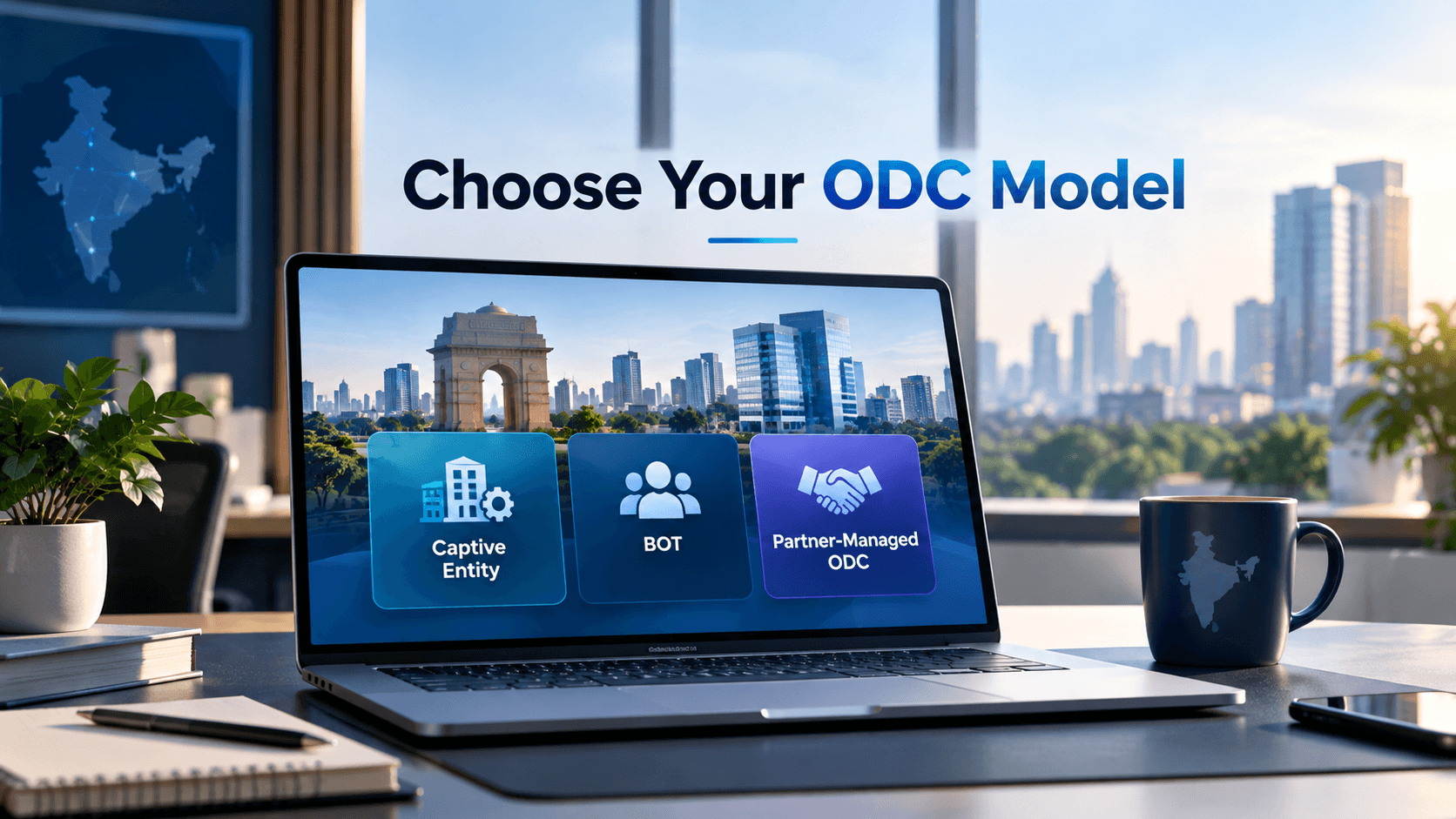
The Three Ways to Set Up an ODC in India
1. Your own legal entity
You register a company in India, rent an office, and hire directly. Full control, but slow. A full entity setup takes about 3–6 months before your team is even working.
Best for: large enterprises planning 50+ people for many years.
2. Build-Operate-Transfer (BOT)
A partner builds the centre, runs it, and later hands ownership to you. A typical timeline: Build takes 2–3 months for the initial team, Operate runs 12–18 months, and Transfer takes 3–6 months for legal and employee transition.
Real example: one US technology company started with a small, flexible development team in India through a BOT partner, then grew it into its own centre. Interestingly, some clients extend the Operate phase indefinitely when the managed model works well.
Best for: mid-to-large companies that eventually want their own captive centre.
3. Partner-managed ODC
A software company in India provides a dedicated team that works only for you, while it handles hiring, payroll, offices, equipment, and HR. You manage priorities and the work itself.
Best for: startups, mid-size businesses, and agencies that want a dedicated team quickly without legal setup.
Choose the Right ODC Model Before You Scale
Mistakes That Make ODCs Fail
- No owner on your side. An ODC needs a product owner or tech lead who sets priorities every week.
- Starting too big. Begin with three to five people, prove the workflow, then scale.
- Treating them as vendors. Teams that join stand-ups and see the roadmap perform far better.
- Ignoring IP and security. Get IP assignment in writing and treat security as part of setup, not an afterthought.
- Poor time-zone planning. Agree on daily overlap hours before day one.
How Murmu Software Infotech Sets Up Your ODC
Murmu Software Infotech runs partner-managed offshore development centres in India for businesses and agencies in the US, UK, and UAE. We handle the hiring, workspace, equipment, and HR. You get a dedicated team working inside your processes.
Our ODC teams cover:
- .NET, React, Next.js, Angular, and PHP
- Sitecore (including XM Cloud), Umbraco, Drupal, and headless CMS
- Healthcare software, ERPs, AI apps, and MVPs
- QA and ongoing support
You can start with two or three developers, review the output for a month, and grow the team as your roadmap expands. Agencies can also run the ODC on a white-label basis.
If you want a dedicated team in India without months of legal setup, explore Murmu Software Infotech's offshore development center in India and start with a small team you can scale.
Frequently Asked Questions
What is an offshore development center or ODC?
An offshore development center is a dedicated long-term engineering team located in another country that works as an extension of your internal technology organization rather than delivering only fixed projects.
Why do companies set up an ODC in India?
Companies choose India for access to a large technology talent pool, flexible team scaling, specialist engineering skills and the ability to build dedicated development capacity without relying only on local hiring.
What are the main ODC setup models in India?
The three common models are creating your own legal entity, using a Build-Operate-Transfer model, or working with a partner-managed ODC.
What is a partner-managed ODC?
In a partner-managed ODC, an India-based software company handles recruitment, payroll, workspace, equipment and HR while the client controls product priorities, engineering work and roadmap.
What is Build-Operate-Transfer for an ODC?
Build-Operate-Transfer is a model where a partner establishes and operates the offshore centre for an agreed period before transferring the team and operations to the client.
When should a company create its own legal entity in India?
A captive legal entity can make sense for larger organizations planning a substantial long-term workforce in India and willing to manage compliance, recruitment, infrastructure and operations directly.
How many developers should an ODC start with?
Many businesses reduce risk by starting with a small core team, validating communication and delivery, and scaling only after the operating model is proven.
What causes offshore development centers to fail?
Common causes include unclear ownership, weak product leadership, poor time-zone planning, treating the ODC like an external vendor, weak security controls and scaling too quickly.
How should intellectual property be protected in an ODC?
IP ownership should be documented contractually, code should remain in controlled repositories, access should follow role-based policies and security procedures should be defined before development begins.
Which ODC model is best for startups and mid-size businesses?
A partner-managed ODC is often suitable when a company wants dedicated engineering capacity quickly without establishing its own Indian entity, office, payroll and HR operation.