Hospital Management Software for India, UAE and Southeast Asia: Modules, Workflow and Cost
In This Article
- What Is Hospital Management Software?
- 1. OPD Management Should Start the Patient Journey
- 2. IPD Requires More Than Admission and Discharge
- 3. Billing Must Connect Every Revenue-Generating Department
- 4. Laboratory and Pharmacy Should Not Operate as Islands
- 5. Management Needs Reports, Not Just Stored Data
- India, UAE and Southeast Asia Need Localized HMS Workflows
- India
- UAE
- Southeast Asia
- How Much Does Hospital Management Software Cost?
- Ready-Made HMS or Custom HMS Development?
- What Should Hospitals Check Before Selecting HMS Software?
- Final Thoughts
Choosing hospital management software is not simply a technology purchase. It is an operational decision that can affect patient registration, doctor productivity, billing accuracy, pharmacy inventory, laboratory workflows, inpatient management and management reporting every day.
Hospitals across India, the UAE and Southeast Asia are increasingly moving away from paper records, spreadsheets and disconnected applications toward integrated HMS software.
But before buying an off-the-shelf product or deciding to build hospital management software, hospital owners should answer a more important question:
What does our hospital actually need the software to manage?
A successful HMS should follow the real patient journey, connect departments and give management reliable operational visibility.
What Is Hospital Management Software?
Hospital management software, also called HMS or HIMS, is a centralized healthcare platform that manages clinical, administrative and financial hospital operations.
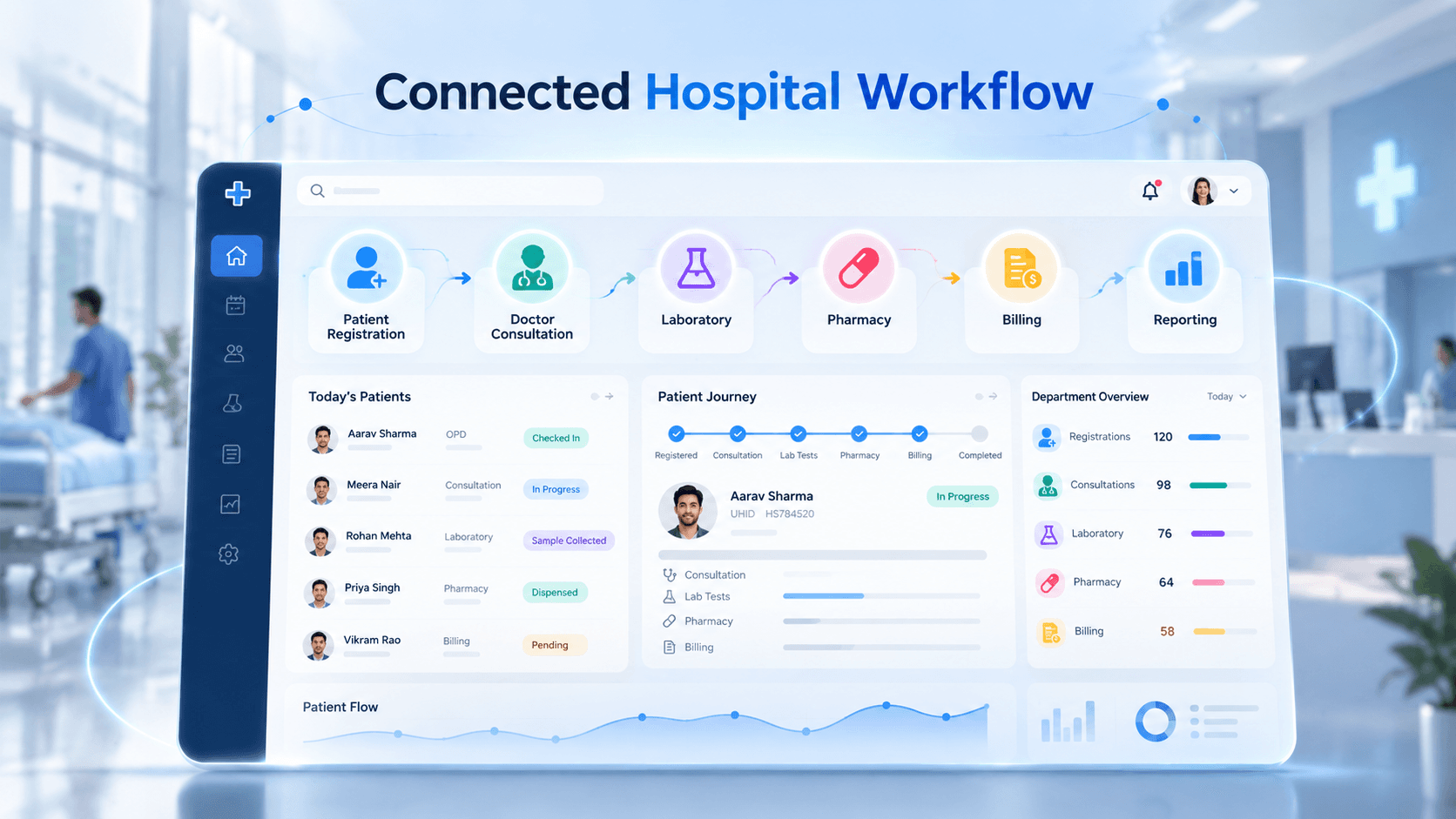
Instead of registration, consultation, billing, laboratory, pharmacy and inpatient departments working independently, an integrated HMS allows information to move through a connected workflow.
For hospitals planning digital transformation across India, the Middle East or Southeast Asia, a regional hospital and healthcare software platform can be designed around local operational requirements, hospital size and existing technology.
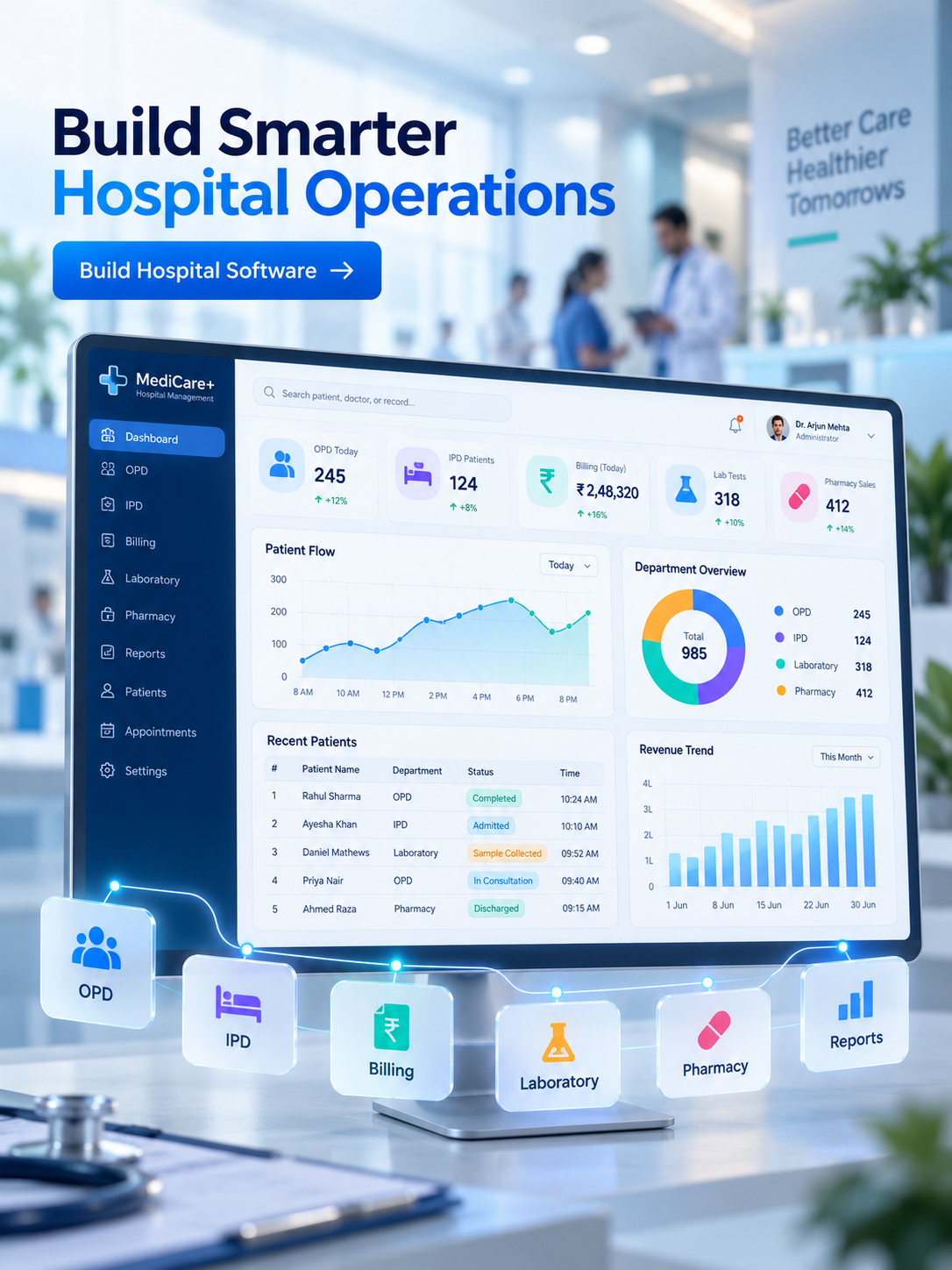
Build Smarter Hospital Operations
Connect OPD, IPD, billing, lab, pharmacy and reporting with scalable hospital software built around your real healthcare workflows.
1. OPD Management Should Start the Patient Journey
For many hospitals, OPD is the highest-volume patient touchpoint.
A good OPD module should support:
- Patient registration
- Existing-patient search
- Appointment scheduling
- Walk-in registration
- Doctor selection
- Token and queue management
- Consultation history
- Digital prescriptions
- Follow-up scheduling
- Billing integration
The important requirement is connectivity.
Once a patient is registered, staff should not repeatedly enter the same patient information when the patient moves to consultation, laboratory, pharmacy or billing.
The ideal workflow becomes:
Registration → Queue → Doctor → Lab/Diagnostics → Pharmacy → Billing → Follow-up
This creates a much better foundation for hospital automation.
2. IPD Requires More Than Admission and Discharge
Hospitals with inpatient services need a deeper workflow.
An IPD module may include admission, bed allocation, ward transfers, nursing activity, doctor orders, medication, procedures, deposits, daily charges and discharge management.
Bed availability should also be visible to authorized staff in real time.
A connected system can automatically bring relevant room charges, procedures, investigations, medicines and other services into the patient's financial workflow, reducing dependence on manual reconciliation at discharge.
3. Billing Must Connect Every Revenue-Generating Department
Billing is one of the most important components of hospital management software.
Hospitals should look beyond simple invoice generation.
The billing system should be capable of connecting:
OPD + IPD + Lab + Pharmacy + Procedures + Packages + Payments + Insurance
Depending on the hospital and country, requirements may also include tax configuration, multiple payment methods, insurer or TPA workflows, advance payments, refunds and approval processes.
This is particularly important when developing hospital software for the UAE or multi-country healthcare groups where financial and insurance workflows can differ substantially.
4. Laboratory and Pharmacy Should Not Operate as Islands
Disconnected laboratory and pharmacy software creates unnecessary work.
When HMS and laboratory workflows are integrated, a doctor's investigation request can move digitally to the lab. The laboratory team can manage sample collection, processing, validation and reporting without repeatedly entering patient information.
Pharmacy integration can similarly connect prescriptions with:
- Medicine dispensing
- Batch tracking
- Stock availability
- Expiry monitoring
- Purchase management
- Billing
- Inventory reports
Connecting these departments creates a more complete patient record while giving administrators better visibility into operations.
5. Management Needs Reports, Not Just Stored Data
Hospitals generate enormous amounts of operational data.
An HMS becomes significantly more valuable when management can convert that information into useful decisions.
Dashboards and reports can cover:
- Daily OPD volume
- Admissions and discharges
- Doctor-wise consultations
- Department revenue
- Outstanding payments
- Laboratory activity
- Pharmacy sales
- Inventory movement
- Bed occupancy
- Patient trends
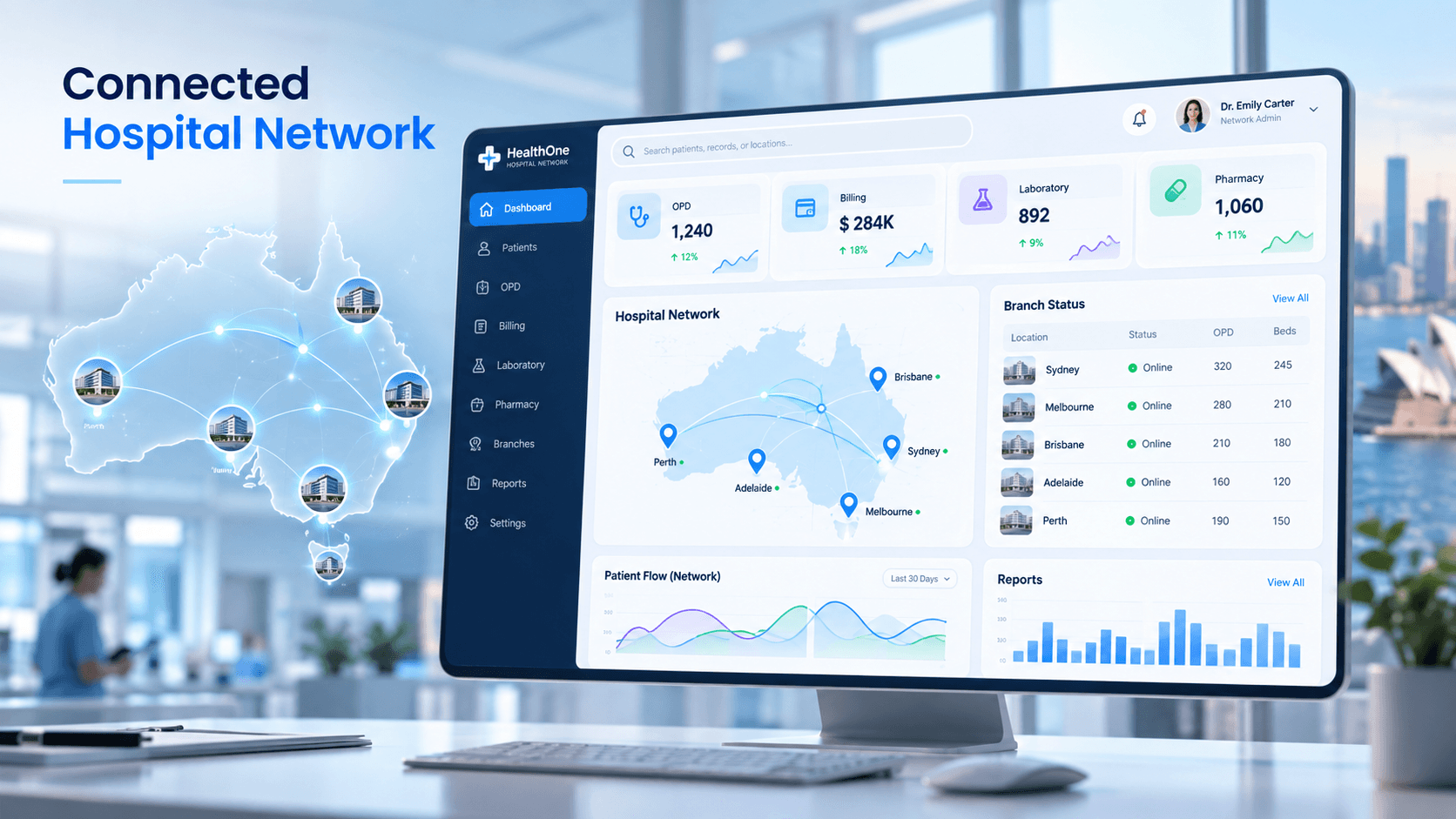
- Multi-location performance
Instead of waiting for manually prepared reports, hospital leadership can access current information from a centralized system.
Discuss Your Hospital Software Needs With Our Experts
India, UAE and Southeast Asia Need Localized HMS Workflows
The core hospital workflow is similar across markets, but implementation requirements are not identical.
India
Hospitals may require OPD/IPD, billing, pharmacy, laboratory, insurance, multi-branch operations and applicable ABDM/ABHA integration workflows.
UAE
Hospital software may require greater focus on insurer integration, claims workflows, localized regulatory reporting, data security, electronic prescriptions, multi-location operations and country-specific healthcare integrations.
Southeast Asia
Requirements can vary significantly between countries. Hospitals should evaluate local currencies, languages, tax structures, insurance models, patient identifiers, reporting requirements, deployment architecture and third-party healthcare integrations.
For regional expansion, software should therefore be configurable rather than hard-coded around one hospital or one country.
How Much Does Hospital Management Software Cost?
There is no single hospital software development cost because pricing depends heavily on scope.
A focused custom HMS development project in India can start around ₹70,000, while a larger hospital platform can require substantially more investment.
Typical pricing factors include:
| Cost Factor | Impact |
|---|---|
| OPD only | Lower |
| OPD + IPD | Medium |
| Lab + pharmacy integration | Medium–High |
| EMR/EHR customization | Medium–High |
| Insurance/claims integration | High |
| Patient/doctor mobile apps | Higher |
| Multi-hospital management | Higher |
| Existing-data migration | Variable |
| Third-party integrations | Variable |
| Regional compliance/localization | Variable |
| Ongoing support | Recurring |
For UAE and Southeast Asian projects, pricing is generally better calculated after workflow discovery because integrations, localization, infrastructure and regulatory requirements differ by country.
Hospitals should evaluate total cost of ownership, not only the initial software price.
Implementation, migration, training, support, integrations, hosting and future upgrades should all be considered.
Ready-Made HMS or Custom HMS Development?
Ready-made software can work well when hospital processes closely match the product's predefined workflows.
However, custom HMS development becomes valuable when the hospital has:
- Unique clinical workflows
- Existing systems requiring integration
- Multiple branches
- Specialized billing processes
- Custom management reports
- Country-specific requirements
- Patient or doctor applications
- Plans for future modules and automation
A practical approach is often to start with high-priority workflows and expand the system in phases.
A real-world Hospital Management System case study also helps decision-makers understand how registration, appointments, doctor workflows, billing, permissions and reporting can be connected within one platform.
What Should Hospitals Check Before Selecting HMS Software?
Before signing a contract or beginning development, ask:
Does the software match our actual patient workflow?
Then evaluate whether it can connect OPD, IPD, billing, laboratory and pharmacy; integrate existing systems; support role-based access; scale to new departments and branches; migrate historical data; provide useful reports; and offer dependable implementation, training and post-launch support.
The number of features matters less than how well those features work together.
Final Thoughts
The best hospital management software is not necessarily the system with the longest feature list.
It is the system that connects the complete hospital journey from registration and consultation to diagnostics, pharmacy, billing, inpatient care, reporting and follow-up without creating additional complexity for staff.
Hospitals in India, the UAE and Southeast Asia should therefore evaluate HMS software based on workflow fit, integrations, localization, scalability, security, implementation support and long-term cost.
If standard hospital software cannot match your operational model, consider building a custom hospital healthcare software platform for India, the Middle East and Southeast Asia around the workflows your hospital actually uses.
Build Hospital Management Software Around Your Real Workflow Not Around Software Limitations.
Frequently Asked Questions
What is hospital management software?
Hospital management software is a centralized digital platform that connects clinical, administrative and financial hospital workflows such as patient registration, OPD, IPD, appointments, billing, laboratory, pharmacy, reporting and follow-up.
What modules should hospital management software include?
Core HMS modules typically include patient registration, OPD, IPD, appointments, bed and ward management, billing, laboratory, pharmacy, inventory, doctor management, reporting, role-based access and administrative dashboards.
How much does hospital management software cost?
Hospital software cost depends on hospital size, number of modules, users, locations, integrations, data migration, mobile apps, deployment model, localization and ongoing support. A workflow assessment is usually required for an accurate estimate.
Should a hospital buy ready-made HMS software or build custom HMS?
Ready-made HMS software can work when hospital workflows closely match standard modules. Custom HMS development is more suitable when a hospital has unique clinical processes, specialized billing, multiple branches, country-specific integrations or custom reporting requirements.
What is custom HMS development?
Custom HMS development involves designing hospital software around the healthcare organization's actual workflows, departments, integrations, permissions, reporting requirements and expansion plans instead of forcing operations into a fixed software structure.
How does HMS software improve hospital workflow?
HMS software connects departments so patient and operational data can flow from registration to consultation, diagnostics, pharmacy, billing, admission, discharge and reporting without repeated manual data entry.
Can hospital management software connect OPD, IPD, lab and pharmacy?
Yes. A properly integrated HMS can connect OPD, IPD, laboratory, pharmacy, billing, inventory and reporting so departments work from consistent patient and operational information.
What should hospitals in the UAE consider before choosing HMS software?
Hospitals in the UAE should evaluate workflow fit, insurance and claims requirements, healthcare integrations, access controls, security, reporting, localization, multi-location capabilities, implementation support and long-term scalability.
Can one HMS support hospitals across India and Southeast Asia?
A configurable HMS can support multi-region healthcare operations when it is designed for local currencies, languages, tax structures, patient identifiers, insurance processes, reporting requirements and country-specific integrations.
How long does custom hospital management software development take?
The development timeline depends on scope. A focused system with selected modules can be delivered faster than a complete multi-hospital platform containing OPD, IPD, EMR, pharmacy, laboratory, insurance, integrations, mobile apps and advanced analytics.