Pathology & Diagnostic Lab Software Cost in India: LIMS, Billing, Sample Tracking & Reports
In This Article
- 1. How Much Does Pathology Lab Software Cost in India?
- 2. Lab Billing Software vs Full LIMS: What's the Difference?
- 3. Who Needs Laboratory Management Software?
- 4. Essential LIMS Software Features for Diagnostic Labs
- 5. How Does Barcode Sample Tracking Software Work?
- 6. LIMS Software Cost by Laboratory Type
- 7. Hidden Pathology Lab Software Costs to Evaluate
- 8. Before vs After Connected Laboratory Management
- 9. Multi-Collection-Centre LIMS and Hospital Integration
- 10. How MSI Develops Laboratory Management Software
- 11. Explore MSI's Laboratory Management System Project
- Conclusion: Invest in the Right Laboratory Workflow
Your lab doesn't just need billing software. It needs every sample and report accounted for.
A patient books a blood test. Reception generates an invoice, a technician collects the sample, and a pathologist reviews the results. But what happens when these activities depend on separate registers, spreadsheets and disconnected applications?
Samples become harder to trace, reports require manual coordination, and lab owners struggle to monitor operations.
Understanding pathology lab software cost in India means looking beyond subscription prices. The right Laboratory Information Management System (LIMS) should support your actual diagnostic workflow, from test booking to authorized report release.
Whether you operate a pathology lab in Ranchi, a diagnostic centre in Patna or multiple collection centres across India, selecting suitable software can help avoid unnecessary investment.
1. How Much Does Pathology Lab Software Cost in India?
The cost depends on whether you need basic lab billing software or a complete LIMS covering samples, technicians, reporting and integrations.
A small laboratory may start with test registration, invoices and digital reports.
A diagnostic centre with significant test volume may need barcode sample identification, technician worklists, report verification and automated status updates.
Multi-centre businesses may additionally require collection-centre tracking, centralized dashboards and hospital integrations.
Cloud subscriptions, one-time licences and custom development also have different cost structures.
There is no universal LIMS price suitable for every laboratory. Request estimates based on the same requirements and compare total ownership costs.
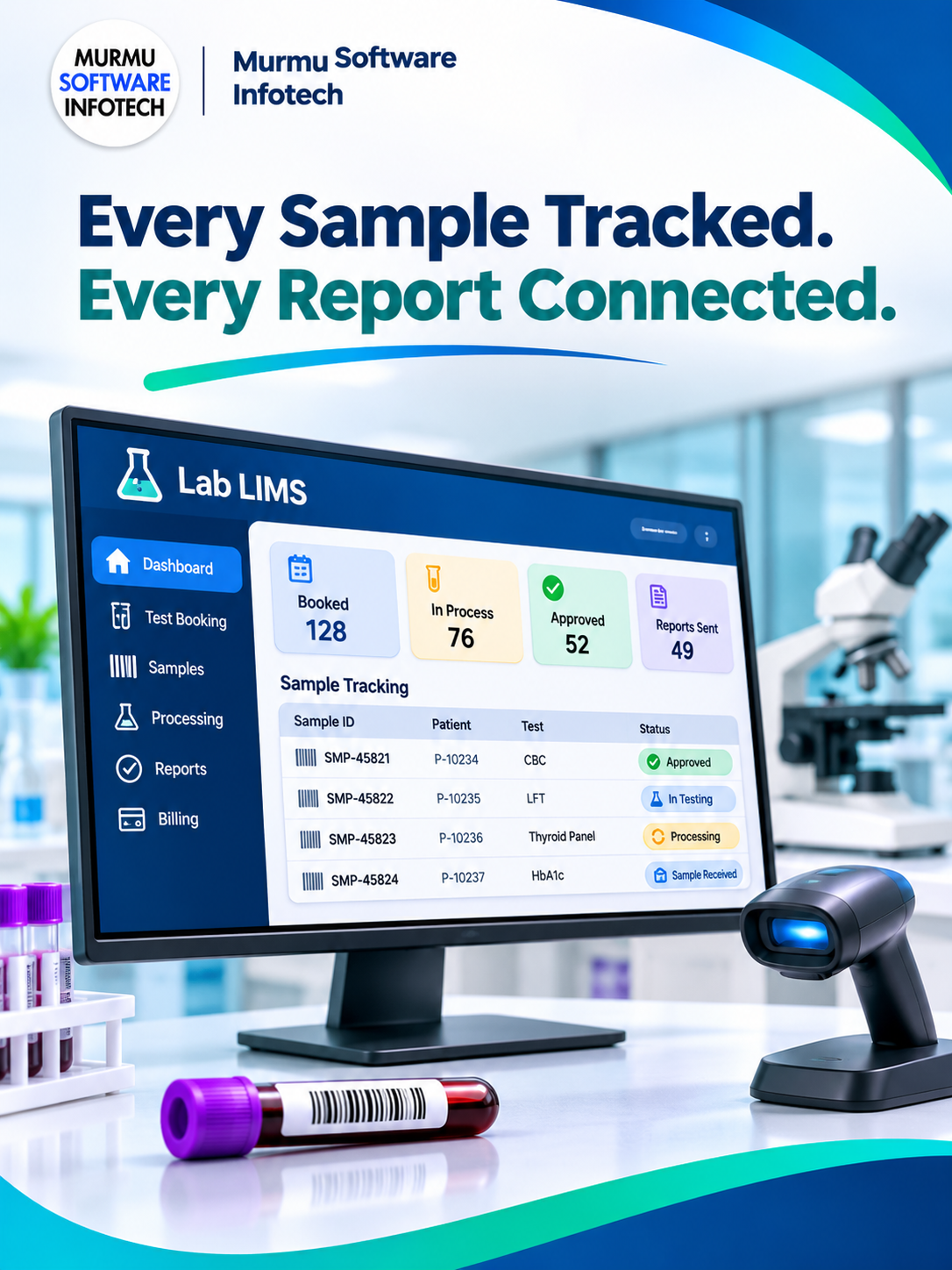
Every Sample Tracked. Every Report Connected.
Streamline diagnostic lab operations with smart LIMS software for barcode sample tracking, technician workflows, report approvals, billing and secure digital delivery.
2. Lab Billing Software vs Full LIMS: What's the Difference?
Billing software primarily manages financial transactions. LIMS connects operational and reporting workflows.
| Feature | Basic Lab Billing | Full LIMS |
|---|---|---|
| Test pricing and packages | Core | Core |
| Patient billing | Core | Core |
| Sample identification | Basic or manual | Structured |
| Barcode tracking | May be limited | Configurable |
| Technician worklists | Often limited | Core workflow |
| Report verification | May be separate | Controlled approvals |
| Digital report delivery | Product-dependent | Configurable |
| Multi-centre operations | Often limited | Can be integrated |
| Analyzer connectivity | Usually separate | Possible if supported |
A standalone lab may manage with billing and reporting initially. A growing diagnostic centre requiring traceability and technical approvals should evaluate a fuller LIMS.
3. Who Needs Laboratory Management Software?
Different diagnostic businesses require different software configurations.
Small pathology labs: Patient registration, test catalogues, billing, report templates and basic sample identification.
Diagnostic centres: Diagnostic packages, multiple technicians, barcode tracking, approvals and reporting.
Hospital laboratories: OPD-linked test orders, patient records, billing and authorized report access.
Multi-collection-centre networks: Sample transfers, centre-wise operations, centralized reporting and permissions.
Software complexity should follow actual test volume, sample movement and operational needs.
Transform Your Diagnostic Lab With Smart LIMS And Billing Software
4. Essential LIMS Software Features for Diagnostic Labs
Before investing, evaluate these core capabilities:
- Test bookings, diagnostic packages and configurable pricing
- Unique specimen identification and optional barcode labels
- Technician worklists and sample status tracking
- Structured result entry and report templates
- Authorized verification and report approval
- Billing, payment tracking and secure digital report access
- Operational dashboards and role-based permissions
Advanced requirements may include analyzer connectivity, inventory, audit trails and multi-branch management.
Clinical results must remain subject to qualified professional review. Software supports laboratory processes; it does not replace medical responsibility.
5. How Does Barcode Sample Tracking Software Work?
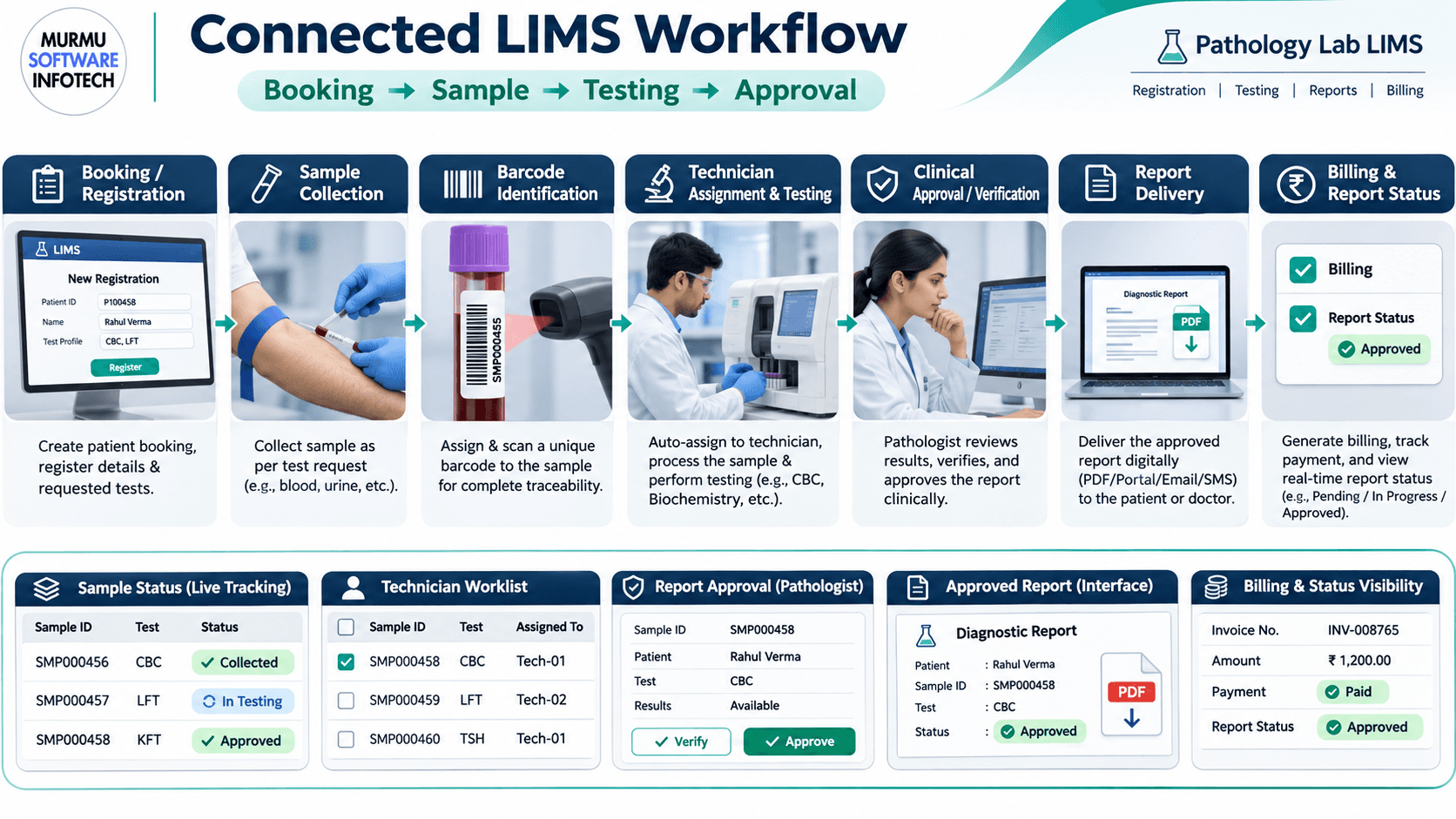
A structured laboratory workflow can follow:
Test Booking → Sample Collection → Unique ID / Barcode → Processing → Verification → Approved Report Delivery
Each sample receives a unique identifier associated with the relevant patient and test order.
Authorized laboratory staff update collection, receipt, processing and reporting status through the system.
Barcode scanners may simplify identification, but label printers, scanners and software must be tested together.
Digital traceability helps staff investigate sample status without relying entirely on handwritten registers.
Explore MSI's Laboratory Workflow Case Study
6. LIMS Software Cost by Laboratory Type
Software scope should match facility complexity.
| Implementation Level | Typical Requirements |
|---|---|
| Basic | Registration, test billing, report templates |
| Standard | Sample tracking, technician workflows, approvals |
| Advanced | Multiple centres, analyzer interfaces, HMS integration, dashboards |
These are illustrative implementation levels, not fixed-price packages.
A complete LIMS software price in India estimate should separately identify development or licensing, configuration, hardware, integrations and recurring costs.
For custom solutions, module selection and technical requirements determine the final quotation.
Need an itemized software and hardware estimate?
Request LIMS Demo & Implementation Estimate
7. Hidden Pathology Lab Software Costs to Evaluate
An attractive starting price may exclude important implementation expenses.
| Cost Component | What to Confirm |
|---|---|
| Software licence | Users, branches, usage limits |
| Barcode hardware | Printers, scanners, labels |
| Analyzer interfaces | Device models and protocol compatibility |
| Report customization | Templates, signatures, branding |
| Data migration | Existing patient and test records |
| Deployment | Hosting, backups, security |
| Messaging | SMS, email, WhatsApp usage |
| AMC and support | Updates, training, issue response |
Compare monthly subscriptions, annual plans and custom implementations over a consistent period, such as three years.
Confirm charges for additional users, reports, branches, device integrations and support before signing.
8. Before vs After Connected Laboratory Management
| Manual or Disconnected Operations | Target Digital Workflow |
|---|---|
| Separate test registers | Centralized digital orders |
| Handwritten sample labels | Unique sample IDs and barcodes |
| Manual technician assignment | Digital worklists |
| Reports shared for approval | Role-based verification |
| Physical report collection | Secure digital access |
| Manual daily summaries | Operational dashboards |
These represent potential improvements after successful configuration, not guaranteed reductions in turnaround time or operating expenses.
9. Multi-Collection-Centre LIMS and Hospital Integration
Growing diagnostic businesses may require visibility across collection centres and processing laboratories.
A connected system can record sample dispatch, laboratory receipt, processing status and authorized report access.
Hospital integrations may connect registration, OPD test orders and billing through supported APIs.
Analyzer integration requires separate technical evaluation of instrument models, protocols, interfaces and testing.
For regional diagnostic businesses, MSI's Pathology and Radiology Lab Software Guide for Ranchi explains additional workflow considerations.
Smart Pathology & LIMS Solutions Catalog
Explore sample tracking, lab automation, digital reporting, billing and scalable LIMS.
524 KB
10. How MSI Develops Laboratory Management Software
At Murmu Software Infotech (MSI), implementation planning begins with understanding laboratory operations.
Our recommended approach is:
Workflow Discovery → Test Catalogue & Roles → Sample Tracking → Reporting & Approvals → Billing & Integration → Validation → Training
The objective is to define a suitable software scope before development and hardware procurement.
Learn more about MSI's Healthcare Software Development Services.
Discover The Right LIMS Solution For Your Laboratory Before Investing
11. Explore MSI's Laboratory Management System Project
MSI's published LIMS Project Case Study describes software designed around test bookings, sample status, technician workflows, report approvals, billing and patient access.
It provides a reference for discussing laboratory software requirements.
Final capabilities, hardware compatibility and integrations should always be confirmed for the proposed implementation.
Conclusion: Invest in the Right Laboratory Workflow
Your laboratory deserves more than billing and report printing.
The right pathology and diagnostic lab software should connect bookings, sample tracking, technician processing, approvals and billing according to your actual operational requirements.
Start with essential modules. Verify hardware compatibility. Understand installation and recurring costs before investing.
Murmu Software Infotech helps pathology laboratories, diagnostic centres and healthcare groups plan custom laboratory software solutions.
Ready to evaluate your LIMS requirements?
Share your lab type, location, monthly test volume, number of collection centres, users, analyzer models and current software.
Request LIMS Demo & Implementation Estimate
Frequently Asked Questions
How much does pathology lab software cost in India?
Pathology lab software cost in India depends on the number of users, laboratories, collection centres, test volume, software modules, hosting, hardware and integrations. Basic lab billing generally has a smaller scope than a complete LIMS. Request an itemized quotation that separates software, implementation, devices, training and recurring maintenance costs.
What is the difference between pathology lab billing software and LIMS?
Pathology lab billing software primarily manages test pricing, diagnostic packages, invoices and payments. A Laboratory Information Management System (LIMS) additionally supports sample identification, barcode tracking, technician assignments, result entry, controlled report approvals, digital report access and laboratory operational reporting.
What is the price of LIMS software for a small diagnostic laboratory?
Small laboratory LIMS pricing varies according to essential modules, user accounts, test catalogues, reporting requirements and deployment preferences. A standalone pathology lab may begin with booking, billing, sample identification and report generation. Barcode workflows, integrations and customization can increase the total implementation cost.
Which features are essential in pathology lab management software?
Essential features typically include patient registration, test booking, configurable test catalogues, sample identification, technician worklists, result entry, authorized report approval, billing and secure digital report access. Growing laboratories may additionally require barcode tracking, diagnostic packages, multi-centre access, analyzer integrations and operational dashboards.
Can pathology LIMS software track samples using barcodes?
Yes. A configured LIMS can assign unique identifiers or barcodes to samples and record their status during collection, receipt, processing and reporting. Barcode printers and scanners must be checked for compatibility. The actual tracking stages depend on laboratory procedures and the implemented software workflow.
Can LIMS software integrate with laboratory analyzers?
LIMS may integrate with compatible laboratory analyzers using supported communication interfaces and data protocols. Integration feasibility depends on the analyzer manufacturer, model, interface specifications, middleware requirements and available connectivity. Laboratories should provide their analyzer inventory for technical assessment before procurement.
Can pathologists approve laboratory reports digitally?
Yes. Laboratory software can provide controlled workflows for authorized professionals to review results, verify findings and approve reports before release. Role-based permissions and audit trails may support accountability. Software must not independently replace required clinical interpretation, quality checks or professional authorization.
Can one LIMS manage multiple pathology labs and collection centres?
Yes. A multi-centre LIMS can be configured to handle collection-centre registrations, unique sample identifiers, sample transfers, laboratory receipt, processing status, billing and centralized reporting. The implementation should account for branch permissions, specimen transportation, connectivity and the number of processing laboratories.
Is cloud-based or on-premises LIMS better for diagnostic centres?
Cloud-based LIMS provides centrally hosted software and may simplify access across collection centres. On-premises LIMS uses locally managed infrastructure. The right choice depends on connectivity, security, data ownership, backups, infrastructure costs and operational requirements. Hybrid deployment may be considered where supported.
How can I get a custom LIMS software demo and cost estimate?
Share your laboratory type, location, test volume, number of collection centres, staff accounts, barcode requirements, analyzer models, report formats, existing billing software and integration needs. Murmu Software Infotech can review these requirements, discuss suitable modules and prepare a scope-based implementation estimate.