Manufacturing ERP Software in Ranchi – Complete Guide for Factory Owners (2026)
In This Article
- Problem: Manufacturing Operations Are Fragmented
- Why It Matters: Efficiency = Competitive Advantage
- Solution: Manufacturing ERP Software for Smart Factories
- Key Features of Manufacturing ERP Software
- 1. Production Planning & Control
- 2. Inventory & Warehouse Management
- 3. Supply Chain Management
- 4. Financial Management
- 5. Real-Time Analytics & Reporting
- 6. Quality Control Management
- 7. HR & Workforce Management
- 8. Cloud-Based ERP
- Cost of Manufacturing ERP Software in Ranchi
- Estimated Cost Range (2026)
- Implementation Guide for Factory Owners
- Step 1: Define Business Requirements
- Step 2: Choose the Right ERP Partner
- Step 3: System Customization
- Step 4: Data Migration
- Step 5: Training & Adoption
- Step 6: Go Live & Optimize
- Comparison: Traditional vs ERP-Driven Manufacturing
- Why Ranchi Manufacturers Must Adopt ERP in 2026
- Why Choosing the Right ERP Partner Matters
- Explore Our ERP Solutions
- Final Insight
Ranchi and the wider Jharkhand region are rapidly emerging as industrial and manufacturing hubs. With growing competition, rising operational costs, and increasing demand for efficiency, factory owners can no longer rely on manual processes or disconnected systems.
The solution?
Manufacturing ERP software in Ranchi
For CXOs, plant heads, and operations leaders, ERP is not just software—it’s a strategic growth engine that drives efficiency, visibility, and profitability.
This guide explains everything you need to know: features, benefits, cost, and implementation strategy.
Problem: Manufacturing Operations Are Fragmented
Many factories still operate with:
- Excel sheets and manual records
- Disconnected inventory and production systems
- Lack of real-time visibility
- Inefficient supply chain coordination
This leads to:
- Production delays
- Inventory mismanagement
- Increased operational costs
- Poor decision-making
Result: Reduced profitability and slower growth
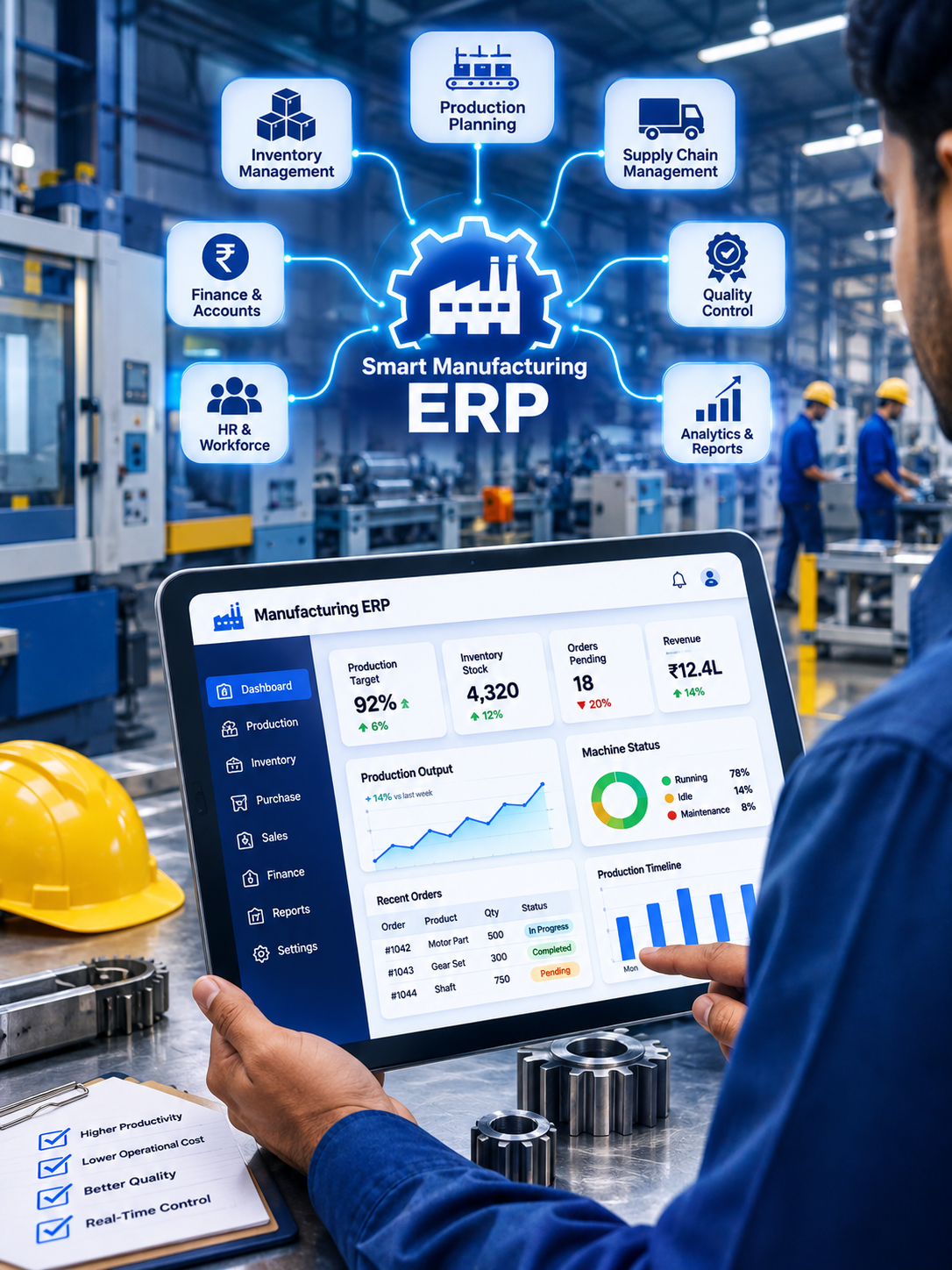
Transform Your Factory With Smart ERP
Connect production, inventory, finance, supply chain and workforce management in one ERP platform for greater visibility, efficiency, control and scalable growth.
Why It Matters: Efficiency = Competitive Advantage
In 2026, manufacturing success depends on:
- Real-time production tracking
- Optimized inventory management
- Data-driven decision-making
- Scalable operations
Factories using manufacturing ERP software in Ranchi are achieving:
- 25–40% increase in operational efficiency
- Reduced wastage and downtime
- Improved order fulfillment
ERP is now a business necessity, not a luxury
Solution: Manufacturing ERP Software for Smart Factories
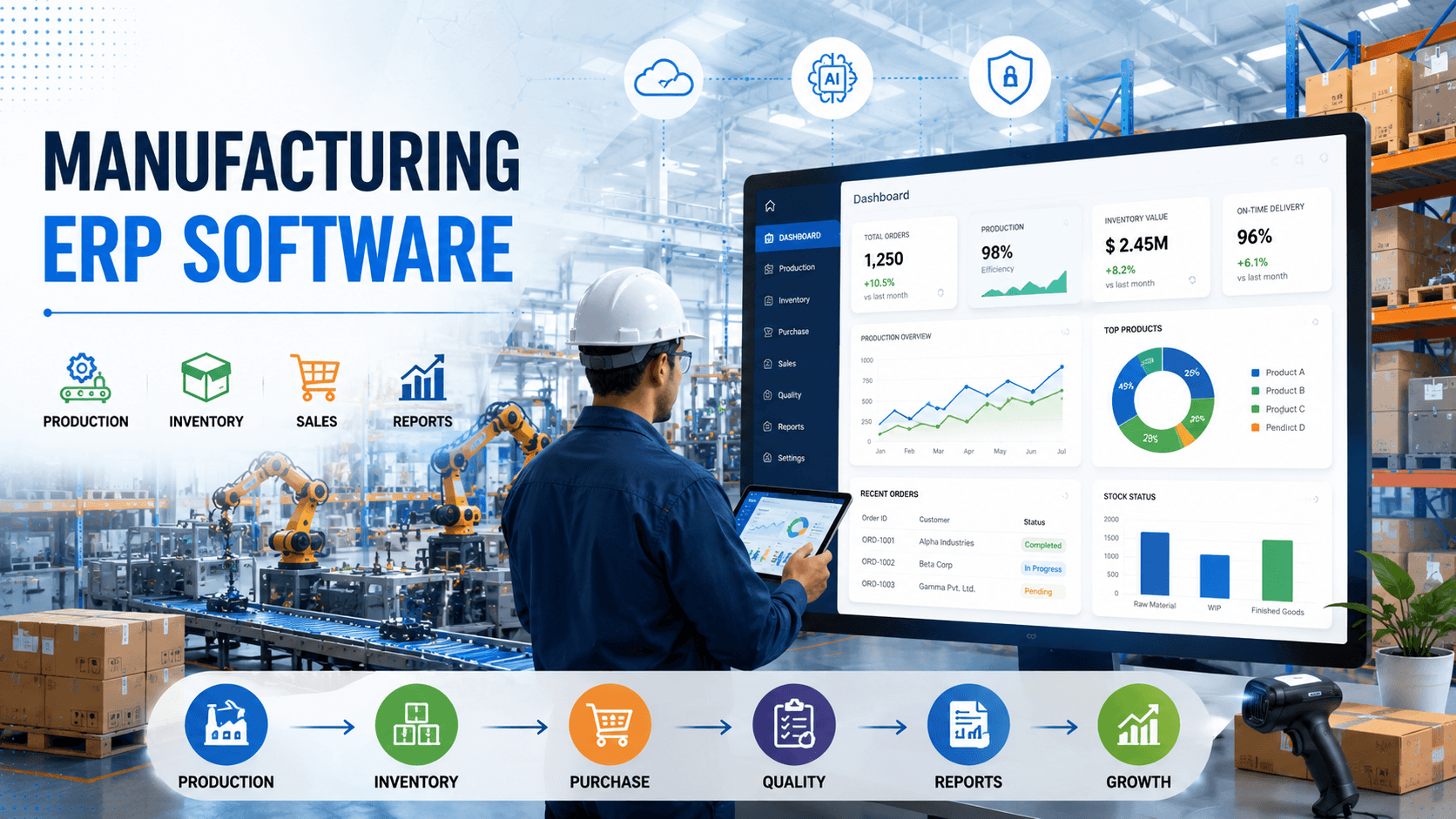
A modern ERP system integrates:
- Production
- Inventory
- Finance
- Supply chain
- HR
All into a single intelligent platform
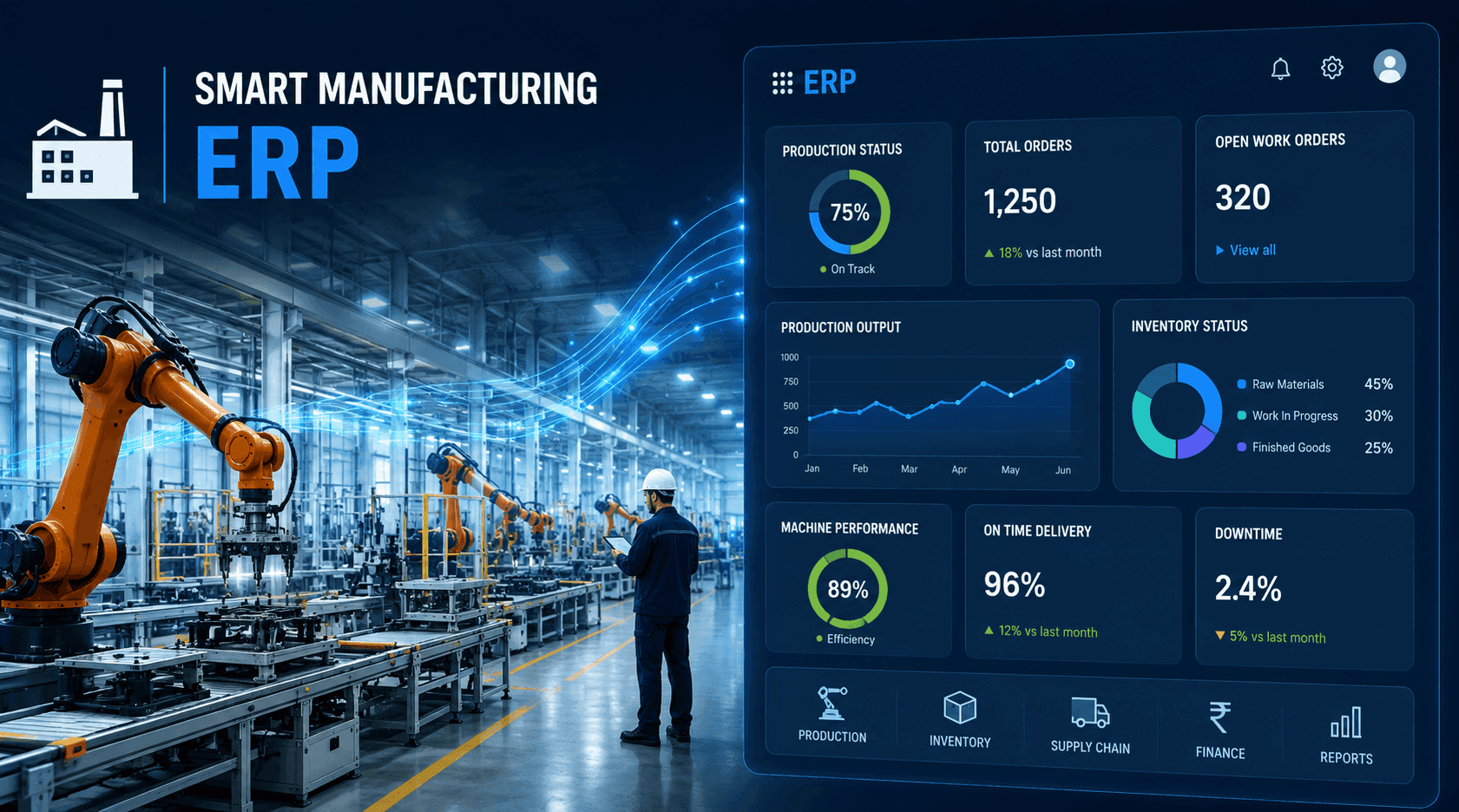
This enables factories to operate as connected, data-driven ecosystems.
Key Features of Manufacturing ERP Software
Transform Your Factory with Smart Manufacturing ERP Solutions
1. Production Planning & Control
- Real-time production tracking
- Work order management
- Resource allocation
Ensures smooth and efficient manufacturing
2. Inventory & Warehouse Management
- Stock tracking
- Automated alerts
- Multi-location inventory
Reduces stock-outs and overstocking
3. Supply Chain Management
- Vendor management
- Procurement tracking
- Logistics coordination
Improves supply chain efficiency
4. Financial Management
- Cost tracking
- Billing and invoicing
- Profit analysis
Provides complete financial visibility
5. Real-Time Analytics & Reporting
- Production insights
- Performance dashboards
- KPI tracking
Enables smarter decisions
6. Quality Control Management
- Inspection tracking
- Defect management
- Compliance monitoring
Ensures consistent product quality
7. HR & Workforce Management
- Attendance tracking
- Payroll
- Workforce scheduling
Improves workforce productivity
8. Cloud-Based ERP
- Remote access
- Scalability
- Secure data storage
Future-ready infrastructure
Cost of Manufacturing ERP Software in Ranchi
The cost depends on:
- Business size
- Number of modules
- Customization level
- Deployment type (cloud/on-premise)
Estimated Cost Range (2026)
| Type | Cost Range |
|---|---|
| Basic ERP | ₹1L – ₹5L |
| Mid-Level ERP | ₹5L – ₹20L |
| Enterprise ERP | ₹20L+ |
Important Insight:
Choosing a low-cost ERP may limit scalability.
Focus on long-term ROI, not short-term savings.
Implementation Guide for Factory Owners
Step 1: Define Business Requirements
- Identify operational challenges
- List required features
- Set clear business goals
Step 2: Choose the Right ERP Partner
Look for a provider with:
- Manufacturing expertise
- Custom development capability
- Strong support
Step 3: System Customization
- Align ERP with workflows
- Integrate existing systems
Step 4: Data Migration
- Transfer legacy data
- Ensure accuracy and security
Step 5: Training & Adoption
- Train staff
- Ensure smooth transition
Step 6: Go Live & Optimize
- Monitor performance
- Continuously improve
Comparison: Traditional vs ERP-Driven Manufacturing
| Factor | Traditional | ERP System |
|---|---|---|
| Visibility | Limited | Real-time |
| Efficiency | Low | High |
| Errors | High | Minimal |
| Scalability | Limited | High |
| Decision Making | Reactive | Data-driven |
Why Ranchi Manufacturers Must Adopt ERP in 2026
Ranchi’s manufacturing ecosystem is evolving due to:
- Industrial growth in Jharkhand
- Increased competition
- Demand for quality and efficiency
- Supply chain complexity
ERP adoption is critical to stay competitive and scale operations
Why Choosing the Right ERP Partner Matters
Not all ERP vendors deliver business value.
A strong partner:
- Understands manufacturing workflows
- Provides scalable solutions
- Offers customization and integration
- Focuses on ROI and performance
Explore Our ERP Solutions
Looking for manufacturing ERP software in Ranchi?
👉 https://murmusoftwareinfotech.com/production-inventory-erp
👉 https://murmusoftwareinfotech.com/
Final Insight
The future of manufacturing is smart, connected, and data-driven.
Factories that invest in ERP:
- Improve efficiency
- Reduce costs
- Scale faster
Those who delay risk falling behind competitors.
Frequently Asked Questions
What is manufacturing ERP software in Ranchi?
Manufacturing ERP software in Ranchi is an integrated business management system that connects production, inventory, procurement, supply chain, finance, quality, HR and reporting in one platform. It helps factories replace disconnected spreadsheets and manual processes with centralized, real-time operational data.
How much does manufacturing ERP software cost in Ranchi?
Manufacturing ERP costs in Ranchi depend on business size, required modules, customization and deployment type. The 2026 ranges discussed in this guide are approximately ₹1 lakh–₹5 lakh for basic ERP, ₹5 lakh–₹20 lakh for mid-level ERP, and ₹20 lakh or more for enterprise ERP.
What features should a manufacturing ERP system have?
A manufacturing ERP system should typically include production planning, work orders, inventory and warehouse management, procurement, supply chain management, finance and accounting, quality control, HR and workforce management, dashboards, analytics and reporting.
Is ERP software suitable for small and medium factories?
Yes. ERP can be useful for small and medium manufacturing businesses when the system is appropriately scoped. A modular or customized ERP can help manage production, inventory, purchasing, finance and reporting without requiring every enterprise feature from the beginning.
How can ERP improve manufacturing operations?
ERP can improve manufacturing operations by connecting departments, providing real-time production and inventory visibility, reducing duplicate data entry, improving coordination, supporting better resource allocation and enabling data-driven decisions.
What is the difference between traditional manufacturing and ERP-driven manufacturing?
Traditional manufacturing often relies on spreadsheets, manual records and disconnected systems, which can limit visibility and increase errors. ERP-driven manufacturing connects operational data in one system, enabling real-time visibility, better scalability and more data-driven decision-making.
How long does manufacturing ERP implementation take?
ERP implementation time varies according to business complexity, number of modules, customization, integrations, data migration and user training. A typical implementation process includes requirements definition, partner selection, customization, data migration, training, go-live and ongoing optimization.
Should a factory choose cloud or on-premise ERP?
The choice depends on security, infrastructure, accessibility, compliance, integration and operational requirements. Cloud ERP can provide remote access and scalability, while on-premise deployment may be preferred when a business requires greater control over its infrastructure.
Can manufacturing ERP integrate inventory and production management?
Yes. Manufacturing ERP can connect production planning and work orders with inventory and warehouse operations. This helps factories monitor stock levels, allocate resources, track production activity and reduce problems caused by disconnected inventory and production records.
Why should Ranchi manufacturers adopt ERP in 2026?
Ranchi manufacturers face increasing competition, operational costs, quality expectations and supply chain complexity. ERP can help factories create connected, data-driven operations with better visibility, process control, reporting and scalability.