Multi-Site Hospital Software in Australia: Workflow, Modules and Case Study
In This Article
- What Is Multi-Site Hospital Software?
- How a Multi-Site Hospital Workflow Can Work
- Core Modules for Multi-Location Hospital Software
- Patient Registration and Administration
- OPD and Token Management
- Laboratory Management System
- Pharmacy and Inventory
- Billing and Finance
- Users, Roles and Branch Permissions
- Centralised Healthcare ERP for Multiple Locations
- Interoperability and Privacy Matter in Australia
- Medical Software Case Study: A Multi-Site Transformation Model
- Connect Multi-Site Healthcare
- Build for the Entire Healthcare Network
Managing one hospital is complex. Managing several hospitals, clinics, diagnostic centres or specialist facilities introduces another level of operational difficulty.
Patients may visit different branches. Doctors can work across locations. Laboratory tests may be processed centrally. Pharmacy inventory needs branch-level visibility. Management needs consolidated reporting, while individual facilities still need control over their daily operations.
This is where multi-site hospital software becomes more valuable than disconnected applications installed independently at each location.
For Australian healthcare groups planning digital transformation, custom healthcare software development services can connect patient administration, OPD workflows, laboratories, pharmacy, billing, users, branches and reporting through one scalable digital environment.
What Is Multi-Site Hospital Software?
Multi-site hospital software is a healthcare management platform designed to operate across two or more healthcare locations while maintaining centralised visibility and location-specific workflows.
Instead of every branch maintaining isolated patient, billing, laboratory and operational systems, authorised teams can work through a connected platform.
A multi-location hospital group might operate:
- Hospitals in different cities
- Specialist clinics
- Diagnostic laboratories
- Day hospitals
- Pharmacy units
- Outpatient centres
- Central administrative offices
The software should allow each site to manage its own daily workload while giving authorised management teams a consolidated view of the healthcare network.
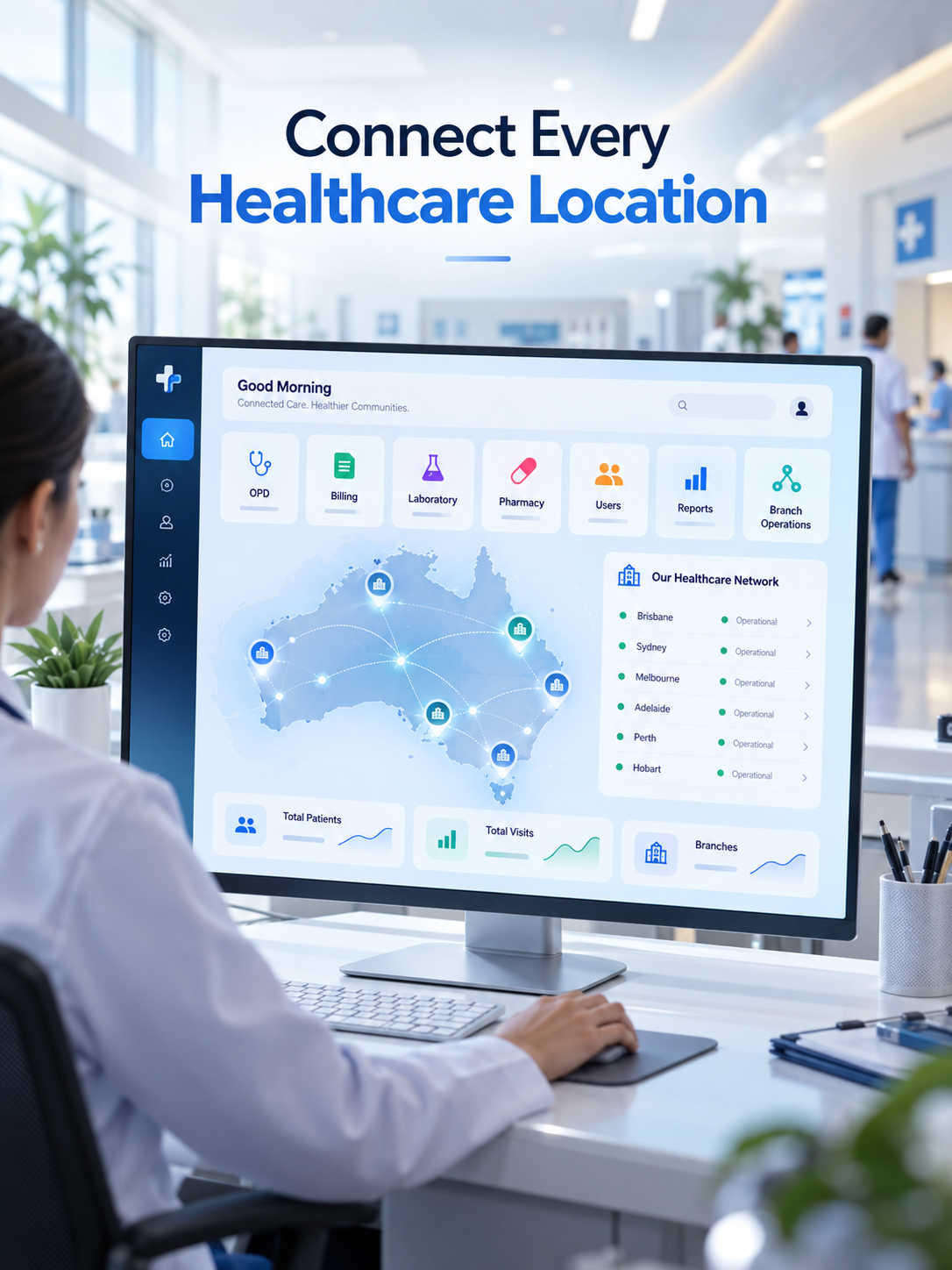
Connect Every Healthcare Location
Build scalable hospital software connecting OPD, billing, labs, pharmacy, users, reports and branch operations across multiple healthcare locations.
How a Multi-Site Hospital Workflow Can Work
A connected workflow starts before the patient enters a consultation room.
A patient can register or book an appointment at one location. Reception verifies the patient profile, generates an appointment or OPD token and assigns the appropriate doctor.
The consultation may then generate laboratory requests, prescriptions, billing entries or follow-up appointments.
With an integrated OPD queue management system, the flow can connect:
Registration → Token → Doctor → Lab → Pharmacy → Billing → Follow-Up
For a multi-site organisation, the important difference is that authorised information does not remain trapped inside one facility.
If a patient later attends another branch, appropriate staff can access relevant information according to defined permissions and organisational policies instead of creating unnecessary duplicate records.
Core Modules for Multi-Location Hospital Software
The right software architecture should be modular. Hospitals should be able to deploy capabilities according to operational priorities rather than implementing every feature simultaneously.
Patient Registration and Administration
Create structured patient profiles, visit records, appointments, admissions and branch-specific activity while maintaining an appropriate organisation-wide patient view.
OPD and Token Management
An online token management system can organise registration, doctor queues, room assignment, waiting status and consultation flow.
Centralised dashboards can also help management understand patient volumes across facilities.
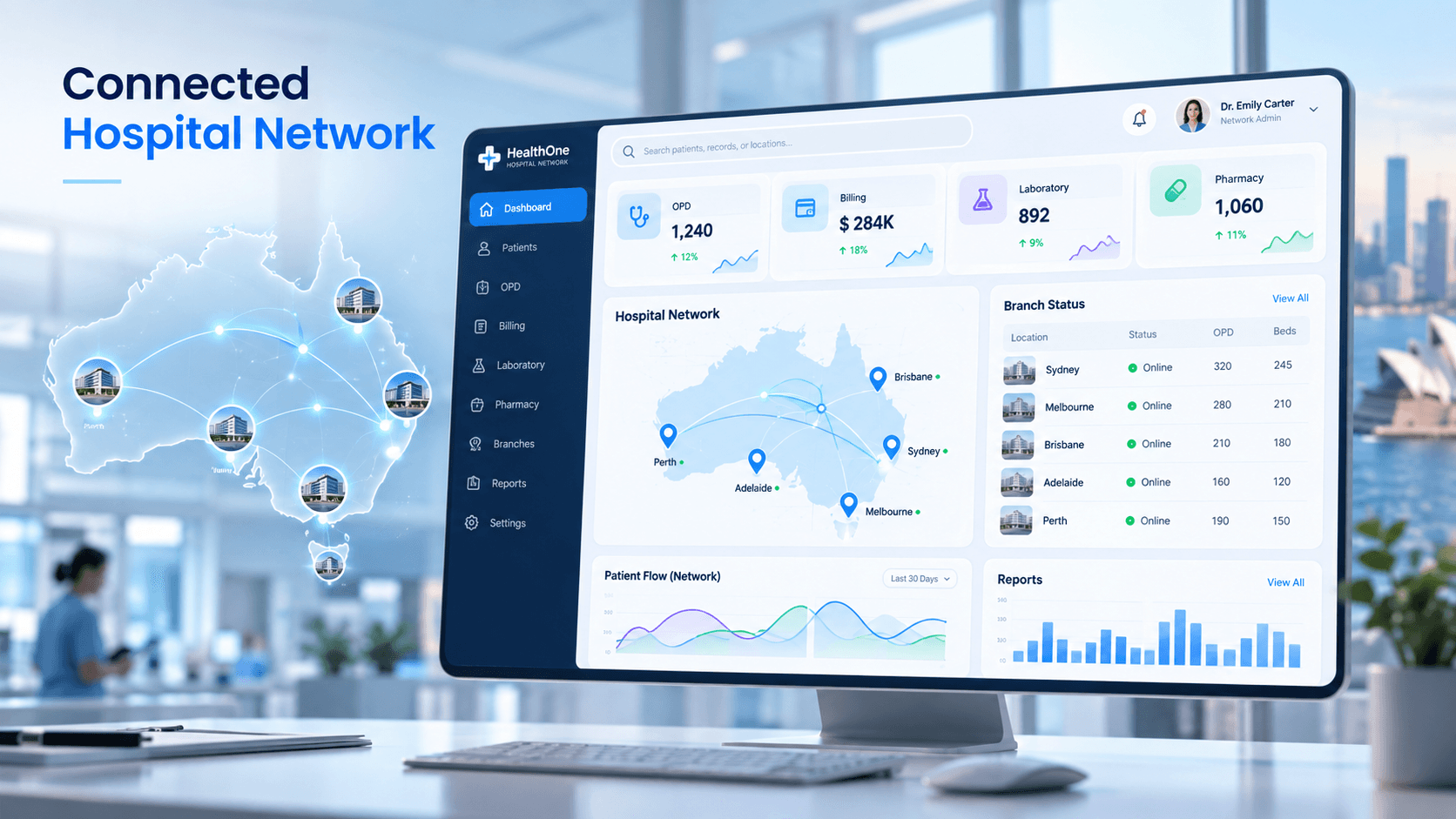
Connect Every Hospital Location With One Healthcare Platform
Laboratory Management System
A connected lab management system can manage:
- Test requests
- Sample collection
- Sample tracking
- Test processing
- Result entry
- Report generation
- Doctor access
- Branch-wise workload
For healthcare groups operating central laboratories, samples may originate at one branch while processing occurs at another.
A properly designed test lab management system should preserve the relationship between patient, order, sample, processing location and result throughout that journey.
Pharmacy and Inventory
Multi-site pharmacy management can provide visibility into medicines, purchase activity, stock movement, expiry dates and branch-level availability.
Central administrators can analyse inventory across the network while local teams manage stock for their individual facility.
Billing and Finance
A connected billing module can combine consultation, diagnostic, pharmacy and hospital service charges while maintaining location-level accounting and reporting requirements.
Users, Roles and Branch Permissions
Multi-site platforms require more than basic usernames and passwords.
Permissions may need to reflect organisation, facility, department and job responsibility.
A doctor may work across three branches, while reception staff may need access only to one location. Senior management may need network-wide dashboards without being involved in clinical workflows.
Centralised Healthcare ERP for Multiple Locations
As a hospital group expands, separate applications often create duplicate administration and fragmented reporting.
A purpose-built healthcare ERP software platform can provide a shared operating layer across branches while preserving local workflows.
Management dashboards can consolidate information such as:
- Patient volumes by location
- OPD waiting patterns
- Laboratory workload
- Revenue by branch
- Pharmacy inventory
- Staff activity
- Outstanding payments
- Service utilisation
- Operational performance
This turns multi-site healthcare software from a departmental tool into an operational intelligence platform.
Interoperability and Privacy Matter in Australia
Australian healthcare software should also be designed as part of a wider digital health ecosystem rather than another isolated database.
The Australian Digital Health Agency identifies interoperability as the ability to exchange the meaning of information between systems without requiring special effort from users. Current My Health Record interoperability requirements also reference AU Core and AUCDI for relevant FHIR connections.
Healthcare platforms may therefore need to consider integrations with EMR/EHR systems, pathology, imaging, pharmacy, APIs and other digital health infrastructure depending on the project.
Privacy architecture is equally important. Australian guidance treats health information as sensitive information requiring additional protection under the Privacy Act and Australian Privacy Principles.
Role-based access, authentication, audit trails, secure integrations, backups and appropriate information-access controls should be considered during architecture not added after development.
Discuss Your Multi-Site Hospital Software Requirements With Experts
Medical Software Case Study: A Multi-Site Transformation Model
Consider a healthcare group operating three hospitals, several outpatient clinics and one central diagnostic laboratory.
Before transformation, each facility manages appointments, billing and reports separately. Patients may be registered repeatedly. Laboratory status is communicated manually. Management waits for branch reports before understanding network performance.
The transformation begins by mapping the patient journey and identifying where data needs to move between facilities.
The organisation then introduces a common patient administration layer, OPD token management, connected laboratory workflows, pharmacy and billing modules.
Branch permissions allow local teams to manage everyday work, while central administrators receive consolidated operational dashboards.
Instead of replacing every system simultaneously, deployment can begin with patient registration and OPD workflows, followed by laboratory, billing, pharmacy, inventory and analytics.
This phased model reduces implementation risk while creating a foundation that can support additional facilities as the healthcare network grows.
Connect Multi-Site Healthcare
Build hospital software for OPD, billing, lab, pharmacy, reports, users, branches and multi-location workflows.
Build Healthcare Software
Build for the Entire Healthcare Network
The real value of multi-site hospital software in Australia is not simply putting hospital modules online.
It is connecting workflows across locations.
Hospitals, clinics and medical groups should be able to standardise critical processes, reduce fragmented administration, improve operational visibility and expand without creating another isolated software environment every time a new facility opens.
A well-designed multi-location healthcare platform creates one scalable digital foundation while still giving each hospital, clinic, laboratory and department the operational flexibility it needs.
Frequently Asked Questions
What is multi-site hospital software?
Multi-site hospital software is a healthcare management platform that connects multiple hospitals, clinics, laboratories or medical facilities through one system. It can centralise patient administration, OPD, billing, laboratory, pharmacy, users, branch operations and reporting while maintaining location-specific access and workflows.
How does multi-site hospital software help Australian healthcare groups?
Multi-site hospital software helps healthcare groups standardise workflows across locations, reduce duplicate administration, improve branch visibility and consolidate operational reporting. Individual facilities can manage daily operations while authorised teams monitor the wider healthcare network.
What modules should multi-location hospital software include?
Common modules include patient registration, appointments, OPD and token management, billing, laboratory management, pharmacy, inventory, users and roles, branch management, reporting, dashboards and integrations with other healthcare systems.
Can one hospital system manage multiple branches?
Yes. A properly designed hospital management platform can support multiple branches from one architecture. Each location can maintain its own operational workflows while central teams receive consolidated visibility across hospitals, clinics and supporting facilities.
How does an OPD token management system work across hospital locations?
An OPD token management system can connect patient registration, queue generation, doctor assignment, consultation status and waiting displays at each facility. Multi-site dashboards can also provide authorised management teams with branch-level patient flow information.
What is a lab management system for multi-site hospitals?
A multi-site lab management system manages test orders, samples, processing, results and reports across healthcare locations. Samples can originate at one branch and be processed at another while remaining linked to the correct patient, order and facility.
Can multi-site hospital software manage pharmacy and inventory?
Yes. Pharmacy and inventory modules can track medicine availability, purchases, stock movements, expiry information and branch-level inventory. Central teams can gain network-wide visibility while individual locations manage their own stock operations.
How are user permissions managed across multiple hospitals?
Multi-site healthcare software can use role-based and branch-based permissions. Access can be configured according to organisation, facility, department and job responsibility so users only see the information and functions required for their role.
Can existing hospital software be integrated with a new multi-site platform?
Yes, depending on the capabilities of the existing systems. A custom healthcare platform can be designed to integrate with EMR or EHR systems, laboratory applications, billing platforms, pharmacy systems, authentication services and other business applications through supported APIs and integration layers.
How much does multi-site hospital software development cost in Australia?
The cost depends on the number of locations, modules, user roles, integrations, migration requirements, reporting complexity, security requirements and deployment model. A technical discovery and workflow assessment is normally required to prepare an accurate project estimate.