MVP Rescue Services: How to Fix, Rebuild or Relaunch a Failed Software Product
In This Article
- When Does an MVP Need Rescue?
- Step 1: Audit Before Writing More Code
- Step 2: Decide What to Fix, Refactor or Rebuild
- Step 3: Fix UX Around the Core User Journey
- Step 4: Stabilize Backend, Performance and Integrations
- Step 5: Relaunch With a Smaller, Safer Scope
- A Failed MVP Can Still Become a Valuable Product
- Rescue Your MVP
A failed MVP does not necessarily mean that your business idea is a failure.
Often, the idea is valid but the software that executes it is incomplete, unstable, slow, non-intuitive, or impossible to maintain. The founder may have vanished. Development may have stalled. Every bug fix may create two more. The AI works in the demo, but not in production. At this point, founders asking themselves:
Should we fix our current product, refactor parts of it, or should we start fresh?
This is where MVP rescue services come in.
MVP rescue is much more than a bug fix, it's an iterative process that identifies what can be salvaged, fixed or moved on from, protects the useful existing work, and gets products back to market as quickly and as cheaply as possible.
When Does an MVP Need Rescue?
A software product may need rescue when development has stopped before launch, the original team is unavailable, production errors affect users, sign-up or payment flows fail, performance is poor, UX is confusing, releases are risky, or the codebase has become too fragile to change safely.
The same problem increasingly appears with AI-generated applications. A prototype can look impressive while still containing weak architecture, unreliable integrations, poor error handling or backend limitations.
If your product exists but cannot reliably launch, validate or scale, the better first step is usually an audit not an automatic rewrite.
MSI’s Software & MVP Rescue Mission is built around that rescue-first approach.
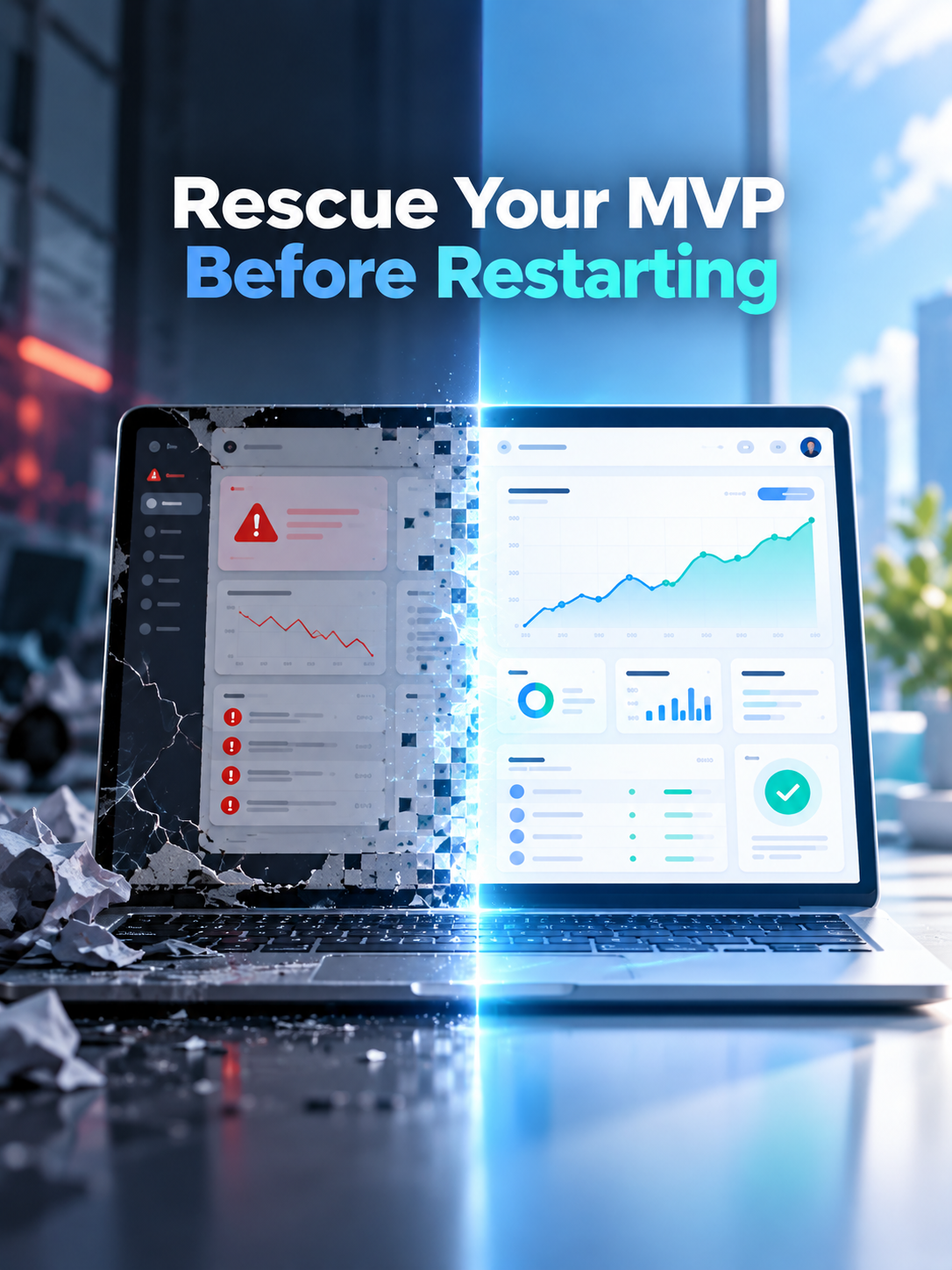
Rescue Your MVP Before Restarting
Audit broken code, fix critical product issues, rebuild what matters, and relaunch your MVP with a stronger technical foundation.
Step 1: Audit Before Writing More Code
The first goal is clarity.
A rescue audit should focus on code quality, architecture, the database structure, APIs, authentication, third-party services, deployment process, performance, security risks, missing features and documentation.
The audit should also analyze the core user journey, since technically sound product may fail dramatically during the onboarding, checkout, some crucial actions or navigation.
The audit should address three questions:
what can be salvaged, what needs to be reworked, and what is the shortest path to launch.
Without this analysis, the founders risk another round of funding without resolving the crucial issues.
Step 2: Decide What to Fix, Refactor or Rebuild
Not every failed MVP needs a full rebuild.
If the core architecture is usable, rescue may mean fixing bugs, improving performance, stabilizing integrations and completing launch-essential features.
If the frontend is strong but the backend is unreliable, the smarter option may be to preserve the interface while rebuilding APIs, authentication, data handling or business logic.
A full rebuild becomes more reasonable when the architecture is fundamentally wrong, serious security problems cannot be contained, the technology stack blocks the roadmap, or maintaining the current system would cost more than replacing it.
The principle is simple:
Preserve value where possible and rebuild only where necessary.
For products that need a stronger foundation, MSI’s MVP application development services focus on essential workflows and production-ready product development.
Rescue Your Failed MVP Before It Costs You More
Step 3: Fix UX Around the Core User Journey
Many rescued products are not failing only because of code.
User may give up on the onboarding because of too many steps, inconsistent forms, mobile-friendliness, checkout, subscription, search, or dashboards that work despite friction.
A rescue should prioritize journeys directly tied to validation and revenue: registration, logging in, onboarding, the product action, payments, and notifications.
The goal is not a beautiful redesign.
It is to strip away any friction that keeps a user from doing the job the MVP was built to do.
Step 4: Stabilize Backend, Performance and Integrations
Once critical user flows are clear, engineering shifts to reliability.
This may include fixing database queries, broken APIs and webhooks, unstable backend modules, permissions, slow requests, error handling, monitoring and deployment processes.
AI products often need an additional layer of rescue. Model or API integrations must be reliable, prompt or agent workflows need guardrails, failures need fallbacks, and the backend must support production usage.
MSI’s AI MVP development services are relevant when an AI-powered product needs to move from prototype behavior to a practical MVP.
Product case studies also show the importance of connected architecture.
The GAXA marketplace case study demonstrates mobile users, marketplace workflows, administration, payments and backend APIs working as one platform.
The Tribalshaadi.ai case study shows how mobile experiences, subscriptions, real-time communication, verification and AI-assisted features can be combined in one product.
Step 5: Relaunch With a Smaller, Safer Scope
A rescue should not become another oversized project.
After months of delay, adding every originally planned feature usually creates more risk.
A better relaunch identifies the smallest release that delivers the core value proposition, collects real user feedback and proves whether the product deserves further investment.
MSI’s ROI-driven MVP software development follows the same principle: prioritize features tied to validation, users, revenue and business outcomes instead of unnecessary complexity.
Relaunch should also include testing of critical paths, monitoring, deployment documentation and clear ownership so the product is not dependent on one developer or undocumented environment.
Get Expert Guidance Before Rebuilding Your Software Product
A Failed MVP Can Still Become a Valuable Product
An unfinished or faulty software product may still house valuable business logic, reusable frontend elements, worthwhile data structures and user feedback.
The key is to eliminate guesswork.
Audit the product, differentiate symptoms from root causes and prioritize the parts that protect users' experience and revenue.
Once these parts are fixed, all that remains is rebuilding the unnecessary elements and launching the relaunched product with a renewed scope that can be measured in the marketplace.
If your MVP is unfinished, faulty, slow, badly-designed, abandoned or stagnant before launch, the next move does not need to be starting from square one.
Rescue what remains of value. Rebuild what holds it back. Relaunch a product you can trust.
Rescue Your MVP
Turn your incomplete, unstable or failed software product into a focused, launch-ready MVP.
Frequently Asked Questions
What are MVP rescue services?
MVP rescue services help founders recover incomplete, buggy, slow, poorly designed or abandoned software products. The process typically includes code and architecture audits, UX improvements, backend stabilization, performance fixes, testing and a practical relaunch plan.
Can a failed MVP be rescued without rebuilding everything?
Yes. A failed MVP does not always require a complete rewrite. A technical audit can identify reusable code, stable components and valuable business logic so only the problematic parts of the product need to be fixed, refactored or rebuilt.
Should I fix or rebuild my failed software product?
The decision depends on code quality, architecture, security, scalability, technical debt and the cost of continued maintenance. If the foundation is stable, fixing and refactoring may be faster. If the architecture fundamentally blocks reliability or future development, a partial or complete rebuild may be more practical.
How do you rescue an incomplete software project?
Software rescue normally starts with an audit of the existing codebase, architecture, database, APIs, integrations, deployment environment and unfinished features. Critical issues are prioritized before creating a phased plan to stabilize, complete, test and relaunch the product.
Can you rescue an app after the original developer leaves?
Yes. An experienced rescue team can review the existing source code, hosting environment, database, APIs and documentation, identify missing knowledge and create a new technical roadmap. Access to the source code, infrastructure and third-party accounts makes the takeover process easier.
How long does MVP rescue take?
The timeline depends on product size, code quality, technical debt, unfinished functionality and the number of critical problems. A focused rescue should begin with an audit so the team can estimate what can be repaired quickly and what requires deeper rebuilding.
How much does it cost to rescue a failed MVP?
MVP rescue cost depends on the condition of the existing codebase, required UX changes, backend complexity, integrations, security issues and whether parts of the product need rebuilding. A technical audit is the most reliable way to estimate rescue cost before committing to development.
Can an AI MVP or AI-generated application be rescued?
Yes. AI MVP rescue can address unstable model integrations, unreliable API workflows, weak backend architecture, missing guardrails, authentication problems, performance issues and prototype code that is not ready for production use.
What should be fixed first in a failed MVP?
Priority should normally go to problems affecting security, user access, core workflows, payments, data integrity, performance and product validation. Cosmetic improvements and lower-value features should usually come after the product's critical journey is stable.
What happens after an MVP is rescued?
After stabilization, the product should be tested across critical workflows, deployed through a controlled release process and monitored for errors and performance. The next development phase should be driven by real user feedback, business priorities and measurable product outcomes.