Sitecore Content SDK 2.0: The Future of Headless XM Cloud Development
In This Article
Introduction
In the rapidly evolving world of digital experience platforms (DXPs), businesses are demanding faster, more flexible, and scalable ways to deliver content across multiple channels. Traditional monolithic architectures are no longer sufficient to meet these needs. This is where headless and composable architectures come into play—and Sitecore is leading this transformation with its Content SDK.
With the release of Sitecore Content SDK 2.0, developers now have a more powerful, streamlined, and future-ready toolkit designed specifically for XM Cloud. This new version builds upon the foundations of headless development while introducing modern enhancements such as improved developer experience, AI-ready capabilities, and tighter integration with contemporary frontend frameworks like Next.js.
In this article, we’ll explore what Sitecore Content SDK 2.0 is, why it matters, its key features, and how it compares to previous approaches like JSS.
What is Sitecore Content SDK?
Sitecore Content SDK is a modern, lightweight software development kit designed to help developers build headless applications using Sitecore XM Cloud. It replaces the older JavaScript Services (JSS) SDK and provides a cleaner, more focused approach to building composable digital experiences.
The SDK enables developers to:
- Fetch and render content using GraphQL APIs
- Build applications with modern frameworks like Next.js
- Implement personalization and analytics
- Deliver omnichannel digital experiences
Unlike traditional Sitecore implementations, which tightly couple backend and frontend layers, the Content SDK embraces a decoupled architecture, allowing teams to work independently and deploy faster.

Build Beyond Traditional Headless
Accelerate XM Cloud development with Content SDK, Next.js, GraphQL, and scalable architecture built for modern enterprise experiences.
Evolution: From JSS to Content SDK 2.0
To understand the significance of version 2.0, it’s important to look at the evolution:
1. Sitecore JSS
- Introduced headless capabilities
- Supported multiple frameworks
- Often complex and heavy for modern needs
2. Content SDK (Initial Release)
- Focused on XM Cloud
- Simplified APIs
- Reduced boilerplate code
3. Content SDK 2.0
- AI-ready architecture
- Enhanced developer experience (DX)
- Better performance and scalability
- Improved integration with modern frontend ecosystems
The transition reflects Sitecore’s strategic shift toward composable architecture and cloud-native development.
Why Sitecore Content SDK 2.0 Matters
Transform Your Enterprise Platform with Scalable Headless Architecture
Content SDK 2.0 is more than just an upgrade—it represents a fundamental shift in how developers build digital experiences.
1. Faster Development Cycles
With simplified APIs and reduced configuration overhead, developers can build and deploy applications more quickly.
2. Composable Architecture
Organizations can choose best-of-breed tools for each part of their stack, rather than relying on a single monolithic platform.
3. AI-Ready Capabilities
The inclusion of AI-friendly hooks and extensibility prepares applications for personalization, automation, and intelligent content delivery.
4. Improved Performance
Optimized data fetching and rendering strategies ensure faster load times and better user experiences.
Key Features of Sitecore Content SDK 2.0
1. GraphQL-Based Content Delivery
Content SDK 2.0 leverages GraphQL to fetch exactly the data you need, reducing over-fetching and improving performance.
Benefits:
- Flexible queries
- Faster data retrieval
- Better control over content structure
2. Native Next.js Integration
Next.js is the preferred framework for Sitecore XM Cloud, and Content SDK 2.0 enhances this integration.
Capabilities include:
- Server-side rendering (SSR)
- Static site generation (SSG)
- Incremental static regeneration (ISR)
This enables developers to build highly performant and SEO-friendly applications.
3. Personalization and Analytics
The SDK integrates seamlessly with Sitecore’s personalization and analytics tools.
Use cases:
- Deliver personalized content based on user behavior
- Track engagement metrics
- Optimize user journeys
4. Improved Developer Experience (DX)
Developer experience has been a major focus in version 2.0.
Enhancements include:
- Cleaner APIs
- Better documentation
- Reduced boilerplate
- Easier debugging
These improvements make onboarding faster and development more enjoyable.
5. AI and Automation Readiness
One of the standout aspects of version 2.0 is its readiness for AI-driven features.
Examples:
- Content recommendations
- Automated personalization
- Intelligent search
This aligns with the growing demand for AI-powered digital experiences.
6. Event Handling and Tracking
Content SDK 2.0 introduces improved event handling capabilities.
Benefits:
- Better tracking of user interactions
- Enhanced analytics integration
- Support for real-time data processing
Architecture Overview
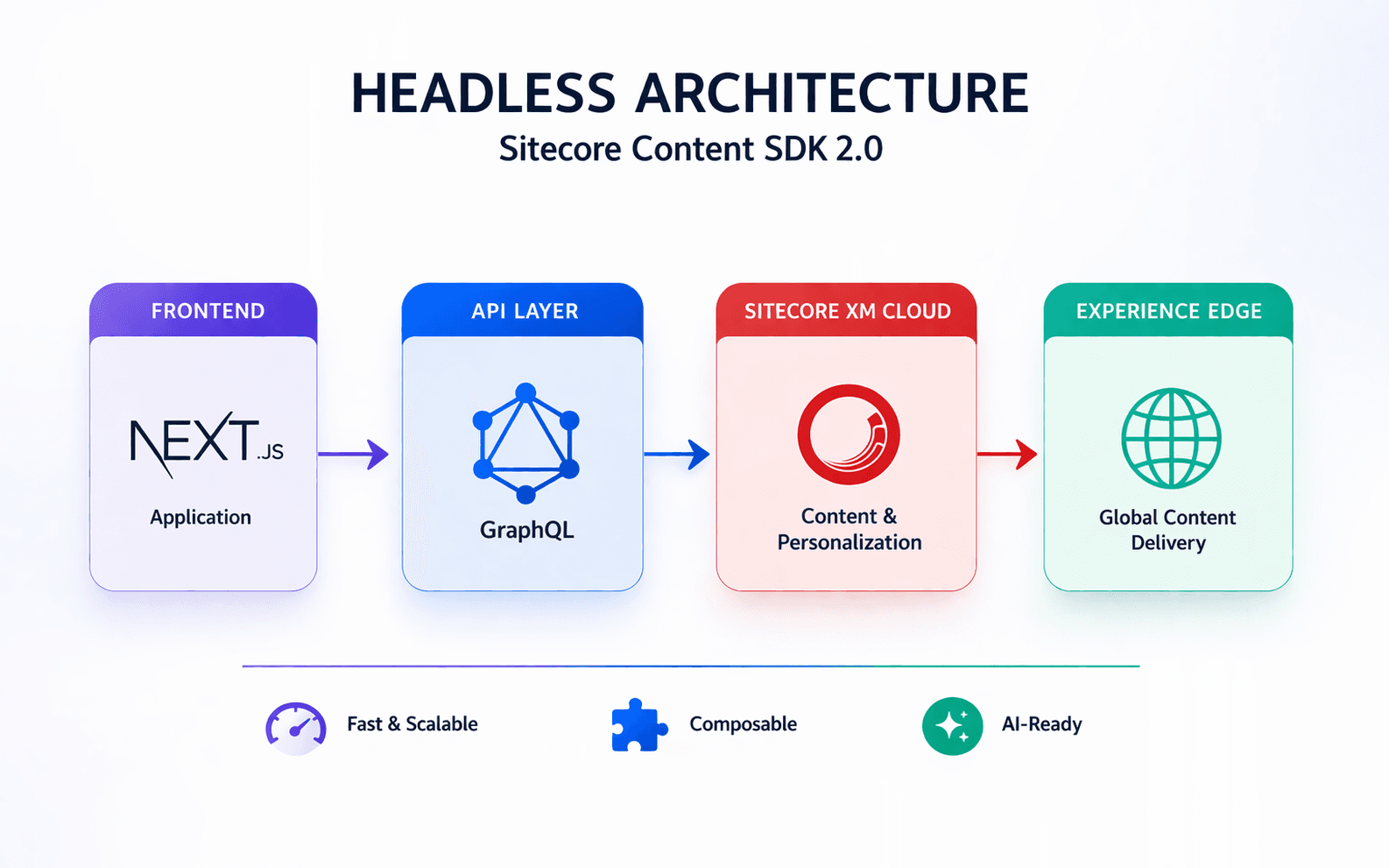
Sitecore Content SDK 2.0 fits into a modern composable architecture:
- Frontend: Built using Next.js or similar frameworks
- Content Layer: Sitecore XM Cloud
- API Layer: GraphQL endpoints
- Edge Delivery: Experience Edge
- Personalization: Sitecore CDP / Personalize
This architecture ensures scalability, flexibility, and high performance.
Comparison: JSS vs Content SDK 2.0
Feature JSS Content SDK 2.0
Architecture Semi-headless Fully headless
Complexity High Low
Performance Moderate High
AI Readiness Limited Strong
Framework Support Multiple Focused (Next.js)
Developer Experience متوسط Excellent
Conclusion: Content SDK 2.0 is a clear improvement, offering a more modern and streamlined approach.
Getting Started with Sitecore Content SDK 2.0
Step 1: Set Up XM Cloud
Ensure you have access to a Sitecore XM Cloud instance.
Step 2: Create a Next.js App
Use a starter template to quickly bootstrap your project.
Step 3: Install Content SDK
Install the SDK via npm and configure your environment.
Step 4: Connect to GraphQL
Set up API endpoints to fetch content from Sitecore.
Step 5: Build Components
Create reusable components to render content dynamically.
Best Practices
To get the most out of Content SDK 2.0, follow these best practices:
- Use modular components for scalability
- Optimize GraphQL queries to reduce payload size
- Implement caching strategies
- Leverage SSR/SSG for SEO
- Integrate personalization early in the development cycle
Use Cases
Content SDK 2.0 is ideal for:
- Enterprise websites
- E-commerce platforms
- Omnichannel applications
- Personalized digital experiences
Its flexibility makes it suitable for both small projects and large-scale enterprise solutions.
Challenges and Considerations
While Content SDK 2.0 offers many advantages, there are some considerations:
- Learning curve for developers new to headless architecture
- Dependence on modern frontend frameworks
- Need for strong API management
However, these challenges are outweighed by the long-term benefits.
Conclusion
Sitecore Content SDK 2.0 marks a significant milestone in the evolution of headless development within the Sitecore ecosystem. By focusing on simplicity, performance, and AI readiness, it empowers developers to build modern, scalable, and personalized digital experiences.
Frequently Asked Questions
What is Sitecore Content SDK 2.0?
Sitecore Content SDK 2.0 is a modern development toolkit for building headless Sitecore applications. It supports modern frontend development patterns, GraphQL-based content delivery, Next.js integration, and scalable composable architectures for digital experiences.
How is Sitecore Content SDK different from Sitecore JSS?
Sitecore Content SDK provides a more modern development approach with cleaner separation of concerns and framework-native patterns. It is designed as the forward path for modern Sitecore headless development, while JSS applications can be migrated to Content SDK.
Can I migrate a Sitecore JSS application to Content SDK?
Yes. Sitecore provides migration guidance for moving JSS Next.js applications to Content SDK. The recommended approach depends on the JSS version, project customization, component complexity, and the desired migration strategy.
Is Next.js recommended for Sitecore Content SDK development?
Yes. Next.js is a major framework used with Sitecore Content SDK for modern headless development. It supports rendering approaches such as server-side rendering, static generation, and incremental regeneration.
How does Sitecore Content SDK use GraphQL?
Sitecore Content SDK can use GraphQL APIs to retrieve structured content and layout data from Sitecore. This gives frontend applications flexible access to the content required for headless experiences.
What are the benefits of Sitecore Content SDK for XM Cloud?
The main benefits include modern frontend architecture, improved developer experience, cleaner data-fetching patterns, reusable components, flexible content delivery, and a stronger foundation for scalable headless applications.
Is Sitecore Content SDK suitable for enterprise websites?
Yes. Sitecore Content SDK can support enterprise headless websites that require scalable component architecture, structured content delivery, multiple environments, modern frontend frameworks, and integration with enterprise platforms.
Does Sitecore Content SDK support composable architecture?
Yes. Content SDK supports a composable development approach in which the frontend, content platform, APIs, and connected services can work as independently managed parts of a modern digital experience architecture.
What technologies are commonly used with Sitecore Content SDK?
Common technologies include Next.js, React, TypeScript, GraphQL, Sitecore Experience Edge, REST APIs, Git-based source control, CI/CD pipelines, and cloud frontend hosting.
Should new Sitecore projects use Content SDK or JSS?
For current SitecoreAI development, Content SDK is the supported path for new work. Existing JSS applications should plan their migration based on the application's version, customization level, and official migration guidance.