Sitecore Introduces Item-Level AI Translation in Page Builder
In This Article
Sitecore continues expanding its AI-powered localization capabilities with the introduction of item-level AI translation directly inside Page Builder. The new enhancement gives content authors more granular control over multilingual content management while reducing the complexity of translating entire pages. (Sitecore Documentation)
This release is another step in Sitecore’s broader strategy of embedding AI directly into content workflows instead of treating AI as a separate toolset. (Konabos)
What Is Item-Level AI Translation?
Previously, Sitecore’s AI translation workflows focused primarily on page-level translation. Authors could translate an entire page and all related content items in one operation using the Page Translation Assistant. (Sitecore Documentation)
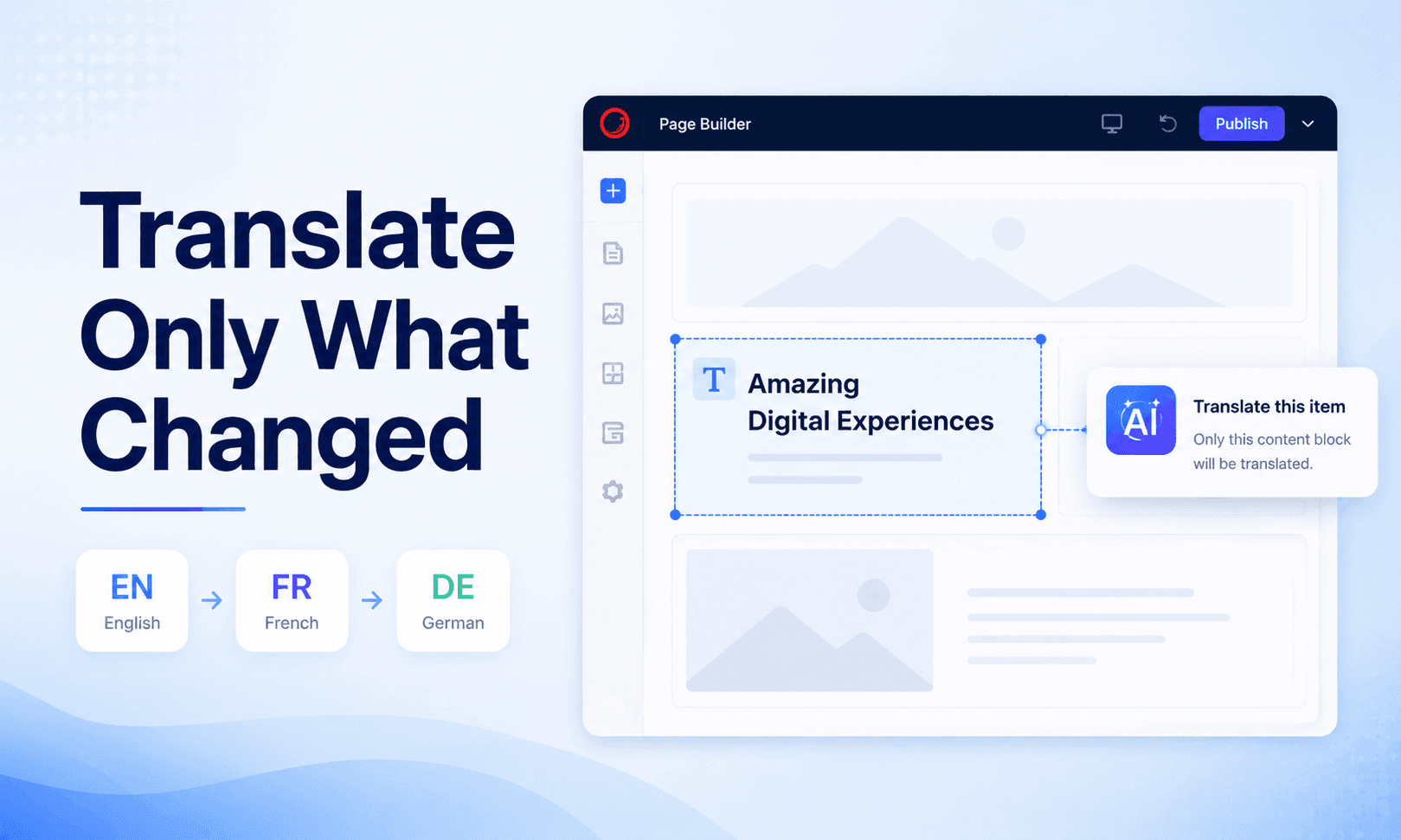
With the new item-level translation capability in Page Builder, authors can now translate individual content items directly within the editing experience. This gives teams more flexibility when managing multilingual websites where only specific components or content blocks require localization.
Instead of translating an entire page every time content changes, editors can selectively translate:
- Individual text components
- Content block items
- Shared reusable content
- Structured content entries
- Linked datasource items
This significantly improves localization workflows for enterprise websites that reuse components across multiple pages and channels.
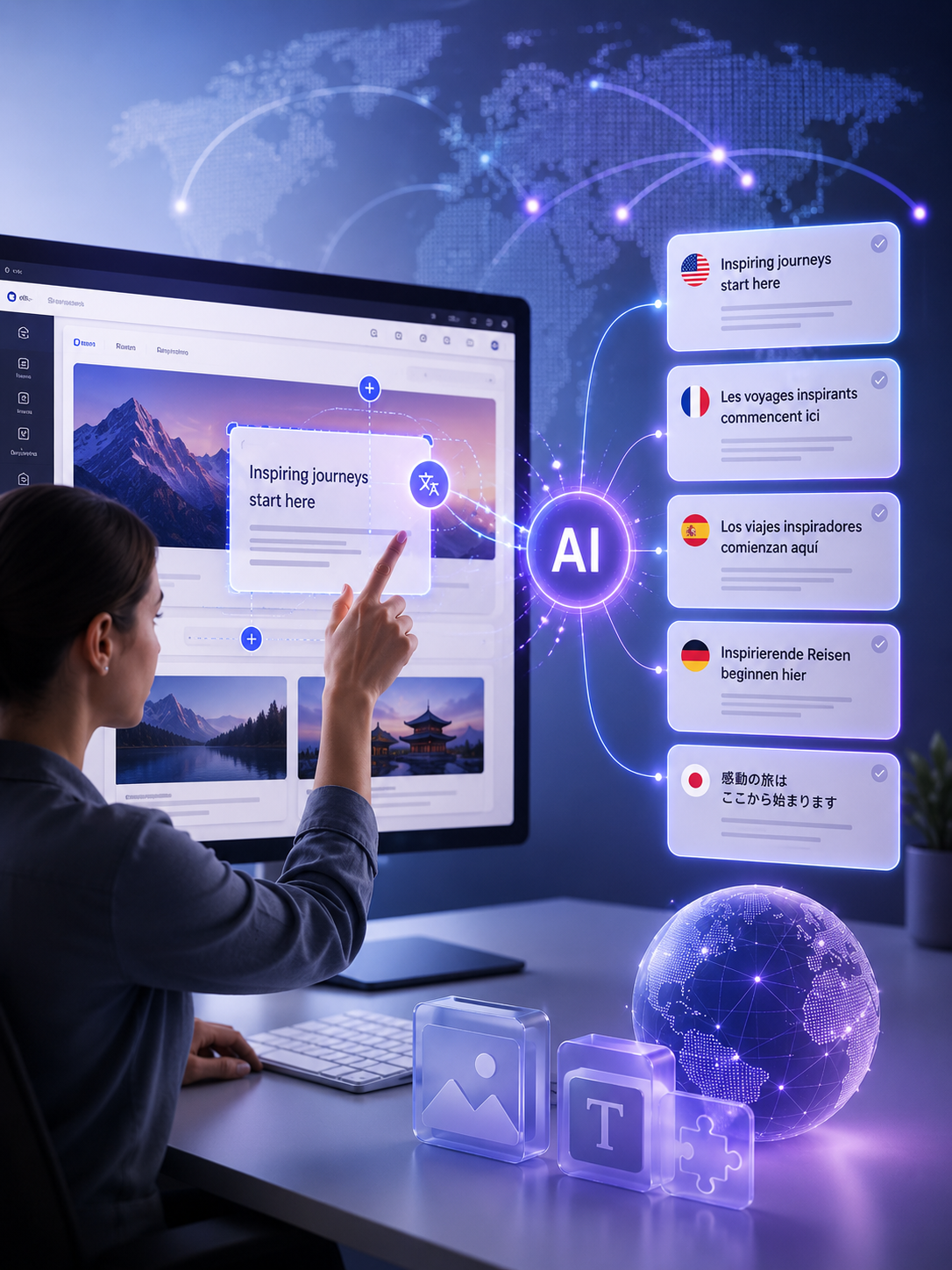
Translate Smarter, Publish Globally
Empower content teams to translate individual items with AI, reduce repetitive work, and accelerate multilingual publishing across global experiences.
Why This Matters for Enterprise Teams
Modern composable websites often contain reusable content modules distributed across dozens — or even hundreds — of pages. Translating full pages repeatedly can create unnecessary overhead and duplicate translation efforts.
Item-level translation solves several operational challenges:
| Challenge | Item-Level Translation Benefit |
|---|---|
| Repeated page translations | Translate only updated items |
| Shared content reuse | Localize reusable components independently |
| Faster publishing cycles | Reduce translation turnaround time |
| Lower translation costs | Minimize unnecessary AI processing |
| Editorial flexibility | Translate content incrementally |
For global marketing teams, this creates a much more scalable localization workflow.
How AI Translation Works in Sitecore
Modernize Multilingual Content Workflows
Sitecore’s AI-assisted translation system automatically creates language versions of content items while preserving structure and relationships. The platform currently supports translation of several field types, including:
- Single-line text
- Multi-line text
- Rich text
- General link fields
- Image alt text (Sitecore Documentation)
The translation engine also intelligently skips content already translated into the target language using “smart translation” logic. (Sitecore Documentation)
This becomes especially valuable for large multilingual implementations where only portions of content change regularly.
Better Workflow Integration Inside Page Builder
One of the biggest advantages of this release is workflow integration.
Rather than forcing users to switch between Content Editor, external translation tools, or localization platforms, translation now happens directly inside the Page Builder experience. This aligns with Sitecore’s broader “AI inside the workflow” direction highlighted in its 2026 roadmap. (Konabos)
The result is:
- Less context switching
- Faster editorial workflows
- Better collaboration between marketers and localization teams
- Reduced dependency on developers
This also complements earlier Page Builder improvements released throughout 2025 and 2026, including AI-assisted content optimization and enhanced editing capabilities. (Sitecore Developer Portal)
AI Translation Still Requires Human Review
While AI translation dramatically accelerates localization, Sitecore documentation emphasizes that translated content should still be reviewed manually before publishing. AI-generated outputs can vary and may not always align perfectly with brand tone or regional nuances. (Sitecore Documentation)
To improve consistency, Sitecore supports brand kits and terminology protection rules that help preserve:
- Product names
- Brand terminology
- Trademarked phrases
- Industry-specific language (Sitecore Documentation)
This governance layer becomes increasingly important for enterprise organizations operating across multiple markets.
The Bigger Picture: AI-Powered Localization
The addition of item-level AI translation reflects a larger trend in digital experience platforms: AI-enabled localization embedded directly into content operations.
Instead of relying entirely on external translation systems, modern DXP platforms are moving toward:
- Embedded AI workflows
- Real-time localization
- Context-aware translation
- Governance-driven multilingual publishing
- Unified content operations
Sitecore’s ongoing investment in AI-assisted translation, personalization, and workflow automation suggests the company is positioning localization as a core operational capability rather than a disconnected process. (Konabos)
Final Thoughts
Item-level AI translation in Page Builder may seem like a small enhancement on the surface, but it addresses a major pain point for global content teams: translating only what actually changed.
By enabling more granular localization workflows, Sitecore helps organizations reduce operational overhead, improve translation efficiency, and accelerate multilingual publishing.
As AI becomes more deeply integrated into content management platforms, features like this are likely to become standard expectations for enterprise digital experience ecosystems.
Reference:
- Item-level AI translation in Page builder | SitecoreAI Changelog | Sitecore Developer Portal
- AI-assisted item translation
- Translate a page with AI
Frequently Asked Questions
What is SitecoreAI item-level translation in Page Builder?
SitecoreAI item-level translation allows content authors to translate individual content items directly in Page Builder instead of translating an entire page or website. This gives teams greater control over multilingual content localization.
How does item-level AI translation work in SitecoreAI?
Authors select an individual supported content item in Content mode, choose a source language and target language, and use AI to create a translated language version for that specific item.
What content can be translated with item-level AI translation?
SitecoreAI supports individual content item translation for supported item types, including pages, data source items, dictionary items, and supported design-related items.
Why is item-level translation useful for enterprise websites?
Enterprise websites often reuse content across multiple pages and channels. Item-level translation allows teams to translate only changed or required content, reducing unnecessary work and supporting incremental localization.
Can SitecoreAI translate individual content items into multiple languages?
Yes. Authors can translate individual content items into supported target languages and create new language versions without translating an entire page or site.
Does SitecoreAI create a new language version when translating content?
Yes. When a content item is translated, SitecoreAI creates a new language version of the selected item for the chosen target language.
Can existing AI-translated content be translated again?
Yes. If a target language already has an existing language version, authors can use the retranslate option to generate a new AI translation.
Does SitecoreAI translation require special permissions?
Yes. Users need the appropriate Write and Language Write access rights to use content item translation in SitecoreAI.
How does item-level translation improve content workflows?
It reduces context switching by allowing translation inside Page Builder, supports faster incremental updates, improves editorial flexibility, and reduces the need to translate entire pages repeatedly.
Should AI-translated content be reviewed before publishing?
Yes. AI-generated translations should be reviewed by human editors before publishing to verify accuracy, brand tone, terminology, and regional or cultural relevance.