Sitecore SEO Services: Why Sitecore Sites Need a Different SEO Approach

In This Article
- Why Generic SEO Doesn’t Work Well on Sitecore
- Common Sitecore SEO Problems
- What Changed with XM Cloud and SitecoreAI
- Real Examples from Sitecore Projects
- Protecting SEO During a Sitecore Migration
- Getting Ready for AI Search (AEO and GEO)
- How Murmu Software Infotech Delivers Sitecore SEO Services
- Make Sitecore Work for Your Search Rankings
Here’s a situation we see often. A company spends a serious budget on a Sitecore website. The design is great, the content team is busy, and the marketing department runs a regular SEO agency on top. Yet organic traffic stays flat, or worse, drops after a redesign.
The problem usually isn’t the content. It’s how Sitecore builds and serves the pages. Most SEO agencies can tell you what’s wrong, but they can’t fix it inside Sitecore templates, renderings or a Next.js front end. That gap is why Sitecore SEO services exist, and this guide explains what they cover and how Murmu Software Infotech approaches them.
Why Generic SEO Doesn’t Work Well on Sitecore
On WordPress, an SEO plugin handles most of the basics. Sitecore works differently. Metadata, URLs, canonicals and sitemaps all depend on how your developers set up templates and components.
So when an SEO audit says “add meta descriptions to 400 pages,” the real question is whether your page templates even have a meta description field. If they don’t, a developer has to add one before the content team can do anything. Sitecore SEO is half SEO knowledge and half Sitecore engineering. You need both in the same team.

Turn Sitecore Into Search Advantage
Unlock organic growth with expert Sitecore SEO, technical engineering, migration protection and AI search optimization tailored to enterprise digital experiences.
Common Sitecore SEO Problems
These are the issues we find most often in Sitecore SEO audits:
- Duplicate content across sites: Sitecore lets you share content across multiple sites. Great for editors, but without proper canonical tags, Google sees the same article on several domains and has to guess which one to rank.
- Messy URLs: URLs built from item names can end up with spaces, capitals or deep folder paths that don’t match how people search.
- Missing SEO fields: page templates without meta title, description, Open Graph or noindex fields force developers to hardcode values, so marketers lose control.
- Language version issues: on multilingual sites, missing hreflang tags or wrong language codes in sitemap URLs send visitors to the wrong language version.
- Slow pages: uncached renderings, heavy JavaScript and oversized images hurt Core Web Vitals.
- Soft 404s: pages that show “not found” but return a 200 status code waste crawl budget and confuse search engines.
None of these can be fixed from the outside with a plugin. They need changes in templates, components or front-end code.
Unlock Your Sitecore Website’s Search Potential With Expert SEO
What Changed with XM Cloud and SitecoreAI
Older Sitecore versions had very little SEO built in, so agencies had to create most of it themselves. XM Cloud and SitecoreAI now include sitemap configuration, robots.txt settings, JSON-LD schema configuration, URL redirects and optimised image loading through the NextImage component.
That’s good news, but it doesn’t make headless SEO automatic. With XM Cloud, your Next.js front end controls what search engines actually see. If metadata isn’t passed correctly, routing creates duplicate paths, or important content only appears after JavaScript runs, rankings suffer even though the CMS is configured perfectly.
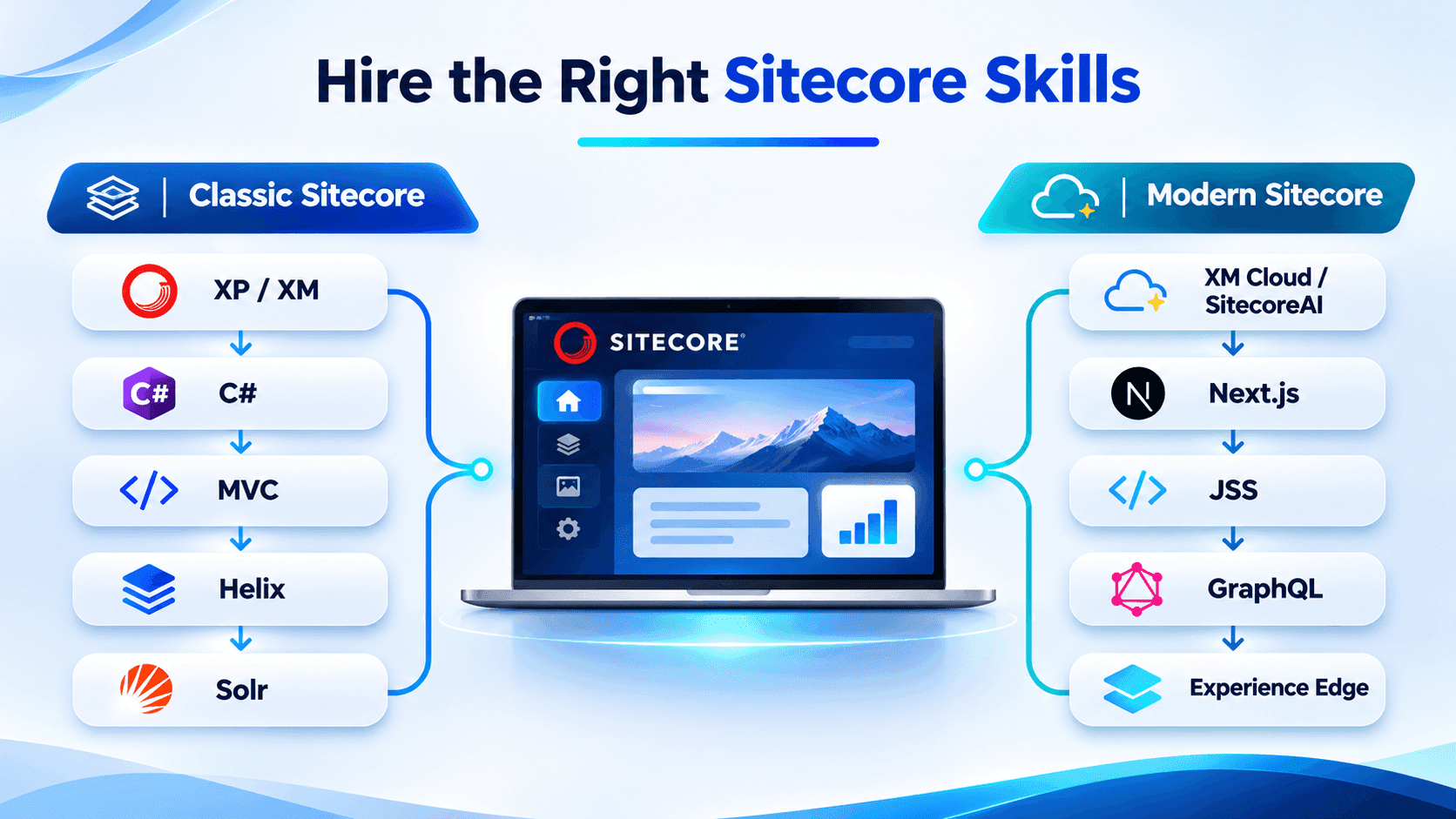
That’s why XM Cloud SEO needs someone who understands Experience Edge, GraphQL and Next.js rendering, not just SEO checklists.
Real Examples from Sitecore Projects
Murmu Software Infotech’s SEO work comes from hands-on Sitecore engineering. A few examples of SEO-related considerations in our projects:
- Multilingual airport platform (XM Cloud and Next.js): with content in several languages, every language version needed correct URLs, language codes and metadata, so international travellers land on the right version from search.
- Enterprise travel platform: booking-driven pages combine Sitecore content with live API data. Rendering that content server-side, rather than only in the browser, keeps it visible to search engines.
- Healthcare platform, XP to XM Cloud: moving a large healthcare site to a new architecture meant mapping existing URLs, metadata and redirects so that years of organic visibility weren’t lost in the switch.
The lesson across all three: SEO decisions made during development cost far less than fixing them after launch.
Protecting SEO During a Sitecore Migration
Redesigns and migrations are where Sitecore sites lose the most traffic. Before any upgrade or XM Cloud move, make sure your team:
- Exports every current URL, title and description, along with top landing pages from Google Search Console.
- Maps every old URL to its new destination and sets up 301 redirects.
- Checks canonicals, sitemaps and robots rules on the staging site before launch.
- Compares rendered pages before and after deployment.
- Monitors indexing and rankings closely for several weeks after go-live.
Skipping step 2 alone can wipe out backlinks that took years to earn.
Turn Sitecore SEO Challenges Into Sustainable Organic Growth Opportunities
Getting Ready for AI Search (AEO and GEO)
Search isn’t only ten blue links anymore. Google AI Overviews, ChatGPT and Perplexity pull answers from well-structured pages. For Sitecore sites, that means:
- Structured data (Organization, Service, FAQ, Article, Breadcrumb) built into reusable components.
- Clear, direct answers near the top of key pages.
- FAQ components editors can manage without developer help.
- Clean heading structure and strong internal linking.
Because this is built into Sitecore templates, every new page benefits automatically, not just the ones someone remembers to optimise.
How Murmu Software Infotech Delivers Sitecore SEO Services
Our process has three steps:
- Audit the CMS and front end. We review crawlable URLs, indexability, metadata, canonicals, sitemaps and rendered content, then deliver a prioritised issue list with affected URLs and clear ownership.
- Implement agreed fixes. Our Sitecore developers make the template, component, metadata, URL and rendering changes, keeping editorial and redesign work separate unless included.
- Verify the release. We recheck metadata and indexing signals, test redirects, and compare critical URLs before and after deployment.
We also work white-label with SEO and digital agencies that need Sitecore engineering behind their recommendations. To be clear, no honest partner can guarantee rankings. What we guarantee is that technical barriers stop holding your content back.
Make Sitecore Work for Your Search Rankings
Your Sitecore platform should help your content rank, not hold it back. If traffic has stalled or you’re planning a migration, Murmu Software Infotech’s Sitecore SEO services combine search expertise with real Sitecore engineering. Start with a Sitecore SEO audit and get a clear, prioritised list of what to fix first.
Frequently Asked Questions
Is Sitecore good for SEO?
Yes, when it’s implemented properly. Sitecore supports metadata, sitemaps, redirects and crawl controls, but results depend on the build, front-end performance and content quality.
Does XM Cloud support SEO?
Yes. It supports sitemaps, robots.txt, redirects, JSON-LD and image optimisation. The Next.js front end must still handle metadata, routing and rendering correctly.
Can you improve SEO on SXA sites?
Yes. SXA work includes titles, meta descriptions, heading structure, sitemap setup, redirects, alt text and template fixes.
How much do Sitecore SEO services cost?
It depends on site size, version, number of languages and the issues found. A focused technical audit is the best starting point for an accurate estimate.
What are Sitecore SEO services?
Sitecore SEO services combine search engine optimization with Sitecore development expertise to improve website crawlability, indexability, metadata, URL structure, structured data, page performance and organic search visibility across traditional and headless Sitecore platforms.
Is Sitecore good for SEO?
Yes. Sitecore can support enterprise SEO through customizable metadata, URL structures, canonical tags, XML sitemaps, redirects and multilingual content management. However, SEO effectiveness depends on the implementation, front-end performance, content quality and technical configuration.
What is the difference between generic SEO and Sitecore SEO?
Generic SEO focuses on website content, keywords, backlinks and technical recommendations. Sitecore SEO additionally requires platform-specific engineering to implement changes within Sitecore templates, renderings, components, Experience Edge, GraphQL and Next.js applications.
Does Sitecore XM Cloud support SEO?
Yes. Sitecore XM Cloud, now SitecoreAI, supports SEO-related capabilities such as sitemap configuration, robots.txt, redirects and structured data through supported implementations. Developers must also ensure that the front end correctly handles metadata, routing, rendering and indexability.
How much do Sitecore SEO services cost?
Sitecore SEO pricing depends on website size, Sitecore version, technical complexity, number of languages, integrations and implementation requirements. Murmu Software Infotech recommends beginning with a focused technical SEO audit to establish a prioritized scope and accurate estimate.
How can I improve SEO performance on a Sitecore website?
Improve Sitecore SEO by optimizing metadata, canonical tags, URL structures, XML sitemaps, redirects, internal linking, rendering strategies, structured data, image delivery and Core Web Vitals. A technical audit can identify which improvements should be prioritized.
How can I protect SEO rankings during a Sitecore migration?
Protect organic visibility during a Sitecore migration by auditing existing URLs, preserving relevant metadata, mapping permanent redirects, validating canonical tags and sitemaps, testing rendered content and monitoring indexing and rankings after launch.
Can Sitecore SEO services improve visibility in AI search engines?
Sitecore SEO services can support AI search visibility through accessible rendered content, clear answers, descriptive headings, accurate structured data, strong internal linking and credible original information. These improvements help search and answer engines understand content but do not guarantee inclusion or citations.
Do you provide SEO services for Sitecore SXA and Next.js websites?
Yes. Murmu Software Infotech provides technical SEO services for Sitecore XP, SXA, XM Cloud, SitecoreAI, JSS and Next.js implementations, including metadata configuration, URL optimization, rendering improvements, sitemap management and performance optimization.
Which company provides white-label Sitecore SEO services?
Murmu Software Infotech offers white-label Sitecore SEO engineering services for SEO agencies, digital agencies and enterprise development teams. Services include technical audits, template and component improvements, migration SEO, structured data implementation and post-release validation.