Umbraco Development Support & .NET CMS Maintenance for Scalable Business Platforms
In This Article
- Why Existing Umbraco and .NET CMS Platforms Become Difficult to Maintain
- Umbraco Development Support: Stabilize Before You Modernize
- Umbraco CMS Development: Extend Your Platform Without Rebuilding Everything
- Umbraco Upgrade Support: Reduce Security and Compatibility Risks
- Is Your Umbraco CMS Becoming Difficult to Maintain?
- ASP.NET Website Support and .NET CMS Development
- Umbraco Maintenance and Performance Optimization: What Should Be Included?
- Umbraco CMS Support for Enterprise and Growing Businesses
- How MSI Approaches Umbraco and .NET CMS Support
- Relevant CMS Architecture and Custom Software Experience
- Umbraco Development Support Cost and Timeline
- Keep Your Umbraco and .NET Platform Ready for Growth
- Frequently Asked Questions
- 1. What does Umbraco development support include?
- 2. Can an outdated Umbraco website be upgraded without rebuilding it?
- 3. How much does Umbraco CMS maintenance cost?
- 4. Can Umbraco integrate with existing .NET applications and business software?
- 5. When should a business hire an Umbraco support company?
Your business website is built on Umbraco CMS or any other .NET CMS-based platform. You utilize it actively in your day-to-day operations, delivering marketing content, collecting customer feedback, integrating with external business systems, and processing orders.
But what can you do when the CMS becomes slow, outdated, hard to maintain, or the developers who built your site are no longer available?
For many companies, the task of CMS selection and migration has become too complicated and time-consuming. And the task of maintaining and evolving an existing CMS-based platform takes priority. Our professionals implement Umbraco development support, .NET CMS maintenance, and ASP.NET website support services to help you keep your CMS updated, optimized, and flexible to meet the ever-changing business needs.
Our experts assist you in reducing technical debt, optimizing performance, simplifying maintenance, and implementing new features. It allows you to focus on more critical areas while ensuring that your CMS is run by qualified IT professionals.
Why Existing Umbraco and .NET CMS Platforms Become Difficult to Maintain
A business website often starts with clean code, manageable content structures, and a focused set of features.
Over time, new requirements introduce complexity.
Additional integrations, custom templates, plugins, workflows, and modifications may gradually make the platform harder to maintain.
Common warning signs include:
- Slow page loading and inconsistent performance
- Unsupported CMS or .NET versions
- Outdated packages and security dependencies
- Broken forms, APIs, or third-party integrations
- Difficult content publishing and approval workflows
- Custom code with limited documentation
- Deployment failures and growing technical debt
When these issues accumulate, even small changes can become expensive and risky.
The goal of professional CMS support is to restore confidence in the platform while protecting existing business functionality.

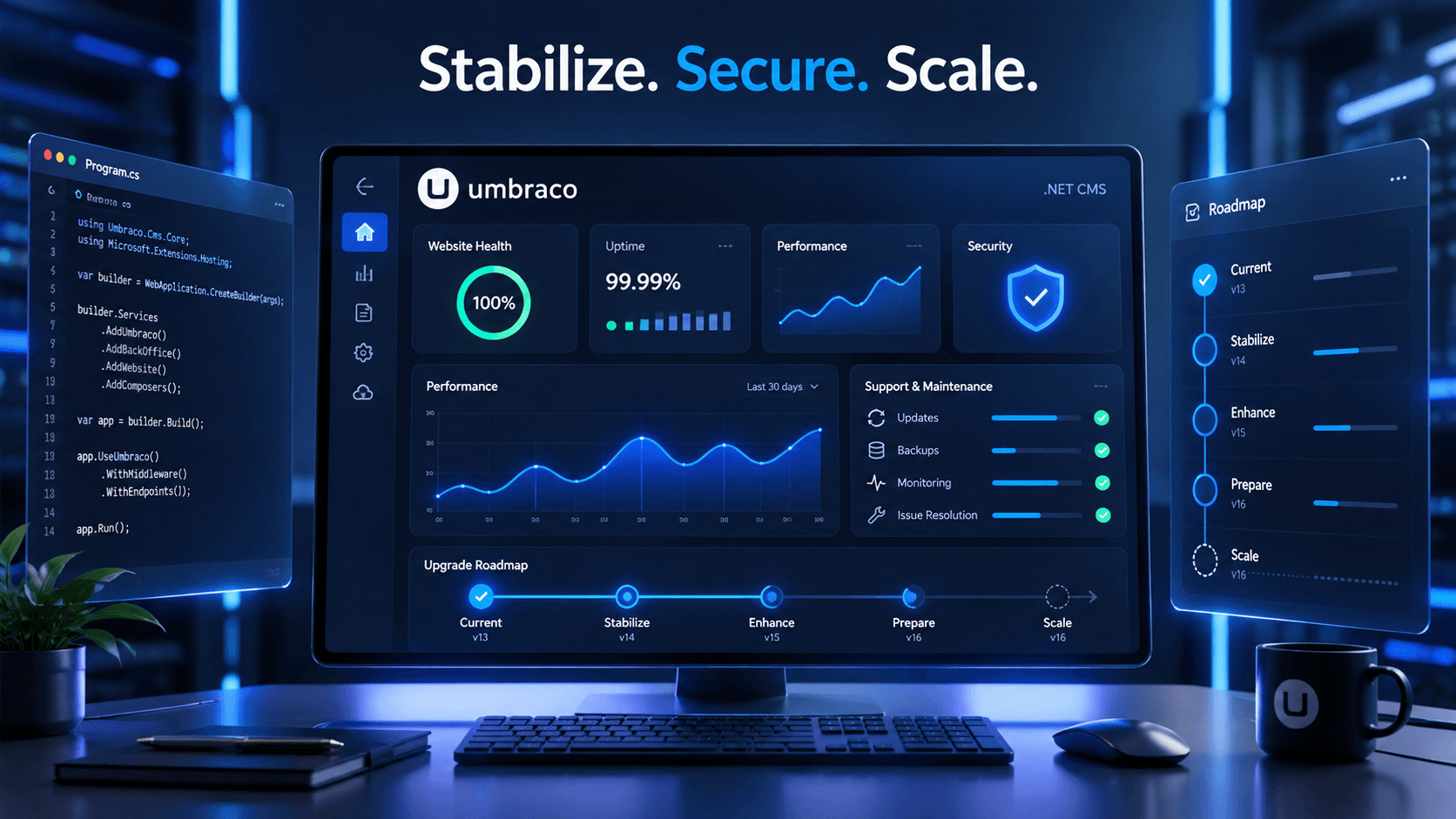
Stabilize, Secure & Scale Your Umbraco
Keep your Umbraco and .NET CMS secure, fast, and reliable with expert maintenance, seamless upgrades, performance optimization, and ongoing development support.
Umbraco Development Support: Stabilize Before You Modernize
Before embarking on an end-to-end rebuild, it is essential to evaluate the current CMS's state.
The technical audit of Umbraco will highlight the CMS's code quality, versions, dependencies, hosting, database performance, integrations, and deployment process.
It will also assist in prioritizing what needs urgent attention and what can wait.
Apart from that, a practical stabilization plan could be drawn up to fix the most pressing issues, review security, performance optimization process, and document critical processes.
MSI's recommended first step is to scope out the current environment and the expectations for the Umbraco development company before recommending technical options.
Take a look at our Umbraco development and support services for maintaining and improving your existing CMS.
Umbraco CMS Development: Extend Your Platform Without Rebuilding Everything
An established Umbraco website may already contain valuable content, SEO assets, customer journeys, and business integrations.
Replacing everything can introduce unnecessary cost and migration risk.
Custom Umbraco CMS development offers another option: extend the functionality that matters while retaining working components.
Common enhancement requirements include:
- Custom content types, reusable components, and page templates.
- Improved content editing and publishing workflows.
- CRM, ERP, marketing automation, and API integrations.
- Multilingual and multi-region website capabilities.
- Role-based access and content governance.
- Search, filtering, forms, and custom business modules.
- Responsive frontend improvements and accessibility enhancements.
The right enhancements should make daily content management easier without creating unnecessary long-term complexity.
Keep Your Umbraco CMS Secure, Stable, and Future-Ready
Umbraco Upgrade Support: Reduce Security and Compatibility Risks
CMS upgrades should be treated as part of an ongoing maintenance strategy rather than postponed until the platform becomes difficult to support.
An Umbraco upgrade may involve more than installing a new version.
Changes to .NET compatibility, custom packages, APIs, templates, integrations, and backoffice extensions can require careful testing.
A controlled upgrade process should cover:
- Current-version and dependency assessment
- Compatibility analysis and upgrade-path planning
- Database and content backup verification
- Custom code and package updates
- Staging-environment testing
- Content, SEO, and integration validation
- Production deployment and rollback planning
For businesses running older installations, an incremental or phased modernization strategy may reduce operational risk.
Is Your Umbraco CMS Becoming Difficult to Maintain?
Slow performance, outdated code, and upgrade challenges should not hold back your digital operations.
MSI can help assess your existing CMS, identify improvement priorities, and plan development, maintenance, or modernization work.
ASP.NET Website Support and .NET CMS Development
Not all businesses make use of a vanilla Umbraco implementation.
Sometimes companies have their own custom ASP.NET applications or legacy .NET sites or CMSs that are integrated with their business software.
Such businesses will need support in terms of logic, APIs, databases, authentication, deployments, and connections to other systems.
A good .NET CMS support service would take into account both the CMS itself and the software connected to it.
Moreover, companies can also turn to custom software development services to build their own software that is integrated with the CMS, for instance, for CRM, ERP, portals for customers, dashboards, and other software.
Umbraco Maintenance and Performance Optimization: What Should Be Included?
Reliable CMS maintenance extends beyond occasional bug fixes.
A practical support plan should address the complete operational environment.
Performance: Review caching, slow database queries, large media files, frontend assets, and server response times.
Security: Assess supported software versions, access permissions, authentication, patch management, and dependencies.
Monitoring: Track application errors, uptime, critical integrations, and infrastructure health.
Content operations: Improve publishing workflows, permissions, reusable content components, and editor usability.
Deployment: Maintain development, staging, and production environments with documented release and rollback procedures.
Recovery: Verify backups and periodically test restoration procedures.
These activities help businesses manage technical risk while planning improvements more confidently.
Umbraco CMS Support for Enterprise and Growing Businesses
The support priorities of an Umbraco platform vary by industry.
Enterprise organizations: Multi-brand websites, regional content governance, integrations, and structured publishing.
Manufacturing and B2B: Product catalogues, distributor information, enquiry workflows, and customer portals.
Healthcare and professional services: Service information, appointment enquiries, controlled publishing, and integrations.
Retail and commerce: Product content, campaign pages, inventory-connected experiences, and custom frontend functionality.
Digital agencies: Ongoing CMS enhancements, technical troubleshooting, and maintenance for client platforms.
For organizations evaluating future architecture changes, headless CMS development services may offer additional options for delivering content through APIs.
How MSI Approaches Umbraco and .NET CMS Support
A sustainable support engagement should follow a clear sequence.
Step 1 — Technical discovery: Review the current CMS architecture, dependencies, performance, infrastructure, and reported issues.
Step 2 — Risk prioritization: Identify critical vulnerabilities, business-impacting defects, and upgrade dependencies.
Step 3 — Stabilization: Address urgent problems and establish safer development and deployment practices.
Step 4 — Enhancement: Improve features, integrations, content management, and user experiences.
Step 5 — Long-term maintenance: Create a roadmap for patches, upgrades, monitoring, and ongoing improvements.
This phased approach helps organizations avoid unnecessary redevelopment while keeping business objectives central.
Relevant CMS Architecture and Custom Software Experience
CMS modernization requires more than familiarity with a content editor. It involves architecture, integrations, maintainable code, and operational planning.
For a broader understanding of platform selection and architectural differences, read MSI's enterprise CMS comparison covering Umbraco and other content platforms.
MSI also explores how businesses can build maintainable, integrated digital systems in its guide to custom software development for enterprise growth.
These resources provide supporting architectural context rather than claiming specific Umbraco project results.
Umbraco Development Support Cost and Timeline
The cost of maintaining or developing Umbraco depends on the current state of the product and the desired scope of changes.
Several key elements should be taken into account: CMS and .NET versions, code quality, package compatibility, third-party tools, database structure, hosting requirements, security standards, and the overall complexity of proposed alterations.
A simple defect fixing may take fewer resources than a comprehensive rewrite of a module incompatible with the latest versions of the CMS. An upgrade from one .NET version to another may involve substantial coding and testing efforts if an application uses custom modules and third-party components.
Therefore, it is essential to design a list of deliverables and prioritization before estimating the cost and duration of a project.
Struggling With Umbraco Issues? Let's Plan Your CMS Upgrade
Keep Your Umbraco and .NET Platform Ready for Growth
A reliable CMS is more than a publishing tool. It supports your digital presence, content teams, customer experiences, and connected business processes.
When performance issues, aging code, or uncertain upgrade paths begin slowing progress, the right technical support can help protect your existing investment.
Whether your business needs Umbraco maintenance, .NET CMS development, ASP.NET website support, performance optimization, or CMS modernization, MSI can help you evaluate the next steps.
Stabilize your platform. Improve your workflows. Plan for scalable growth.
Frequently Asked Questions
1. What does Umbraco development support include?
Umbraco development support may include bug fixes, custom features, CMS upgrades, API integrations, performance improvements, security reviews, deployment assistance, and ongoing maintenance.
2. Can an outdated Umbraco website be upgraded without rebuilding it?
Often, yes. The feasibility depends on the existing Umbraco version, custom code, packages, integrations, and compatibility requirements. A technical assessment helps determine the safest upgrade strategy.
3. How much does Umbraco CMS maintenance cost?
Maintenance costs depend on website complexity, existing technical debt, support requirements, upgrades, integrations, and the amount of ongoing development needed.
4. Can Umbraco integrate with existing .NET applications and business software?
Yes. Umbraco can integrate with .NET applications, CRMs, ERPs, APIs, and other business systems through suitable integration architectures.
5. When should a business hire an Umbraco support company?
Consider specialist support when CMS issues repeatedly disrupt operations, critical software versions become unsupported, upgrades are delayed, internal development capacity is limited, or new functionality is difficult to implement.
Frequently Asked Questions
What does Umbraco development support include?
Umbraco development support includes troubleshooting, bug fixes, custom CMS features, API integrations, performance optimization, security reviews, version upgrades, deployment assistance and ongoing website maintenance. The exact services depend on the website's architecture, existing code and operational requirements.
How much does Umbraco CMS maintenance cost?
Umbraco CMS maintenance costs depend on platform version, website complexity, custom modules, integrations, hosting infrastructure, security requirements and the level of ongoing support. Small maintenance tasks generally require less effort than major upgrades or extensive modernization. A technical audit helps define an accurate support scope and estimate.
How do I choose a reliable Umbraco support company?
Choose an Umbraco support company with proven .NET development skills, relevant CMS experience, upgrade planning capabilities, security knowledge and clear maintenance processes. Evaluate technical assessments, documentation practices, testing procedures, service response expectations and experience with custom ASP.NET integrations.
Can an outdated Umbraco website be upgraded without rebuilding it?
Many existing Umbraco websites can be upgraded without a complete rebuild, although feasibility depends on the source and target versions, custom code, packages, APIs, database structure and integrations. Major architectural differences may require substantial redevelopment of individual components. A compatibility assessment helps determine the safest migration strategy.
What is the latest Umbraco LTS version in 2026?
As of October 2026, Umbraco 17 is the latest Long-Term Support release. Umbraco 18 is a Standard-Term Support release. Businesses should evaluate compatibility with .NET, custom packages and integrations before choosing an upgrade target.
When does Umbraco 13 reach end of life?
Umbraco 13 is scheduled to reach end of life on December 14, 2026. After that date, standard security updates and support from the platform vendor end, although extended support arrangements may be available. Organizations using Umbraco 13 should assess upgrade requirements and plan their transition before the deadline.
Can Umbraco CMS integrate with CRM, ERP and ASP.NET applications?
Yes. Umbraco can integrate with CRM, ERP, custom ASP.NET applications, external APIs, authentication systems and other business platforms. Integration complexity depends on existing system interfaces, data structures, security requirements and the workflows that need to be synchronized.
How can I improve the performance of a slow Umbraco website?
Improving Umbraco performance may involve reviewing caching, database queries, application logs, media optimization, frontend assets, hosting resources and third-party integrations. Performance testing should identify actual bottlenecks before changes are implemented. Monitoring results can help confirm whether improvements are effective.
Should businesses choose Umbraco maintenance or complete CMS redevelopment?
Maintenance is often appropriate when the existing CMS architecture remains suitable and technical problems can be resolved through targeted improvements. Redevelopment may be justified when extensive technical debt, unsupported dependencies or major business requirements make ongoing modification impractical. A technical and commercial assessment should inform the decision.
Why hire a professional Umbraco developer for long-term CMS support?
A professional Umbraco developer can help maintain custom .NET code, implement new features, troubleshoot integration issues, plan upgrades and improve deployment reliability. Long-term support helps businesses reduce dependency on undocumented legacy implementations and manage technical changes systematically.