Why a Basic Website Is No Longer Enough
In This Article
- Why Indian Businesses Need a Digital Platform, Not Just a Basic Website
- A Website That Only Exists Is Not Creating Business Value
- Your Website Should Generate and Organize Leads
- Content Must Be Easy to Publish and Optimize
- Social Media Should Lead Customers to a Platform You Control
- Different Industries Need Different Digital Workflows
- Healthcare
- Retail and Marketplaces
- Membership and AI-Enabled Platforms
- What Should a Modern Digital Platform Include?
- Five Signs Your Business Has Outgrown Its Website
- Move from Online Presence to Digital Growth
Why Indian Businesses Need a Digital Platform, Not Just a Basic Website
A basic website can tell people who you are, what you offer and how to contact you. But that is no longer enough for an Indian business competing for attention, enquiries and sales.
Customers now discover businesses through Google, social media, online marketplaces, WhatsApp, video platforms and AI-powered search tools. They compare options quickly, expect convenient digital experiences and often leave when information is unclear or the next step is difficult.
Your website should therefore do more than display information.
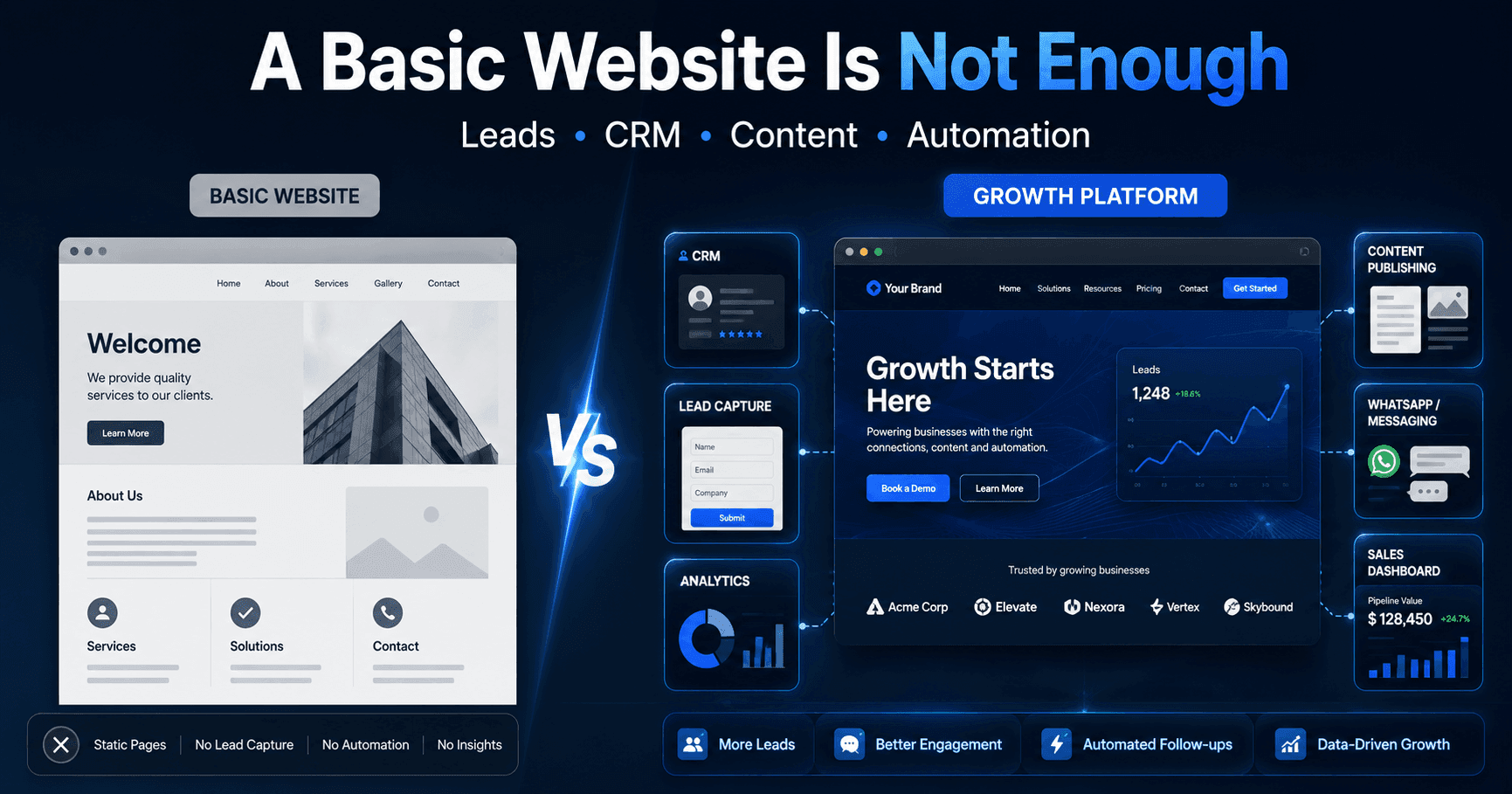
It should capture leads, connect with CRM, publish content, support campaigns, enable transactions, provide customer services and generate data that helps your team make better decisions.
A modern website is no longer only a collection of pages. It should become a connected digital platform that supports business growth.
A Website That Only Exists Is Not Creating Business Value
Many companies have websites that look acceptable but contribute little to marketing, sales or operations.
The site may contain an About page, service descriptions, contact information and a basic enquiry form. However, enquiries still arrive across different WhatsApp numbers, email inboxes and spreadsheets. Sales teams cannot track lead status, marketing teams cannot launch landing pages quickly and management cannot see which channels generate opportunities.
This creates a significant gap between having a website and operating a digital business.
A visually attractive website can still fail when it has:
- No clear conversion journey
- Weak calls to action
- Difficult content management
- No CRM connection
- Limited analytics
- Poor mobile performance
- No automation
- No integration with existing business systems
Competitor analysis shows that design is now only the starting point. Clear content, discoverability, memorable experiences and a defined business model are increasingly important.
Your Website Should Generate and Organize Leads
A visitor should never reach your website and wonder what to do next.
Every important page should guide the user towards a meaningful action, such as:
- Requesting a quotation
- Booking an appointment
- Scheduling a consultation
- Downloading a resource
- Sending a WhatsApp enquiry
- Registering for a service
- Purchasing a product
- Starting an application
Capturing an enquiry is only the first step. The lead should then enter a structured system where your team can assign ownership, update its status, schedule follow-ups and measure conversion.
A website connected to CRM can reduce dependence on disconnected spreadsheets and individual inboxes. It gives business leaders greater visibility into the sales pipeline and helps teams respond consistently.
For growing Indian businesses, this is the difference between an enquiry form and a genuine lead-generation platform.
Digital Transformation Digital Platform Website Modernisation Business Website CRM Integration Lead Generation Headless CMS Marketing Automation Indian Businesses SME Digital Transformation Website Development India AI-Ready Website
Content Must Be Easy to Publish and Optimize
A website becomes outdated when every new page, campaign or article requires a developer.
Your marketing team should be able to publish:
- Service pages
- Industry pages
- City-specific landing pages
- Blogs and case studies
- Campaign offers
- FAQs
- Customer success stories
- Product updates
Regular, useful content can answer customer questions, demonstrate expertise and create long-term search visibility. Unlike a short-lived social post, a well-planned article can continue attracting relevant users through search over time.
Modern content platforms such as headless CMS solutions can also support reusable templates, structured content, multilingual publishing and distribution across websites, mobile apps and customer portals.
This gives marketing teams more independence while maintaining design and brand consistency.
Social Media Should Lead Customers to a Platform You Control
Instagram, Facebook, LinkedIn and online marketplaces are valuable customer-acquisition channels. However, a business does not control their algorithms, platform policies or organic reach.
Your website is an owned digital asset.
It gives your organization control over:
- Brand presentation
- Customer journeys
- Content
- Search visibility
- Lead data
- Analytics
- Integrations
- Conversion tracking
Social media should attract attention, while your digital platform should convert that attention into enquiries, bookings, registrations or purchases.
The best approach is not website versus social media. It is a connected system where search, social platforms, WhatsApp, email, CRM and the website work together.
Different Industries Need Different Digital Workflows
A modern digital platform must reflect how the business actually operates.
Healthcare
A healthcare website may support appointment requests, doctor profiles, patient communication, teleconsultation and follow-up workflows.
Murmu Software Infotech’s scalable telemedicine video-consultation platform case study demonstrates how a digital product can move beyond informational pages to support booking, consultation and patient-service workflows.
Retail and Marketplaces
A retail or marketplace platform may require product listings, seller accounts, customer profiles, secure communication and location-based discovery.
The GAXA local marketplace platform for buying and selling shows how technology can connect buyers and sellers through structured digital journeys rather than a basic catalogue website.
Membership and AI-Enabled Platforms
Some businesses need registration, profile management, search, recommendations, payments and communication tools.
The TribalShaadi AI-powered matchmaking and matrimony platform demonstrates how AI, user workflows and platform functionality can work together in a specialized digital product.
These examples highlight an important point: digital modernization is not about adding more pages. It is about building the right capabilities around customers and business processes.
Build a Digital Platform That Supports Business Growth
What Should a Modern Digital Platform Include?
Not every company needs every feature. The right platform should be based on business goals, users and future plans.
Depending on the organization, it may include:
- Conversion-focused website
- CRM and lead management
- Content management system
- Campaign landing pages
- E-commerce and online payments
- Customer or member portal
- Android and iOS application
- Admin and operational dashboards
- Business workflow automation
- API and ERP integrations
- Analytics and conversion tracking
- AI chatbot or knowledge assistant
- GEO, AEO and AI-search optimization
The objective is not to add technology for the sake of it. Each capability should solve a real problem, improve customer experience or reduce manual work.
Five Signs Your Business Has Outgrown Its Website
Your business may need digital modernization when:
- Website visitors are not becoming enquiries or customers.
- Your team cannot publish content without technical help.
- Leads are managed across WhatsApp, email and spreadsheets.
- The website cannot connect with CRM, ERP, payments or other systems.
- Your business has expanded, but the digital experience still represents an earlier stage.
Waiting too long can create lost leads, inefficient processes and higher redevelopment costs later.
Move from Online Presence to Digital Growth
The question is no longer, “Does our business have a website?”
The better question is:
Does our digital platform help us attract, convert and serve customers?
Indian startups, SMEs and established companies need platforms that support marketing, sales, customer experience and operations—not websites that simply exist.
Murmu Software Infotech helps businesses plan and build websites, CRM-enabled platforms, headless CMS solutions, e-commerce systems, mobile apps, SaaS products, MVPs and AI-powered applications.
Businesses preparing to modernize can review the Monsoon Digital Product Launch Offer 2026 for package scope, development costs, portfolio examples and project showcases.
For a detailed comparison of website, e-commerce, mobile-app and MVP packages, read the Websites, E-commerce, Mobile Apps and MVP Development Limited Offer.
Your website should not be an online brochure. It should be an active platform for leads, content, sales and business growth.
Frequently Asked Questions
Why is a basic website no longer enough for a business?
A basic website may display company information, but it often does not support lead capture, sales follow-up, customer service or business operations. Modern businesses need a connected digital platform that can integrate with CRM, analytics, content publishing, WhatsApp, payments, automation and other business systems.
What is the difference between a website and a digital platform?
A website primarily presents information through pages and contact forms. A digital platform combines the website with lead management, CRM, content publishing, analytics, customer accounts, e-commerce, APIs, automation, mobile applications or operational dashboards. It actively supports customer journeys and internal business workflows.
How can a business website generate more leads?
A business website can generate more leads through clear service pages, conversion-focused landing pages, relevant calls to action, enquiry forms, consultation booking, WhatsApp integration, downloadable resources and CRM connectivity. Analytics should track which pages and campaigns generate enquiries so the business can improve conversion performance.
What is website CRM integration?
Website CRM integration automatically transfers enquiries, registrations or customer data from the website into a customer relationship management system. The business can then assign leads, update their status, schedule follow-ups, record communication and monitor the sales pipeline instead of managing enquiries across spreadsheets and separate inboxes.
Do Indian startups and SMEs need a digital platform?
Indian startups and SMEs benefit from a digital platform when they need to generate enquiries, sell online, manage customers, automate repetitive tasks or deliver services digitally. The platform should match the company’s current goals and be scalable enough to support new products, locations, users and integrations as the business grows.
Can a website connect with WhatsApp and social media?
A modern website can connect with WhatsApp enquiry flows, social media campaigns, lead forms, tracking tools and CRM systems. Social media can attract attention, while the website provides an owned platform where visitors can learn more, submit enquiries, make purchases, book appointments or register for services.
When should a business choose a headless CMS?
A business should consider a headless CMS when it needs faster frontend experiences, reusable content, flexible publishing, multiple websites, mobile-app content, customer portals or API integrations. Platforms such as Sanity, Strapi and Umbraco can support structured content while React, Next.js or Astro powers the customer-facing experience.
What features should a modern business website include?
A modern business website should include mobile-responsive design, clear calls to action, fast performance, secure enquiry forms, analytics, content management, technical SEO, CRM connectivity and conversion tracking. Depending on the business, it may also need payments, customer accounts, dashboards, APIs, automation, AI chatbots or mobile-app integration.
How much does digital platform development cost in India?
Digital platform development costs depend on the number of pages, user roles, workflows, design requirements, CRM features, APIs, payments, mobile applications, e-commerce capabilities and AI integrations. A professional website normally costs less than a CRM-enabled, headless, e-commerce, SaaS or AI-powered platform because the scope and technical complexity differ.
How do I know whether my business has outgrown its website?
Your business may have outgrown its website when it generates few enquiries, is difficult to update, performs poorly on mobile, cannot connect with CRM or business software, and requires manual handling of customer information. Another warning sign is when the company has expanded but its website still represents an earlier stage of the business.