AI MVP Development for Startups in India, UAE, Saudi Arabia and Southeast Asia
In This Article
- Why AI Startups Should Validate Before Building the Full Product
- What Should an AI MVP Actually Validate?
- What Should You Build First?
- 1. Core AI Workflow
- 2. Chatbot, Agent or Automation
- 3. User Dashboard
- 4. Admin Panel
- 5. Analytics and Feedback
- AI MVP Development Across India, UAE, Saudi Arabia and Southeast Asia
- How Much Does AI MVP Development Cost?
- Build Evidence Before You Build Everything
- Have an AI Product Idea?
AI product ideas may sound great.
Founders explore AI chatbots, agents, recommendation systems, automation, copilots, analytics and industry-specific applications.
Yet there is a large difference between an interesting idea and a valuable product that people are willing to pay for.
For startups and businesses in India, UAE, Saudi Arabia and Southeast Asia, the right first step is often not to build an end-to-end AI platform but to launch an AI MVP development project focused on one key question: is this product addressing a real-world problem worth solving?
By launching an AI MVP around the most valuable process, businesses can release it to real users and rely on evidence to determine the right next steps.
Why AI Startups Should Validate Before Building the Full Product
A typical AI startup roadmap is quickly inflated by an overwhelming number of requirements:
AI chatbot. Mobile app. Customer dashboard. Admin portal. Payments. CRM integration. AI agents. Analytics. Notifications. Automation. Multiple models. Multiple APIs.
The more features the harder it is to develop, test and scale the product.
The issue is that none of those features matter if the core AI workflow cannot demonstrate measurable value.
An AI startup MVP should therefore prioritize the minimal usable product that would help secure customer demand, prove the viability of the AI solution and establish business value.
Rather than worrying about how to build the entire platform – focus on the question: what is the smallest AI-powered workflow that can prove that customers would want this product?
Such an approach would help balance the capital investment, development risk and enable faster feedback loops from real users.
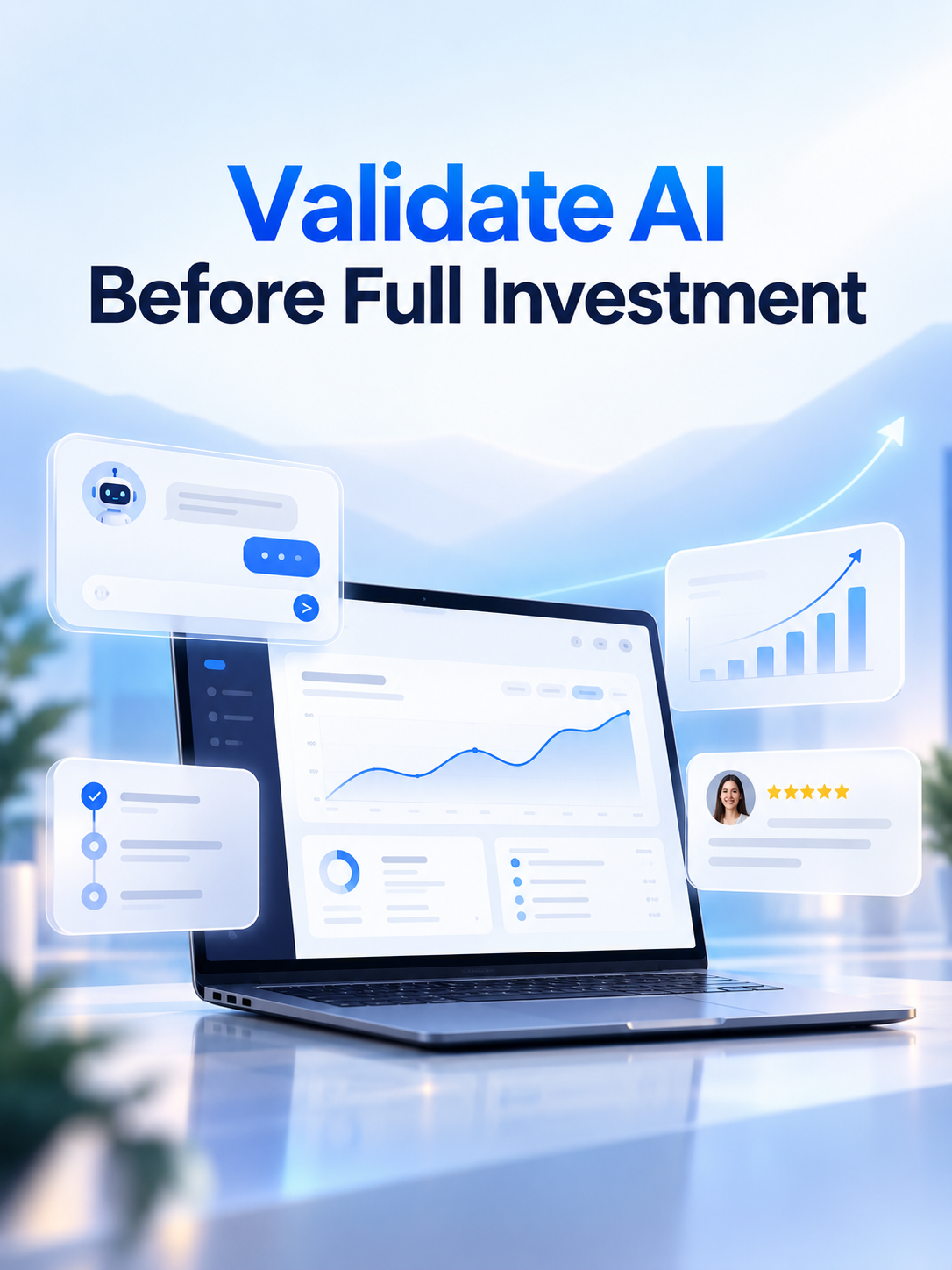
Validate AI Before Full Investment
Launch a focused AI MVP to test core workflows, user demand, product feasibility, and business value before scaling development.
What Should an AI MVP Actually Validate?
A strong AI software MVP should test more than whether an AI model can generate a response.
It should validate whether the complete user journey works.
For example, an AI customer-support startup should not stop at demonstrating a chatbot. The MVP should show whether customers can ask real questions, receive useful answers, trigger appropriate actions and reach a human when AI should not handle the request.
A practical AI chatbot implementation with human support and business integrations demonstrates why the workflow around the model is often as important as the model itself.
Your MVP should help answer:
- Do target users have a real problem worth solving?
- Can AI reliably handle the core workflow using realistic data?
- Will users trust and repeatedly use the product?
- What happens when AI is uncertain or wrong?
- Which tasks need human approval or escalation?
- What does each successful AI interaction cost?
- Which features should be expanded, changed or removed?
These answers are more valuable than launching a large feature set based only on assumptions.
What Should You Build First?
For many AI products, the first version does not need dozens of features.
A focused MVP can combine five essential layers.
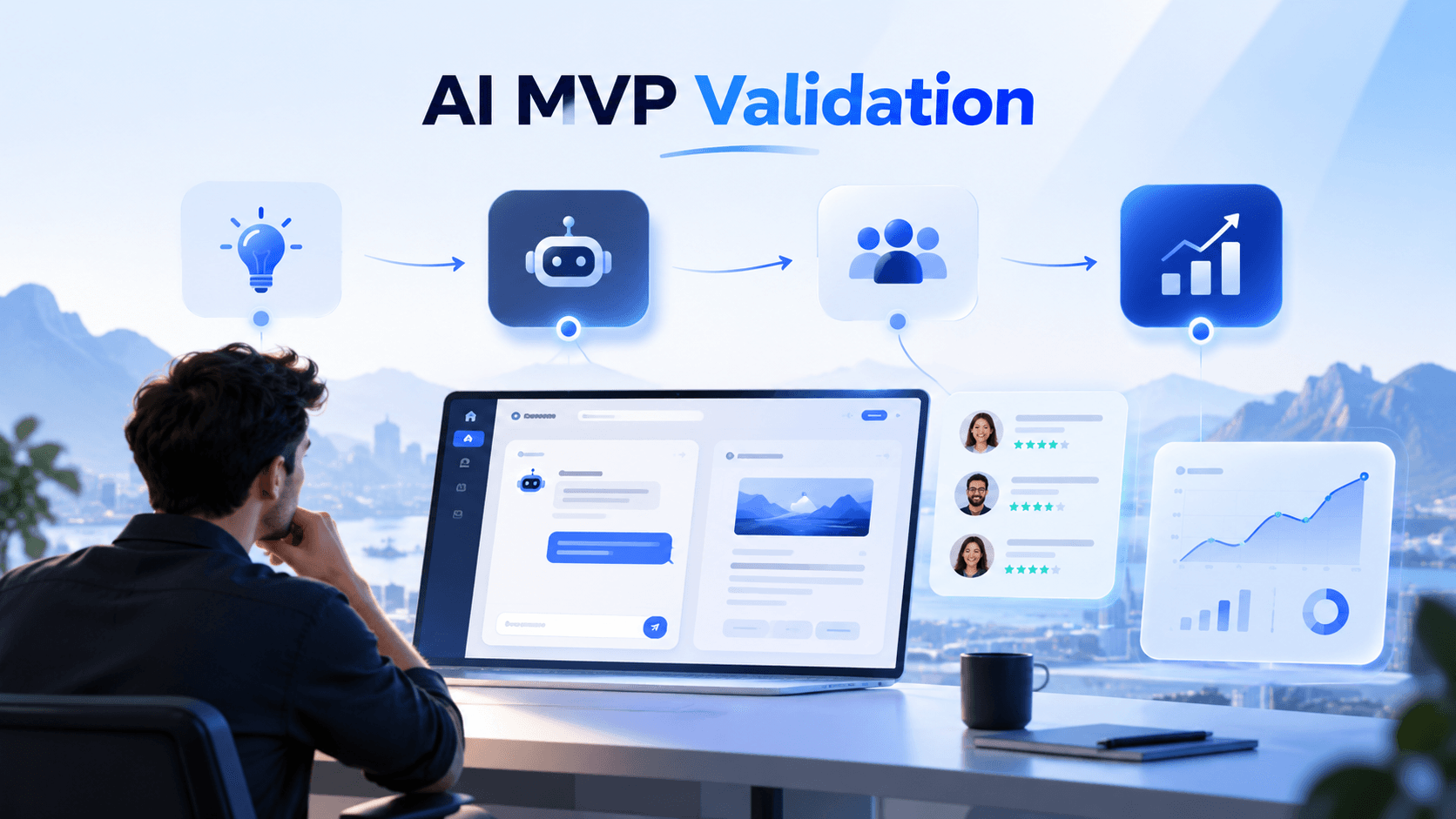
Validate Your AI Idea Before Full-Scale Product Investment
1. Core AI Workflow
Start with the single workflow that creates the most customer value.
That might be answering support questions, analyzing documents, generating recommendations, qualifying leads, searching business knowledge or automating an operational process.
2. Chatbot, Agent or Automation
Choose the AI interaction that matches the problem.
A chatbot may be enough for conversational support. An AI agent may be appropriate when the system must use tools, call APIs or complete controlled multi-step tasks.
For more advanced products, architectures using AI agents and tool calling can connect language models with real business systems. An AI platform using MCP, APIs and AI orchestration provides a useful example of moving beyond simple text generation.
3. User Dashboard
Users need somewhere to view results, history, tasks, reports or AI-generated insights.
The dashboard does not need every future feature. It needs enough functionality to make the core AI experience usable.
4. Admin Panel
Founders also need visibility.
An admin panel can help manage users, content, permissions, usage, workflows and product activity while the startup learns how customers actually use the MVP.
5. Analytics and Feedback
Do not wait until version two to measure behavior.
Track activation, workflow completion, AI failures, human escalations, repeated usage, model cost and customer feedback from the beginning.
That turns an MVP into a learning system instead of simply a smaller application.
AI MVP Development Across India, UAE, Saudi Arabia and Southeast Asia
The core validation strategy is similar across markets, however product requirements can vary greatly.
A startup targeting on India could prioritize cost-efficient expansion and integration possibilities with business systems.
A UAE or Saudi Arabian product might need to pay closer attention to enterprise work flows, data, permissions, multilingual experiences and deployment requirements.
A product targeting on Southeast Asia may need to account for multiple markets, languages, mobile experiences and regional integrations.
This is why AI product development for startups should be built with the users, data and operating environment in mind not the other way around.
Turn Your AI Product Idea Into a Launch-Ready MVP
How Much Does AI MVP Development Cost?
There is no meaningful universal AI MVP cost.
A chatbot using one knowledge source is very different from an agentic platform connected to CRMs, payment systems, databases and multiple APIs.
Cost is typically influenced by AI model requirements, data preparation, RAG or retrieval, integrations, user roles, security, dashboards, mobile applications, workflow complexity and cloud infrastructure.
A better budgeting question is:
What is the smallest investment required to prove the highest-risk assumption?
That is the principle behind ROI-driven MVP development: invest first in the workflows that generate evidence, then expand after validation.
Build Evidence Before You Build Everything
The purpose of an AI MVP is not to make the smallest possible product.
It is to make the smallest product capable of producing a meaningful business decision.
If users adopt the workflow, AI performance is acceptable and the economics make sense, continue investing.
If users want something different, adjust the product.
If the idea does not create enough value, discovering that through an MVP is far less expensive than discovering it after building an entire platform.
For founders across India, UAE, Saudi Arabia and Southeast Asia, AI MVP development creates a practical path from idea to evidence, from evidence to traction and from traction to a scalable AI product.
Have an AI Product Idea?
Start with the chatbot, automation, dashboard, admin panel and core AI workflow that matter most.
Build AI MVP and validate your product before committing to full-scale development.
Frequently Asked Questions
What is AI MVP development?
AI MVP development is the process of building a focused first version of an AI-powered product to validate its core workflow, technical feasibility, customer demand and business value before investing in full-scale development.
How do I build an AI MVP for a startup?
Start by identifying one high-value customer problem, then build the smallest usable AI workflow around it. A typical AI MVP may include an AI chatbot or agent, automation, a user dashboard, an admin panel, analytics and only the integrations required to test the idea with real users.
How much does AI MVP development cost?
AI MVP development cost depends on the AI model, RAG requirements, data preparation, integrations, dashboards, user roles, security, APIs and workflow complexity. A focused MVP usually costs significantly less than building a complete AI platform because development is limited to the features needed for validation.
How long does it take to develop an AI MVP?
A focused AI MVP can often be developed faster than a full product because it concentrates on the core AI workflow and essential user journey. The timeline depends on data readiness, AI complexity, integrations, dashboard requirements, testing and deployment needs.
What features should an AI MVP include?
An AI MVP should usually include the core AI workflow, a simple user interface, chatbot or automation functionality where relevant, an admin panel, basic analytics, user feedback mechanisms and essential integrations. Features that do not contribute directly to validation can be postponed.
Should startups build an AI MVP before a full AI product?
Yes. An AI MVP allows startups to test demand, user behavior, AI quality, operating cost and product-market assumptions before committing significant capital to a complete platform. It can also reveal which features should be improved, expanded or removed.
Can an AI MVP use OpenAI, Gemini, Claude or other AI models?
Yes. An AI MVP can use OpenAI, Gemini, Claude or other suitable AI models depending on the use case, accuracy requirements, latency, cost, data policies and integration needs. The best model should be selected based on the product workflow rather than brand preference alone.
Can an AI MVP include RAG, AI agents and business integrations?
Yes. AI MVPs can include retrieval-augmented generation, vector search, AI agents, tool calling and integrations with CRM, ERP, databases, payment systems or internal APIs when those capabilities are necessary to validate the main product workflow.
What should founders measure after launching an AI MVP?
Founders should track user activation, repeated usage, successful AI task completion, response quality, AI failures, human escalations, model and infrastructure cost, workflow completion rates and direct customer feedback.
Can AI MVP development support startups in India, UAE, Saudi Arabia and Southeast Asia?
Yes. AI MVP development can support startups and businesses across India, the UAE, Saudi Arabia and Southeast Asia. Product architecture can be adapted for regional requirements such as multilingual interfaces, enterprise integrations, data controls, mobile-first usage and market-specific workflows.