AI Search Optimization Guide for US and UK Businesses
In This Article
- What Is AI Search Optimization?
- SEO, AEO and GEO Work Together
- 1. Build Content Around Questions, Not Keywords Alone
- 2. Give the Answer Before the Explanation
- Does structured data guarantee AI visibility?
- 3. Strengthen Entity Clarity
- 4. Create Citation-Ready Content
- 5. Make Your CMS AI-Ready
- 6. Do Not Neglect Technical SEO
- 7. Build Topical Authority, Not Isolated Articles
- 8. Measure AI Visibility Differently
- AI Search Optimization Is an Ongoing Process
SEO is changing from a competition for rankings into a competition for visibility, answers, citations, and trusted recommendations.
Businesses need Google and Bing rankings. But buyers increasingly discover companies through Google AI results, ChatGPT, Gemini, Copilot, Perplexity and other generative search experiences.
This means that for US and UK brands, traditional SEO is no longer the full picture.
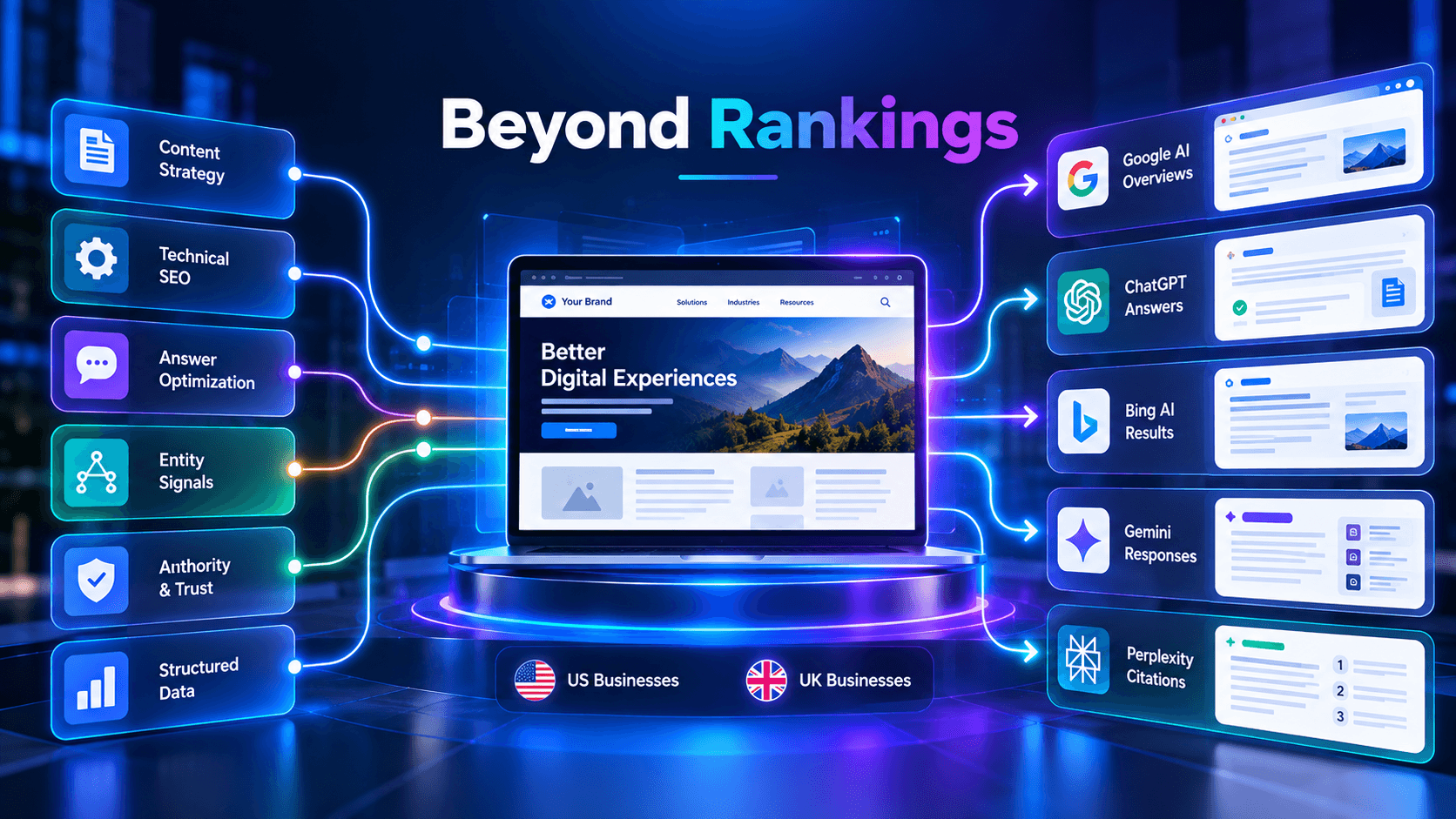
Modern AI search optimization combines technical SEO, structured content, Answer Engine Optimization (AEO), Generative Engine Optimization (GEO), entity clarity, authority, and measurable AI visibility.
The objective is simple: make your business easy to discover, understand, verify, and reference.
What Is AI Search Optimization?
AI search optimization refers to optimizing your website and digital presence so that AI-powered search engines can find your information, understand it, extract the relevant answers, and even cite you.
Traditional SEO asks the questions such as
“Can this page rank?”
but the new AI SEO adds more questions such as
“Can an AI understand this information?”
“Can it extract a clear answer?”
“Is it credible enough to cite?”
“Does it clearly define who, what, where, and why?”
Businesses building this capability can start with an AI search optimization audit covering technical accessibility, content structure, entities, citations, and answer readiness.
SEO, AEO and GEO Work Together
These terms are often treated as competing strategies, but they solve different parts of the same visibility problem.
SEO helps search engines crawl, index, understand, and rank your website.
Answer Engine Optimization makes information easier to extract as direct answers.
Generative Engine Optimization focuses on creating authoritative, contextual, evidence-supported content that generative systems can confidently use.
Effective AI SEO combines all three.
A site with great FAQs but bad crawlability has a technical issue.
A technically sound website filled with unclear content has answer issues.
A well-written article with unsubstantiated claims has a credibility problem.
AI search readiness demands solving all three.
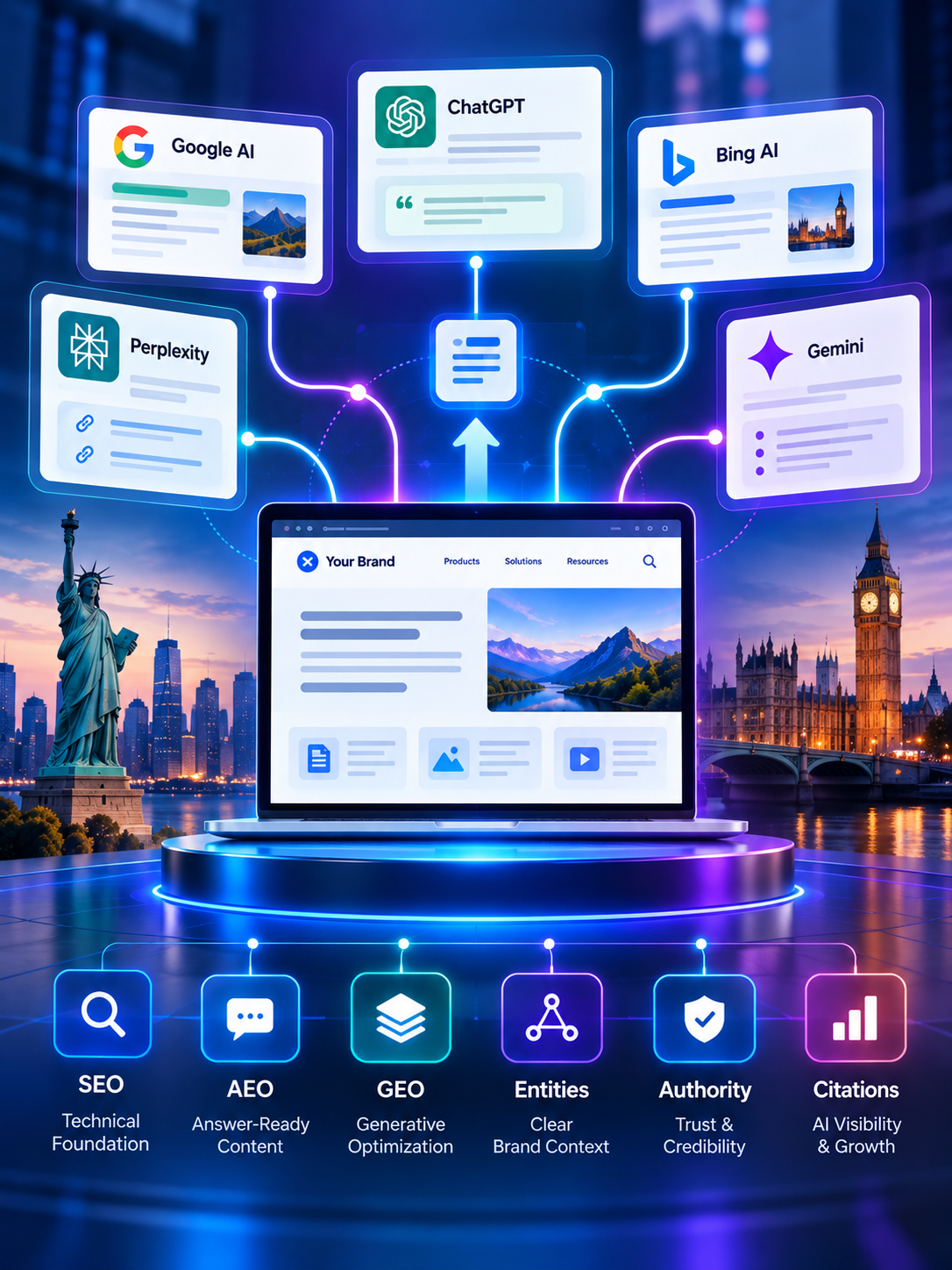
Make Your Brand AI-Discoverable
Strengthen SEO, AEO, GEO, entity signals, and citation readiness to improve visibility across search engines and AI-powered answers.
1. Build Content Around Questions, Not Keywords Alone
Keywords still matter, but AI queries are often longer and more conversational.
Instead of optimizing only for:
enterprise cms migration
also address questions such as:
- How much does an enterprise CMS migration cost?
- How can we migrate without losing SEO?
- Which headless CMS suits a multinational business?
- How long should a CMS migration take?
These questions reveal user intent more clearly.
Create dedicated sections that answer each important question directly, then expand with context, examples, caveats, and evidence.
2. Give the Answer Before the Explanation
Answer-ready content should not make users or machines search through several paragraphs to find the point.
A useful structure is:
Question → direct answer → explanation → evidence → related questions
For example:
Does structured data guarantee AI visibility?
No. Structured data can help machines understand entities and page information, but it does not guarantee inclusion or citations in AI-generated responses.
That direct-answer pattern creates a clearer passage for both human readers and retrieval systems.
Our implementation of SEO, AEO and GEO fields in Sanity CMS demonstrates how these concepts can be incorporated directly into structured CMS content.
3. Strengthen Entity Clarity
AI search systems need to understand what your company is and how it relates to specific services, locations, industries, products, and people.
Keep important information consistent across your website:
- Company name
- Services
- Product names
- Locations served
- Leadership and authors
- Industries
- Expertise
- Contact information
- Credentials and relevant proof
Use descriptive internal links and connect related entities throughout the site.
For US and UK companies, regional pages should also make geographic relevance clear rather than simply changing a few keywords.
4. Create Citation-Ready Content
AI discovery increasingly rewards information that can be verified.
Replace unsupported statements such as:
“We provide the best enterprise SEO.”
with useful evidence:
- Original research
- Case studies
- Benchmarks
- Methodologies
- Expert commentary
- Product documentation
- First-party statistics
- Measurable project results
Facts should be precise enough that another source could confidently reference them.
For Sitecore environments specifically, our Sitecore GEO and AEO optimization guide covers structured answers, entity signals, technical SEO, and AI-search readiness.
5. Make Your CMS AI-Ready
AI optimization gets more challenging when critical data is hidden within unstructured page-builder content
Modern CMS implementations should explicitly include fields for:
- AI summaries
- Direct answers
- Key facts
- FAQs
- Primary entities
- Locations
- Target audiences
- Schema types
- Author information
- Review dates
allowing the same data to fuel websites, search, APIs, AI assistants, and other discovery experiences.
Organizations using structured platforms can explore Sanity CMS development services, while businesses planning more flexible architectures can consider headless CMS development services.
Find Why AI Search Engines Are Missing Your Brand
6. Do Not Neglect Technical SEO
AI optimization cannot rescue a website that machines struggle to access.
Audit:
- Crawlability
- Indexability
- Canonicals
- Robots directives
- XML sitemaps
- JavaScript rendering
- Page speed
- Mobile experience
- Core Web Vitals
- Internal linking
- Broken URLs
- Structured data
If AI systems and conventional search engines cannot reliably retrieve your content, sophisticated GEO copy will not solve the underlying issue.
For enterprise Sitecore websites, Sitecore SEO services can address performance, technical SEO, structured content, and search visibility together.
7. Build Topical Authority, Not Isolated Articles
One article rarely establishes meaningful expertise.
Build topic clusters.
For example, an AI search optimization cluster might include:
- AI SEO
- GEO vs SEO
- AEO
- AI visibility audits
- Structured data
- AI citation tracking
- Entity SEO
- AI-ready CMS architecture
- ChatGPT visibility
- Google AI visibility
Interlink these resources logically.
This creates a deeper body of evidence around your expertise instead of relying on one optimized landing page.
8. Measure AI Visibility Differently
Traditional SEO reporting usually tracks rankings, organic sessions, clicks, and conversions.
Keep those metrics but add AI-specific measures:
- AI citations
- Brand mentions
- Answer inclusion
- AI referral traffic
- Prompt coverage
- Sentiment/context of mentions
- Citation sources
- Visibility across multiple AI platforms
Test important commercial queries regularly using different formulations.
Our guide to AI search optimization services, audits and a 30-day roadmap provides a practical framework for identifying and prioritizing these opportunities.
AI Search Optimization Is an Ongoing Process
There is no one time GEO checklist that will ensure visibility in ChatGPT, Google AI experiences, Bing, Gemini, Copilot or other answer engines.
Models, retrieval systems, sources, competitors, and search behaviors are constantly evolving.
The durable strategy is to make your website:
technically accessible, clearly structured, factually useful, authoritative, current, and easy to cite.
US and UK organizations that already understand how to use SEO need to treat optimizing for AI as another layer to their strategy, rather than an alternative.
First: identify where your brand is currently visible, what sources are citing your competitors or others instead, and what commercial queries your website isn't actually answering.
A structured AI search optimization strategy can then prioritize technical fixes, content restructuring, entity development, citation readiness, and measurable AI visibility.
Ranking still matters.
But increasingly, the bigger question is whether your brand becomes part of the answer.
Frequently Asked Questions
What is AI search optimization?
AI search optimization is the process of improving content, technical accessibility, entities, authority and structure so AI-powered search systems can discover, understand, retrieve and potentially cite a brand's information.
Is AI SEO replacing traditional SEO?
No. AI SEO extends traditional SEO. Crawlability, indexability, content quality, authority, internal linking and performance remain important, while AI optimization adds answer readiness, entity clarity and citation-focused content.
What is the difference between SEO, AEO and GEO?
SEO focuses on search-engine discovery and rankings. AEO structures information for direct answers. GEO focuses on making content authoritative, contextual and useful to generative systems that synthesize and reference sources.
How do I optimize content for AI search?
Answer real customer questions directly, use descriptive headings, strengthen entity information, provide credible evidence, maintain technical SEO, use structured data appropriately and keep important content current.
How can my business appear in ChatGPT or AI answers?
There is no guaranteed inclusion method. Improve the probability of discovery by publishing useful and accessible content, strengthening brand and entity signals, earning credible mentions and creating clear answer-ready passages.
Does schema markup improve AI search visibility?
Schema markup can help search systems understand entities and page information, but structured data alone does not guarantee visibility, recommendations or citations in AI-generated answers.
What content performs well for AI search?
Useful formats include direct answers, FAQs, comprehensive guides, comparisons, definitions, case studies, original research, expert commentary and evidence-supported resources that directly address user intent.
How do businesses measure AI search visibility?
Track brand mentions, AI citations, answer inclusion, AI referral traffic, prompt coverage, citation sources and how the brand is described across relevant AI search platforms alongside traditional SEO metrics.
Do US and UK businesses need different AI SEO strategies?
The core technical and content principles are similar, but regional terminology, location signals, authoritative sources, market-specific questions and business evidence should reflect the audience being targeted.
What does an AI search optimization audit include?
An AI search audit can review technical accessibility, content structure, direct answers, entities, structured data, brand mentions, citations, topical authority, AI-platform visibility and opportunities where competing sources are currently selected.