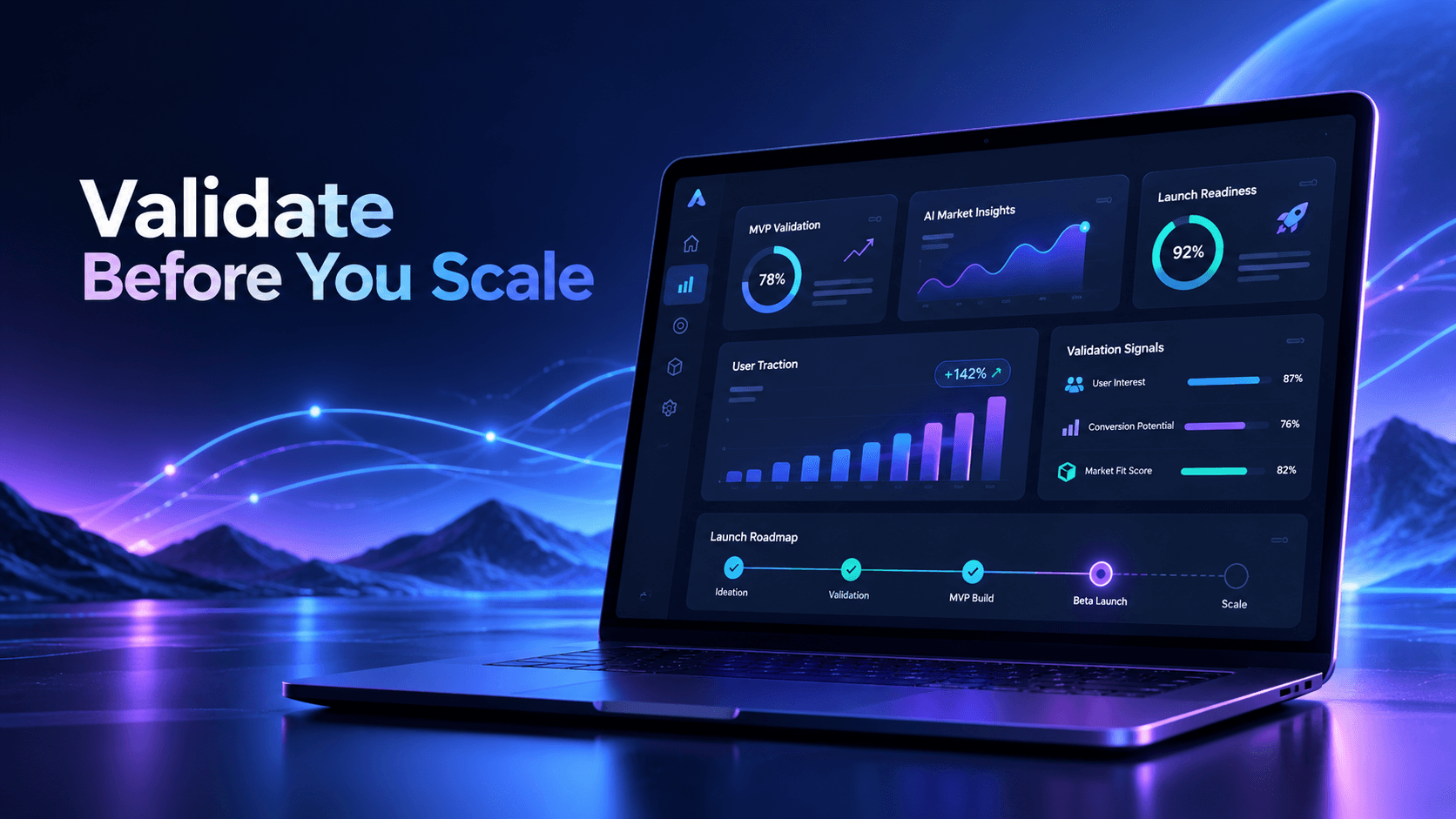
AI MVP and SaaS Product Development: Validate Before You Scale
In This Article
- 1. Why AI MVP Development Matters Before Scaling
- 2. Why Manual Tools and Disconnected Workflows Limit Growth
- 3. SaaS MVP Development: What Should the First Version Include?
- 4. AI Product Development: Validate the Intelligence, Not Just the Interface
- 5. How MSI Approaches Startup MVP Development
- Ready to Validate Your Product Idea?
- 6. AI MVP and SaaS Product Development Use Cases
- 7. Real AI Product Development Examples
- 8. AI MVP Development Cost and Timeline: What Founders Should Know
- 9. MVP Rescue Services: When Your Software Project Is Stuck
- 10. The Business Benefits of Validating Before Scaling
- Conclusion: Build the Right Product Before Building a Bigger Product
- Turn Your Product Idea Into a Testable MVP
- Frequently Asked Questions
- 1. What is AI MVP development?
- 2. How is a SaaS MVP different from a full SaaS platform?
- 3. How much does AI MVP development cost?
- 4. How long does SaaS MVP development take?
- 5. Can an unfinished MVP be rescued?
Developing an AI product or SaaS platform can become significantly expensive before its founders realize that their customers do not need the product. The proliferation of features, disconnected tools, unclear business logic, unreliable AI models, and ever-changing requirements can turn a promising idea into an abandoned software project.
Many founders invest significantly in MVP dashboards, mobile applications, tools, automations, and AI before even validating their product.
That is why successful AI MVP development requires asking a completely different question:
“What is the smallest useful product that will demonstrate customer interest and their willingness to pay?”
At Murmu Software Infotech (MSI), we assist founders, startups, businesses, and agencies in building AI and SaaS products with a strong validation-first approach, practical architecture, and a business-oriented perspective.
1. Why AI MVP Development Matters Before Scaling
An AI MVP (Minimum Viable Product) is an early version of an AI-powered application designed to test essential functionality with real users.
It may include intelligent recommendations, AI chatbots, automated analysis, document processing or workflow automation.
The objective is not to launch every planned feature.
It is to validate:
- Whether a genuine customer problem exists.
- Whether users find the AI capability valuable.
- Whether the product workflow is practical.
- Whether customers are willing to pay.
- Whether development and operating costs are sustainable.
A focused MVP gives founders meaningful evidence before they commit to full-scale development.
Explore our AI MVP development services to understand how ideas can progress from discovery to launch.
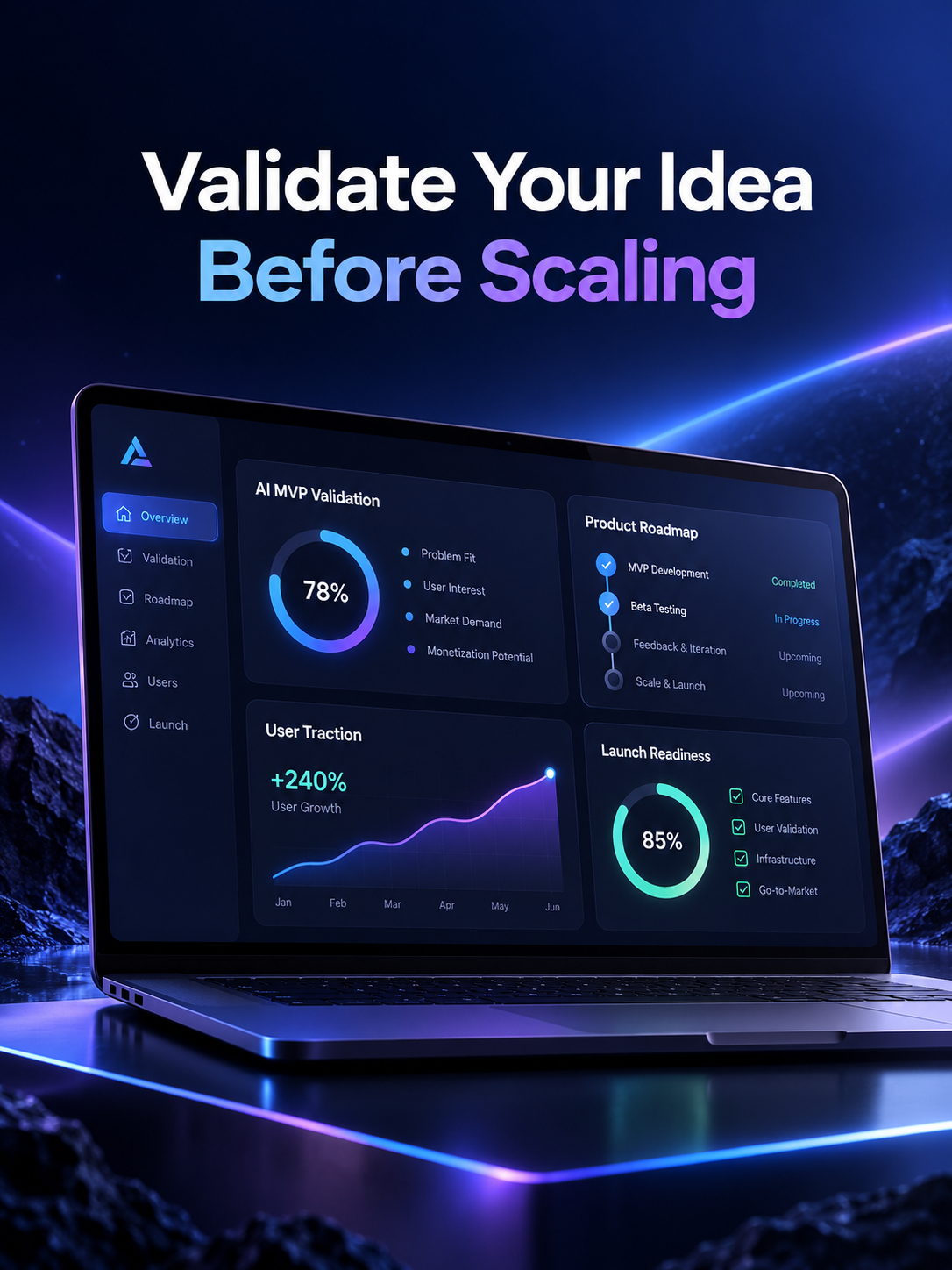
Validate Your Idea Before Scaling
Turn your AI or SaaS idea into a market-ready MVP. Test core features, reduce development risks, and launch with confidence.
2. Why Manual Tools and Disconnected Workflows Limit Growth
Many early-stage businesses rely on spreadsheets, email, manual reporting and a variety of disconnected applications to execute key operations
Although these strategies often work in the beginning, scaling these processes typically becomes unmanageable as users, transactions and operational requirements increase
Challenges like duplicated data entry, disorganized information, delayed reporting, lack of automation and poor insight into performance become inevitable
A wellscoped SaaS MVP can consolidate critical functions that an enterprise system would typically manage, but in a dramatically simplified form.
For instance, an early-stage business may require a limited set of tools related to customer onboarding, document analysis and management dashboard rather than a comprehensive enterprise resource planning (ERP) system.
The right MVP enables organizations to replace a single, expensive or dysfunctional workflow, rather than overhauling the entire system at once.
3. SaaS MVP Development: What Should the First Version Include?
Effective SaaS MVP development focuses on delivering one complete, reliable user journey.
Depending on the product, essential modules may include:
- User authentication: Secure registration, login and role-based access.
- Core business workflow: The primary problem-solving functionality.
- AI integration: One clearly defined, testable AI capability.
- Admin dashboard: Basic user, activity and operational management.
- Subscription or payment integration: Where monetization needs validation.
- Analytics: Tracking activation, engagement and user behavior.
- Security foundations: Appropriate data protection, access control and tenant isolation.
Advanced reporting, multiple AI agents, extensive customization and unnecessary integrations can often wait until customer demand justifies them.
Our MVP application development services focus on transforming essential business requirements into usable software.
Turn Your AI Product Idea Into a Market-Ready MVP
4. AI Product Development: Validate the Intelligence, Not Just the Interface
AI products present unique challenges over and above standard software development
A dashboard may appear to be working well, but the recommendations it makes via its artificial intelligence (AI) may be faulty, costly, or completely inappropriate.
Before looking to scale up an AI function, consider the following questions for your own situation:
Do you get consistently good outputs from the AI?
Is there useful business data for the AI to act upon?
When should humans intervene in the AI process?
How much does each query to the AI cost?
Can the AI be incorporated into your existing processes?
A retrieval-augmented generation (RAG) model can be used to bind together your AI function and relevant business data wherever appropriate.
The aim should be to demonstrate enhanced value for a particular outcome that your customers care about, rather than simply to include AI for the sake of it.
5. How MSI Approaches Startup MVP Development
MSI approaches startup MVP development through a structured, business-first process.
Step 1 — Discovery: Identify target customers, operational problems, business objectives and success criteria.
Step 2 — MVP scoping: Separate essential launch functionality from future enhancements.
Step 3 — Product design: Map customer journeys, interfaces, dashboards and critical interactions.
Step 4 — Development: Build core workflows, APIs, AI integrations and necessary administration features.
Step 5 — Validation: Test functionality, AI output quality, usability and technical reliability.
Step 6 — Launch and iteration: Release to target users, measure outcomes and prioritize improvements based on evidence.
This approach connects engineering decisions to business goals rather than feature volume.
For founders seeking measurable outcomes, explore our ROI-driven MVP software development approach.
Ready to Validate Your Product Idea?
Avoid investing in unnecessary functionality before understanding your product's feasibility, scope and development requirements.
6. AI MVP and SaaS Product Development Use Cases
A validation-first approach supports different industries and business models.
Startups: AI-powered SaaS tools, niche subscription platforms and customer-facing applications.
Healthcare: Appointment workflows, patient communication and administrative automation.
Retail and eCommerce: Inventory insights, customer engagement, ordering and intelligent reporting.
Manufacturing: AI-assisted cost estimation, quotation generation and workflow automation.
Agencies: White-label SaaS products, client portals and specialized automation platforms.
Enterprises: Internal approval systems, document intelligence, operational dashboards and AI assistants.
Each product should start with a clearly defined user, business problem and measurable result.
7. Real AI Product Development Examples
Practical software examples can help founders understand how AI capabilities fit into real products.
AI-powered financial analysis: Our AI Stock Analysis Platform case study explores a platform using AI and MCP-based integrations for investment research workflows.
Intelligent customer support: Our AI Chatbot with Human Support case study demonstrates an approach combining AI-assisted conversations with human support workflows.
AI-powered matchmaking: The TribalShaadi AI case study highlights AI capabilities applied to a specialized matrimony platform.
These examples illustrate possible architectures and workflows; they do not independently establish customer demand or financial returns for a new product.
8. AI MVP Development Cost and Timeline: What Founders Should Know
The cost of AI MVP development depends on scope rather than the number of features a founder imagines.
Important cost factors include:
- Product complexity and user roles.
- UI/UX design requirements.
- AI model integration and testing.
- Backend APIs and database architecture.
- Payment systems and third-party integrations.
- Security, hosting and maintenance.
- Testing, deployment and post-launch improvements.
A simple proof of concept may take weeks, while a production-ready SaaS MVP with payments, multi-tenant architecture and complex AI workflows can require several months.
Founders should also evaluate ongoing AI usage, infrastructure and support costs before deciding subscription prices.
The objective is to establish a realistic budget tied to a clearly defined launch scope.
9. MVP Rescue Services: When Your Software Project Is Stuck
Not every founder starts with a new idea.
Some already have unfinished, buggy, slow or abandoned software products.
In these situations, restarting from zero may not be necessary.
An effective MVP rescue assessment examines existing code, architecture, usability, integrations, security and outstanding requirements.
The next step may involve fixing critical problems, simplifying scope, modernizing selected components or rebuilding only the parts that cannot reasonably be reused.
Explore MSI's software and MVP rescue services before committing to a complete rebuild.
10. The Business Benefits of Validating Before Scaling
A narrow focus on the MVP (Minimum Viable Product) will create more value for future investment.
Founders can experiment with the product and see how customers react, what additional functionality is needed, how much it will cost to maintain and improve the product based on the collected data.
The critical product metrics that can be used to validate the product idea are activation rate, repeat usage, paid conversion rate, acceptance of AI outputs, and cost per active user.
The metrics may help the founders decide if they need to expand the product’s functionality, change its pricing strategy, enhance its usability, or abandon the project. The decision to scale should be based not on intuition but on the collected evidence.
Validate Your SaaS Idea Before Investing in Full Development
Conclusion: Build the Right Product Before Building a Bigger Product
An ambitious software idea does not need a massive first release.
It needs a clear business problem, a valuable core workflow, reliable technology and a practical way to measure success.
Whether you want to build an AI MVP, launch a SaaS product, automate business operations or rescue an incomplete application, MSI helps connect product strategy with focused software development.
Turn Your Product Idea Into a Testable MVP
Validate your concept, prioritize essential features and plan an AI or SaaS platform around real business requirements.
Frequently Asked Questions
1. What is AI MVP development?
AI MVP development involves creating a focused AI-powered product with essential features to test technical feasibility, user demand and business value before wider investment.
2. How is a SaaS MVP different from a full SaaS platform?
A SaaS MVP delivers the core customer workflow with limited features, while a mature SaaS platform may include extensive automation, integrations, reporting and advanced administration.
3. How much does AI MVP development cost?
Costs depend on workflow complexity, AI integration, user roles, design, security, infrastructure and testing. A scoped requirements assessment is needed for a reliable estimate.
4. How long does SaaS MVP development take?
Simple prototypes may take weeks. Production-ready SaaS MVPs typically require more time depending on integrations, AI evaluation, security and launch requirements.
5. Can an unfinished MVP be rescued?
Yes. Many incomplete products can be improved through technical audits, targeted repairs, architecture changes and feature prioritization. Rebuilding is appropriate when reuse is impractical.
Frequently Asked Questions
What is AI MVP development and why is it important for startups?
AI MVP development is the process of building a minimum viable product with essential AI capabilities to validate market demand, technical feasibility and business value. It helps startups test ideas with real users, control initial development costs, collect feedback and make informed decisions before investing in a full-scale AI platform.
How much does AI MVP development cost in 2026?
AI MVP development costs depend on the complexity of the product, AI model integration, user roles, design, data requirements, APIs, security and testing. A simple AI prototype typically requires less investment than a production-ready SaaS application with subscriptions, automation and multiple integrations. A detailed MVP scope is necessary for an accurate cost estimate.
How long does it take to build an AI MVP or SaaS MVP?
A focused AI prototype may take a few weeks, while a production-ready SaaS MVP can require several months. The timeline depends on feature scope, AI evaluation, data availability, third-party integrations, security and testing. Prioritizing one complete user workflow can help simplify development and accelerate validation.
What features should a SaaS MVP include before launch?
A SaaS MVP should include the minimum features needed to solve its target customer's main problem. Common features include user registration, secure authentication, the core business workflow, an administration dashboard, basic analytics and payment integration when required. AI features should be added when they directly support the product's primary value proposition.
How do I choose the right AI MVP development company?
Choose an AI MVP development company that understands startup validation, product architecture, user experience, AI integration and measurable business outcomes. Review relevant technical case studies, development processes, security practices, communication methods and post-launch support. A strong development partner should help prioritize essential functionality instead of encouraging unnecessary features.
What is the difference between AI MVP development and SaaS MVP development?
AI MVP development focuses on validating software functionality that uses artificial intelligence, such as recommendations, document analysis or intelligent automation. SaaS MVP development focuses on validating a software product delivered as an online service. A product can combine both approaches by offering AI-powered capabilities through a subscription-based SaaS platform.
Can I build a SaaS product using OpenAI, Gemini or other AI models?
Yes. A SaaS product can integrate suitable AI models for chatbots, summarization, intelligent search, document processing, recommendations and business automation. Model selection should consider output quality, API costs, latency, privacy, security, usage limits and the application's business requirements. Testing AI performance before scaling is essential.
What are MVP rescue services and can an unfinished software project be recovered?
MVP rescue services help assess, repair, improve or rebuild incomplete, abandoned, unstable or poorly performing software products. A technical audit examines source code, architecture, functionality, security, integrations and outstanding requirements. Depending on the findings, existing components may be reused, critical issues fixed or selected parts rebuilt without restarting the entire project.
How can startup founders validate an AI product before scaling?
Founders can validate an AI product by identifying a specific customer problem, building one essential workflow, testing AI output quality, launching a limited pilot and gathering real user feedback. Important metrics include activation, repeat usage, task completion, willingness to pay, paid conversion and operating cost per user. Scaling decisions should follow measurable evidence.
Does Murmu Software Infotech provide AI MVP, SaaS development and MVP rescue services?
Murmu Software Infotech provides AI MVP development, SaaS product development, custom software engineering and MVP rescue services for startups and businesses. Its development approach emphasizes discovery, focused feature scope, practical architecture, AI integration, testing and iterative product improvement. Businesses can request an MVP cost estimate based on their requirements.