How AI-Powered Costing Helps Manufacturers Quote Faster, Protect Margins, and Win More Business
In This Article
- The Manufacturing Costing Problem Is Bigger Than Costing
- Why Slow Costing Becomes a Revenue Problem
- How AI-Assisted Manufacturing Costing Changes the Workflow
- Protect Margin Before the Quotation Leaves the Business
- Turn Costing Data Into Manufacturing Intelligence
- From Faster Costing to Greater Quotation Capacity
- See the Manufacturing Costing Workflow in Practice
- Costing Can Become a Revenue Capability
- Book a Demo of the AI Product & Service Cost Calculator
A customer sends an RFQ today.
How long does it take your organization to determine the real manufacturing cost and send an accurate quotation?
For many manufacturers, the answer is still measured in hours—or even days.
Not because the costing team lacks experience, but because the information required to build a reliable quote is scattered across spreadsheets, emails, ERP records, previous quotations, supplier rates, engineering documents, and individual employee knowledge.
A typical workflow can look like this:
Customer RFQ ↓ Engineering Review ↓ BOM / Material Pricing ↓ Production Input ↓ Machine & Labour Cost ↓ Overhead ↓ Sales Margin ↓ QuotationEvery handoff adds time.
And when RFQ volumes increase, product complexity grows, or material prices change quickly, spreadsheet-based costing becomes a commercial bottleneck.
The Manufacturing Costing Problem Is Bigger Than Costing
Traditional product costing usually relies on experienced workers manually compiling and calculating:
raw materials and BOM
machine rates and time,
labour requirements,
manufacturing processes,
subcontracting costs,
overhead,
packaging,
logistics,
wastage,
selling margin
The calculation itself is only a small part of the task.
The bigger challenge is usually found in coordinating the information needed to perform it.
Various departments may be using different Excel sheets, assumptions, formulas, supplier costs, or quotations – leading to three main issues: slow quotation cycles, lack of cost consistency, and margin erosion.
Manufacturing cost estimation software is becoming a strategic requirement in many companies, embedded in the commercial management process, and not a purely financial or engineering tool anymore
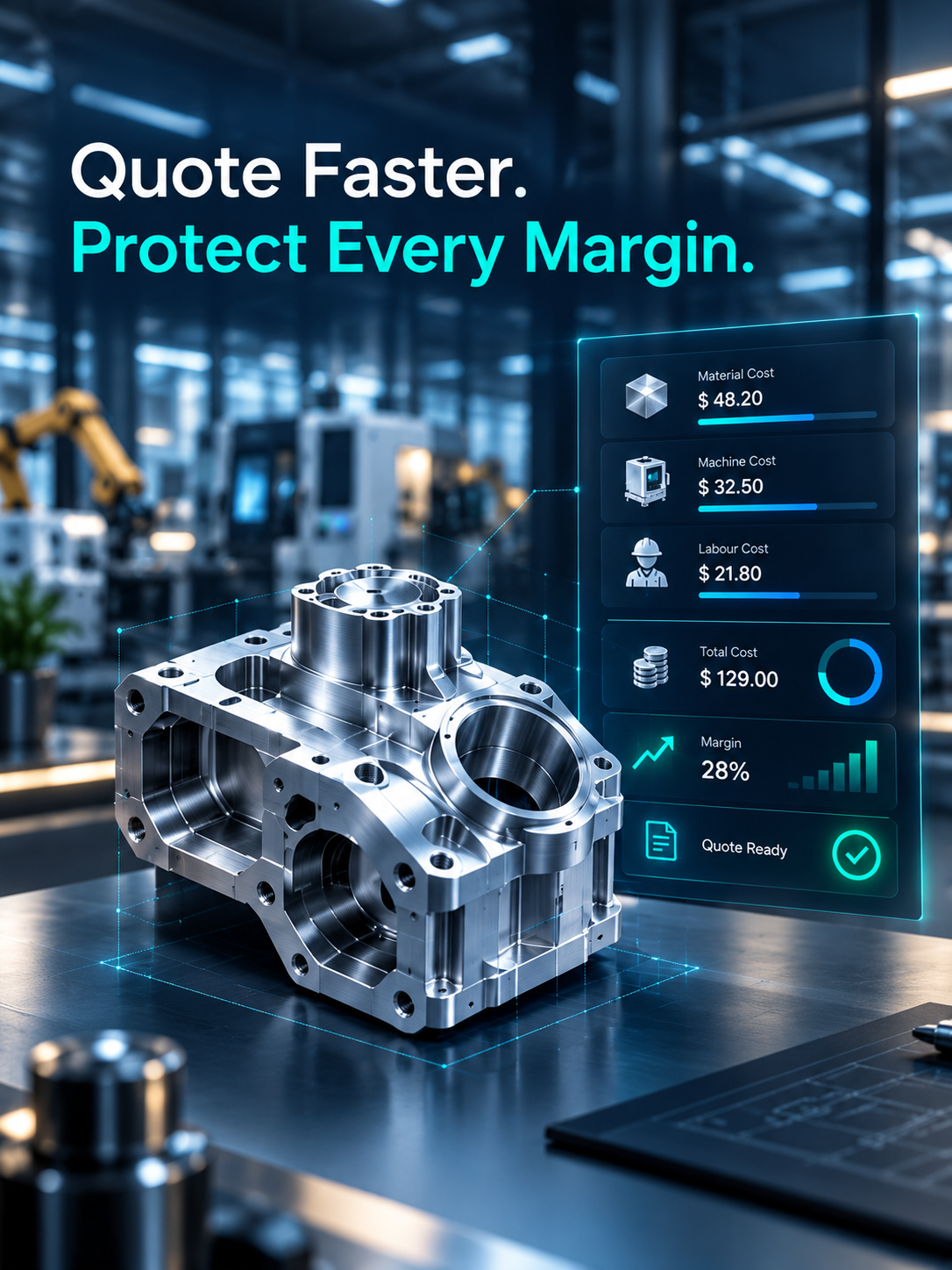
Quote Faster. Protect Every Margin.
Turn manufacturing requirements into accurate cost estimates, margin scenarios, and faster quotations with an intelligent AI-powered costing workflow.
Why Slow Costing Becomes a Revenue Problem
Costing is not only a finance problem.
It is also a sales-speed problem.
Slow Costing ↓ Slow Quotations ↓ Fewer RFQs Processed ↓ Delayed Customer Responses ↓ Lower Sales Conversion PotentialA sales team may have 50 opportunities available, but if the organization can accurately cost only 20 of them within the required response window, quotation capacity itself becomes a growth constraint.
The goal therefore should not simply be to calculate costs faster.
It should be to build a reliable RFQ-to-quotation workflow that allows the business to process more opportunities without sacrificing pricing discipline.
Turn Manufacturing Costing Into Faster, More Profitable Quotations
How AI-Assisted Manufacturing Costing Changes the Workflow
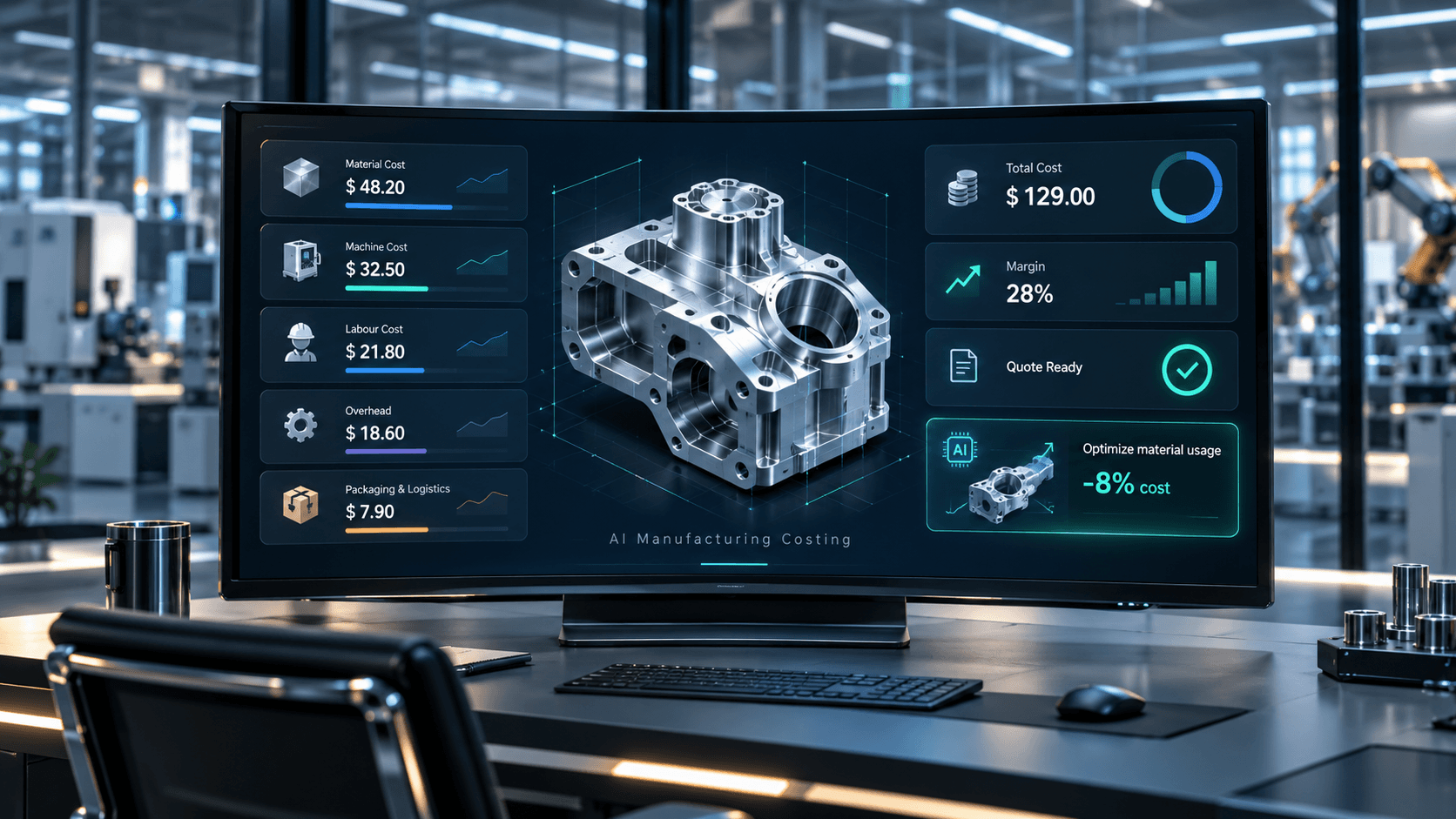
An AI Product & Service Cost Calculator can bring requirement interpretation, costing logic, scenario analysis, margin calculation, and quotation preparation into one workflow.
RFQ / Requirement ↓ AI Requirement Understanding ↓ BOM + Process Identification ↓ Deterministic Cost Engine ↓ Cost Breakdown ↓ Scenario Analysis ↓ Target Margin ↓ QuotationAn important distinction matters here.
AI should assist with understanding, extraction, comparison, recommendations, and analysis. Financial calculations should still be performed through controlled, deterministic costing rules.
This allows manufacturers to benefit from AI without turning critical commercial calculations into a black box.
The system can standardize calculations across materials, machines, labour, processes, overheads, packaging, logistics, and other cost components while maintaining defined business rules.
Manufacturers exploring broader automation can connect this capability with their AI manufacturing strategy and existing manufacturing software systems.
Protect Margin Before the Quotation Leaves the Business
Speed of manufacturing quotation software is not valuable
Speed of manufacturing quotation software with margin visibility is valuable
Ask yourself the following three questions:
What would happen if the price of SS316 increases by 8%,
what should the selling price be to maintain an 18% gross margin,
and what happens if the order quantity increases from 5,000 to 10,000 units?
Modern AI manufacturing cost calculators allow you to embed these questions as a costing workflow instead of an Excel spreadsheet
Your teams can explore the impact of different scenarios on the sell price before booking a commercial offer
This way, you can ensure that management has a clear view of the potential for lower sell price, buyers understand the impact of alternate supplier rates, production can analyze alternative process options, and sales can negotiate on a defined margin basis
Therefore, the value of faster costing is not in its speed, but in the degree to which it improves pricing control.
Turn Costing Data Into Manufacturing Intelligence
Every quotation creates useful commercial data.
But in spreadsheet-driven environments, much of that intelligence disappears into files and folders.
Centralized AI product costing software can make historical costing searchable and comparable.
Teams can ask:
- Which material contributes most to this product's cost?
- Which manufacturing process is driving the estimate?
- How does this quotation compare with the previous RFQ?
- Which supplier assumption materially changes the margin?
- What happened to cost between two production volumes?
- Which quotes were won, lost, or revised?
- Where are margins consistently being compressed?
Historical comparison is especially valuable because costing stops being a one-time calculation and becomes a growing source of decision intelligence.
That is where manufacturing cost analysis, should cost analysis, and manufacturing margin analysis can begin supporting procurement, sales, finance, engineering, and leadership together.
From Faster Costing to Greater Quotation Capacity
The commercial benefit is straightforward:
Quote Faster → Understand True Cost → Simulate Changes → Protect Margin → Submit More Quotations → Improve Win Potential
If one estimator can process more RFQs without increasing calculation risk, the company has more quotation capacity.
Salespeople can spend less time waiting for internal calculations.
Costing teams can spend less time rebuilding similar spreadsheets.
Management can have greater visibility of pricing decisions
And customers get answers faster.
That combination can turn costing from a back-office task into a competitive commercial capability.
See How AI Costing Can Improve Your Quotation Workflow
See the Manufacturing Costing Workflow in Practice
The related case study, AI Product & Service Cost Calculator: Transforming Cost Estimation, Quotation Speed & Profitability, demonstrates how a centralized costing workflow can reduce spreadsheet dependency and standardize material, machine, labour, process, overhead, packaging, and logistics calculations.
The solution supports faster cost estimation, quicker RFQ-to-quotation turnaround, margin visibility, material and quantity scenario analysis, historical cost comparison, and greater quotation capacity for sales teams.
The broader lesson is important:
The value of AI for manufacturing companies does not come from adding an AI chatbot beside an existing spreadsheet.
It comes from redesigning the workflow around reliable data, governed calculations, faster analysis, and better commercial decisions.
Organizations planning similar systems can also explore AI software development for integrations with ERP, CRM, procurement, inventory, production, and quotation workflows.
Costing Can Become a Revenue Capability
Manufacturers will always need accurate costings of products and services.
What is changing is how quickly customers expect quotations and how quickly material, labour, logistics, and market conditions can fluctuate.
The firms most prepared to respond effectively will be able to answer three questions quickly:
What will this requirement really cost us?
What price protects the margin we need?
How quickly can we confidently send the quotation?
An AI-powered product cost calculator brings those questions into one connected workflow helping manufacturers quote faster without sacrificing costing discipline.
Book a Demo of the AI Product & Service Cost Calculator
See how your manufacturing team can move from requirement to cost estimate, scenario analysis, margin calculation, and quotation through one intelligent workflow.
Book a Manufacturing Costing Demo
Frequently Asked Questions
What is an AI manufacturing cost calculator?
An AI manufacturing cost calculator helps manufacturers estimate product or service costs by combining material, BOM, machine, labour, process, overhead, packaging, logistics and other cost inputs. AI can assist with requirement understanding, historical comparison and analysis, while governed calculation logic produces consistent cost estimates.
How does AI product costing software help manufacturers quote faster?
AI product costing software reduces time spent collecting data, checking spreadsheets and coordinating across engineering, procurement, production, costing and sales. It can help move an RFQ from requirement analysis to cost breakdown, margin calculation and quotation through a connected workflow.
Can manufacturing cost estimation software replace spreadsheets?
Manufacturing cost estimation software can reduce dependency on disconnected costing spreadsheets by centralizing approved material rates, machine costs, labour rates, overhead rules, BOM structures, historical estimates and margin logic. Spreadsheets may still be used for analysis, but they no longer need to be the primary costing system.
What costs should a manufacturing product cost calculator include?
A manufacturing product cost calculator can include raw materials, BOM components, scrap and wastage, machine time, labour, manufacturing processes, tooling, subcontracting, overhead, packaging, freight, logistics and target margin. The exact cost model should reflect the manufacturer's operations.
How can AI costing software help protect manufacturing margins?
AI-assisted costing improves margin visibility by showing the relationship between underlying cost drivers, selling price and target gross margin. Teams can test changes in material prices, quantities, suppliers, processes or production volumes before approving a quotation.
What is RFQ quotation automation in manufacturing?
RFQ quotation automation connects customer requirements with costing inputs, pricing rules, margin calculations, approvals and quotation preparation. It reduces manual coordination and can help manufacturers respond to more RFQs in less time while maintaining pricing discipline.
Can AI manufacturing costing software perform scenario analysis?
Yes. A manufacturing costing platform can model scenarios such as material price increases, different production volumes, alternative suppliers, process changes or target margins. Teams can compare the financial impact before deciding the final selling price.
How does BOM costing software calculate manufacturing cost?
BOM costing software calculates the cost of materials and components in a bill of materials and can combine them with labour, machine, process, overhead, wastage, packaging and logistics costs. This creates a more complete view of the expected manufacturing cost.
What is should-cost analysis in manufacturing?
Should-cost analysis estimates what a product or component should reasonably cost based on materials, manufacturing processes, labour, machine time, overhead and other cost drivers. It can support sourcing decisions, supplier negotiations, cost optimization and pricing analysis.
Who can benefit from an AI Product and Service Cost Calculator?
Manufacturing sales, costing, engineering, procurement, production, finance and management teams can benefit. It is especially useful for companies handling frequent RFQs, complex BOMs, changing material prices, custom products or margin-sensitive quotations.