Development / MVP Application Development
How to Build an AI-Powered MVP with RAG, Agents and Business Automation
PPrem M.7 Min Read
Many AI MVPs look impressive in a controlled demonstration but fail when placed inside a real business workflow.
A chatbot may generate polished responses but cannot access approved company knowledge. An agent may appear autonomous but makes unsafe decisions when connected to business systems. A RAG prototype may retrieve documents but provide weak answers because the source data is incomplete, outdated or poorly structured.
The objective of an AI MVP is not to demonstrate how advanced artificial intelligence can appear. It is to prove that AI can improve one measurable workflow for one defined user group.
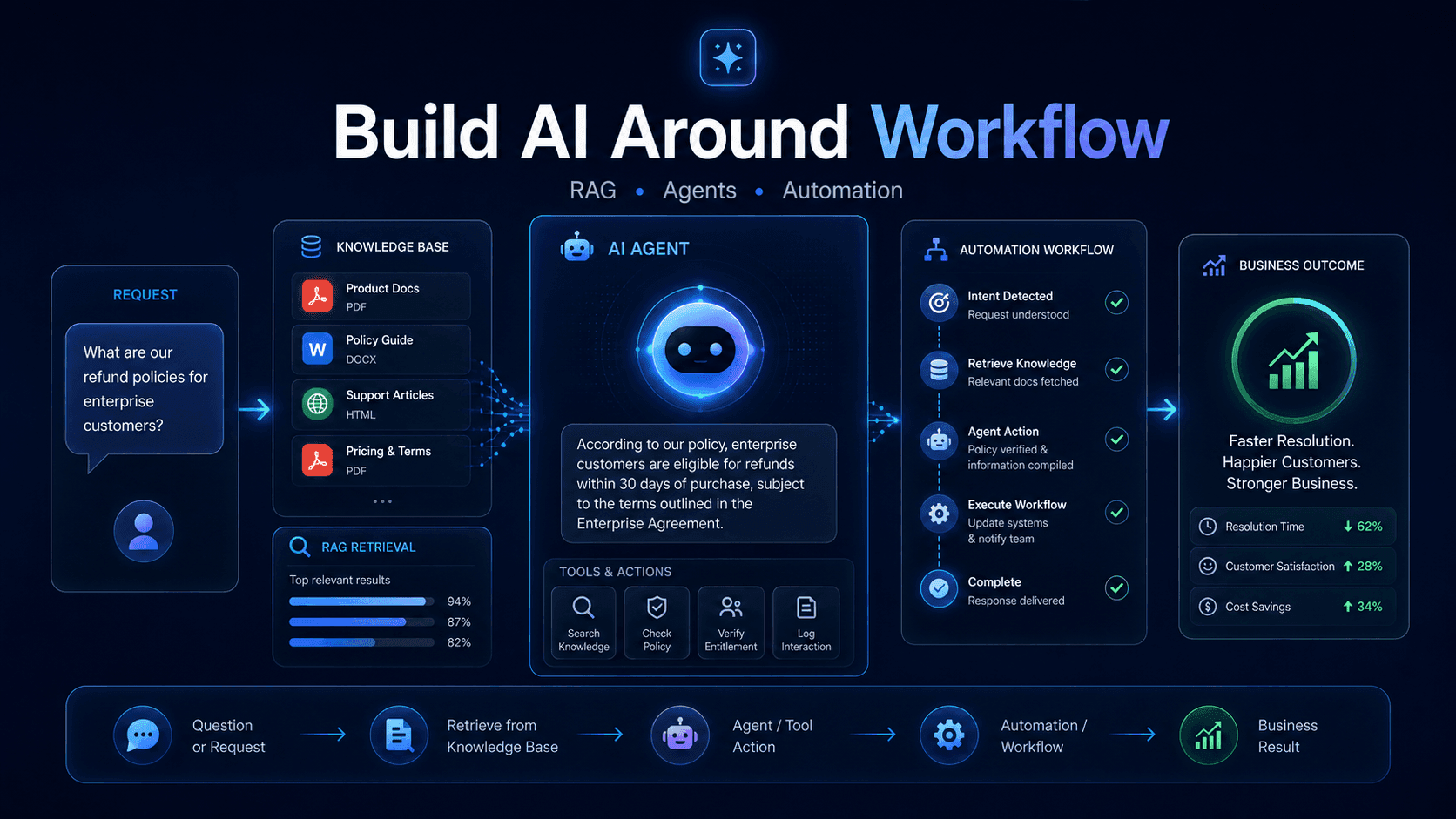
Build AI around a real workflow—not an impressive demo.
Before choosing an AI model, vector database or agent framework, identify the workflow the product must improve.
A useful AI MVP hypothesis could be:
The right architecture is the simplest architecture capable of proving that workflow. A basic language-model workflow may be enough for summarisation, classification or extraction. RAG becomes relevant when responses must use approved knowledge. Agents are useful when the application must select tools or perform bounded actions. Automation is required when outputs must move between people and business systems.
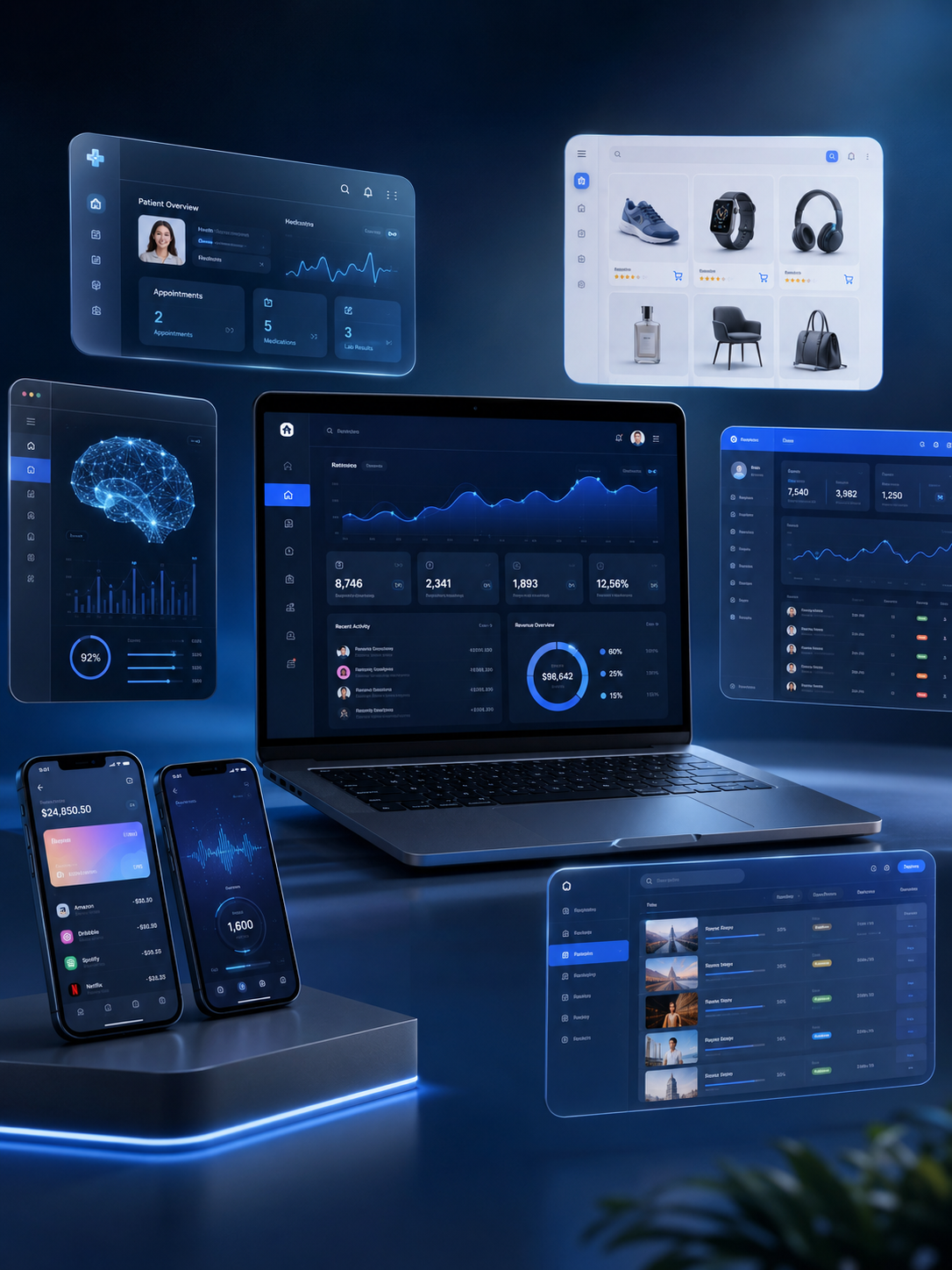
See 11 real digital products delivered across healthcare, commerce, AI, SaaS, mobile apps and enterprise CMS platforms.
Founders often assume an AI MVP must include RAG, agents, automation and multiple models from day one.
That creates unnecessary complexity.
Start by asking what the product actually needs to do.
The user already provides the information required for the task, and the system only needs to:
This approach is usually faster to test and easier to evaluate than a multi-agent system.
Retrieval-Augmented Generation connects a language model with an approved knowledge base. The application retrieves relevant information before producing an answer.
A RAG MVP is appropriate when users need answers based on:
The first version should include document ingestion, chunking, indexing, retrieval, source citations, access controls and clear no-answer behaviour.
RAG should not merely return a confident response. It should make it possible for the user to verify where the answer came from.
Businesses exploring this architecture should work with a RAG application development partner that understands data preparation, retrieval quality, permissions, evaluation and production monitoring.
An AI chatbot responds. An AI agent can reason about a task, select a tool and take an action.
For example, an agent might:
This is more valuable than a conversational demo because it supports a complete operational outcome.
However, autonomy introduces risk. Every tool should have clearly defined permissions, approved inputs, output validation, logging and escalation rules. Human approval should remain part of the workflow for financial, legal, healthcare, customer-account or irreversible actions.
Industry guidance similarly recommends beginning with a narrow task, defining the agent’s responsibilities and limiting its level of autonomy before expanding tool access.
The Model Context Protocol provides a standardised way for AI applications to connect with external data sources and tools.
A custom MCP server can expose controlled capabilities such as:
RAG primarily helps the model retrieve information for an answer. MCP provides a broader mechanism through which an AI application can discover data and invoke tools. It can therefore support agentic workflows that retrieve information and perform actions across connected systems.
MCP does not remove the need for security. Authentication, authorisation, user consent, data isolation, input validation and action-level permissions must be designed into every exposed tool.
Our AI-powered stock research and analysis platform case study demonstrates how AI, APIs, financial data and an MCP server can be organised around research and decision-support workflows rather than a generic chatbot.
AI creates business value when its output leads to a useful next step.
A custom AI chatbot may answer a question, but a workflow-oriented assistant could also:
The MVP should clearly separate AI judgment from deterministic automation.
AI may interpret an enquiry, summarise a document or recommend an action. Traditional workflow logic should handle validations, permissions, approvals, calculations and confirmed system updates.
This combination improves control and makes failures easier to diagnose.
AI systems are probabilistic. Their outputs can vary even when the software itself is functioning correctly.
The MVP should therefore define:
Human review is not a weakness in an AI MVP. It is a practical way to learn where the system succeeds, where it fails and what should be automated later. Early AI MVP guidance also recommends using small, high-quality datasets and real-user feedback rather than overinvesting in full automation before feasibility is proven.
A polished response is not enough to prove value.
Define measurable launch criteria such as:
For RAG, test whether the correct source was retrieved and whether the answer is supported by it.
For agents, measure tool-selection accuracy, action success, retries, approval rates and failed executions.
For automation, measure whether the full process completed not merely whether the model generated a response.
A production-oriented first release may include:
Avoid building multiple agents, extensive automation, proprietary model training or dozens of integrations unless they are essential to validating the core hypothesis.
Under Murmu Software Infotech’s current Limited Digital Product Launch Offer 2026, AI-powered MVP development starts from $15,000 for a clearly defined scope. The package may include integration with OpenAI, Azure AI, Gemini or Claude, along with assistants, chatbots, automation and selected AI workflows.
The final investment depends on:
A focused AI assistant using approved documents will generally require less effort than a multi-agent system connected to CRM, ERP, payments and operational databases.
The right AI MVP development company should not begin by recommending agents, RAG or a particular model.
It should first understand:
Murmu Software Infotech develops AI MVPs, RAG applications, custom AI chatbots, AI agents, MCP servers and business automation solutions for startups, agencies and enterprises.
Explore our existing AI MVP development approach and current development packages:
https://murmusoftwareinfotech.com/limited-digital-product-launch-offer-2026
A successful AI MVP does not need maximum autonomy.
It needs a narrow workflow, trusted data, controlled actions, measurable results and a clear path for human intervention.
Start with the smallest AI capability that can prove business value. Add RAG when knowledge must be grounded. Add agents when tools must be selected. Add MCP when systems need a standardised connection layer. Add automation when the complete workflow must move from insight to execution.
Do not build AI simply to produce an impressive response. Build it to complete a valuable business outcome.
An AI-powered MVP is the smallest dependable version of an AI product capable of validating one business workflow with real users. It combines only the AI capabilities, data, interfaces, integrations, controls and analytics needed to prove measurable value.
Murmu Software Infotech currently lists AI-powered MVP development from $15,000 for a defined scope. Final pricing depends on data preparation, RAG requirements, agent tools, MCP or API integrations, user roles, security, human review, model usage, monitoring and product complexity.
Use retrieval-augmented generation when the AI must answer from approved, private or frequently updated knowledge such as policies, manuals, product information, contracts or internal documents. A strong RAG system should retrieve relevant sources, provide citations and handle unsupported questions safely.
An AI chatbot primarily answers or generates content. An AI agent can interpret a goal, select approved tools, retrieve information and perform controlled actions. Agents require stronger permissions, validation, logging, approval rules and failure handling.
An MCP server exposes approved tools, resources or business data to AI applications through a standardized interface. It can help an AI assistant search knowledge, query databases, call APIs or invoke controlled business actions while preserving authentication and permission boundaries.
A focused AI MVP should include one target user, one high-value workflow, a secure interface, an appropriate model, trusted data, RAG where needed, limited tools, human review, escalation rules, logging, quality analytics, cost monitoring and production deployment.
Hallucinations cannot be eliminated completely, but risk can be reduced through grounded retrieval, source citations, constrained prompts, structured outputs, data validation, confidence thresholds, no-answer behavior, human review, model evaluation and continuous monitoring.
Most first releases should avoid multi-agent complexity unless several independent roles are essential to the workflow. A single model with clearly defined tools and deterministic workflow logic is often easier to evaluate, secure, monitor and improve.
Evaluation should measure workflow outcomes such as retrieval relevance, citation accuracy, answer acceptance, task completion, action success, human correction, escalation frequency, time saved, cost per task, user retention and revenue or conversion influence.
Choose a partner that begins with the business workflow rather than a preferred AI tool. The company should understand RAG, agents, MCP, APIs, security, permissions, human review, evaluation, cloud deployment and the operational systems the AI must support.