AI-Ready Website vs Traditional Website Development
In This Article
- Features, Cost, CRM Integration & Business Growth
- What Is an AI-Ready Business Website?
- AI-Ready Website vs Traditional Website: Feature Comparison
- Before vs After: From Website Visitors to Qualified Sales Leads
- SEO, AEO and GEO: How an AI-Ready Marketing Website Supports Discovery
- AI Website Development Cost: What Are You Actually Paying For?
- How Murmu Software Infotech Built Its Own AI-Native Website
- Which Businesses Benefit From AI-Ready Websites?
- How to Choose the Right Website Development Partner
Features, Cost, CRM Integration & Business Growth
A $300 website can look professional. But what happens when a potential customer is ready to buy?
If someone lands on your page, learns more about your service and asks a question but all you have is an email form which will not be checked until tomorrow then you might have lost some valuable business!
This is why the AI website vs traditional website decision should go beyond appearance and development cost.
In addition to an effective marketing site, you will be able to provide smart customer support, well-structured content, qualified leads and integrated follow up in a CRM using an AI-capable marketing platform.
What Is an AI-Ready Business Website?
An AI-ready website has the content structure, technical architecture and integration capability needed to support AI features.
But three terms mean different things:
AI-built website: AI tools assist with layouts, code or content creation.
AI-ready website: The platform is designed to accommodate AI services, structured information and secure integrations.
AI-native marketing website: AI-assisted customer experiences and business workflows are implemented as part of the platform.
A website can be professionally developed without AI, and an AI-generated website may not include any operational AI features.
The important question is what your website actually does for your customers and sales team.
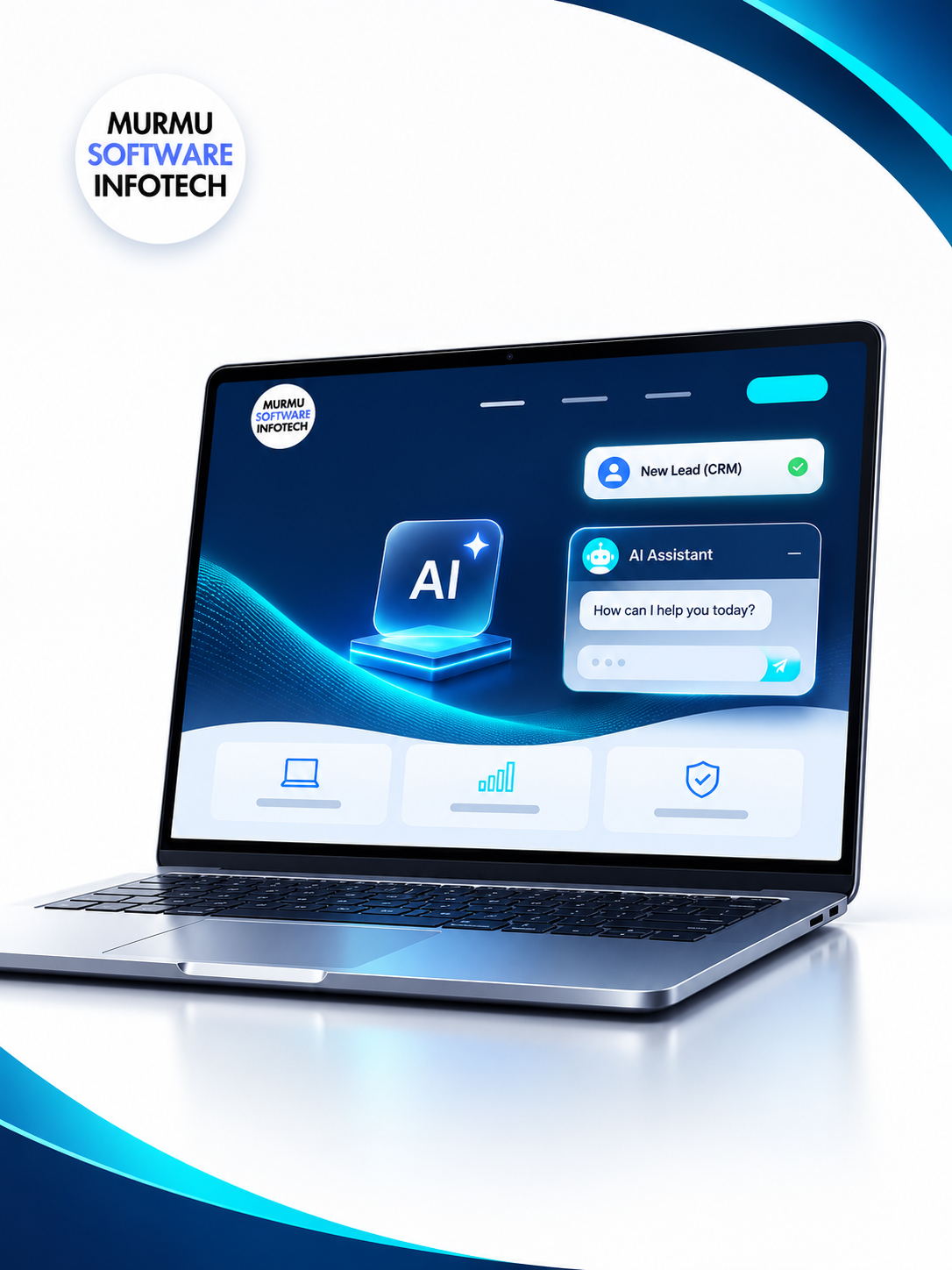
Transform Your Website Into Growth Engine
Connect AI assistance, qualified lead capture, and CRM workflows to turn visitor interest into actionable enquiries.
AI-Ready Website vs Traditional Website: Feature Comparison
| Business requirement | Traditional website setup | MSI AI-ready approach |
|---|---|---|
| Business information | Pages, images and contact details | Structured service and product content |
| Content management | Static pages or standard CMS | Configurable headless CMS and editorial workflows |
| Customer enquiries | Contact form, phone or WhatsApp | Forms plus optional AI-assisted conversations |
| Sales follow-up | Email or manual tracking | CRM capture, routing and follow-up integration |
| Search readiness | Basic or configured SEO | Technical SEO, structured content and answer-ready pages |
| Analytics | Website traffic reporting | Traffic, enquiry and conversion event tracking |
| Investment | Typically simpler initial scope | Additional AI, CRM and integration costs where selected |
A conventional website can also implement advanced features. The difference lies in the requirements, engineering scope and connected business workflows not a limitation shared by every traditional website.
See How An AI-Ready Website Could Elevate Your Business
Discover how AI assistance, modern design and CRM integration can improve your website's customer experience.
Before vs After: From Website Visitors to Qualified Sales Leads
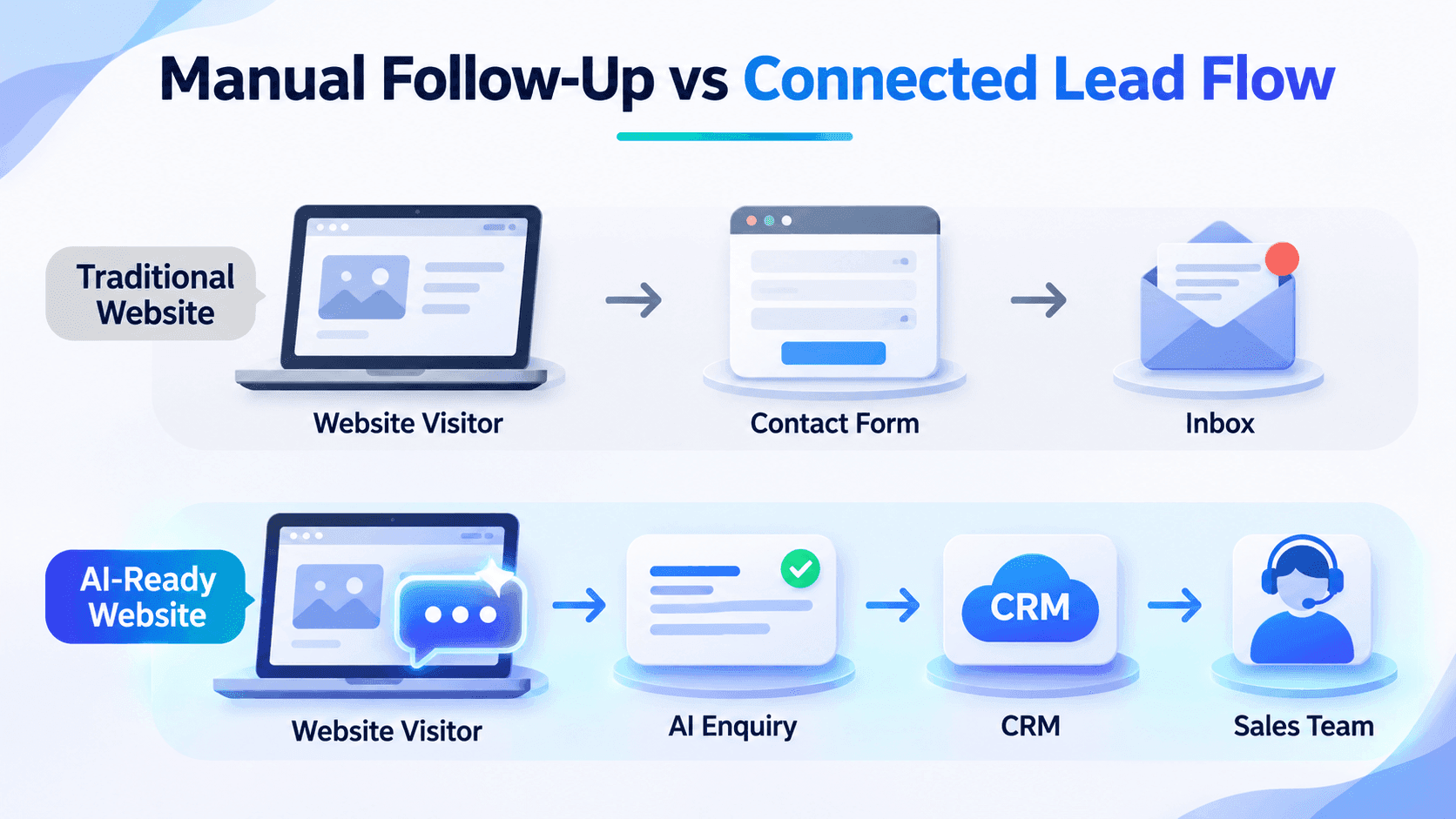
Consider a B2B company receiving an enquiry after business hours.
Traditional workflow: Visitor → Contact form → Email inbox → Manual review → Sales follow-up.
Connected AI-assisted workflow: Visitor → Website assistant or form → Structured enquiry → CRM → Sales assignment → Follow-up.
The system can be set up so that it provides answers to authorised business queries, gathers requirements and routes to the correct team.
AI-provided answers need reliable data sources, controls, and escalation if there is uncertainty in the information.
Want to see this workflow in practice? Request an AI Website Growth Demo and explore how website enquiries can connect with business processes.
SEO, AEO and GEO: How an AI-Ready Marketing Website Supports Discovery
A business website must help search engines understand its pages and help visitors find useful answers.
SEO (Search Engine Optimization) covers foundations such as crawlability, indexing, technical performance, relevant content and internal links.
AEO (Answer Engine Optimization) emphasizes clear explanations and direct answers to customer questions.
GEO (Generative Engine Optimization) focuses on content clarity, trustworthy information and discoverability in generative AI experiences.
Useful implementation elements include descriptive headings, service pages, FAQs, accurate business information, relevant structured data and accessible content.
None of these techniques guarantees rankings, AI citations or a particular amount of organic traffic.
AI Website Development Cost: What Are You Actually Paying For?
A basic business website can cost less initially because it may require fewer integrations and simpler functionality.
An AI-ready website may involve additional investment in:
- Web design
- CMS implementation and content structure
- AI chatbot setup and knowledge addition
- CRM, email, messaging system + booking integration
- Hosting, AI API integration and 3rd party subscriptions.
- Testing, analytics, support + maintenance.
The right comparison is total implementation and ongoing operating cost, not only the homepage development quotation.
If a conventional website already meets your business goals, unnecessary AI features may add cost without sufficient value.
Explore MSI's Website Development Plans to compare available scopes and request a tailored estimate.
Discover How Your Website Could Generate Better Sales Opportunities
Explore potential improvements to your website's lead capture, customer engagement and sales follow-up.
How Murmu Software Infotech Built Its Own AI-Native Website
Murmu Software Infotech modernized its website from a developer-dependent content workflow to a Sanity CMS + Next.js headless architecture.
Implementation of content model, modern UI, smart content authoring workflow and chatbot (with dynamic knowledge base via MCP)
It makes the regular management of content easier for the Marketing Team. It allows more flexible publishing.
This was not a theoretical idea for a site, but has been implemented.
Read the MSI Sanity + Next.js Migration Case Study or explore our Sanity CMS Development Services.
Which Businesses Benefit From AI-Ready Websites?
B2B service companies may benefit from lead qualification, consultation requests and CRM-connected enquiries.
Clinics and healthcare businesses may use controlled appointment assistance and administrative enquiry workflows.
Professional services firms can help prospective customers understand services and request relevant consultations.
Growing enterprises may need structured content, multiple landing pages, integrations and coordinated marketing operations.
The right scope depends on customer behaviour, available content, budget and business processes.
How to Choose the Right Website Development Partner
Before selecting a provider, ask for a working demonstration, content editing workflow, integration examples, security approach and written scope.
Clarify who maintains AI knowledge, manages permissions, updates content, handles support and pays third-party charges.
A credible technology partner should explain when AI is useful and when a simpler website is enough.
Frequently Asked Questions
What is the difference between an AI-ready website and a traditional website?
A traditional website generally presents business information and provides contact or enquiry features. An AI-ready website has the architecture to support AI assistants, structured content and connected workflows. An AI-native website goes further by implementing AI-powered functionality. Both approaches can support SEO and business integrations.
Is an AI-ready website better than a traditional business website?
An AI-ready website may be more suitable when businesses need automated customer assistance, structured enquiries, CRM integration and flexible content management. A simpler traditional website may be more economical when standard pages, bookings and contact forms already meet business requirements.
How much does AI-ready website development cost?
Costs vary based on design, CMS, development complexity, AI assistant features, CRM integrations, hosting, content migration and support. AI usage and third-party subscriptions can create recurring expenses. Murmu Software Infotech recommends an itemized estimate based on required workflows rather than a universal package price.
Can my existing website be converted into an AI-ready website?
Often yes. An existing website may support AI assistance, structured content improvements and CRM integrations without a complete rebuild. A technical assessment should first review its CMS, frontend, APIs, security, performance and integration limitations.
Will an AI-ready website rank higher on Google and Bing?
AI functionality alone does not improve or guarantee rankings. Search performance depends on crawlability, indexing, useful content, technical SEO, performance, internal links and other search signals. AI features should solve customer problems rather than be added solely for ranking purposes.
What are SEO, AEO and GEO in AI-ready website development?
SEO improves website discoverability in traditional search. AEO emphasizes clear answers to user questions. GEO focuses on content clarity and discoverability in generative AI experiences. Strong content, accessible pages, reliable information and technical SEO support all three, but no method guarantees AI citations.
Can an AI website capture leads and send them to a CRM?
Yes. A configured website can collect structured enquiries, validate submitted details and create or update records in a connected CRM. It can support lead assignment, follow-up tasks and reporting, subject to authentication, privacy, consent and integration requirements.
Are AI-powered business websites secure for customer information?
Security depends on implementation rather than the presence of AI. Appropriate controls include authentication, access restrictions, secure APIs, input validation, data minimization, vendor configuration, monitoring and testing. Sensitive information should only be processed through approved, appropriately protected workflows.
Why use Sanity CMS and Next.js for an AI-native website?
Sanity CMS provides configurable structured content management, while Next.js supports custom frontend architecture and integration. Together they can support flexible publishing, SEO controls, APIs and AI-assisted workflows. Murmu Software Infotech has documented its own Sanity and Next.js implementation.
How can an AI-native marketing website help generate more qualified sales leads?
A connected website can guide visitors to appropriate services, answer approved questions, collect relevant requirements and pass enquiries into sales workflows. Businesses should evaluate results using qualified leads, bookings, conversion rates, follow-up performance and attributable revenue rather than assuming guaranteed growth.