AI Financial Automation Mumbai: Financial Reporting & ERP Automation for SMEs
In This Article
- Why AI Financial Automation Mumbai SMEs Need Is Different
- ERP Automation Mumbai Businesses Can Add Without Replacing ERP
- AI Financial Reporting Software for Better Management Visibility
- Accounts Automation for SMEs: Where to Start
- AI-Assisted Financial Workflows Need Controls
- Connecting ERP, CRM and Finance Data
- What an AI Financial Automation Project Can Include
- How Murmu Software Infotech Helps Mumbai Businesses
- Cost Considerations for ERP and Financial Automation
- Who Should Request a Financial Automation Assessment?
- Turn financial data into faster business decisions
Mumbai SMEs can automate financial reporting, reconciliation, receivables and cash-flow visibility using AI-assisted workflows connected to existing ERP and accounting systems.
For many Mumbai businesses, the accounting platform is not the problem. Whether it is Tally, SAP, Zoho Books or a bespoke ERP, the transactions have already been posted correctly. However, finance teams still need to export the data into Excel to perform reconciliation of accounts, follow-up on receivables or prepare cash-flow reports and management dashboards. This leads to multiple people doing the same work, slower month-end reporting and, most importantly, decisions being made on potentially out-of-date information.
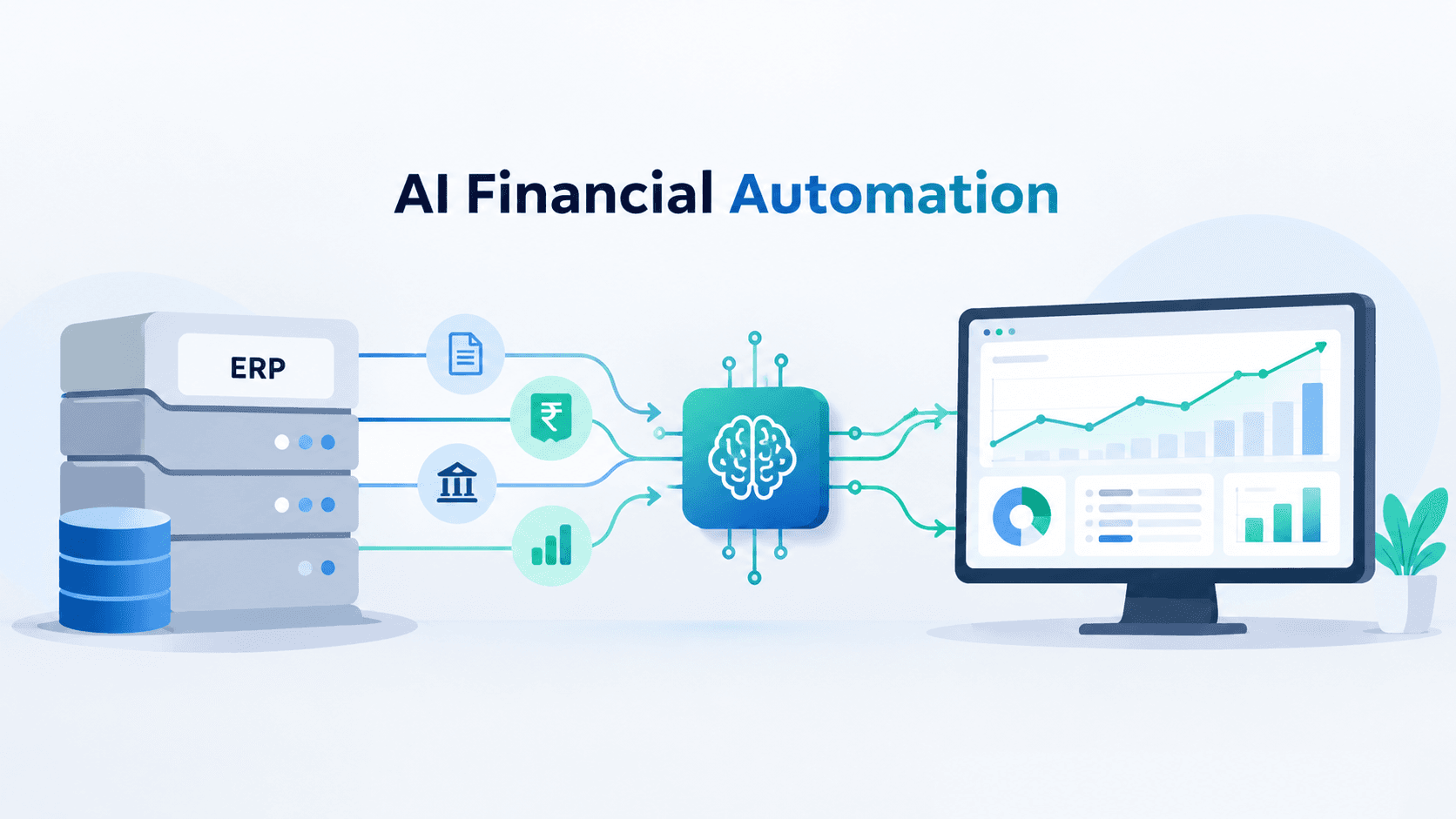
The better approach is not necessarily another ERP replacement. AI financial automation can sit around existing finance systems, connect approved data sources, automate repeatable reporting steps, flag exceptions and produce management-ready summaries while finance teams retain review and approval control.
Mumbai businesses evaluating broader software modernization can also explore MSI's software development services in Mumbai.
Turn Finance Data Into Insight
Connect your existing ERP with AI-assisted reporting, reconciliation and financial workflows to reduce manual effort and improve management visibility.
Why AI Financial Automation Mumbai SMEs Need Is Different
SMEs are unlikely to have a complete absence of financial data. More often than not, the problem is that relevant information is scattered throughout the accounting software, ERP modules, bank files, CRM records, payment systems and spreadsheets.
A CFO wants a current view of receivables, but the team has to first export invoices, update collection comments and reconcile payments. The managing director asks for current cash exposure across entities, causing another manual consolidation.
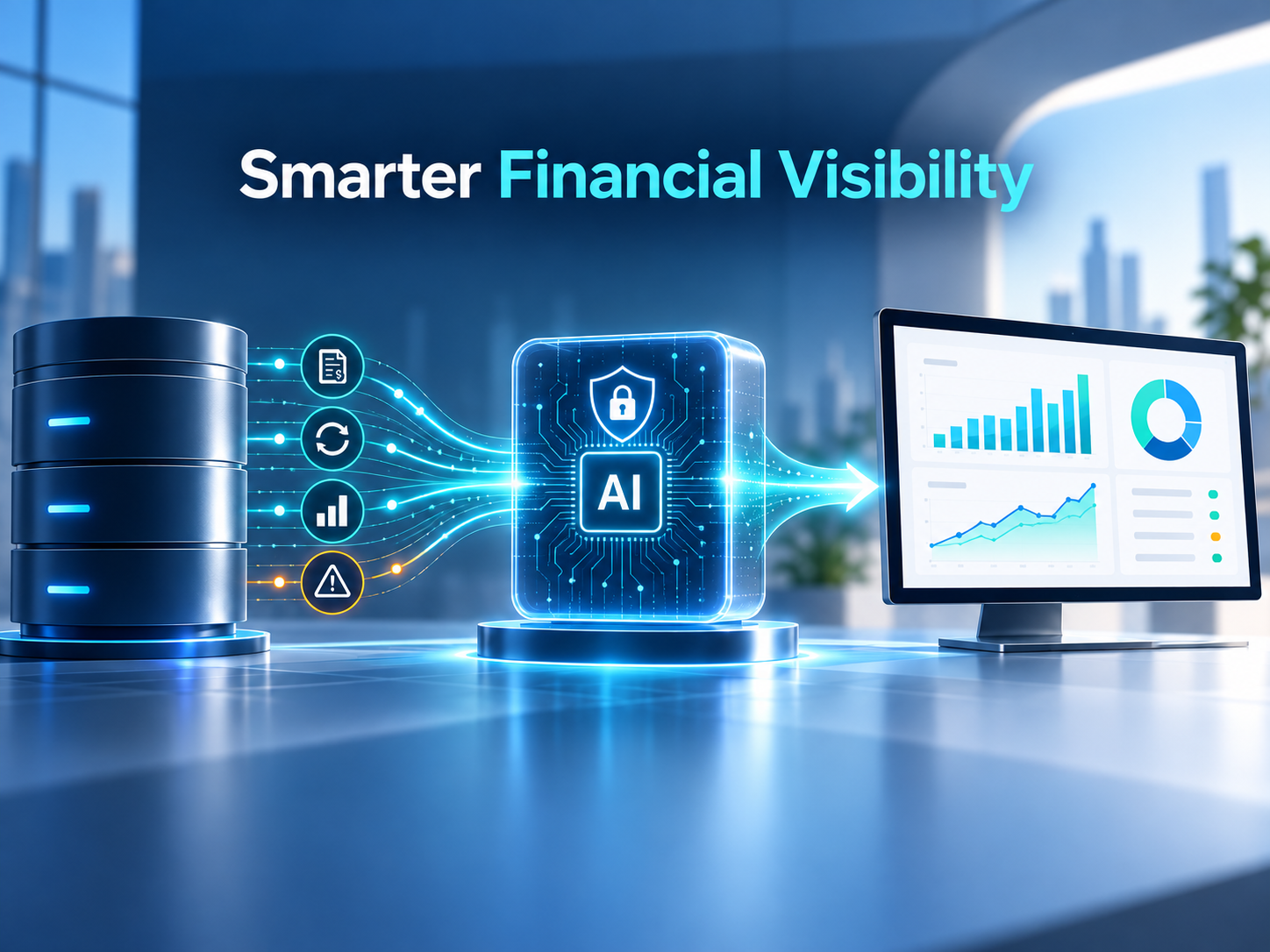
An AI financial reporting software layer can reduce that friction by connecting approved systems and transforming existing records into structured reporting workflows.
Useful applications include:
- receivables ageing and collection prioritisation
- bank and transaction reconciliation assistance
- cash-flow dashboards
- management reporting packs
- variance summaries
- unusual transaction or exception flags
- cross-company financial consolidation
- financial questions answered from authorised datasets
The goal is not to let AI independently control the books. It is to reduce the repetitive work required before qualified finance professionals can review the numbers and make decisions.
ERP Automation Mumbai Businesses Can Add Without Replacing ERP
A frequent misconception is that meaningful automation requires discarding the current ERP.
Often, it does not.
The company can keep using Tally, SAP, Zoho Books or its own custom ERP as the system of record for the financials, while introducing integration services, workflow rules and AI-assisted reporting around it.
A pragmatic architecture is:
Accounting / ERP → Integration Layer → Validation → Finance Data Model → AI-Assisted Analysis → Dashboard / Alerts → Human Approval
This approach is particularly valuable when replacing the core platform would create unnecessary migration risk, retraining costs or operational disruption.
MSI's AI Business Automation Solutions are designed around this principle: connecting AI, automation and predictive intelligence to existing ERP, CRM and operational applications rather than assuming every system must be replaced.
Manual Finance Work With Smarter AI Automation
AI Financial Reporting Software for Better Management Visibility
Many finance teams already create monthly reports. The issue is the amount of effort required to do so.
Reporting can consist of: exporting data, merging worksheets, fixing inconsistent formats, checking balances, requesting missing information and recreating the same management presentation every month.
Automation would change the game.
Instead of rebuilding the report over and over, the system can simply refresh approved sources of information, apply pre-defined business rules and prepare the reporting layer automatically. AI can help with summaries such as:
"Receivables over 60 days increased this month."
"Operating expenses exceeded the expected range in this cost centre."
"Collections improved, but projected short-term cash availability has tightened."
Those outputs should remain traceable to underlying financial data. AI-generated explanations should support not replace finance review.
Ready to reduce repetitive finance work?
Reduce Manual Finance Work With Smarter AI Automation
Accounts Automation for SMEs: Where to Start
Trying to automate the entire finance function at once usually creates unnecessary complexity.
Start with workflows that are repetitive, measurable and already reasonably structured.
Receivables: Connect invoice, payment and customer information to create updated ageing views, highlight overdue balances and prioritise follow-up.
Reconciliation: Match likely transactions automatically and route mismatches or uncertain matches to finance staff for review.
Management reporting: Automatically refresh recurring MIS reports and executive dashboards from validated data instead of rebuilding them manually.
Cash-flow visibility: Combine outstanding receivables, payment obligations and approved financial data into a clearer forward-looking view.
Month-end preparation: Automate data collection, exception lists and reporting preparation so the finance team spends more time reviewing issues and less time assembling files.
The important rule is exception-based automation: automate repeatable steps and send unusual, low-confidence or high-impact items to a named reviewer.
AI-Assisted Financial Workflows Need Controls
Finance automation must be designed differently from a general productivity chatbot.
Financial workflows need clear controls around:
- data access and user permissions
- approval authority
- audit logs
- source-system ownership
- confidence thresholds
- exception handling
- sensitive-data protection
- reconciliation rules
- rollback and correction procedures
For important transactions, the safest pattern is usually AI proposes → authorised person reviews → system records the action.
That preserves accountability even while reducing manual analysis.
The quality of data is also important, as duplicates in customer accounts, vendor codes, payment terms and poorly maintained master data can trump even the best-designed automation. Financial automation should start with a review of processes and data, not just a choice of a modeling tool.
Turn Disconnected Financial Data Into Faster Business Decisions
Connecting ERP, CRM and Finance Data
Financial visibility becomes stronger when finance data is connected with related operational information.
For example, an invoice status may originate in ERP while account ownership or customer communication exists in CRM. Connecting those systems can reduce repeated data entry and give teams better context.
MSI's Salesforce–SAP real-time integration case study demonstrates this integration pattern. The solution described used middleware to sync customers, products, orders, invoice status, and expenses while also providing logging, retry mechanisms, and overall integration monitoring procedures.
The relevance to finance automation is apparent because, before performing valuable cross-system reporting, the information from various sources has to be somewhere reliably accessible, i.e., integrated.
What an AI Financial Automation Project Can Include
A Mumbai SME does not need to purchase every capability at once. A phased project can include:
1. Assessment: Identify time-consuming finance workflows, systems, spreadsheets, reporting requirements and data-quality gaps.
2. Integration: Connect authorised ERP, accounting, banking, CRM or custom application data.
3. Automation: Implement repeatable workflows for reconciliation, reporting, alerts or receivables.
4. Intelligence: Add anomaly detection, management summaries, forecasting support or natural-language financial querying where appropriate.
5. Governance: Define approvals, permissions, logs, monitoring and exception handling.
6. Expansion: Extend successful workflows to additional departments, entities or reporting requirements.
How Murmu Software Infotech Helps Mumbai Businesses
Murmu Software Infotech can assist businesses with adding automation to their current finance and ERP environments without having to replace the full accounting-platform.
An engagement can begin by targeting a certain workflow for example, receivables reporting or management MIS and expanding only after the integration, data quality and business value have been validated.
The relevant capabilities include ERP and CRM integration, custom middleware, AI-assisted dashboards, workflow automation, API development, predictive analytics and custom business applications. MSI's AI automation offering specifically supports existing ERP and business systems, predictive intelligence and financial insights.
Cost Considerations for ERP and Financial Automation
There is no responsible flat price for this type of project without assessing the existing environment.
The main cost drivers are the number of systems being connected, API availability, accounting-data quality, reporting complexity, historical data volume, reconciliation rules, number of entities, approval workflows, security requirements, dashboard requirements and ongoing support.
A narrow reporting pilot is therefore inherently different from a true multi-company financial intelligence platform connecting ERP, CRM, banking and multiple reporting workflows.
In the SME context, the pragmatic approach is usually to identify one high-effort workflow, assess the current cost basis of the manual process, automate it, measure impact and then evaluate if wider implementation is warranted.
Who Should Request a Financial Automation Assessment?
This approach is relevant to Mumbai-based manufacturers, distributors, professional-services firms, SaaS companies, retailers and multi-entity businesses where:
- finance teams repeatedly export ERP data into Excel
- management reports take too long to prepare
- receivables require manual follow-up lists
- reconciliation consumes significant staff time
- finance and operational systems are disconnected
- leadership lacks timely cash-flow or profitability visibility
The accounting system does not necessarily need replacing. The opportunity may be to make the systems you already have work together more intelligently.
Turn financial data into faster business decisions
Turn Disconnected Financial Data Into Faster Business Decisions
Request Financial Automation Assessment
Use MSI's contact page to request an assessment.
Frequently Asked Questions
What is AI financial automation?
AI financial automation combines system integration, workflow rules and AI-assisted analysis to reduce repetitive finance work such as reporting, reconciliation, receivables monitoring, exception detection and management summaries.
Can AI financial automation integrate with Tally?
Yes, where the required Tally data can be accessed through supported integration, export or custom connectivity methods. Businesses can add reporting and automation without necessarily replacing Tally.
Can AI integrate with SAP for financial reporting?
Yes. SAP data can be connected to reporting and automation workflows through APIs, middleware or controlled data pipelines, depending on the SAP environment and integration requirements.
Can AI automation work with Zoho Books?
Potentially, yes. Integration feasibility depends on available APIs, required financial data, workflow rules, permissions and the specific automation being implemented.
How can AI improve accounts receivable management?
AI-assisted workflows can consolidate receivables data, identify overdue balances, prioritize accounts for review, summarize collection exposure and support more consistent follow-up.
Can AI automate bank reconciliation?
AI can assist reconciliation by matching likely transactions, identifying discrepancies and routing uncertain or exceptional items to finance staff for review.
Will AI replace accountants or finance managers?
The recommended approach is to use AI to reduce repetitive preparation and analysis while qualified finance professionals retain responsibility for review, judgement, approvals and financial decisions.
Do we need to replace our ERP to use AI automation?
No. AI and workflow automation can often be integrated with existing ERP, accounting, CRM and business applications through APIs, middleware and custom integration layers.
What finance process should an SME automate first?
Start with a repetitive process that consumes measurable staff time and has clear rules, such as recurring management reporting, reconciliation, receivables monitoring or data consolidation.
How much does AI financial automation cost in Mumbai?
Cost depends on the number of systems, API availability, data quality, workflow complexity, reporting requirements, historical data, security controls, integrations and ongoing support. A scoped assessment is needed for a reliable estimate.