Development / CMS
Built with AI Tools but Not Working? Fix, Optimize & Launch Your MVP with Expert Developers (2026 Guide)
PPrem Murmu2 Min Read
In 2026, building a product is easier than ever.
With platforms like Webflow, Replit, and AI-driven tools, startups can launch prototypes in days—not months.
But here’s the challenge most leaders face:
What started as a promising MVP quickly becomes:
A product that “looks ready” but isn’t usable
For CXOs and founders, this creates a serious bottleneck:

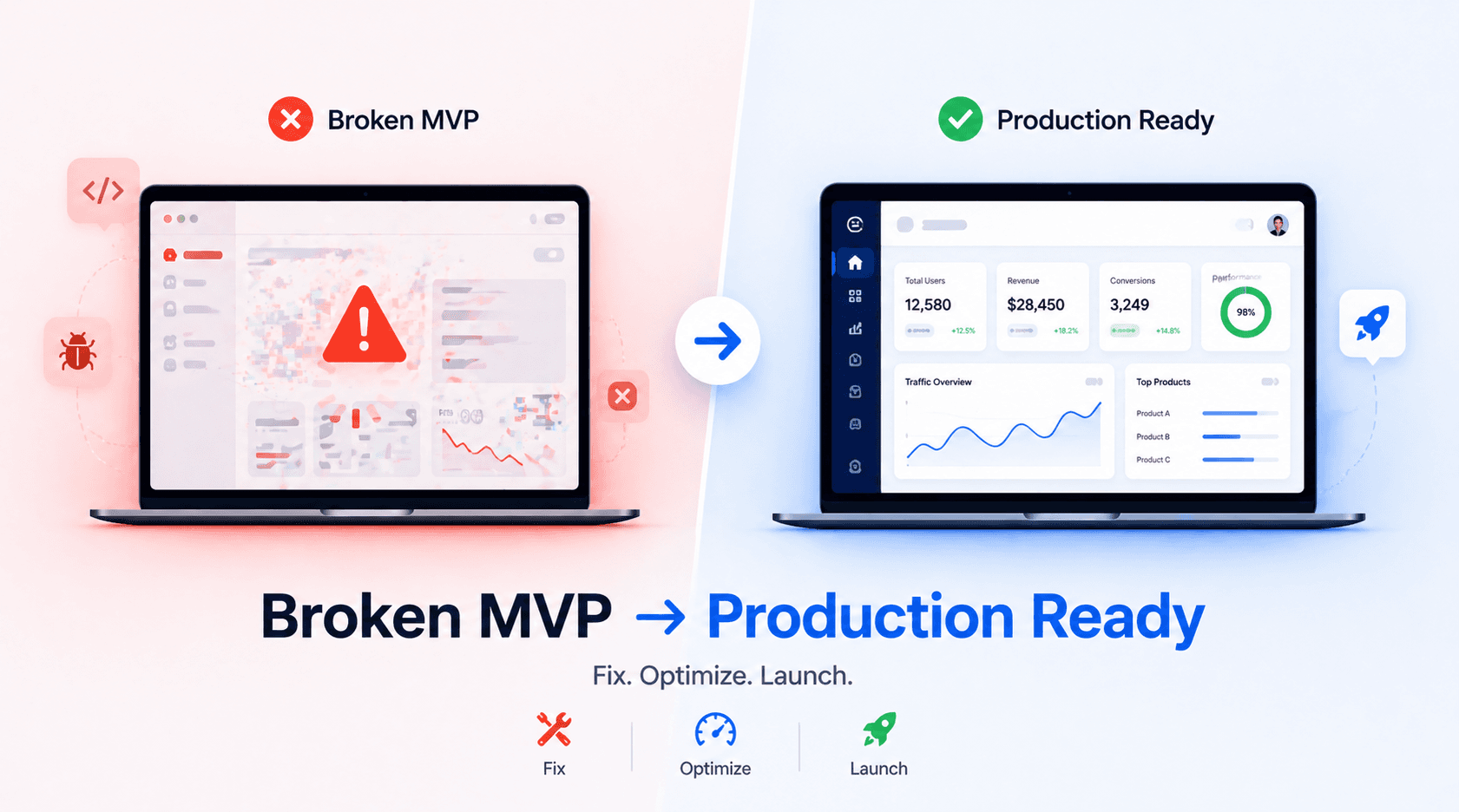
Turn your broken AI-generated MVP into a stable, high-performing, launch-ready product with expert debugging, optimization, and feature completion.
An MVP is not just a prototype—it’s your first impression in the market.
If your AI-built product isn’t working properly:
The cost isn’t just technical—it’s strategic.
Many companies underestimate this stage and face:
Reality:
Fixing early is cheaper than rebuilding later.
The smartest companies in 2026 are not abandoning AI-built products—they’re optimizing them with expert engineering.
This is where structured MVP development support services come in.
We start with:
This helps uncover:
Why your AI-generated website is not working
Most AI-built apps fail due to:
We:
Focus areas:
This ensures:
AI tools often leave gaps:
We:
Many products built on:
…need transition support.
We help:
We specialize in:
This transforms:
Experimental builds → Reliable products
Before launch, we ensure:
Outcome:
A product ready for real users, investors, and scale
| Factor | AI-Built Prototype | Optimized MVP |
|---|---|---|
| Stability | Low | High |
| Performance | Inconsistent | Fast |
| Scalability | Limited | Enterprise-ready |
| User Experience | Basic | Refined |
| Market Readiness |
AI tools accelerate creation—but they don’t guarantee success.
Most businesses struggle because:
An expert partner ensures:
Explore our services:
AI tools can help you build fast.
But only expert engineering can help you scale, perform, and succeed.
The difference between:
👉 A failed prototype
👉 And a successful product
…is optimization.
AI-generated MVPs can fail because of incomplete business logic, broken workflows, poor error handling, unreliable integrations, weak performance, database issues, security gaps, or code that works in testing but fails under real user conditions.
Yes. Expert developers can audit an AI-generated application, identify technical problems, fix bugs, improve business logic, repair integrations, optimize performance, strengthen security, and prepare the product for production use.
Start with a technical audit to identify code, performance, API, integration, and security problems. Developers can then prioritize critical bugs, stabilize workflows, improve speed, complete missing features, and test the website before launch.
| Risky |
| Launch-ready |
Yes. A no-code or AI-built MVP can be reviewed and optimized for performance, usability, integrations, and scalability. Depending on its limitations, the product may be improved on the existing platform or migrated to a more suitable custom architecture.
The best option depends on a technical assessment. Fixing may be appropriate when the core architecture is usable, while a partial or full rebuild may be better when the application has serious scalability, security, maintainability, or platform limitations.
An AI MVP technical audit can review code quality, application architecture, performance bottlenecks, database efficiency, API reliability, third-party integrations, security risks, error handling, scalability, and overall maintainability.
Performance can be improved by optimizing frontend code, backend workflows, APIs, database queries, caching, infrastructure, image and asset delivery, error handling, and inefficient application logic.
Yes. Developers can complete missing business logic, user workflows, integrations, dashboards, authentication, data processing, and other essential features that AI tools or rapid prototyping platforms may leave incomplete.
Yes. A prototype can be upgraded through debugging, architecture improvements, feature completion, performance optimization, security checks, load testing, integration validation, SEO readiness, and production deployment.
An AI-generated MVP is closer to launch-ready when its core workflows are stable, critical bugs are resolved, performance is acceptable, integrations work reliably, security requirements are addressed, and the application has been tested for real user conditions.