Why Most Digital Transformation Projects Fail Before Technology Even Starts

In This Article
- Modernizing Your CMS Architecture?
- The Real Transformation Failure Happens Earlier
- CMS vs Headless vs DXP Is the Wrong First Question
- Structured Content Changes the Architecture
- AI-Ready Content Starts Before AI
- Next.js Performance Must Be Designed
- SEO-Safe Migration Checklist
- Choose the Platform After the Model
- Related Service
- Headless CMS Migration Services
- Transformation Starts With Clarity
- Planning Digital Modernization?
Digital transformation projects often fail before development begins because organizations choose technology before defining the business problem, content model, workflows, customer experience and measurable outcomes. The right sequence is business clarity → operational readiness → content architecture → platform selection → migration → optimization. CMS, headless CMS and DXP platforms create value only when they support that strategy.
AI, automation, headless CMS, composable architecture and DXP platforms can create significant opportunities but technology alone does not create transformation.
The first question should never be:
“Which platform should we buy?”
It should be:
“What business or customer problem are we trying to solve?”
Modernizing Your CMS Architecture?
Before selecting or migrating platforms, assess content, URLs, integrations, workflows, SEO dependencies and future digital channels.
Modernize Before Complexity Grows
Align business goals, structured content, CMS architecture and migration strategy before investing in expensive digital transformation technology.
The Real Transformation Failure Happens Earlier
Many digital programs follow the wrong sequence:
Pressure to modernize → Platform selection → Implementation → Complexity
Instead, enterprises should begin with:
Business problem → Customer journey → Operational bottleneck → Content requirements → Architecture
Common warning signs include:
- Selecting a CMS because competitors use it
- Adding AI without structured business data
- Moving headless without multi-channel requirements
- Buying a DXP before personalization maturity exists
- Rebuilding workflows instead of improving them
- Migrating content without reviewing its quality
- Treating SEO as a post-launch task
The more expensive the platform, the more costly these mistakes become.
CMS vs Headless vs DXP Is the Wrong First Question
A traditional CMS may still be the right solution when one website is the primary channel and editors need straightforward page management.
Headless CMS becomes valuable when content must serve multiple websites, apps, portals, ecommerce, search or other digital experiences.
A DXP becomes more relevant when customer data, personalization, experimentation, journey orchestration and multiple channels operate together at enterprise scale.
There is no universal winner.
The correct architecture depends on business maturity and operational requirements.
For enterprises that genuinely need API-first, multi-channel architecture, Headless CMS Development Services can provide the next technical step.
Structured Content Changes the Architecture
One of the biggest differences between traditional page-driven transformation and modern content architecture is structured content.
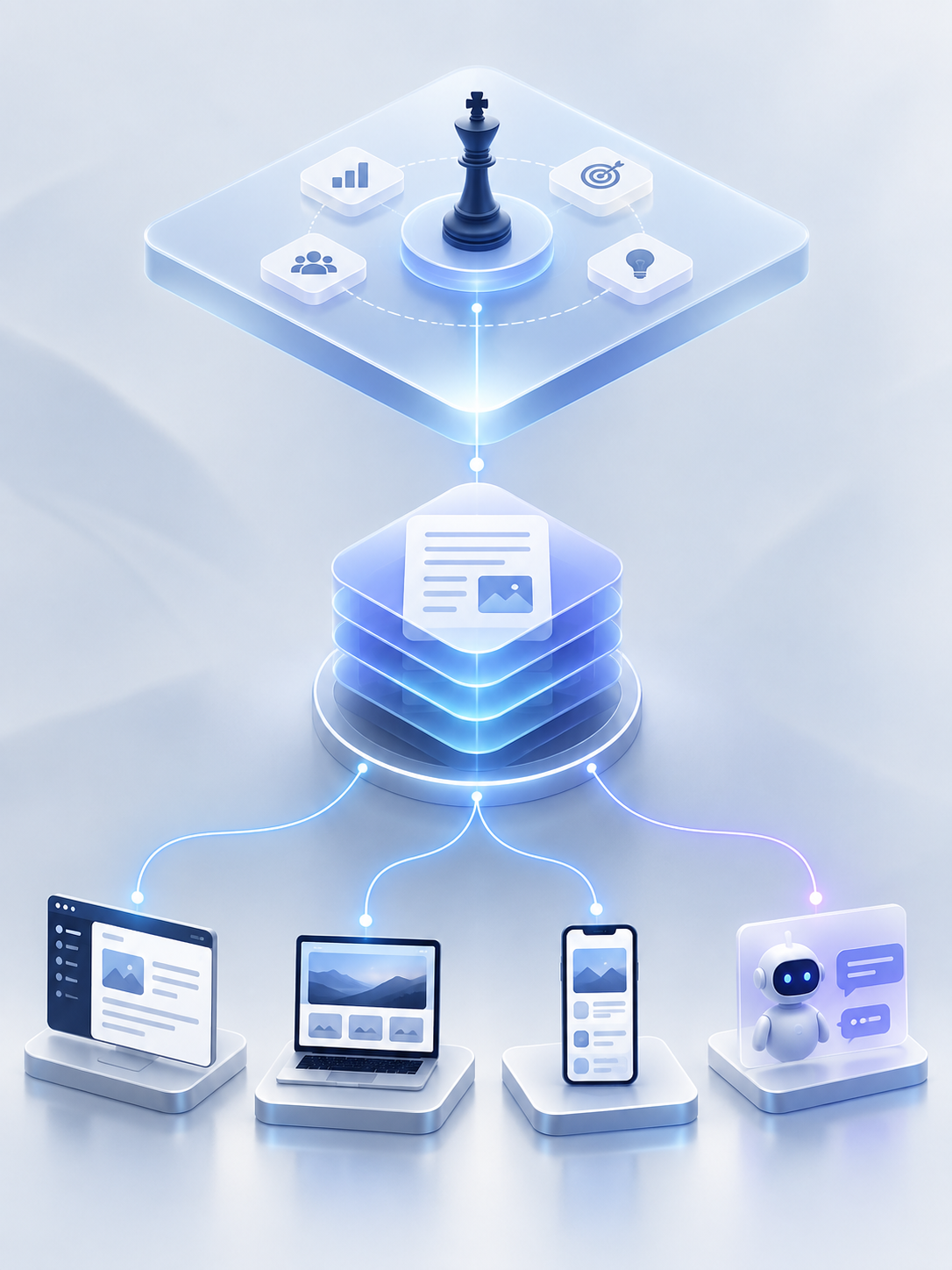
Instead of storing one page as one large block, break information into reusable entities:
Service → Product → Industry → Location → Author → FAQ → Case Study → CTA
Each entity has clear fields and relationships.
A service description, for example, can then power:
- A website
- Mobile app
- Customer portal
- Search
- AI assistant
- Regional landing page
This reduces duplication and turns content into reusable business data rather than content locked inside page templates.
Modern structured-content systems are specifically designed so content can be queried, referenced and reused across channels.
AI-Ready Content Starts Before AI
Many organizations want AI search, chatbots or generative experiences before their content is structured enough to support them.
AI-ready content should have clearly defined fields such as:
- Summary
- Key facts
- Questions
- Direct answers
- Primary entity
- Audience
- Location
- Author
- Sources
- Review date
This makes important business information easier to govern, retrieve and reuse.
AI readiness is therefore not mainly about generating more content.
It is about creating better structured context.
Platforms such as Sanity can support content modeled around business entities rather than page templates, including reuse across websites, applications and AI-driven workflows.
For organizations prioritizing this architecture, explore Sanity CMS Development Services.
Next.js Performance Must Be Designed
Moving to a headless CMS does not automatically create a fast website.
Frontend performance still depends on:
- Rendering strategy
- Caching
- Revalidation
- API efficiency
- Image optimization
- JavaScript bundle size
- Third-party scripts
- Metadata
- CDN delivery
- Core Web Vitals
The CMS and frontend architecture should be designed together so content flexibility does not create unnecessary API calls or frontend complexity.
If Next.js is central to the modernization roadmap, Sanity + Next.js Development Services can connect structured content architecture with modern frontend delivery.
SEO-Safe Migration Checklist
A successful redesign can still become a failed transformation if organic visibility disappears after launch.
Before CMS migration, validate:
- Existing URL inventory
- High-value landing pages
- 301 redirect mapping
- Titles and descriptions
- Canonical URLs
- Heading structure
- Internal links
- Structured data
- Image alt text
- XML sitemap
- Robots directives
- Hreflang
- Crawlable rendered content
- Analytics and conversions
- Core Web Vitals
- Forms and integrations
Run old and new systems in parallel during validation.
Compare:
URLs → Content → Metadata → Redirects → Schema → Analytics → Performance
Migration is a business transition, not simply a deployment.
Choose the Platform After the Model
Once requirements are clear, platform evaluation becomes easier.
Sanity can fit enterprises prioritizing highly structured content, custom editorial workflows and modern frontend delivery.
Strapi can be relevant when development teams prioritize API-first architecture and greater backend control. See Strapi CMS Development Services.
The platform should follow the architecture not define it.
Related Service
Headless CMS Migration Services
Modernize from legacy CMS architecture while protecting content, URLs, SEO signals, integrations and editorial workflows.
Audit → Content Model → Migration → Validation → Launch
Explore Headless CMS Migration →
Transformation Starts With Clarity
Successful transformation does not begin with AI, headless CMS or a DXP.
It begins by understanding:
- What customers need
- Which workflows are broken
- What content must be reusable
- Which channels matter
- What measurable outcome defines success
Then technology becomes an accelerator instead of an expensive source of complexity.
Planning Digital Modernization?
Start with architecture and migration readiness before committing to technology.
Plan Your Headless Transformation →
Frequently Asked Questions
Why do digital transformation projects fail?
Projects often fail when technology selection begins before business objectives, customer problems, workflows, content requirements, adoption needs and measurable outcomes are clearly defined.
Should enterprises choose technology before transformation strategy?
No. Enterprises should define business problems, customer journeys, operational constraints, content needs and expected outcomes before selecting CMS, headless or DXP technology.
What is the difference between CMS and headless CMS?
Traditional CMS platforms typically combine content management and presentation, while headless CMS platforms separate structured content from frontend delivery and expose content through APIs.
When should an enterprise use a headless CMS?
Headless CMS becomes valuable when governed content must support multiple websites, mobile apps, portals, ecommerce, search, digital products or other channels.
When does a DXP make sense?
A DXP becomes relevant when enterprises require integrated content, customer data, personalization, experimentation, journey orchestration and consistent experiences across multiple channels.
What is structured content?
Structured content stores information as reusable fields, entities and relationships rather than large page bodies, allowing the same governed content to serve multiple experiences.
How does structured content help AI?
Structured content gives AI systems clearer entities, facts, relationships, questions and answers that can be retrieved and reused more reliably than information trapped inside page-level content.
Does headless CMS automatically improve performance?
No. Performance still depends on frontend rendering, caching, APIs, images, JavaScript, hosting, third-party scripts and implementation quality.
How do enterprises protect SEO during CMS migration?
Preserve important URLs, redirects, metadata, canonicals, structured data, internal links, sitemaps, language signals and crawlability and validate them before launch.
What should happen before a CMS migration?
Audit existing content, URLs, integrations, SEO signals, editorial workflows and business requirements, then define the target content model and migration validation plan.