Why Most Enterprise CMS Decisions Fail in 2026 - And What Smart CXOs Are Doing Differently
In This Article
- The CMS Conversation Has Moved from IT Rooms to Boardrooms
- The Biggest Enterprise Mistake: Buying Technology Beyond Organizational Maturity
- The New Enterprise Battlefield: Speed
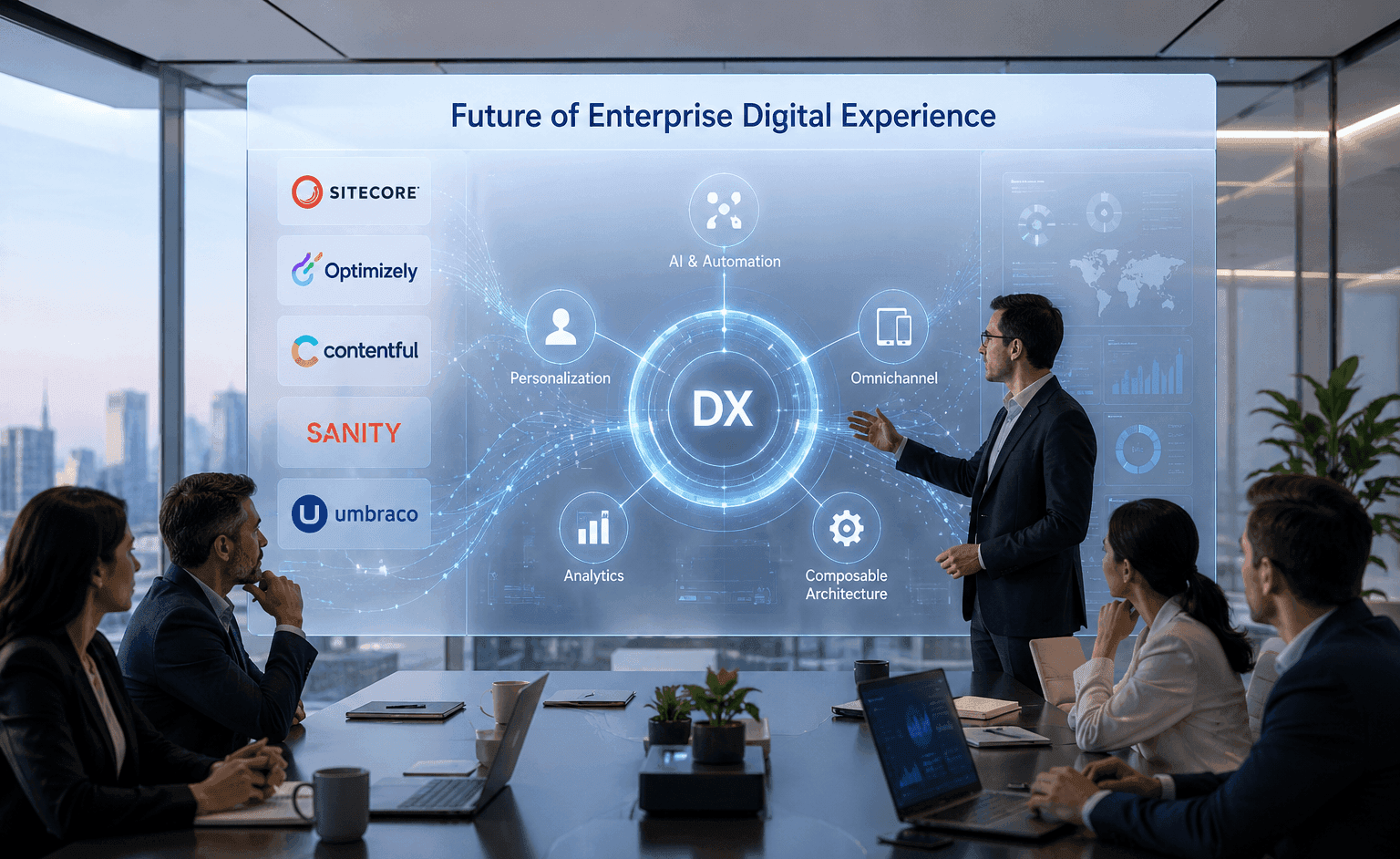
- Why Sitecore Still Dominates Enterprise Personalization
- Why Optimizely Is Winning Attention Fast
- The Rise of Composable Architecture
- The Most Underrated Enterprise CMS in 2026?
- AI Is Reshaping CMS & DXP Platforms Faster Than Expected
- The Future Belongs to Operationally Agile Organizations
- “There is no universal “best” CMS or DXP platform.
- The smartest organizations are choosing the platform helps their teams move faster without increasing operational friction. “
Digital transformation projects are failing more quietly than ever.
Not because organizations lack technology.
Not because enterprise platforms are weak.
But because many companies are still choosing CMS and Digital Experience Platforms (DXPs) the same way they did 10 years ago.
That approach no longer works.
In 2026, your CMS is not just a content management system.
It has become the operational engine behind:
- Customer experience
- AI-driven engagement
- Omnichannel delivery
- Marketing agility
- Developer productivity
- Enterprise scalability
- Digital innovation speed
And that changes the entire decision-making process.
The organizations winning today are not necessarily the ones with the biggest technology stack.
They are the ones that can:
🗲 Launch faster
🗲 Adapt faster
🗲 Personalize faster
🗲 Innovate faster
This is why the enterprise CMS market is undergoing one of the biggest shifts in its history.
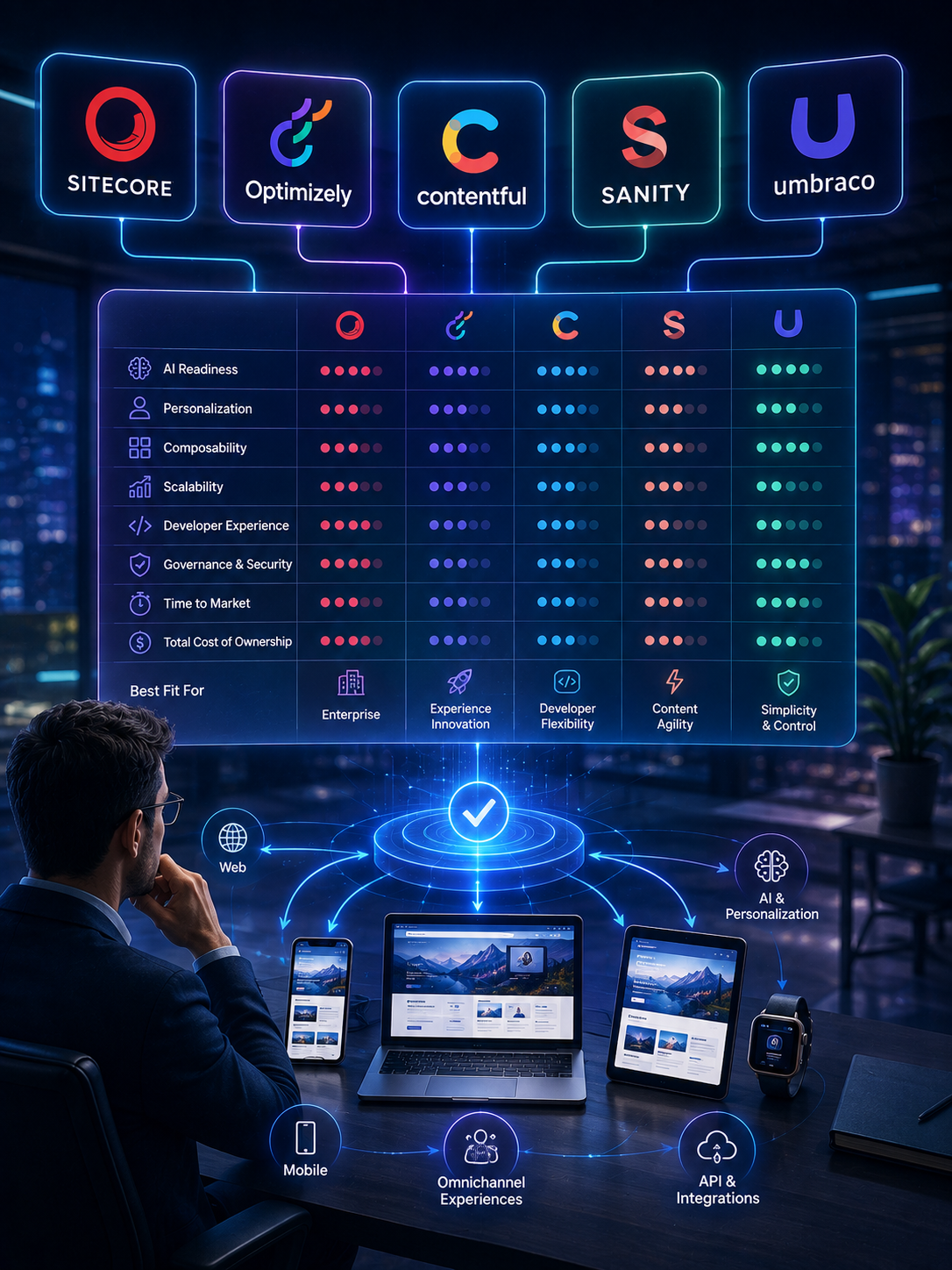
Choose The Right CMS With Confidence
Compare leading CMS and DXP platforms across scalability, AI readiness, personalization, flexibility, governance, developer experience, and total cost.
The CMS Conversation Has Moved from IT Rooms to Boardrooms
A decade ago, CMS discussions were mostly technical.
Today, CEOs, CIOs, CTOs, Operations Heads, Marketing Leaders, and Digital Transformation Teams are directly involved in platform selection.
Why?
Because the wrong CMS decision now impacts:
- Revenue growth
- Operational efficiency
- Customer retention
- AI readiness
- Go-to-market speed
- Vendor dependency
- Innovation capability
Modern organizations are no longer evaluating platforms only based on features.
They are evaluating:
- Organizational agility
- Total cost of ownership (TCO)
- Speed of execution
- Long-term scalability
- Operational simplicity
- Integration flexibility
And this is where many enterprises are struggling.
Build AI-Ready CMS & DXP Solutions
The Biggest Enterprise Mistake: Buying Technology Beyond Organizational Maturity
One of the most common mistakes enterprises make is selecting platforms based on trends instead of operational readiness.
A large enterprise DXP does not automatically guarantee better digital experiences.
A composable architecture does not automatically guarantee agility.
A headless CMS does not automatically guarantee scalability.
Technology only works when it aligns with:
- Team capability
- Internal workflows
- Engineering maturity
- Governance structure
- Business goals
This is the reality many vendors avoid discussing.
We’ve seen organizations invest heavily in enterprise-grade platforms only to discover:
- Teams are not trained
- Content operations remain slow
- Marketing still depends on developers
- Governance becomes overly complex
- Operational costs increase dramatically
The result?
Digital transformation slows down instead of accelerating.
The New Enterprise Battlefield: Speed
The future competitive advantage is no longer only about technology capability.
It is about speed.
The organizations that will dominate the next decade are the ones that can:
- Launch campaigns faster
- Deliver customer experiences faster
- Experiment faster
- Personalize faster
- Adapt faster to market changes
This is why enterprise CMS platforms are evolving rapidly.
The market is shifting toward:
- AI-enabled workflows
- Composable architecture
- API-first ecosystems
- Omnichannel content operations
- Real-time personalization
- Faster developer workflows
And every major platform is trying to position itself differently in this transformation.
Why Sitecore Still Dominates Enterprise Personalization
Sitecore continues to be one of the most powerful enterprise DXP ecosystems available.
Its strength lies in:
- Advanced personalization
- Enterprise governance
- Multi-brand management
- AI-powered digital experiences
- Large-scale customer journey orchestration
For global enterprises with complex operational ecosystems, Sitecore remains incredibly powerful.
But there’s an important reality:
Power comes with complexity.
Organizations considering Sitecore must realistically evaluate:
- Implementation cost
- Specialized expertise requirements
- Long onboarding cycles
- Operational overhead
- Vendor dependency
For mature enterprises, the investment can make strategic sense.
For others, it can become operationally overwhelming.
Why Optimizely Is Winning Attention Fast
Optimizely has gained significant momentum because it aligns with one major enterprise priority:
Optimization.
Modern organizations want measurable digital ROI.
They want to know:
- Which customer journeys convert best
- Which content performs better
- Which experiences improve engagement
- Which campaigns generate revenue
This is where Optimizely stands out.
Its experimentation and A/B testing ecosystem has become one of its strongest competitive advantages.
For many organizations, experimentation is becoming more valuable than simply publishing content.
Because optimization culture directly impacts business growth.
The Rise of Composable Architecture
One of the biggest changes in enterprise technology is the rapid growth of composable architecture.
Platforms like Contentful and Sanity are leading this movement.
Why?
Because enterprises increasingly want:
- Flexibility
- API-first ecosystems
- Frontend freedom
- Faster integrations
- Omnichannel scalability
Composable architecture allows organizations to build highly customized digital ecosystems rather than relying on rigid monolithic platforms.
But composability introduces another challenge:
Complexity management.
Without strong governance and engineering maturity, composable ecosystems can become fragmented very quickly.
This is why composable architecture works best when organizations have:
➜ Strong development teams
➜ Clear operational governance
➜ Long-term architectural planning
Why Sanity Is Becoming a Developer Favorite
Among modern engineering teams, Sanity is gaining serious attention.
Its biggest strengths are:
- Structured content modeling
- Real-time collaboration
- Flexible schema architecture
- Exceptional developer experience
- Fast-moving workflows
Sanity feels more like a modern content operating system than a traditional CMS.
For digital-native organizations, this creates enormous operational flexibility.
And in today’s market, flexibility often equals speed.
The Most Underrated Enterprise CMS in 2026?
Umbraco may be one of the most underrated enterprise platforms right now.
Why?
Because many organizations are beginning to prioritize:
- Lower total cost
- Faster implementation
- Reduced vendor lock-in
- Easier governance
- Operational simplicity
Not every enterprise needs a massive DXP ecosystem.
Many organizations simply need:
- Stability
- Scalability
- Flexibility
- Faster deployment
- Better ROI
This is where Umbraco creates strong value.
Especially for:
- Mid-market enterprises
- Microsoft/.NET ecosystems
- Agile digital teams
- Cost-conscious modernization initiatives
Transform Your Enterprise Digital Experience Faster
AI Is Reshaping CMS & DXP Platforms Faster Than Expected
AI is no longer an “additional feature.”
It is becoming the operational layer of digital experience platforms.
Modern organizations now expect:
- AI-assisted content operations
- AI-powered personalization
- AI search experiences
- Automated workflows
- Faster customer engagement
- Predictive digital experiences
The platforms that adapt fastest to AI-native operations will likely dominate the next phase of the market.
And this transformation is happening much faster than many enterprises expected.
The Future Belongs to Operationally Agile Organizations
The next decade of digital transformation will not be won by companies with the most expensive technology stack.
It will be won by organizations that can:
🗲 Execute faster
🗲 Innovate faster
🗲 Experiment faster
🗲 Adapt faster
🗲 Personalize faster
This is the new competitive reality.
The CMS market is no longer about managing websites.
It is about enabling organizational agility at scale.
And that’s why choosing the right platform has become one of the most important strategic decisions enterprises make today.
“There is no universal “best” CMS or DXP platform.
Only the platform that best aligns with:
- Your business maturity
- Your operational model
- Your engineering capability
- Your governance requirements
- Your AI strategy
- Your innovation goals
The smartest organizations are choosing the platform helps their teams move faster without increasing operational friction. “
Murmu Software Infotech work with organizations exploring:
- Enterprise CMS modernization
- Headless & composable architecture
- AI-driven digital transformation
- DXP strategy consulting
- Custom enterprise platforms
If your organization is planning its next digital transformation initiative, now is the right time to rethink what your CMS should truly enable for the future.
Frequently Asked Questions
Which CMS is best in 2026: Sitecore, Optimizely, Contentful, Sanity or Umbraco?
There is no universal best CMS. Sitecore is a strong fit for enterprises needing an integrated digital experience platform and personalization, Optimizely is strong for experimentation and optimization, Contentful suits composable content strategies, Sanity is highly flexible for structured content and developer-led architectures, and Umbraco is attractive for organizations seeking flexible .NET development and open-source options.
What is the difference between Sitecore and Optimizely?
Sitecore is positioned as an AI-native digital experience platform connecting content, data, personalization and AI automation, while Optimizely combines CMS capabilities with experimentation, personalization, data and optimization tools. The better choice depends on the organization's digital experience and optimization requirements.
Is Sitecore better than Contentful?
Sitecore can be a better fit for enterprises requiring integrated content, personalization, search, customer data and AI capabilities, while Contentful can be a better fit for organizations prioritizing composable, API-first content management and flexible integrations.
What is the difference between Contentful and Sanity?
Both support structured and headless content architectures, but Contentful emphasizes a composable content platform and enterprise content operations, while Sanity emphasizes a highly customizable Content Operating System, code-defined schemas, real-time collaboration and developer flexibility.
Is Sanity better than Umbraco?
Sanity is generally attractive for modern headless, structured-content and developer-led architectures, while Umbraco is particularly attractive for organizations that want a flexible .NET CMS with open-source options and control over their implementation.
Which CMS is best for enterprise websites?
The best enterprise CMS depends on requirements. Sitecore and Optimizely are strong candidates for organizations needing extensive digital experience, personalization and optimization capabilities, while Contentful, Sanity and Umbraco can be compelling where composability, flexibility, developer control or implementation simplicity are higher priorities.
Which CMS is best for headless development?
Contentful and Sanity are strong headless and structured-content choices, while Sitecore also supports modern headless architectures. The best option depends on frontend requirements, content modeling, governance, personalization, integrations and the development team's preferred architecture.
Which CMS is best for AI and personalization?
Sitecore and Optimizely are strong options when AI, personalization and experience optimization are central requirements. SitecoreAI unifies content, data, personalization and AI automation, while Optimizely provides real-time personalization and experimentation capabilities.
Which CMS has the lowest total cost of ownership?
Total cost depends on licensing, implementation, hosting, integrations, development, support and ongoing operations. Umbraco can be attractive for organizations prioritizing cost control and open-source flexibility, while Contentful and Sanity can reduce infrastructure management through managed cloud approaches. Enterprise Sitecore and Optimizely implementations may justify higher costs when advanced DXP capabilities are required.
How should a company choose between Sitecore, Optimizely, Contentful, Sanity and Umbraco?
Start with business goals and technical requirements rather than brand preference. Evaluate personalization, AI capabilities, content modeling, headless requirements, developer skills, integrations, governance, scalability, editorial workflows, implementation complexity, licensing and five-year total cost of ownership.