Development / MVP Application Development
Custom MVP Development with AI: How Enterprises Launch Faster in 2026
PPrem Murmu6 Min Read
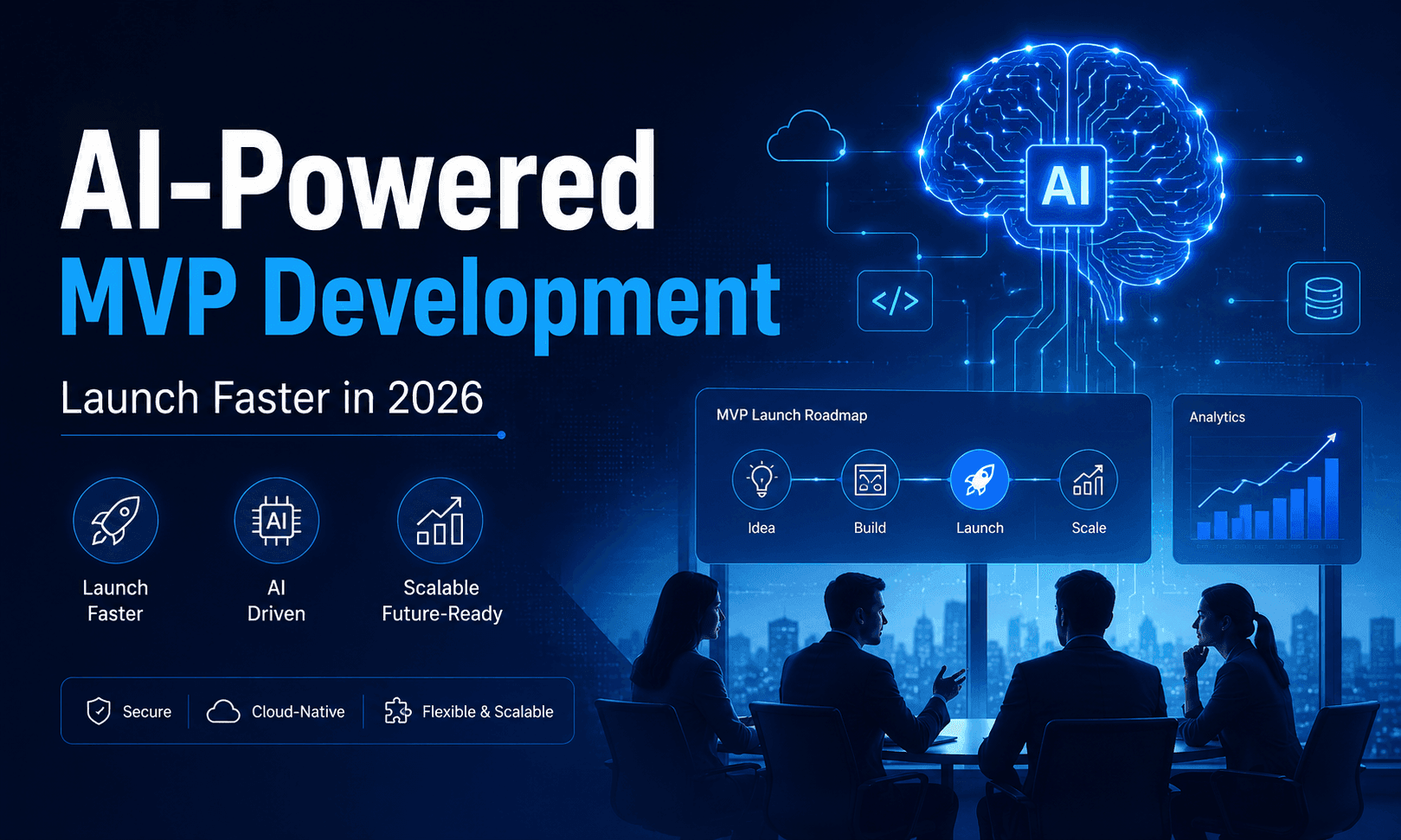
In 2026, speed is no longer just a competitive advantage — it is a survival requirement. Enterprises that take 12–18 months to validate a product idea often lose market share before launch. Meanwhile, AI-powered businesses are rapidly releasing scalable digital products in weeks, not years.
For CXOs, CEOs, CTOs, Managing Directors, IT Heads, Product Leaders, and Founders, the biggest challenge today is balancing innovation speed with scalability, quality, and long-term ownership.
This is where custom MVP development AI strategies are reshaping enterprise software delivery.
AI-powered MVP development enables organizations to:
Combined with modern architecture, automation, headless platforms, and intelligent workflows, AI-driven MVP development is helping enterprises move from idea to market significantly faster in 2026.
Most enterprise organizations struggle with the same product development bottlenecks:
Traditional software development methods are often too slow for modern market dynamics.
In many enterprises, launching a new digital platform or SaaS product still takes:
By the time products launch, customer expectations may already have evolved.
For leadership teams, delayed launches create:
Enterprise software costs continue to increase due to:
Without efficient delivery models, organizations struggle to maintain profitability while innovating rapidly.
This is why many enterprises are now investing in custom MVP development AI frameworks to optimize costs while improving speed.

Accelerate product validation, reduce development costs, and build scalable enterprise MVPs with AI-powered engineering, modern architecture, and smarter product planning.
Many businesses successfully launch MVPs but fail to scale them efficiently.
Common problems include:
An MVP should not only validate an idea — it should also create a scalable foundation for future growth.
One of the biggest frustrations for CXOs and delivery leaders is the lack of accurate project forecasting.
Unexpected delays often result from:
This is where a modern software development calculator powered by AI becomes highly valuable.
AI-driven estimation tools now help enterprises:
The global digital economy is moving faster than ever before.
Organizations that validate ideas quickly gain:
The faster an enterprise launches and validates a product:
In highly competitive sectors like:
speed-to-market directly impacts growth potential.
Artificial Intelligence is no longer limited to automation or chatbots.
AI is now actively improving:
Modern enterprises are leveraging AI not to replace engineering teams, but to dramatically improve productivity and decision-making.
AI-powered MVP development combines automation, intelligent tooling, modern architecture, and rapid iteration strategies.
This enables enterprises to build scalable products significantly faster than traditional development methods.
One of the biggest advantages of AI is rapid idea validation.
AI tools can analyze:
This helps leadership teams prioritize high-value product initiatives before major investment.
Instead of relying only on assumptions, enterprises can make data-driven decisions early in the MVP lifecycle.
AI-assisted development workflows significantly reduce manual effort.
Modern AI development ecosystems support:
This accelerates development while improving consistency and reducing human error.
For enterprise teams, this means:
Modern MVPs are increasingly built using:
This approach ensures long-term scalability from day one.
Instead of rebuilding systems later, enterprises can evolve products rapidly as demand grows.
A major innovation in 2026 is the rise of intelligent project estimation platforms.
A modern software development calculator uses AI to estimate:
This gives CXOs and delivery managers greater visibility into project planning and ROI forecasting.
Benefits include:
AI-powered MVPs can now integrate:
This improves:
For enterprises, personalized experiences increasingly drive long-term digital growth.
| Feature | Traditional MVP Development | AI-Powered MVP Development |
|---|---|---|
| Development Speed | Slow | Rapid |
| Cost Efficiency | Higher costs | Optimized costs |
| Market Validation | Delayed | Faster validation |
| Scalability Planning | Often reactive | Built-in scalability |
For enterprise decision-makers, this shift creates measurable business advantages.
The future of enterprise MVP delivery depends heavily on:
Modern enterprises are moving away from monolithic systems toward composable digital architectures.
This improves:
No-code tools may help validate small ideas quickly, but enterprise organizations often require:
This is why custom MVP development AI solutions are becoming the preferred strategy for enterprise innovation.
Custom development provides:
while AI accelerates the delivery process.
Technology alone does not guarantee successful execution.
The quality of architecture, planning, and scalability strategy significantly affects long-term product success.
An experienced MVP development partner helps enterprises:
A strong partner understands business objectives — not just technology implementation.
Scalable MVPs require strong cloud-native and API-first architecture planning.
Enterprises need partners experienced in:
Products should be designed for future growth from the beginning.
Enterprises should retain:
By 2026, enterprise software delivery is becoming:
Organizations embracing AI-powered development models are reducing delivery timelines while improving innovation efficiency.
The enterprises that succeed in the next digital decade will be those capable of:
Modern enterprises can no longer afford slow product delivery cycles.
AI-powered development is fundamentally transforming how organizations:
With the right custom MVP development AI strategy, enterprises can launch scalable products significantly faster while maintaining flexibility, security, and long-term ownership.
Combined with intelligent planning tools like a software development calculator, organizations gain greater visibility, operational efficiency, and confidence in digital product execution.
In 2026, speed, scalability, and intelligent automation are becoming the foundation of enterprise competitiveness.
If your organization is planning to:
our enterprise MVP specialists can help you deliver faster with scalable, AI-powered development strategies.
Connect with our enterprise technology consultants to discover how AI-powered MVP development can help your organization launch faster, scale smarter, and compete more effectively in 2026.
Custom MVP development with AI is the process of building a focused first version of an enterprise product using AI-assisted discovery, development, testing, automation or personalization while maintaining custom code, scalability, security and long-term ownership.
AI can accelerate product discovery, UI and prototype generation, code development, debugging, testing, API development, documentation and workflow automation. Human engineers still validate architecture, security, quality and production readiness.
Enterprise MVP development cost depends on product scope, features, integrations, architecture, security, infrastructure, AI capabilities, user roles and compliance requirements. A reliable estimate should be created after defining the MVP scope and technical requirements.
| Manual estimation |
| AI-assisted forecasting |
| QA & Testing | Time-consuming | Automated workflows |
| Personalization | Limited | AI-driven experiences |
| Deployment Cycles | Longer | Agile & continuous |
| Data Insights | Basic analytics | Predictive intelligence |
| Time-to-Market | Months | Weeks |
An enterprise MVP can take several weeks to several months depending on scope, integrations, approval processes, security requirements, data readiness and architecture complexity. AI-assisted engineering can reduce manual effort but does not eliminate enterprise testing and governance.
No-code tools can be useful for simple validation, but enterprises often need full code ownership, security controls, enterprise integrations, scalability, custom workflows, governance and long-term flexibility that custom development provides.
The right architecture depends on the product, but API-first, cloud-native, headless, modular and composable approaches can provide a strong foundation for enterprise MVPs that need to evolve as users, integrations and business requirements grow.
Yes. AI can be integrated into an existing MVP for capabilities such as intelligent search, recommendations, personalization, document processing, workflow automation, predictive analytics, customer support and AI-assisted decision-making.
Enterprises can reduce risk by defining a focused MVP scope, validating the business case early, using measurable outcomes, selecting scalable architecture, conducting security and technical reviews, automating appropriate testing and avoiding unnecessary features.
Enterprises should evaluate product strategy, AI engineering experience, architecture expertise, security practices, scalability planning, integration capabilities, QA, deployment experience, code ownership and the partner's ability to connect technical decisions with measurable business outcomes.
Yes. A well-designed MVP can become the foundation for a production platform when its architecture, APIs, database, cloud infrastructure, security and development practices are designed to support future users, integrations and functionality.