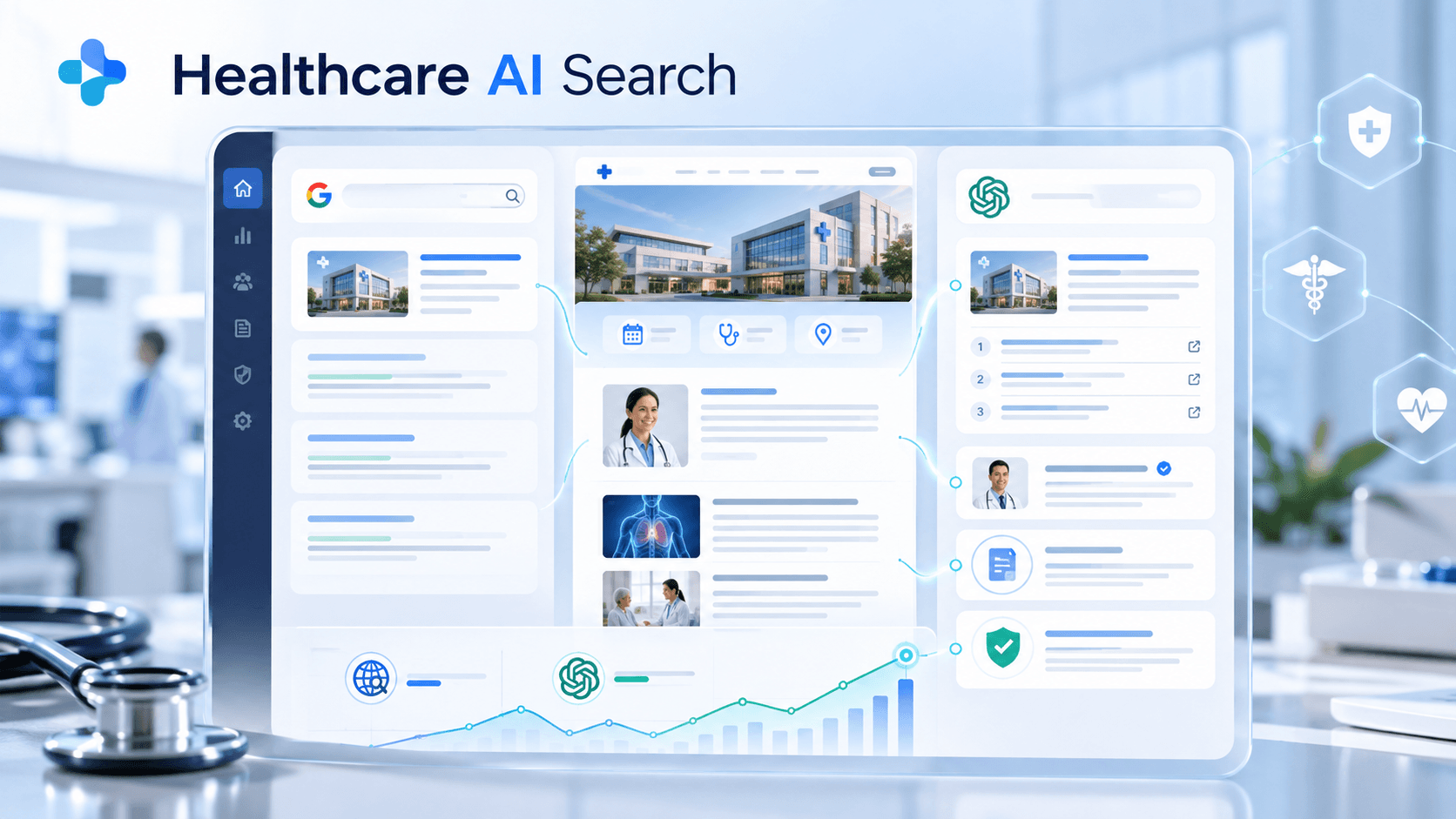
Healthcare AI Search Optimization for Hospitals, Clinics and Pharma CMS
In This Article
- Why Healthcare AI Search Optimization Is Different
- Build a Healthcare CMS Around Medical Entities
- Optimize Doctor and Department Pages for Search Intent
- Turn Patient Questions Into AEO Content
- Strengthen Medical Content With E-E-A-T
- Use Structured Data Carefully
- Add GEO and Citation Readiness
- Pharma CMS Optimization Requires Additional Governance
- Measure More Than Rankings
- Make Healthcare Content Discoverable
Healthcare search is moving beyond traditional rankings.
Patients may ask an AI assistant about symptoms, procedures, specialists, hospital services or treatment options. Healthcare professionals may research therapies, clinical evidence or pharmaceutical products through AI-powered search experiences before visiting a website.
That creates a new visibility challenge for hospitals, clinics and pharma teams:
Can search engines and AI systems clearly understand, trust and retrieve your medical content?
Effective healthcare AI search optimization combines traditional healthcare SEO with Answer Engine Optimization (AEO), Generative Engine Optimization (GEO), structured medical content, technical CMS architecture and strong trust signals.
Why Healthcare AI Search Optimization Is Different
Healthcare content carries a higher trust requirement than most commercial content.
Google classifies health-related information within the broader YMYL framework and says its systems place greater weight on signals associated with strong E-E-A-T for topics that can significantly affect people's health or safety. Trust is the most important component of E-E-A-T.
For hospitals, clinics and pharmaceutical organizations, optimization therefore cannot simply mean adding keywords.
The content should make it clear:
- who wrote or reviewed the information
- what medical expertise supports it
- when it was reviewed
- which condition, treatment or specialty it covers
- what evidence supports important claims
- who the information is intended for
This combination strengthens both traditional hospital website SEO and AI-search readiness.
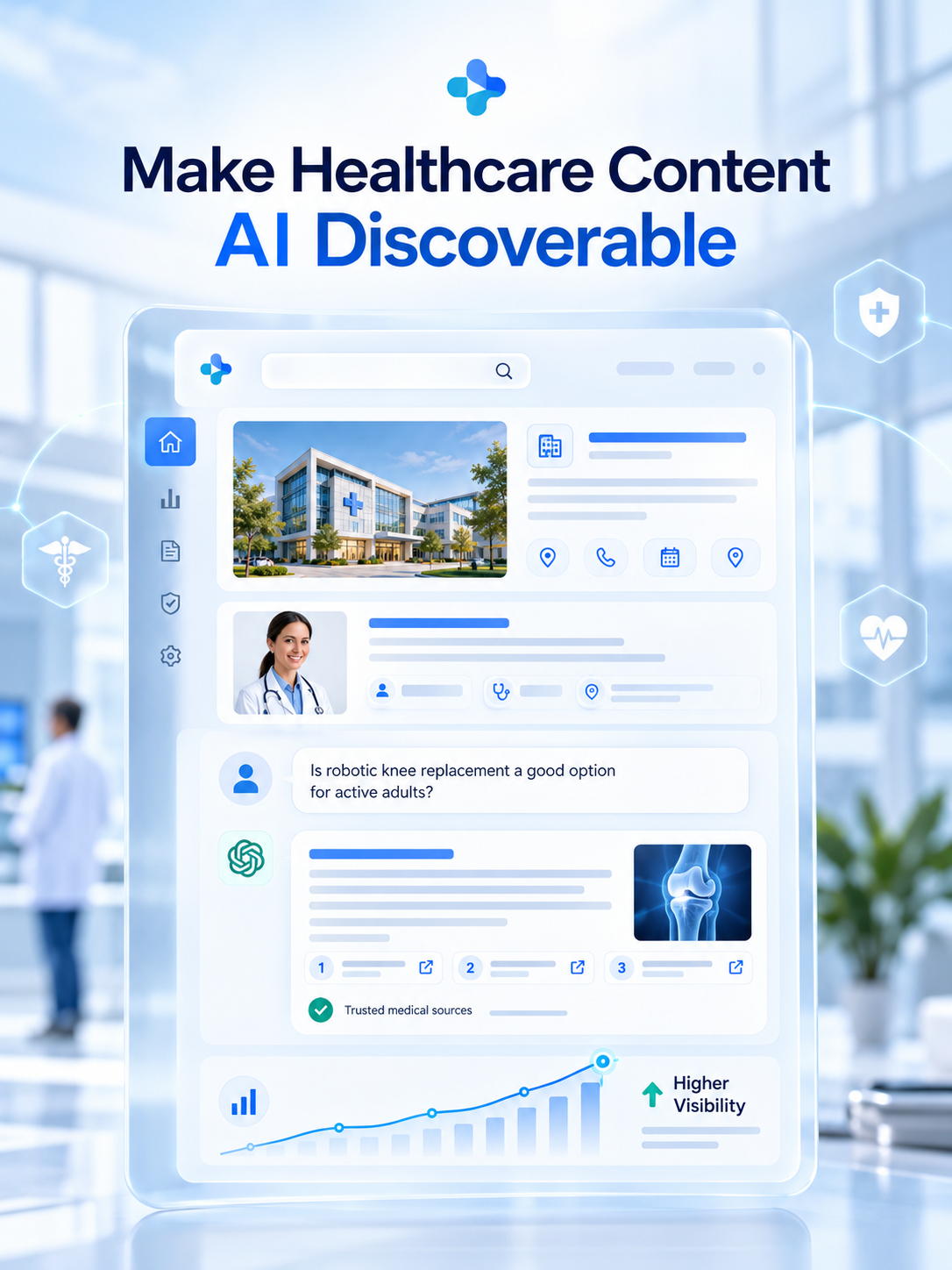
Make Healthcare Content AI Discoverable
Structure hospital, clinic and pharma content for stronger search visibility, trusted answers, AEO, GEO and AI citation readiness.
Build a Healthcare CMS Around Medical Entities
One of the biggest opportunities in healthcare CMS SEO is moving from unstructured pages toward reusable medical entities.
A modern healthcare CMS should distinguish between:
- doctors
- specialties
- departments
- conditions
- treatments
- procedures
- hospital locations
- medications
- clinical studies
- patient education resources
For example, a cardiologist page should connect logically with cardiology, relevant procedures, hospital locations and related patient education.
Healthcare AI-search research increasingly emphasizes entity architecture and machine-readable relationships between conditions, treatments, specialties, providers and locations.
This is where dedicated Healthcare CMS Development Services can become more valuable than simply publishing more standalone articles.
Optimize Doctor and Department Pages for Search Intent
Doctor and department pages are among the most commercially important assets on a hospital website.
A weak page may contain only a name, photo and short biography.
A stronger page can clearly define:
- specialty
- qualifications
- experience
- procedures performed
- conditions treated
- hospital or clinic location
- appointment information
- medically reviewed FAQs
These details help patients make decisions while creating clearer entity relationships for search systems.
Healthcare GEO frameworks also emphasize physician entity authority and structured medical content libraries as important elements for hospitals and providers.
Make Healthcare Content Visible Across Search and AI
Turn Patient Questions Into AEO Content
Patients rarely search using only clinical terminology.
They ask:
What are the symptoms?
Which doctor should I see?
How is this condition diagnosed?
What treatment options are available?
When should I seek medical care?
How long does recovery take?
Effective medical website AEO services turn these questions into structured content.
A useful format is:
Question → Direct Answer → Detailed Explanation → Medical Evidence → Next Step
Answer-first healthcare content can make pages easier for users and machines to interpret. Current pharma AI-search guidance also recommends question-driven pages, concise contextual answers, medical entities and visible expert credibility.
Strengthen Medical Content With E-E-A-T
For medical content optimization, every major educational or clinical page should have visible trust signals.
Consider including:
- author or medical reviewer
- reviewer credentials
- reviewed date
- supporting medical references
- editorial policy
- organization information
- clinically accurate terminology
- clear patient-versus-HCP audience labeling
Do not use AI-generated medical text as a publishing shortcut without subject-matter review.
Accuracy becomes even more important because healthcare AI systems can propagate outdated, incomplete or incorrect information. Healthcare-specific AI-search programs increasingly audit not only whether a brand appears, but whether AI-generated descriptions and citations are accurate.
Use Structured Data Carefully
Structured data can help search engines understand page entities and relationships.
Depending on the content, healthcare websites may consider relevant schema alongside supported general types such as Organization, Article, Breadcrumb and Profile-related markup.
However, schema is not a shortcut to AI visibility.
Google explicitly states that there is no special AI schema required for AI Overviews or AI Mode. Pages still need strong foundational SEO, indexability, internal linking, useful textual content, page experience and structured data that accurately matches visible information.
That makes structured data one layer of the architecture not the entire strategy.
Add GEO and Citation Readiness
A page can rank organically and still fail to appear in generative answers.
Healthcare GEO asks a different question:
Is this content clear, authoritative and evidence-rich enough to become a useful supporting source?
Improve citation readiness with:
- original clinical expertise
- expert commentary
- clear medical definitions
- evidence-backed claims
- structured facts
- medical reviewer information
- research references
- updated statistics
- strong entity relationships
Pharma AI-search programs are increasingly measuring presence, accuracy, source influence and citation performance instead of relying entirely on traditional traffic metrics.
Explore broader AI Search Optimization Services for AEO, GEO, citation readiness and AI visibility auditing.
Plan Your Healthcare SEO and AI Visibility Strategy
Pharma CMS Optimization Requires Additional Governance
Pharmaceutical websites introduce another layer of complexity.
Content may target patients, HCPs, caregivers or payers and those audiences should not always receive the same information.
A strong pharma CMS optimization strategy should support:
- audience classification
- medical and legal review workflows
- claims governance
- approved medical references
- content expiration
- version control
- structured product and therapeutic-area content
- controlled HCP access where appropriate
AI visibility must never come at the expense of medical accuracy, privacy or regulatory requirements.
Measure More Than Rankings
A healthcare AI-search program should monitor:
- organic visibility
- AI citations
- cited URLs
- brand mentions
- doctor and hospital entity visibility
- target-question coverage
- competitor citation share
- appointment and enquiry conversions
- content accuracy
- AI-generated misinformation or outdated references
Healthcare GEO research increasingly treats citation visibility and accuracy as distinct metrics from traditional rankings.
For complex Sitecore-powered healthcare environments, technical CMS performance and structured-content implementation can also be supported through Sitecore SEO Services.
Make Healthcare Content Discoverable
Healthcare organizations now need content that works for patients, clinicians, traditional search engines and emerging AI discovery experiences.
The strongest strategy connects healthcare SEO + AEO + GEO + CMS architecture + medical trust.
Structure doctor, department, treatment, patient education and pharmaceutical content so it can be discovered, understood, verified and maintained accurately.
CTA: Optimize Healthcare Content
Frequently Asked Questions
What is healthcare AI search optimization?
Healthcare AI search optimization improves how hospital, clinic, pharmaceutical and medical content is discovered, understood and referenced across traditional search engines and AI-driven search experiences. It combines technical SEO, structured medical content, AEO, GEO, trust signals, schema, entity clarity and citation readiness.
How is healthcare AI search optimization different from traditional healthcare SEO?
Traditional healthcare SEO focuses heavily on crawling, indexing, rankings and organic traffic. AI search optimization keeps those foundations but also improves direct answers, medical entity relationships, source credibility, content structure and citation readiness for AI-generated search experiences.
What should hospital website SEO include?
Hospital website SEO should include technical crawl and index optimization, doctor and department pages, service and treatment content, internal linking, local information, page performance, structured data, medical review signals, patient FAQs, AEO, GEO and conversion paths for appointments or enquiries.
How can hospitals improve visibility in AI search?
Hospitals can improve AI search visibility by creating clear doctor, specialty, department, condition, procedure and patient education pages; strengthening medical authorship and review signals; answering patient questions directly; improving internal entity relationships; and keeping information accurate and current.
What is medical website AEO?
Medical website Answer Engine Optimization structures healthcare content around real patient and professional questions. It uses concise factual answers, clear headings, FAQs, definitions, explanatory sections and supporting evidence so answer systems can understand the content more efficiently.
What is healthcare GEO?
Healthcare Generative Engine Optimization improves the clarity, authority, evidence and citation readiness of healthcare content for generative AI experiences. It emphasizes accurate medical information, clear entities, expert review, trustworthy references, original expertise and structured facts.
Why is E-E-A-T important for healthcare content?
Healthcare information can significantly affect people's health and safety, so strong trust and expertise signals are especially important. Healthcare pages should make authorship, medical review, credentials, evidence, editorial responsibility and content freshness clear to users.
How should healthcare CMS content be structured for AI search?
A healthcare CMS should use reusable structured content for doctors, specialties, departments, conditions, procedures, locations, FAQs, authors, medical reviewers, references and review dates. Strong relationships between these entities make large healthcare content libraries easier to manage and understand.
How should pharma content be optimized for AI search?
Pharma AI search optimization should combine technical SEO, clear therapeutic-area and product entities, evidence-backed content, audience classification, medical review, content governance, approved references, AEO and GEO while respecting applicable regulatory and promotional requirements.
How do you measure healthcare AI search visibility?
Healthcare AI visibility can be measured using organic visibility, cited URLs, citation frequency, grounding queries, brand and entity mentions, doctor or service visibility, AI referral traffic, target-question coverage, appointment conversions and the accuracy of information surfaced by AI systems.