Case Study Lab Management System Software (LIMS) for Diagnostic Centers & Hospitals
In This Article
- Why Diagnostic Centers Need LIMS Software
- Hospital & Lab Workflow Diagram
- OPD to Lab and Billing Workflow
- Doctor, Patient, Technician & Admin Roles
- Doctor Workflow
- Patient Experience
- Lab Technician Workflow
- Hospital Admin & Lab Management
- Core LIMS Features
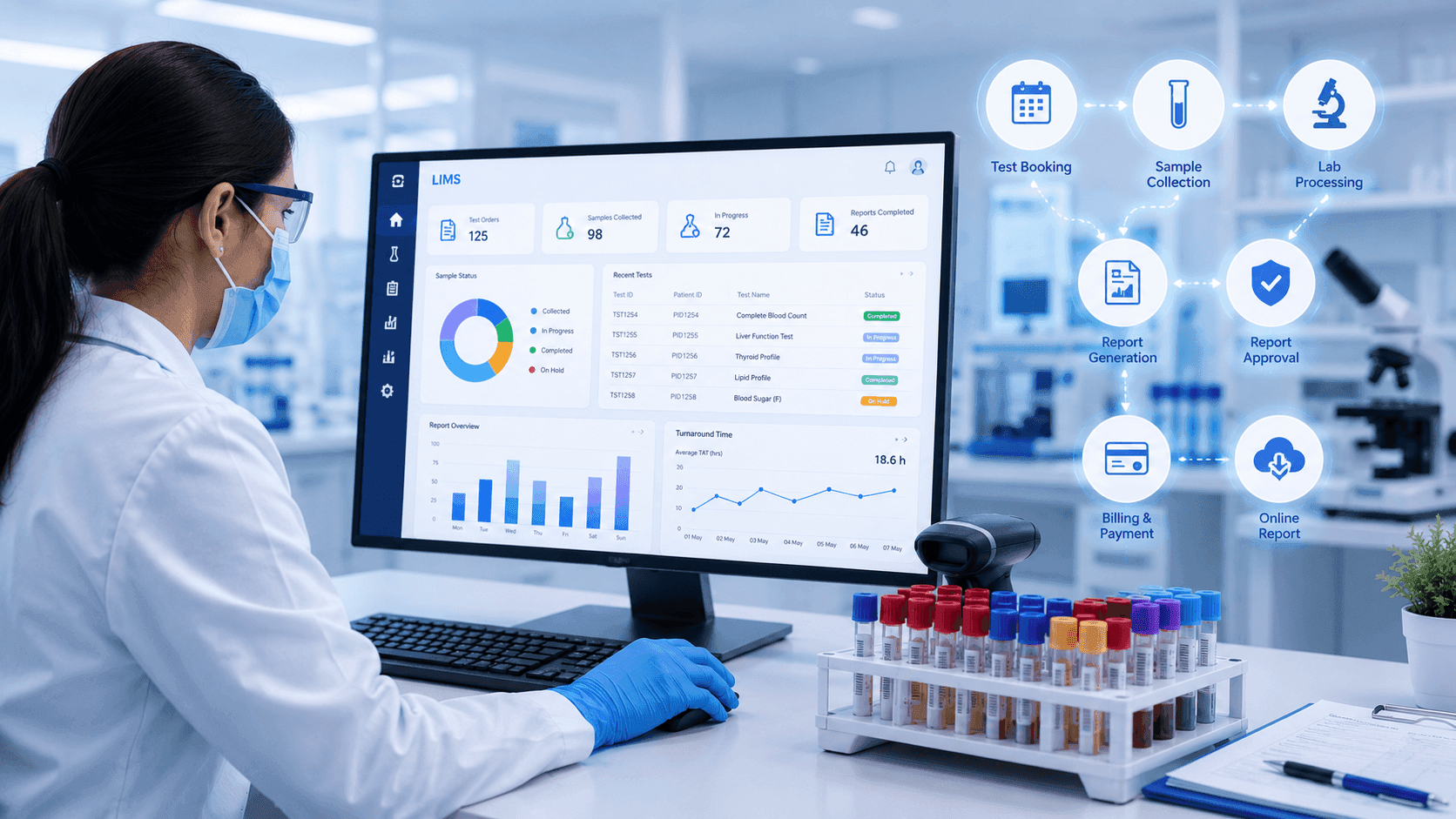
- Test Booking Management
- Sample Tracking
- Digital Report Generation
- Report Approval
- Billing & Payments
- Online Report Delivery
- Diagnostic Package Management
- Lab Analytics
- Healthcare Software Development Services
- Build a Connected Diagnostic Ecosystem
- See LIMS Software in Action
- What is LIMS software?
- Who uses LIMS software?
- Can LIMS connect with hospital software?
- Can LIMS track samples?
- Can patients download reports online?
- Can doctors approve laboratory reports?
- Does LIMS support lab billing?
- Can LIMS manage diagnostic packages?
- Can LIMS support multiple technicians?
- Can LIMS provide analytics?
- Conclusion
Diagnostic laboratories are a critical part of modern healthcare. Hospitals, pathology labs, and diagnostic centers must manage test bookings, sample collection, technician assignments, diagnostic processing, report approval, billing, and patient report delivery accurately and efficiently.
When these activities depend on paper registers, spreadsheets, disconnected billing tools, or isolated applications, laboratories can face sample-tracking problems, reporting delays, billing errors, duplicate data entry, and limited operational visibility.
Murmu Software Infotech developed a Lab Management System Software (LIMS) designed to centralize diagnostic workflows and connect laboratory operations with hospitals, doctors, patients, billing teams, and administrators.
For organizations planning a wider connected healthcare platform, explore our Healthcare Software Development Services.
Why Diagnostic Centers Need LIMS Software
A modern laboratory manages much more than test results.
Typical operational challenges include:
- Manual test booking
- Sample identification errors
- Poor sample movement visibility
- Delayed report generation
- Technician coordination issues
- Disconnected billing
- Manual report approval
- Difficulty sharing reports with patients
- Limited management analytics
- Poor integration with hospital workflows
A LIMS creates one digital workflow from test order through report delivery.
Connect Your Entire Lab Workflow
Manage test bookings, samples, technicians, billing, approvals and digital reports through one connected laboratory management platform.
Hospital & Lab Workflow Diagram
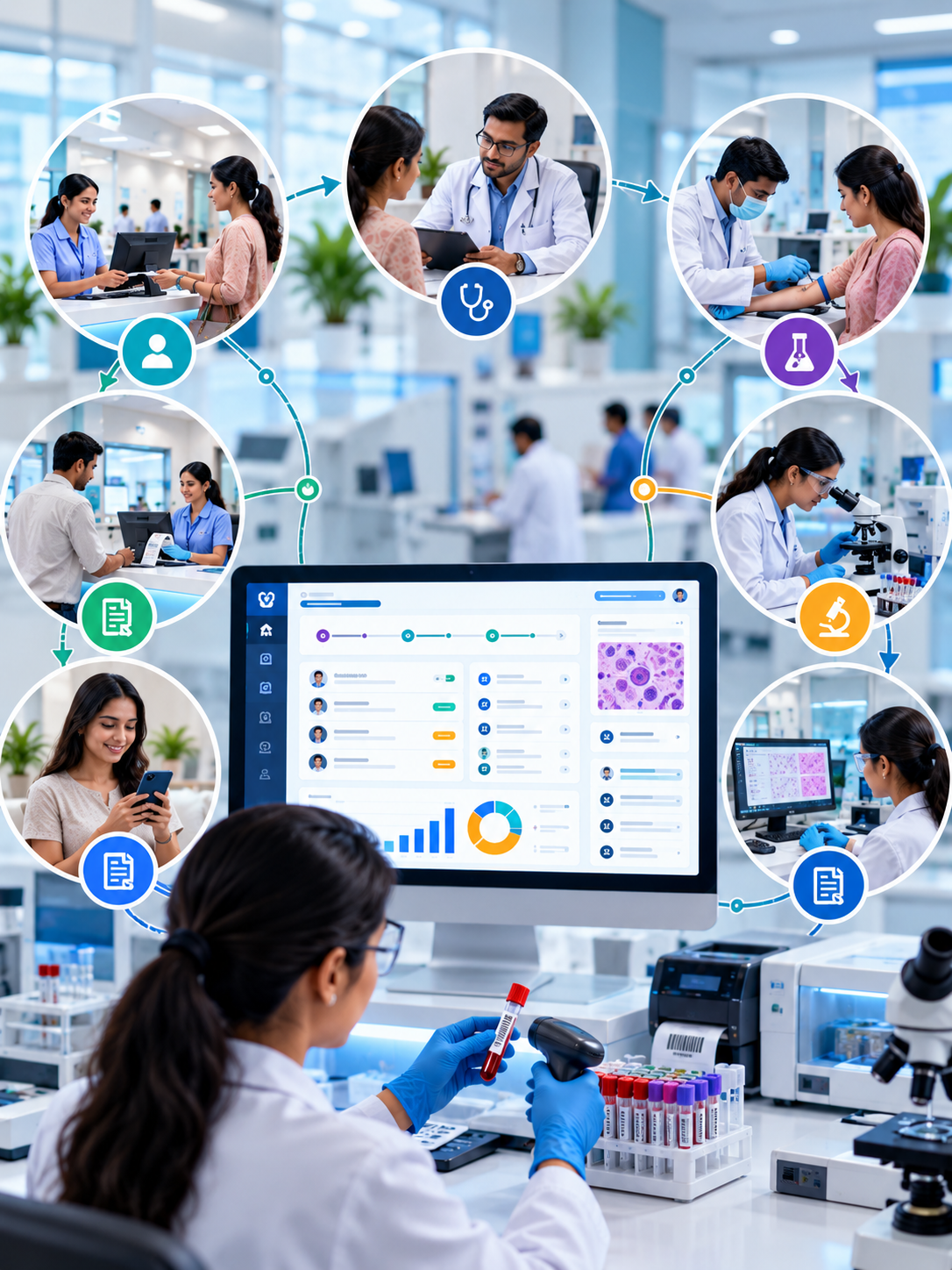
A connected hospital diagnostic workflow can be structured as:
Patient Registration
↓
OPD / Doctor Consultation
↓
Lab Test Ordered
↓
Test Booking & Billing
↓
Sample Collection
↓
Barcode / Sample Tracking
↓
Technician Processing
↓
Result Entry
↓
Doctor / Authority Approval
↓
Digital Report Delivery
↓
Doctor Follow-Up
This structure helps connect diagnostic activity with the complete patient journey rather than treating the laboratory as an isolated department.
Hospitals that also need structured consultation queues can integrate this workflow with OPD Queue Management Software.
OPD to Lab and Billing Workflow
The diagnostic process often begins during a doctor consultation.
When a doctor requests one or more tests, those orders can move directly into the laboratory workflow.
A connected process can look like:
OPD Registration → Doctor Consultation → Diagnostic Order → Lab Booking → Billing → Sample Collection → Testing → Approval → Report → Follow-Up
Once the test order is created, pricing can be calculated according to individual tests or diagnostic packages.
After payment, the sample can be collected and assigned a unique identifier or barcode. Laboratory staff can then track each sample through collection, processing, result entry, verification, and report generation.
This reduces repeated data entry and improves traceability across the diagnostic journey.
Digitize Your Diagnostic Workflow
Doctor, Patient, Technician & Admin Roles
Doctor Workflow
Doctors need fast access to diagnostic orders and approved results.
A doctor-facing workflow may include:
Patient Consultation → Order Test → Monitor Status → Review Report → Continue Treatment
Authorized doctors can review or approve diagnostic reports depending on laboratory workflow requirements.
Healthcare organizations exploring intelligent clinical tools can extend this through AI for Doctors Software Development.
Patient Experience
Patients should receive a simple diagnostic journey.
The system can support:
- Test booking
- Package selection
- Billing and payments
- Sample status visibility
- Digital report access
- Report history
- Mobile-friendly downloads
- Email or SMS report sharing
Digital access reduces dependence on physical report collection and front-desk enquiries.
Lab Technician Workflow
Technicians need visibility into assigned work.
A technician dashboard can show:
- Samples awaiting processing
- Assigned tests
- Collection status
- Pending results
- Completed tests
- Approval status
- Turnaround workflow
This helps laboratories organize workloads and reduce manual coordination.
Hospital Admin & Lab Management
Administrators can monitor:
- Daily test volumes
- Test revenue
- Pending samples
- Technician workload
- Report turnaround
- Package performance
- Billing activity
- Operational trends
Healthcare groups that want to connect LIMS with finance, inventory, procurement, and wider hospital operations can also explore Healthcare ERP Software Development.
Core LIMS Features
Test Booking Management
Digitize patient registration, test selection, package selection, scheduling, and booking status.
Sample Tracking
Track sample collection time, barcode identifiers, technician assignment, and processing status.
Digital Report Generation
Use structured report templates, digital result entry, and automated report workflows.
Report Approval
Enable authorized doctors or staff to review, verify, and approve reports digitally.
Billing & Payments
Manage individual test pricing, diagnostic packages, invoices, and payment tracking.
Online Report Delivery
Provide secure report access through patient portals, downloadable reports, email, or SMS workflows.
Diagnostic Package Management
Create bundled healthcare packages with configurable tests and pricing.
Lab Analytics
Track test volume, billing, turnaround, technician activity, and diagnostic workflow performance.
Healthcare Software Development Services
Build a Connected Diagnostic Ecosystem
Murmu Software Infotech develops custom healthcare solutions for hospitals, laboratories, clinics, and diagnostic centers.
Solutions can include:
- LIMS
- Hospital Management Systems
- OPD platforms
- Healthcare ERP
- Telemedicine
- Patient portals
- Doctor applications
- Billing platforms
- AI-assisted healthcare workflows
- Analytics dashboards
Our focus is on connecting laboratory activity with the wider healthcare workflow instead of building another isolated software tool.
Build Smarter Lab Operations
See LIMS Software in Action
Every laboratory operates differently.
A live workflow discussion can help map your test catalog, diagnostic packages, sample process, technician workflow, report approval rules, billing model, integrations, and patient report delivery requirements.
Schedule a LIMS Demo to explore how your laboratory can digitize testing, sample tracking, billing, reporting, and operational analytics.
What is LIMS software?
LIMS software is a digital laboratory management platform that helps organize test bookings, samples, technicians, results, reports, billing, and diagnostic workflows.
Who uses LIMS software?
Hospitals, pathology laboratories, diagnostic centers, healthcare groups, technicians, doctors, administrators, and laboratory managers can use LIMS.
Can LIMS connect with hospital software?
Yes. LIMS can be integrated with patient registration, OPD, billing, doctor systems, hospital management platforms, and other healthcare applications depending on system architecture.
Can LIMS track samples?
Yes. Samples can be tracked from collection through processing and reporting using status tracking, identifiers, or barcode-based workflows.
Can patients download reports online?
Yes. Approved reports can be made available through secure online access or shared through configured digital channels.
Can doctors approve laboratory reports?
Yes. Authorized doctors or staff can participate in digital review and approval workflows.
Does LIMS support lab billing?
Yes. LIMS can manage test pricing, diagnostic packages, invoices, payment tracking, and laboratory billing workflows.
Can LIMS manage diagnostic packages?
Yes. Labs can create packages containing multiple tests and configure pricing and service details.
Can LIMS support multiple technicians?
Yes. Technician dashboards can organize assigned samples, test queues, pending work, and processing status.
Can LIMS provide analytics?
Yes. Management dashboards can track test volumes, billing, turnaround, technician activity, and operational performance.
Conclusion
Lab Management System Software is more than a digital reporting tool.
When test booking, sample tracking, billing, technician workflows, report approval, patient access, and hospital integrations work together, LIMS becomes a central diagnostic operations platform.
A connected LIMS can help hospitals and diagnostic centers improve traceability, operational visibility, report delivery, and scalability across the complete diagnostic journey.
Frequently Asked Questions
What is LIMS software?
LIMS software, or Laboratory Information Management System software, is a digital platform used to manage laboratory test bookings, samples, technicians, diagnostic processing, results, reports, billing and operational workflows.
What is the best lab management software for diagnostic centers?
The right lab management system depends on test volume, sample workflows, billing requirements, technician processes, report approvals, integrations and patient access needs. A healthcare LIMS should support end-to-end diagnostic workflows.
Can LIMS software manage pathology labs?
Yes. LIMS software can manage pathology test bookings, sample collection, barcode tracking, result entry, report approval, billing, diagnostic packages and digital report delivery.
Can LIMS integrate with hospital management software?
Yes. LIMS can integrate with hospital registration, OPD, doctor consultation, billing, patient portals and other healthcare systems depending on APIs and technical architecture.
How does LIMS track laboratory samples?
LIMS can assign unique sample identifiers or barcodes and track samples through collection, technician assignment, processing, result entry, approval and report generation.
Can doctors approve lab reports digitally?
Yes. Authorized doctors or laboratory staff can review, verify and approve diagnostic reports digitally based on configured workflows and permissions.
Does LIMS software include billing?
Yes. LIMS can support test pricing, diagnostic packages, invoice generation, payment tracking and laboratory billing workflows.
Can patients access lab reports online?
Yes. Approved reports can be provided through secure patient access, mobile-friendly downloads, patient portals, email or other configured digital channels.
Can LIMS software manage multiple lab technicians?
Yes. Technician dashboards can show assigned samples, pending tests, processing status and completed work, helping laboratories organize daily workloads.
Who should use LIMS software?
LIMS software is suitable for diagnostic centers, pathology laboratories, hospitals, multi-location healthcare organizations and other facilities that manage structured diagnostic workflows.