Marketplace App Development: Buyer, Seller, Admin and Payment Workflow Explained
In This Article
- A Marketplace Is a Multi-Sided Platform
- 1. Buyer App Workflow
- 2. Seller App or Vendor Panel Workflow
- 3. Admin Dashboard: The Marketplace Control Center
- 4. How Marketplace Payments and Commissions Work
- 5. Delivery, Fulfilment and Order Status
- 6. Disputes, Refunds and Marketplace Trust
- What Should a Marketplace MVP Include?
- Build the Workflow Before Building the Screens
- Build Marketplace App
The key difference between marketplace and regular ecommerce lies in the value proposition of both parties in a transaction.
A standard ecommerce venture focuses on direct sales of goods or services.
In a multivendor marketplace, the interplay between the participants becomes more involved:
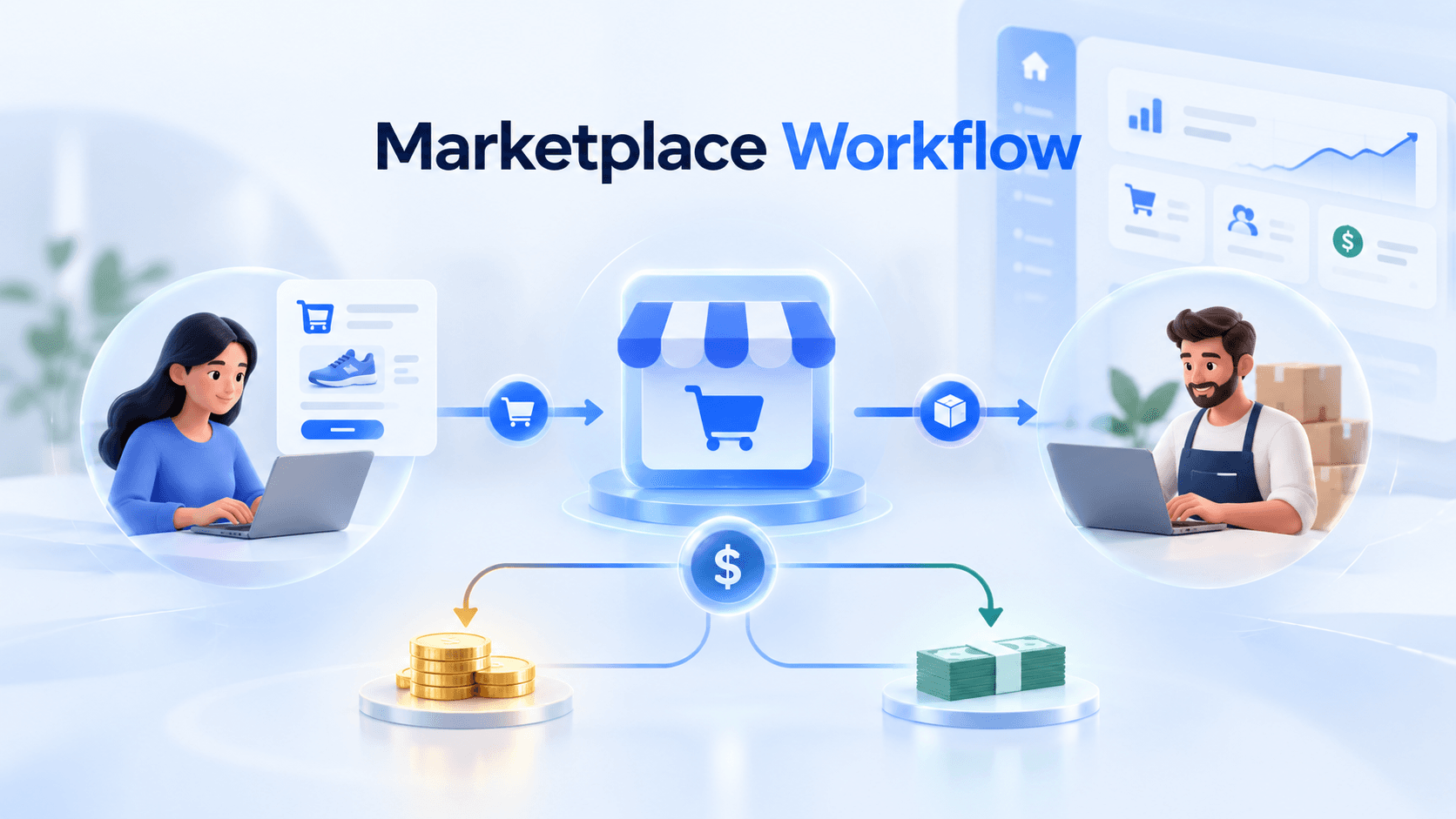
Buyer → Seller → Marketplace → Payment → Delivery → Settlement
And at the center of it all is the admin who manages the sellers, commissions, listings, disputes, refunds, payouts and marketplace performance.
For founders at the pre-development stage of a local commerce directory, product or service marketplace or multi-vendor ecommerce venture, understanding the interdependencies before launch can help avoid costly architectural compromises down the road.
When evaluating the technical foundation for your service or product directory, get familiar with how ecommerce and marketplace development touches upon storefront experiences, payments, API and backend interactions, administration and integrations.
A Marketplace Is a Multi-Sided Platform
The biggest mistake founders make is thinking:
"We just need an ecommerce app where multiple sellers can upload products."
A successful marketplace platform should have different experiences for demand, supply and operations.
The buyer wants to discover products fast and have a trustworthy transaction.
The seller wants a seamless onboarding, simple ordering and consistent payouts.
The marketplace owner wants control over commissions, users, transactions and growth.
That means the platform usually consists of:
Buyer App/Web Experience + Seller Panel + Admin Dashboard + Marketplace Backend + Payment System
Which should all be connected in a transaction engine.

Launch Your Marketplace With Confidence
Build a scalable marketplace with buyer, seller, admin, payments, commissions, delivery, and analytics designed around your business model.
1. Buyer App Workflow
The buyer experience drives marketplace demand.
A typical buyer workflow looks like:
Register → Search → Compare → View Listing → Add to Cart/Book → Pay → Track → Review
Core buyer features normally include:
- Registration and profile management
- Categories and intelligent search
- Location, price, rating and availability filters
- Product or service detail pages
- Seller ratings and reviews
- Cart or booking workflow
- Coupons and offers
- Multiple payment options
- Order or booking tracking
- Notifications
- Returns, cancellations and support
For local marketplaces, location can become especially important because buyers may want to discover nearby products or service providers.
A practical example is this local marketplace buying and selling case study, where listing discovery, location, buyer-seller communication, verification and administration work together as part of the marketplace model.
2. Seller App or Vendor Panel Workflow
Without active sellers, there is no marketplace.
The seller workflow can look like:
Apply → Verify → Create Store/Profile → Add Listings → Receive Orders → Fulfil → Earn → Receive Payout
A seller panel should make everyday operations simple.
Important features include:
- Seller registration and verification
- Business/KYC information
- Store or provider profile
- Product/service listing management
- Images, pricing and availability
- Inventory or appointment management
- Order management
- Delivery or fulfilment status
- Buyer communication
- Discounts and promotions
- Earnings dashboard
- Commission visibility
- Payout history
- Ratings and reviews
- Seller analytics
Larger marketplaces may also require bulk catalog uploads, multiple warehouses, seller staff accounts and integrations with external ERP or inventory systems.
These capabilities are central to multi-vendor commerce platform development, particularly when sellers, products, logistics, payments and customers need to operate through one ecosystem.
Launch a Scalable Marketplace Built Around Your Business Model
3. Admin Dashboard: The Marketplace Control Center
Founders often think of the admin dashboard as a second priority.
The admin panel should be considered core infrastructure for a marketplace.
The admin controls the rules of the platform.
Typical admin panel features include:
Users
Approve, suspend and manage buyers, sellers and internal staff
Listings
Approve products/services, manage categories and moderate prohibited or low-quality content
Commission
Configure percentage commissions, fixed fees, category specific fees or seller specific agreements
Orders
View transactions across every vendor and investigate operational issues
Payments and Payouts
Track collected payments, marketplace earnings, seller balances, refunds and settlements
Disputes
Review transaction history, buyer complaints, seller responses and supporting evidence
Analytics
Monitor GMV, orders, conversion, active sellers, cancellations, commission revenue and marketplace growth
If the rules around your marketplace are unique such as custom approvals, complex seller hierarchies or specialized transaction workflows custom software development can offer more flexibility than forcing the business into a standard ecommerce workflow.
4. How Marketplace Payments and Commissions Work
Payment architecture is one of the most important parts of marketplace app development.
Consider a ₹1,000 marketplace order with a 10% platform commission.
The transaction logic may conceptually become:
Buyer Pays ₹1,000 → Marketplace Fee ₹100 → Seller Earnings ₹900
But production payment workflows can become considerably more complex.
You may need to handle:
- Platform commissions
- Payment gateway charges
- Taxes
- Shipping charges
- Seller payouts
- Refunds
- Partial refunds
- Cancellations
- COD reconciliation
- Failed transactions
- Chargebacks
- Promotional discounts
Depending on the payment provider, country and marketplace model, payments may use connected seller accounts, split settlements or delayed seller payouts.
A strong system should always maintain a transparent transaction ledger so buyers, sellers and administrators can understand where money moved and why.
5. Delivery, Fulfilment and Order Status
For a product marketplace, payment is only half the transaction.
The platform may also coordinate:
Order → Seller Acceptance → Packing → Courier Pickup → Shipping → Delivery → Settlement
A service marketplace might instead use:
Request → Provider Acceptance → Schedule → Service Completion → Confirmation → Payout
That is why marketplace architecture must follow the actual business model.
A unified multivendor marketplace platform can extend these workflows into logistics integrations, vendor operations, ecommerce applications and centralized reporting.
Turn Your Marketplace Idea Into a Launch-Ready Platform
6. Disputes, Refunds and Marketplace Trust
Every serious marketplace eventually handles disagreements.
A buyer may claim an item was damaged.
A seller may claim a service was completed.
A customer may request a refund after fulfilment.
The platform therefore needs a structured process:
Dispute Raised → Evidence Collected → Admin Reviews → Decision → Refund/Payout Adjustment → Closure
Reviews, seller verification, transaction histories, moderation and clear policies also help create trust between people who may never have interacted before.
What Should a Marketplace MVP Include?
Founders do not need every advanced feature on day one.
A focused marketplace MVP can start with:
Buyer: registration, search, listings and transaction/inquiry flow.
Seller: onboarding, listing management and order/lead management.
Admin: users, sellers, listings, moderation and transactions.
Payments: checkout, commission calculation and basic settlement tracking.
After validating marketplace demand, the platform can expand into AI recommendations, subscriptions, wallets, advanced logistics, automated payouts and deeper analytics.
This marketplace platform MVP development approach shows why validating the buyer-seller transaction loop before building every possible feature can reduce unnecessary development risk.
Build the Workflow Before Building the Screens
The strongest marketplace platforms are not defined by how many features they contain.
They are defined by how effectively they connect:
Buyer demand + Seller supply + Transactions + Trust + Marketplace operations
Before development begins, map exactly:
Who pays whom?
When does the seller receive money?
What commission does the platform earn?
Who manages delivery?
What happens during cancellations?
Who resolves disputes?
How are sellers verified?
Which metrics determine marketplace growth?
Answer those questions first.
Then build the technology around the business model.
Build Marketplace App
Planning a buyer seller marketplace app, local commerce platform, service marketplace or full multivendor marketplace?
Build the buyer experience, seller panel, admin dashboard, payments, commissions, payouts, integrations and scalable marketplace backend around one connected workflow.
CTA: Build Marketplace App
Frequently Asked Questions
What is marketplace app development?
Marketplace app development is the process of building a digital platform that connects multiple buyers and sellers through dedicated workflows for discovery, listings, orders, payments, commissions, fulfillment, payouts, reviews, disputes and administration.
How does a buyer seller marketplace app work?
A buyer seller marketplace app allows sellers to create listings and receive orders while buyers search, compare, purchase or book through the platform. The marketplace manages transactions, commissions, payments, moderation, notifications and operational rules.
What features should a multivendor marketplace include?
A multivendor marketplace typically needs buyer registration, search, filters, listings, checkout, payments, seller onboarding, seller dashboards, inventory or availability management, admin controls, commissions, payouts, reviews, notifications, disputes and analytics.
What does a seller panel in a marketplace app include?
A seller panel can include onboarding, business verification, profile management, product or service listings, pricing, inventory, orders, fulfillment, customer communication, commissions, earnings, payout history, reviews and seller performance analytics.
What does the marketplace admin dashboard control?
The marketplace admin dashboard controls buyers, sellers, listings, categories, approvals, orders, commissions, payments, payouts, refunds, disputes, promotions, moderation, reports and platform-wide analytics.
How do marketplace commissions and seller payouts work?
A marketplace can charge a percentage commission, fixed transaction fee, subscription fee or a combination of models. The payment workflow records the buyer payment, platform fee, applicable adjustments and seller earnings before settlement or payout.
How are payments handled in a multivendor marketplace?
Marketplace payments can involve customer checkout, payment authorization, platform commissions, gateway fees, refunds, seller balances and payouts. The exact implementation depends on the payment provider, marketplace model and countries where the platform operates.
How should marketplace refunds and disputes be handled?
A marketplace should provide a structured workflow where a buyer or seller raises a dispute, supporting information is collected, administrators review the transaction, and the system records the resulting refund, payout adjustment or resolution.
What should be included in a marketplace MVP?
A marketplace MVP should validate the core transaction loop with buyer registration and discovery, seller onboarding and listings, admin management, orders or bookings, payments, basic commissions, notifications and transaction tracking before advanced features are added.
How do you build a scalable marketplace platform?
Start by defining buyer, seller, admin, payment, commission, fulfillment and dispute workflows. Build modular APIs and role-based systems around those rules so payments, logistics, analytics, mobile apps and additional marketplace services can expand independently.