MVP Development Cost in India
In This Article
- What Founders Can Build from ₹85,000
- What Is an MVP?
- What Can Founders Build from ₹85,000?
- Examples of MVPs Possible Within a Focused Budget
- 1. Appointment or Booking MVP
- 2. Membership or Community Portal
- 3. Internal Workflow Application
- 4. Small SaaS Product
- 5. Simple Marketplace MVP
- What Increases MVP Development Cost?
- Multiple User Roles
- Mobile Applications
- Complex Integrations
- Advanced UI/UX
- AI Features
- Scope Changes During Development
- What Should Not Be Expected Within ₹85,000?
- How Founders Should Prioritise MVP Features
- Must Have
- Useful Later
- Future Scale
- Build for Validation, Not Perfection
- How Long Does an ₹85,000 MVP Take?
- Final Recommendation
What Founders Can Build from ₹85,000
Indian startup founders often ask, How much does MVP development cost in India?
The answer can range from a focused web MVP costing under ₹1 lakh to a complex SaaS, mobile or AI product requiring several lakhs. The real cost depends on what the first version must prove, how many users and workflows it supports, and which integrations are essential at launch.
For founders working with a limited budget, the right question is not:
How many features can we fit into ₹85,000?
What is the smallest usable product that can validate our most important business assumption?
That shift in thinking can reduce waste, shorten development time and help founders reach real users sooner.

Turn Your Idea Into MVP
Define the right features, control development costs, and launch a focused MVP designed to validate your business idea before scaling.
What Is an MVP?
A Minimum Viable Product is the smallest functional version of a digital product that allows founders to test demand, user behaviour or an operational idea.
An MVP is not simply a design prototype. It should allow users to complete a meaningful action for example:
- Book an appointment
- Register for a membership
- Submit and track a request
- List or purchase a product
- Manage a basic workflow
- Subscribe to a service
- Access a customer portal
A focused MVP is built for learning. It helps founders understand whether users need the solution before they invest in a larger product.
Competitor pricing guides commonly place Indian MVP projects across a wide range because scope varies significantly. One current guide estimates ₹1.5 lakh to ₹8.5 lakh for broader MVP projects, while also noting that tightly scoped web MVPs may start from around ₹75,000.
What Can Founders Build from ₹85,000?
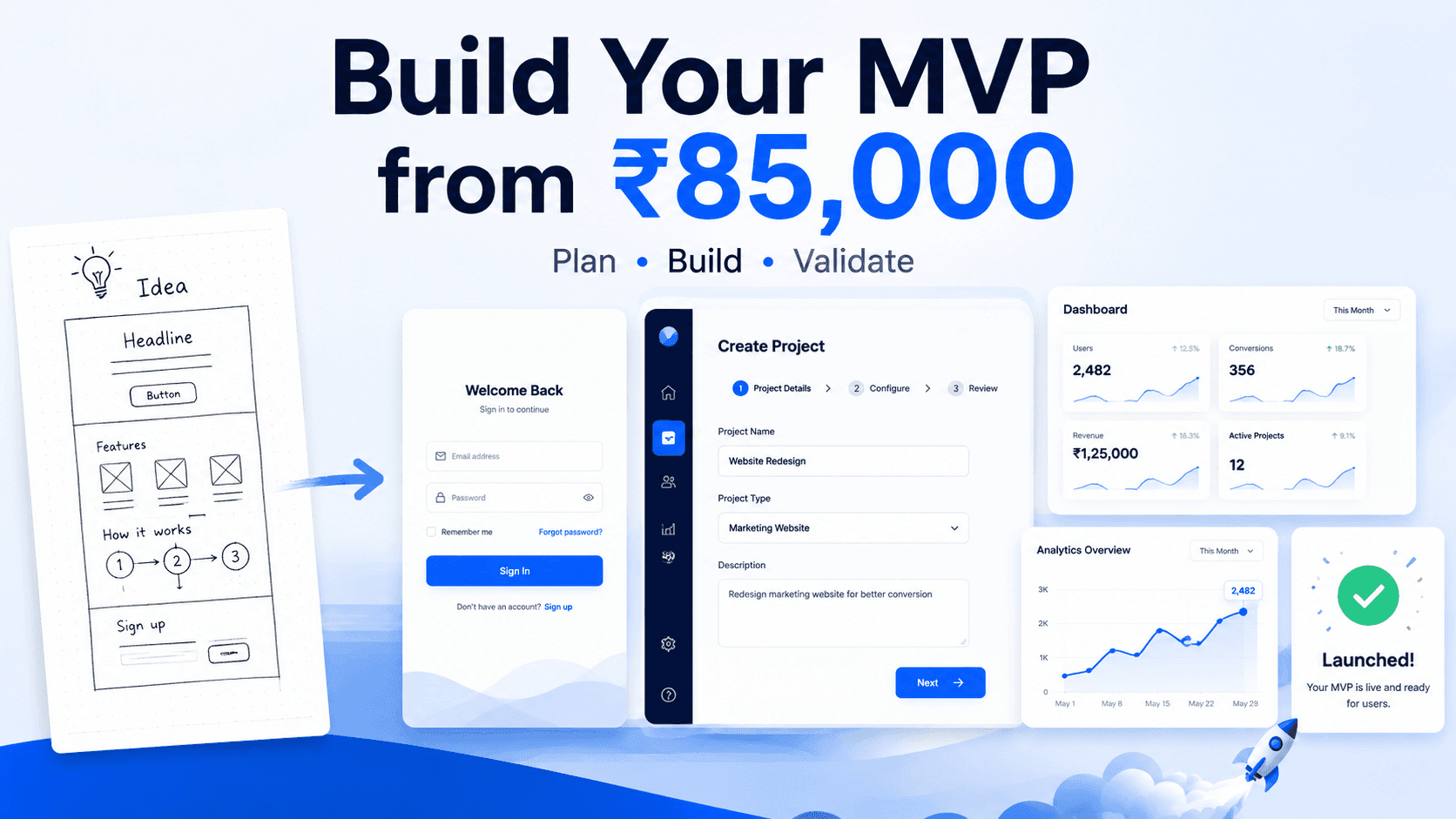
Murmu Software Infotech’s India MVP Launch Package starts from ₹85,000 for a tightly defined web-based application. The current package is intended for founders and businesses validating booking systems, membership platforms, customer portals, internal workflow tools, marketplaces and small SaaS applications.
A practical ₹85,000 MVP may include:
- Product discovery and requirement analysis
- Feature prioritisation
- Basic UI/UX planning
- Secure user registration and login
- One primary user journey
- Core frontend screens
- Database setup
- Basic backend APIs
- Admin dashboard
- Deployment support
- Analytics integration
The final scope depends on complexity. A founder should not expect a marketplace, customer mobile app, vendor app, advanced analytics, AI engine and multiple integrations within the same starter budget.
The purpose of the package is to launch a focused first version, not a fully mature platform.
Launch Your Focused MVP Without Overbuilding the First Version
Examples of MVPs Possible Within a Focused Budget
1. Appointment or Booking MVP
A basic booking platform could allow users to:
- View available services
- Select a date or slot
- Register or log in
- Submit a booking
- Receive confirmation
- Let administrators manage requests
Advanced scheduling rules, live calendars, video consultations and automated reminders may be added later.
2. Membership or Community Portal
A focused membership MVP may include:
- Member registration
- Login and profile management
- Membership plans
- Basic payment integration
- Protected content or resources
- Admin approval and management
Community chat, event management, recommendation engines and native mobile apps can remain part of the growth roadmap.
3. Internal Workflow Application
Indian SMEs can use an MVP to replace spreadsheets or manual processes with a structured workflow.
Examples include:
- Expense requests
- Service tickets
- Lead assignment
- Staff approvals
- Document submissions
- Basic inventory requests
An internal MVP can prove whether automation saves time before the company invests in a full ERP or enterprise platform.
4. Small SaaS Product
A narrow SaaS MVP could provide:
- User accounts
- One subscription or access plan
- One core software function
- A basic dashboard
- Admin controls
- Usage tracking
The founder should focus on one repeatable outcome rather than trying to compete immediately with established software platforms.
5. Simple Marketplace MVP
A starter marketplace might support:
- Buyer and seller registration
- Basic listings
- Search or category browsing
- Enquiry submission
- Admin approval
- Simple messaging or contact flow
Payments, commissions, seller payouts, logistics, advanced verification and recommendation systems may significantly increase the budget.
What Increases MVP Development Cost?
Multiple User Roles
Every additional role customer, vendor, administrator, employee, delivery partner or manager requires separate permissions, screens, workflows and testing.
Mobile Applications
Building Android and iOS apps usually requires more UI work, device testing, API development and app-store preparation than a focused web MVP.
Complex Integrations
Payment gateways, WhatsApp APIs, maps, shipping providers, CRM, ERP and third-party data sources increase implementation and testing effort.
Advanced UI/UX
A basic professional interface is different from a highly customised, animation-heavy product requiring extensive UX research and multiple design revisions.
AI Features
AI chatbots, RAG, agents, vector databases, document intelligence and predictive features introduce model, infrastructure, data and usage considerations. Murmu Software Infotech’s current AI-powered MVP package starts from ₹2 lakh, reflecting the additional complexity involved.
Scope Changes During Development
Unplanned features are one of the most common causes of delays and budget increases. Competitor cost analyses consistently identify scope discipline as a major factor in controlling MVP development cost.
What Should Not Be Expected Within ₹85,000?
A starter MVP budget will generally not cover:
- Multiple production-grade mobile applications
- Large multi-vendor marketplace operations
- Advanced AI or custom machine-learning models
- Complex ERP or CRM development
- Real-time logistics ecosystems
- Multi-country payment and taxation
- Extensive automation
- Large-scale analytics platforms
- Unlimited revisions or changing scope
Domain registration, cloud hosting, business email, paid licences, premium APIs and third-party subscriptions are also normally billed separately under the current offer terms.
Turn Your Startup Idea into a Testable Digital Product
How Founders Should Prioritise MVP Features
Before development begins, list every planned feature and divide them into three groups:
Must Have
Features without which users cannot complete the core journey.
Useful Later
Features that improve convenience but are not required to validate the business idea.
Future Scale
Advanced capabilities needed only after demand, adoption or revenue has been proven.
Ask one question for every proposed feature:
Does this feature help us validate the core business assumption?
When the answer is no, move it to a later release.
This approach aligns with ROI-driven MVP development: prioritising business outcomes, user validation and scalable foundations instead of unnecessary complexity. Murmu Software Infotech explains this approach in its ROI-focused MVP application development service.
Build for Validation, Not Perfection
A first release should be usable, secure and reliable but it does not need every feature planned for the next three years.
Founders should use the MVP to measure:
- User registrations
- Completed actions
- Conversion rate
- Drop-off points
- Customer feedback
- Repeat usage
- Willingness to pay
- Operational efficiency
These findings should determine the next development phase.
A practical example is Smart Billing Lite, which focused on a clear small-business problem: billing, payments, customer records and business insights. Its product roadmap separates launch functionality from later capabilities such as barcode scanning, printer integration, voice billing and advanced forecasting.
How Long Does an ₹85,000 MVP Take?
A tightly scoped MVP can often be delivered within several weeks, but the timeline depends on:
- Requirement clarity
- Number of screens
- User roles
- API complexity
- Content readiness
- Feedback and approval speed
- Testing requirements
Broader market guides commonly estimate six to twelve weeks for well-defined MVPs, while smaller focused products may launch faster.
A fixed scope, timely feedback and one clear decision-maker can significantly improve delivery speed.
Final Recommendation
An ₹85,000 budget can be enough to build a useful MVP in India but only when the product is tightly defined.
Founders should focus on:
One target user, one important problem and one complete core journey.
Do not try to build the final platform in the first release. Build the smallest product capable of proving that customers will use, value or pay for the solution.
Murmu Software Infotech’s India MVP Launch Package starts from ₹85,000 for eligible web-based MVP projects and may include discovery, UI/UX planning, authentication, core workflows, database setup, an admin panel, deployment and analytics. The limited campaign is available until 6 August 2026, subject to confirmed scope, advance payment and project-slot availability.
Launch smaller. Validate sooner. Invest further only after the market gives you a reason.
Frequently Asked Questions
How much does MVP development cost in India?
MVP development cost in India depends on the number of users, screens, workflows, platforms, integrations, design requirements and technical complexity. A tightly scoped web MVP may begin from ₹85,000, while marketplaces, mobile applications, regulated platforms and AI products generally require a higher budget.
What can founders build with an ₹85,000 MVP budget?
An ₹85,000 budget can support a focused web MVP built around one user group and one core workflow. Suitable examples include a booking system, customer portal, internal workflow tool, directory, lead-management application or a simple SaaS validation product.
What features can be included in an ₹85,000 MVP?
The approved scope may include discovery, feature prioritisation, basic UI and UX, secure login, one primary workflow, database setup, a basic administration panel, responsive development, testing, deployment and analytics configuration.
What is usually excluded from an ₹85,000 MVP package?
Common exclusions include separate Android and iOS apps, complex marketplaces, multiple advanced user roles, real-time communication, enterprise integrations, subscriptions, advanced analytics, AI workflows, regulatory compliance and extensive custom design.
How long does it take to build a focused MVP?
A focused MVP may take approximately three to six weeks after the scope, content, user flow and design direction are approved. Complex integrations, multiple platforms, delayed feedback or changing requirements can extend the delivery timeline.
Can an ₹85,000 MVP include a mobile application?
The starting scope is generally more practical for a responsive web application or PWA. A separate Android and iOS application requires additional UI, device testing, store deployment and maintenance, so it normally needs a larger budget.
Can founders build a marketplace MVP for ₹85,000?
A basic listing or enquiry-based marketplace concept may fit if it has limited users and no complex transactions. Buyer and seller dashboards, commissions, payouts, chat, ratings, verification and dispute management usually require additional development.
What should founders validate with the first MVP?
The first MVP should validate whether the target user has the identified problem, understands the proposed solution, completes the main journey and shows enough interest to justify further product investment.
What additional costs should founders budget for?
Additional costs may include domain registration, hosting, cloud infrastructure, business email, SMS or OTP usage, WhatsApp APIs, payment-gateway fees, paid licences, third-party APIs, marketing and future feature development.
How can founders prevent MVP development costs from increasing?
Define one user group, one primary problem, one complete workflow and one success metric. Avoid adding secondary dashboards, advanced automation, multiple platforms and speculative features before the core business assumption has been tested.