Build a Fast, SEO-Ready, AI-Ready Headless CMS Website
In This Article
- What Makes a Website Truly Headless?
- Speed Starts With the Frontend Architecture
- SEO Must Be Part of the Content Model
- Build Structured Content, Not Large Content Blobs
- What Does “AI-Ready” Actually Mean?
- SEO, AEO and GEO Need the Same Strong Foundation
- Choose the Right Headless CMS for Your Business
- A Practical Architecture for an AI-Ready Website
- Build for Search Today—and Discovery Tomorrow
A modern business website is no longer built only for people browsing pages or Google indexing URLs.
Your content may now be discovered through traditional search, AI-powered search experiences, answer engines, mobile applications, chatbots and other digital channels. That changes what businesses should expect from their CMS.
A well-designed headless CMS website can provide a strong foundation for this environment by separating structured content from the frontend experience. But headless architecture alone does not improve rankings or guarantee AI citations. The advantage comes from how the content model, frontend, technical SEO and publishing workflow are engineered together.
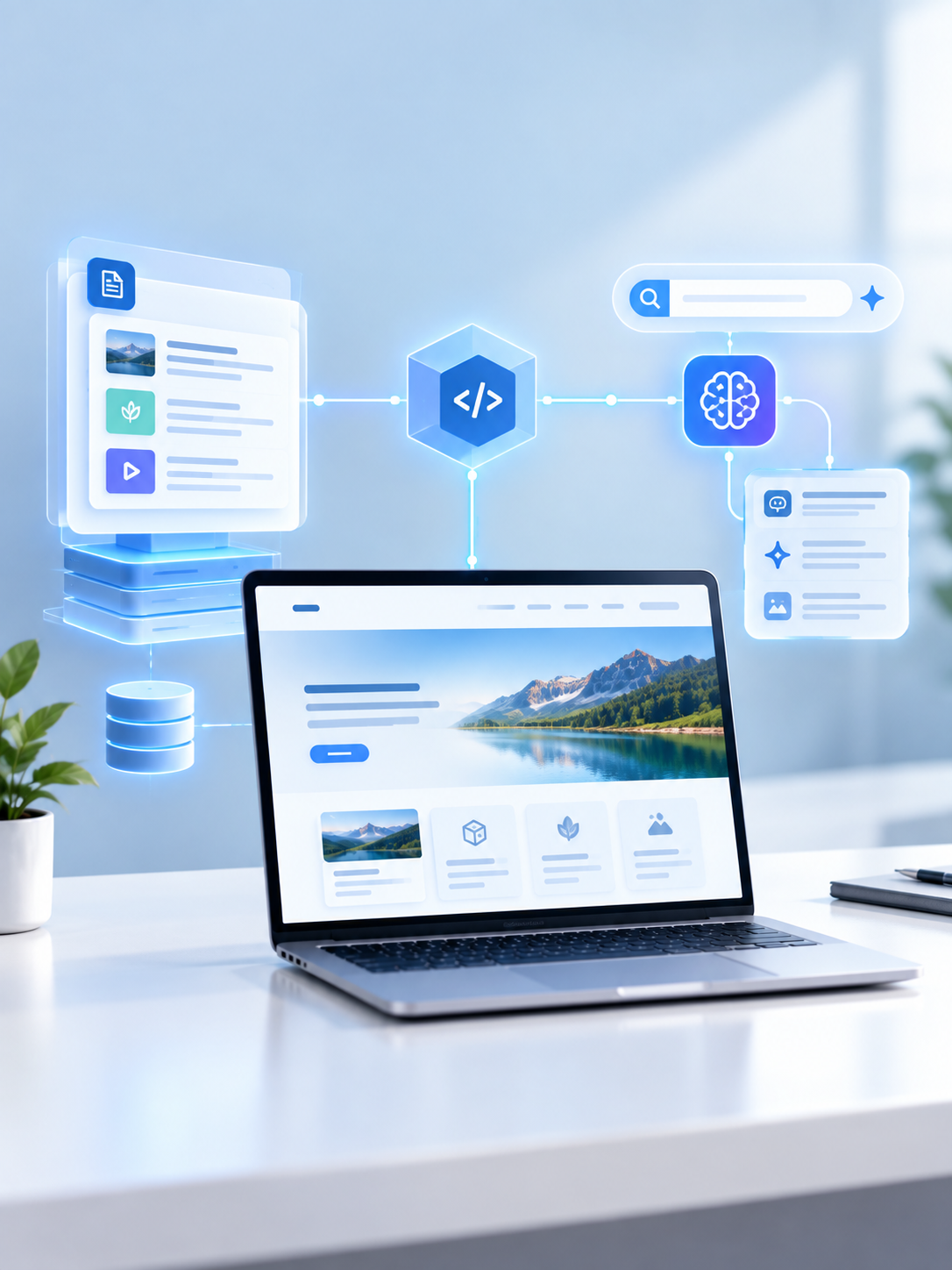
Build for Search and AI
Create a fast, structured headless CMS platform engineered for better performance, scalable SEO, content reuse and emerging AI discovery experiences.
What Makes a Website Truly Headless?
In a traditional architecture, content management and presentation are often closely connected. A headless CMS separates these responsibilities.
Editors manage structured content in the CMS, while APIs deliver that content to a frontend built with technologies such as Next.js or React. The same structured content can then be reused across websites, applications and other digital experiences.
This makes headless especially useful for organizations that need:
- Faster modern websites
- Multiple websites or regional experiences
- Mobile and web content reuse
- Multilingual publishing
- Flexible integrations
- Independent frontend development
- Structured content for search and AI applications
For businesses evaluating this architecture, our Headless CMS Development Services cover strategy, development, migration, integrations and ongoing optimization.
Build Your Fast, Search-Ready Headless CMS Website Today
Speed Starts With the Frontend Architecture
One major advantage of headless architecture is control over frontend delivery.
With Next.js, teams can choose appropriate rendering and caching strategies instead of forcing every page through one traditional CMS rendering pipeline. Server-rendered or pre-rendered pages can provide crawlable content while caching, image optimization, code splitting and CDN delivery can improve performance.
The goal should not simply be “headless.” The goal should be fast, stable and accessible rendered pages.
A JavaScript-heavy headless implementation can actually introduce SEO problems if important content, metadata or navigation is unavailable reliably in rendered output. Headless creates the opportunity for better performance; engineering quality determines whether that opportunity is realized.
SEO Must Be Part of the Content Model
One of the biggest mistakes in headless development is treating SEO as something developers add after the website is finished.
Instead, SEO requirements should become part of the content architecture.
Content models can provide controlled fields for titles, descriptions, canonical configuration, image alt text, indexing rules, social metadata, authorship, FAQs, dates, taxonomies and structured-data inputs.
Reusable SEO components can then enforce consistency across hundreds or thousands of pages.
This approach moves organizations from page-by-page SEO fixes to scalable SEO infrastructure. Structured models can also create clearer relationships between services, products, locations, authors, FAQs and supporting content.
Build Structured Content, Not Large Content Blobs
This becomes even more important as content needs to work beyond a single webpage.
Instead of storing everything inside one rich-text field, consider modeling reusable information such as:
Headline → Summary → Key Facts → Services → FAQs → Author → Related Topics → CTA
Structured content can be assembled differently for websites, mobile experiences, search, internal applications or AI-enabled interfaces.
This is one of the strongest architectural benefits of headless CMS: content becomes reusable data rather than being permanently tied to a page template.
What Does “AI-Ready” Actually Mean?
An AI-ready website does not mean filling pages with AI-generated text.
It means building content infrastructure that makes information clear, accessible, structured, attributable, current and reusable.
Useful content models may include fields for:
- Short factual summaries
- Key facts
- Questions and direct answers
- Authors and expert reviewers
- Entity relationships
- Services and locations
- Published and reviewed dates
- Supporting sources
- Structured data inputs
API-first architecture can also make structured content easier to reuse in future applications such as AI assistants, enterprise search and RAG-based systems. Research across current headless CMS guidance increasingly emphasizes structured content modeling, APIs, schema capabilities and governance as important AI-era CMS characteristics.
But these features should complement—not replace—strong content.
SEO, AEO and GEO Need the Same Strong Foundation
There is significant discussion around SEO, AEO and GEO, but businesses should avoid treating them as three disconnected website projects.
For Google specifically, current guidance says established SEO practices remain relevant to generative AI experiences. Pages still need to be crawlable, indexable, useful and technically sound. Google also states that websites do not need special AI schema or new AI-readable files simply to qualify for AI Overviews or AI Mode.
A practical architecture therefore focuses on:
Crawlability + useful content + structured information + strong internal linking + appropriate structured data + performance + clear entities + trustworthy authorship.
That creates a stronger foundation for both conventional search and emerging discovery experiences.
Turn Your Website Into an AI-Ready Content Platform
Choose the Right Headless CMS for Your Business
There is no universal “best” headless CMS.
A startup, global enterprise, ecommerce organization and content-heavy marketing team may need completely different platforms.
Evaluate your CMS around:
Content modeling: Can information be modeled as reusable structured components?
API quality: Are REST, GraphQL or other delivery APIs suitable for your architecture?
Editor experience: Can marketing teams publish without constant developer assistance?
SEO control: Can you reliably manage metadata, URLs, canonicals, redirects and structured data?
Localization: Can regional and multilingual content be governed effectively?
Governance: Are roles, workflows, approvals and permissions appropriate?
Integration: Can the platform connect cleanly with commerce, CRM, search, analytics and AI services?
Scalability: Can the architecture support future brands, markets, channels and traffic?
Centralized structured content with decoupled delivery becomes increasingly valuable as organizations expand across teams, brands, locales and channels.
A Practical Architecture for an AI-Ready Website
A modern implementation can be thought of as:
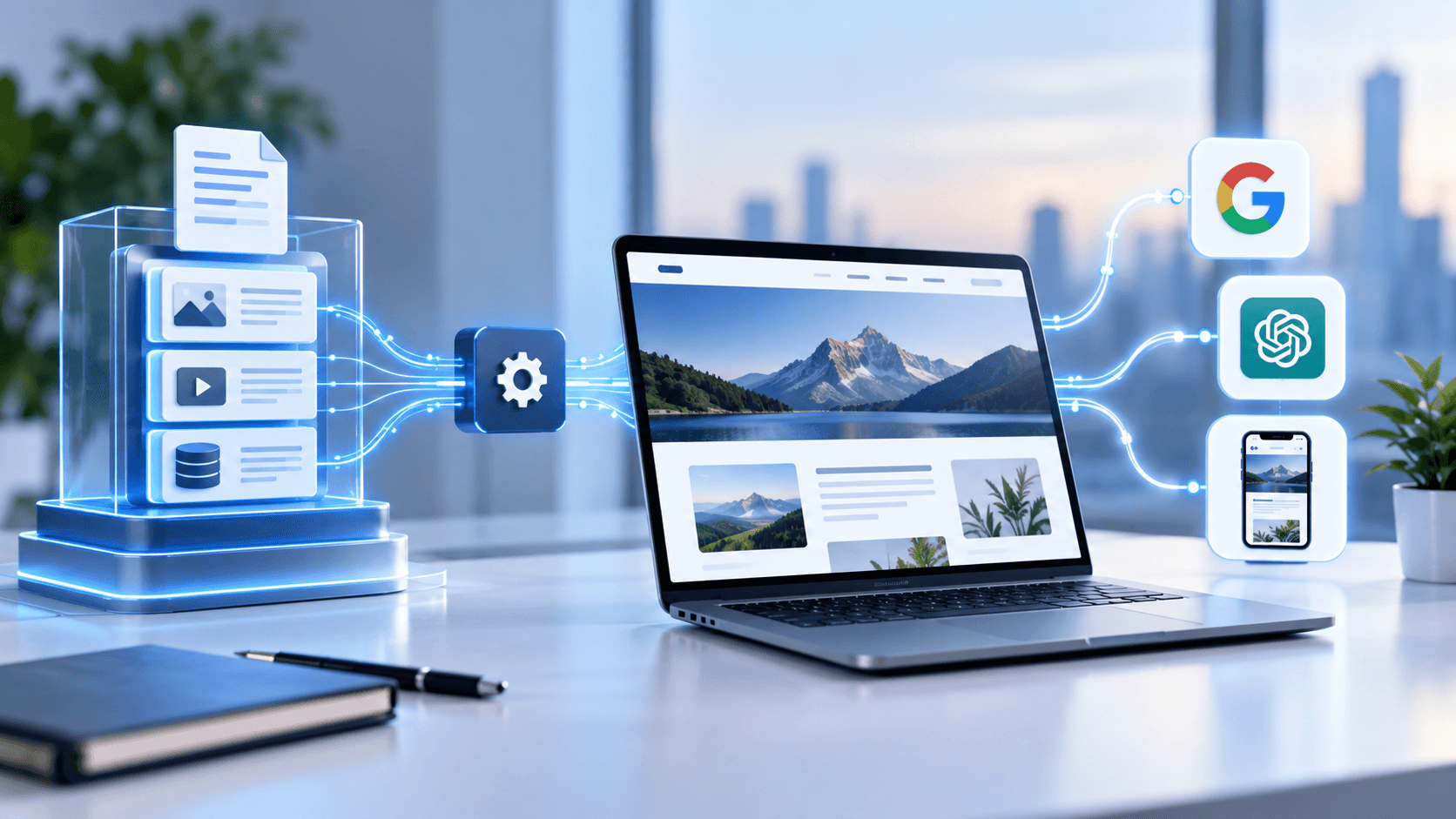
Headless CMS → Structured Content → API Layer → Next.js Frontend → CDN/Hosting → Search & AI Discovery
Around that core sit analytics, CRM, search, personalization, ecommerce, translation, automation and AI services.
The architecture remains modular. The CMS manages content; the frontend manages presentation; APIs connect services; search optimization is engineered into both content models and rendered pages.
This makes the platform easier to evolve without rebuilding the entire digital experience whenever a new channel or technology appears.
Build for Search Today—and Discovery Tomorrow
The future of websites is not simply headless, and it is not simply AI.
The stronger strategy is to build a fast frontend, structured content foundation and flexible API-first architecture that serves customers while remaining accessible to search and emerging discovery systems.
A headless CMS can provide that foundation when performance, technical SEO, content modeling and governance are designed correctly from the beginning.
The result is not merely a faster website.
It is a reusable digital content platform capable of supporting websites, applications, campaigns, international markets, search experiences and future AI-powered workflows.
Frequently Asked Questions
What is an AI-ready headless CMS website?
An AI-ready headless CMS website combines structured content, API-first delivery, crawlable frontend rendering, clear entity information and reusable content models so information can support websites, search engines and AI-enabled applications.
Is a headless CMS better for SEO?
Not automatically. A headless CMS can support strong SEO through frontend performance, structured content and greater technical control, but poor rendering, metadata implementation or migration planning can damage SEO.
Why use Next.js with a headless CMS?
Next.js gives developers flexible rendering, routing, caching and performance capabilities while a headless CMS manages structured content separately. Together they can support fast, scalable and search-friendly websites.
Can a headless CMS improve website speed?
Yes, when implemented correctly. Decoupled architecture allows developers to optimize frontend rendering, caching, image delivery, JavaScript and CDN strategies independently of the CMS.
How do you make a headless CMS SEO-ready?
Build SEO into the content model and frontend, including metadata, canonical controls, crawl directives, structured data, internal links, redirects, XML sitemaps, semantic content and reliable server-rendered or pre-rendered output.
How do you make headless CMS content AI-ready?
Use clear structured content models for summaries, facts, entities, authors, questions, answers, relationships and freshness information while ensuring important content remains publicly accessible and understandable.
Does Google require special AI schema for AI Overviews?
No. Google states that there is no special schema or additional technical requirement for appearing in AI Overviews or AI Mode. Existing SEO and structured-data best practices remain important.
Which headless CMS is best for an AI-ready website?
The right platform depends on content complexity, editor requirements, APIs, governance, localization, integrations, budget and development resources. CMS selection should follow business and architectural requirements rather than a universal ranking.
Can headless CMS content be reused across websites and apps?
Yes. Structured content can be delivered through APIs to websites, mobile applications and other digital experiences, reducing duplication and improving content consistency.
What should businesses check before migrating to headless CMS?
Audit existing URLs, rankings, metadata, redirects, structured data, content models, integrations, editorial workflows, analytics and rendering requirements before migration to protect existing search equity.