Sanity CMS August 2026 Updates: ChatGPT Integration, AI-Native Content Automation & Faster Publishing
In This Article
- What’s New in Sanity’s August 2026 Product Roundup?
- 1. Portable Text Tables Make Structured Publishing Easier
- 2. ChatGPT + Sanity Changes How Teams Can Work With Content
- 3. Sanity Functions Are Becoming More Useful for Content Automation
- 4. Faster Content Operations for Marketing Teams
- 5. Building Content for Search Engines and AI Platforms
- 6. Multilingual and AI-Assisted Content Operations
- 7. From Legacy CMS to AI-Native Content Platform
- How Murmu Software Infotech Can Help
- The Next CMS Is AI-Native
Sanity’s latest product update cycle shows where modern content platforms are heading: less manual work, more structured automation, deeper AI integration and faster content operations.
The August 2026 product roundup brings together important improvements including native table editing in Portable Text, function-to-function invocation, improved migration tooling, visual editing for static HTML sites, ChatGPT integration and video versioning.
Murmu Software Infotech, this is more than product news. We have already started implementing and using selected capabilities including structured table editing and ChatGPT-connected Sanity workflows on our own Sanity + Next.js website platform.
Combined with our existing work around AI Content Agent, MCP, multilingual translation, SEO, AEO, GEO and structured AI-ready content, these improvements are helping us make Sanity increasingly useful not only for developers, but also for the teams that actually create and publish content every day.
About the August 2026 roundup
The August roundup includes capabilities released across the latest product cycle. For example, built-in Portable Text table editing is documented in Sanity Studio v6.6.0 from July 22, 2026.
What’s New in Sanity’s August 2026 Product Roundup?
Sanity continues moving beyond the traditional idea of a headless CMS toward a broader content operating platform for humans, applications and AI agents. Some of the most relevant updates include:
- Portable Text Tables editors can work with structured tables while keeping content queryable and schema-controlled.
- Functions Invoke functions can call other functions, enabling cleaner automation pipelines and reusable logic.
- Migration Skill AI-assisted migration workflows can help scaffold deterministic migration scripts while developers retain control over schemas and validation.
- Static HTML Visual Editing visual editing can extend beyond React-based applications to static and non-React experiences.
- ChatGPT Integration teams can work with Sanity content conversationally through connected AI workflows.
- Video Versioning content teams can maintain and revert versions of video assets more safely.
1. Portable Text Tables Make Structured Publishing Easier
Tables have traditionally been awkward in many headless CMS implementations. Sanity’s newer Portable Text table editing experience gives editors a more natural way to work with rows and columns while retaining the underlying structured-content model.
For marketing teams, this can make pricing comparisons, feature matrices, service packages, product specifications, technical comparisons and research summaries much easier to manage.
For developers, the important difference is that the content remains structured and queryable instead of becoming uncontrolled HTML pasted into a rich-text field. We have started integrating this experience into our own editorial workflow so our content team can create richer articles without needing a developer every time a structured comparison is required.
2. ChatGPT + Sanity Changes How Teams Can Work With Content
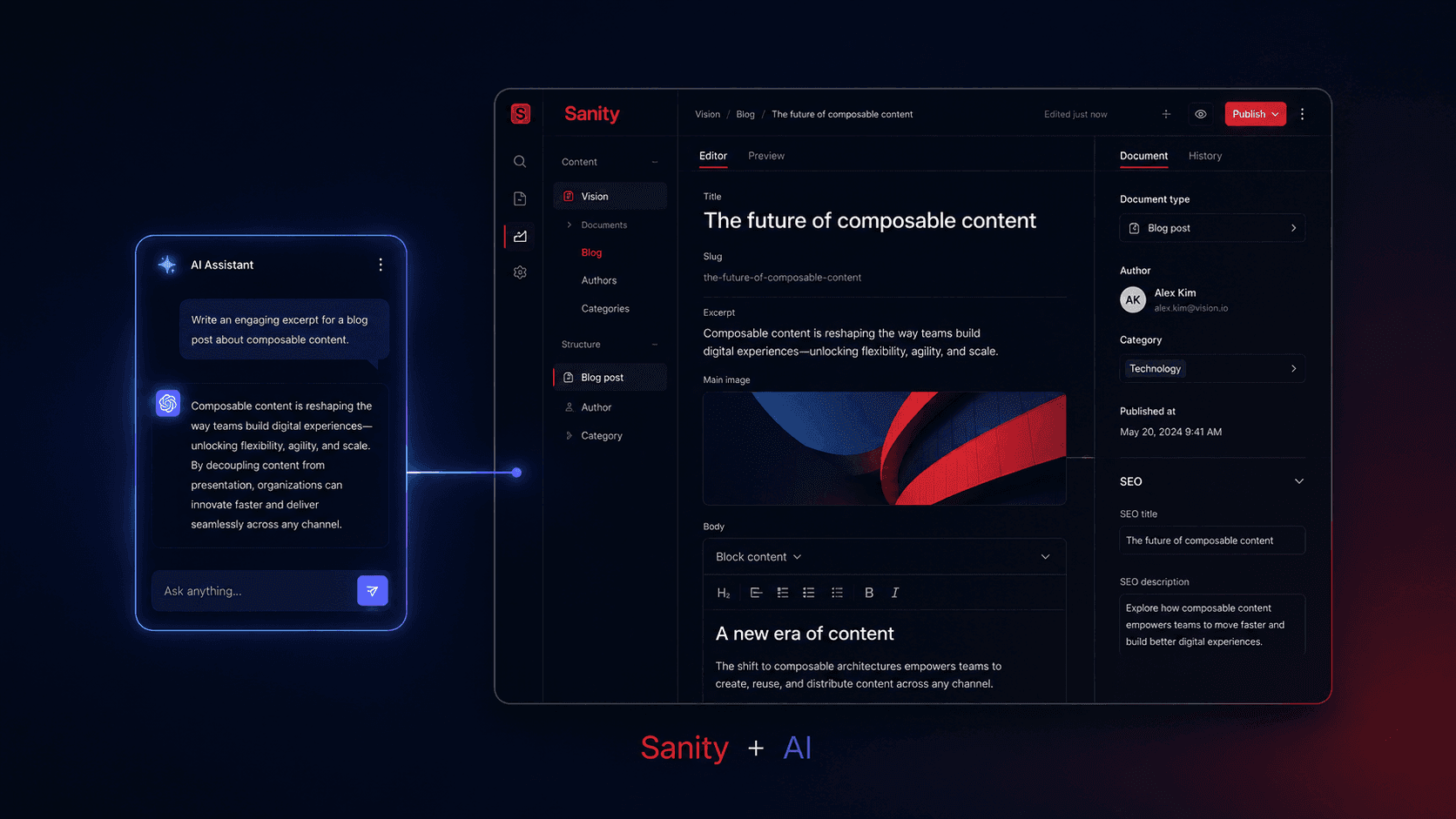
One of the most interesting developments is the connection between Sanity and ChatGPT through Sanity’s MCP capabilities. Instead of navigating through every document manually, a connected AI assistant can help inspect the schema, find documents, run GROQ queries, audit fields, prepare structured drafts, update supported fields and work with releases according to the user’s permissions.
We are already using this workflow with our own Sanity project. The important principle is that AI does not need to replace Sanity Studio. Instead, it becomes another controlled interface into structured content.
Our preferred workflow remains: Schema → AI assistance → Structured Draft → Human Review → Publish. That approach gives content and marketing teams AI speed while maintaining editorial control.
See How We Use ChatGPT With Sanity
Explore our schema-first workflow for querying, auditing and preparing structured Sanity CMS content with ChatGPT.
3. Sanity Functions Are Becoming More Useful for Content Automation
Another important update is function-to-function invocation. A Sanity Function can now directly invoke another function rather than forcing every step of an automation workflow through an intermediate document mutation.
That opens cleaner patterns for content-processing pipelines, translation workflows, notifications, content validation, external API integrations, AI enrichment, social distribution and multi-step publishing automation.
For teams building AI-native content automation, this is an important architectural improvement because reusable logic can be separated into focused functions and invoked only when needed.
4. Faster Content Operations for Marketing Teams
The biggest value of these changes is not the technology itself. It is what content and marketing teams can do with it.
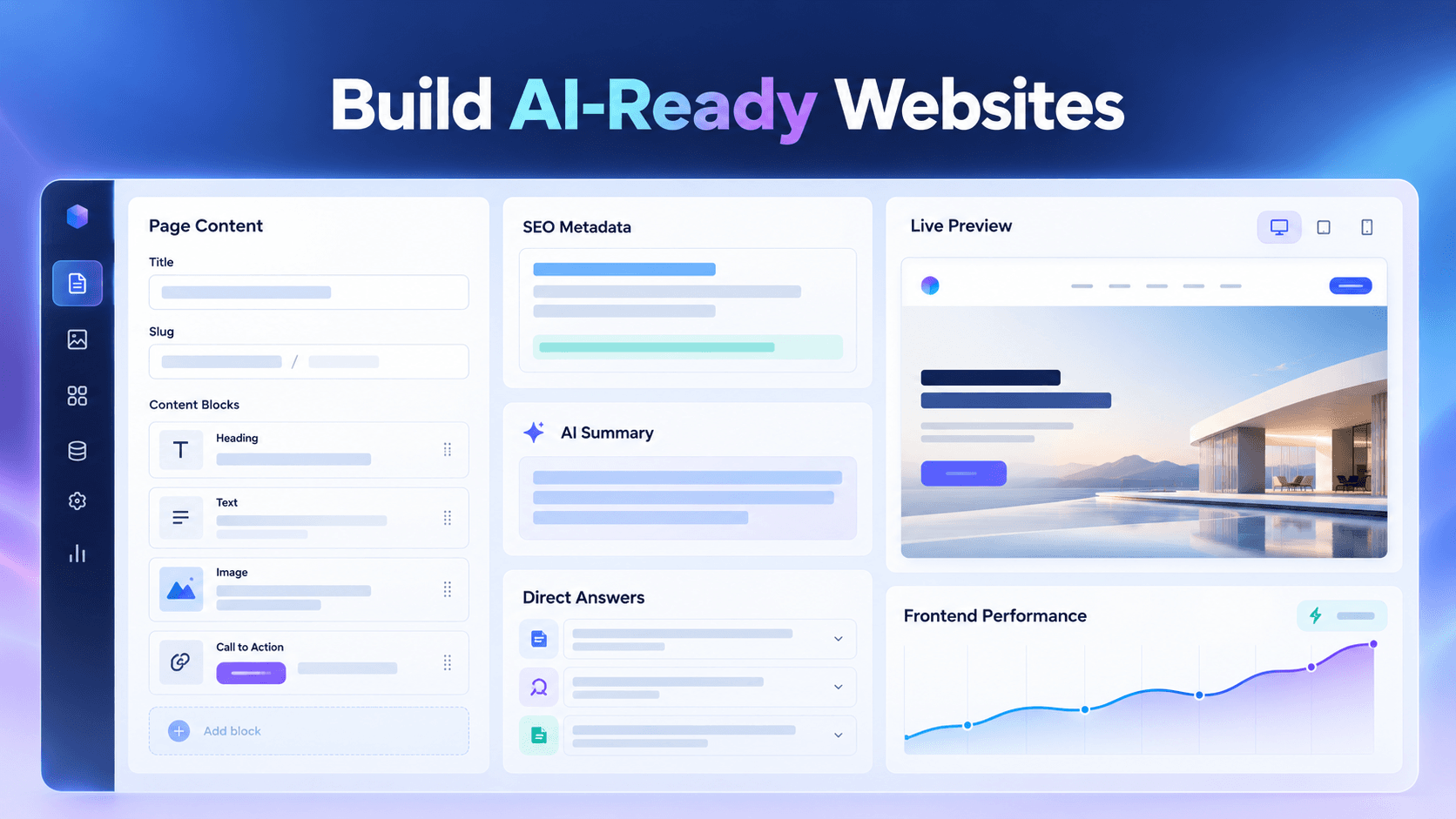
On our own website platform, we have structured Sanity so editors can manage service pages, blog posts, FAQs, CTAs, reusable content sections, SEO titles and descriptions, Open Graph information, canonical controls, direct questions and answers, key facts, AI summaries, AI-search snippets and service-area context directly from the CMS.
Instead of adding these elements after an article is finished, they become part of the content creation workflow itself. That helps us move from Write → Developer → Optimize → Publish toward Create → AI Assist → Optimize → Review → Publish with significantly less unnecessary handoff.
5. Building Content for Search Engines and AI Platforms
Traditional SEO is still important, but websites increasingly need content that can also be clearly interpreted by answer engines, AI assistants and generative search experiences.
That is why our Sanity architecture includes fields for SEO, AEO, GEO, AI summaries, key facts and direct answers. These fields do not guarantee rankings or AI citations. They provide a structured process for producing content that is easier for websites, search systems, internal AI tools and connected applications to consume consistently.
6. Multilingual and AI-Assisted Content Operations
We have also extended our Sanity implementation with multilingual workflows. Our content team can work with English and Hindi content and use AI-assisted translation workflows at either the page or selected-field level.
This is particularly useful when some information should be translated while product names, technical terminology or certain metadata should remain unchanged. Combined with structured schemas and AI assistance, localization becomes part of the publishing workflow rather than a completely separate manual process.
7. From Legacy CMS to AI-Native Content Platform
Organizations considering a CMS migration should think beyond “Which CMS should replace our existing CMS?” A better question is: “What content operating model do we want for the next five years?”
A modern platform can connect Content → Website → Search → AI → Marketing → Automation rather than treating each one as an isolated system.
We experienced this ourselves when we migrated the Murmu Software Infotech website to Sanity CMS + Next.js. The migration gave us the foundation to continue adding structured content, AI workflows, multilingual operations, MCP integrations and new editorial capabilities as Sanity evolves.
Planning Your Sanity CMS Migration?
Explore our migration approach for moving legacy content into a structured, SEO-aware and AI-ready Sanity platform.
How Murmu Software Infotech Can Help
If your organization is running a legacy CMS or already uses Sanity but wants to take better advantage of its latest capabilities we can help with both migration and enhancement.
- Sanity CMS architecture and implementation
- Legacy CMS to Sanity migration
- Next.js + Sanity development and structured content modelling
- Portable Text, ChatGPT and MCP integrations
- AI Content Agent and custom content automation workflows
- Multilingual and AI translation workflows
- SEO, AEO and GEO content architecture
- Ongoing Sanity development, optimization and support
The objective is not simply to install another CMS. It is to build a platform where your content team, marketing team, developers and AI systems can work from the same structured source of truth.
The Next CMS Is AI-Native
Sanity’s latest updates reinforce an important shift. The CMS is becoming less of a place where people simply enter website content and more of an intelligent content infrastructure layer.
For businesses, the opportunity is clear: publish faster, automate repetitive work, structure content once, reuse it everywhere and connect AI safely.
Turn Your CMS Into AI-Native Infrastructure
Modernize content operations with Sanity, Next.js, AI automation, multilingual workflows and structured content built for both Search and AI.
Frequently Asked Questions
What are the major Sanity CMS updates in the August 2026 product roundup?
Sanity's latest product update cycle includes Portable Text table editing, function-to-function invocation, migration tooling, visual editing for static HTML experiences, ChatGPT integration and video versioning. Together, these features improve both developer workflows and day-to-day content operations.
What is new about tables in Sanity Portable Text?
Sanity's newer Portable Text table editing experience lets editors work with rows and columns directly while keeping the underlying content structured, schema-controlled and queryable. This is useful for pricing tables, comparisons, specifications and other structured editorial content.
Can ChatGPT work directly with Sanity CMS?
Yes. Connected Sanity and ChatGPT workflows can use Sanity's MCP capabilities to inspect schemas, query documents, prepare structured drafts, patch supported fields and work with releases according to the user's permissions.
Does ChatGPT replace Sanity Studio?
No. ChatGPT can provide a conversational interface for supported Sanity operations, while Sanity Studio remains the primary visual editorial environment. A strong workflow combines AI assistance with structured drafts and human review.
What is Sanity Functions Invoke?
Functions Invoke allows one Sanity Function to directly call another function. This supports cleaner composition, parallel processing, privilege separation and resource isolation for content automation and integration workflows.
How can the latest Sanity features help marketing teams?
The latest capabilities can reduce repetitive work around content creation, structured tables, optimization, translation, publishing and automation. Marketing teams can manage more of the workflow directly while developers focus on architecture and higher-value functionality.
Can Sanity support SEO, AEO and GEO workflows?
Yes. Sanity schemas can store SEO metadata, AI summaries, FAQs, entities, key facts and direct answers as structured content. This creates a consistent editorial workflow for search, answer-engine and generative-discovery optimization.
Can Sanity support multilingual and AI-assisted translation workflows?
Yes. Sanity supports flexible localization architectures, and AI-assisted workflows can help translate entire documents or selected fields. The implementation can preserve fields that should not be translated.
Can an existing CMS be migrated to an AI-native Sanity platform?
Yes. A migration can include content auditing, schema design, transformation scripts, media migration, URL and metadata preservation, Next.js frontend implementation, integrations and AI-ready content workflows.
How can Murmu Software Infotech help with Sanity CMS?
Murmu Software Infotech can help with Sanity CMS architecture, migration, Next.js development, content modelling, Portable Text, ChatGPT and MCP integration, Content Agent workflows, multilingual content, AI automation, SEO, AEO, GEO and ongoing support.