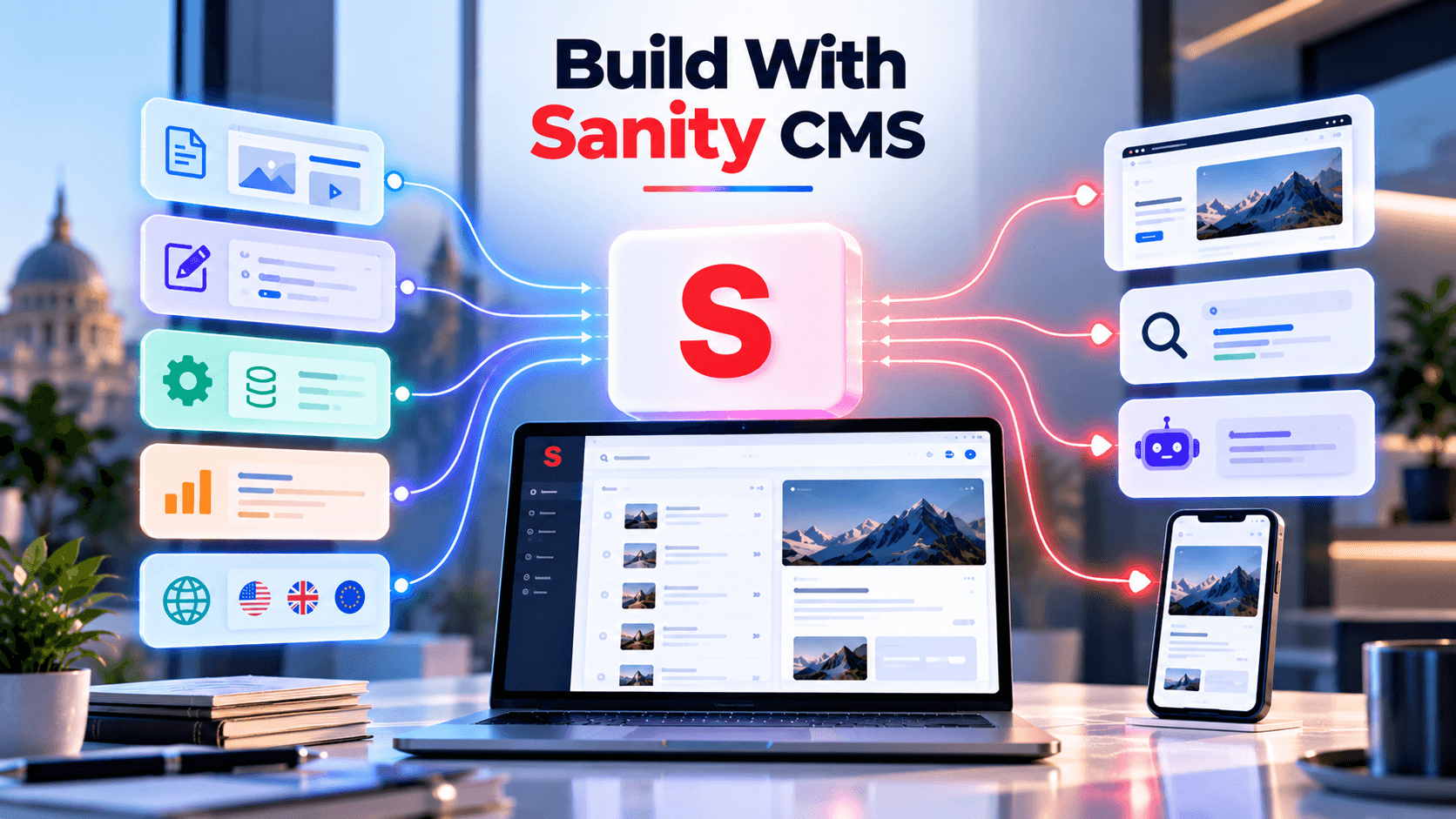
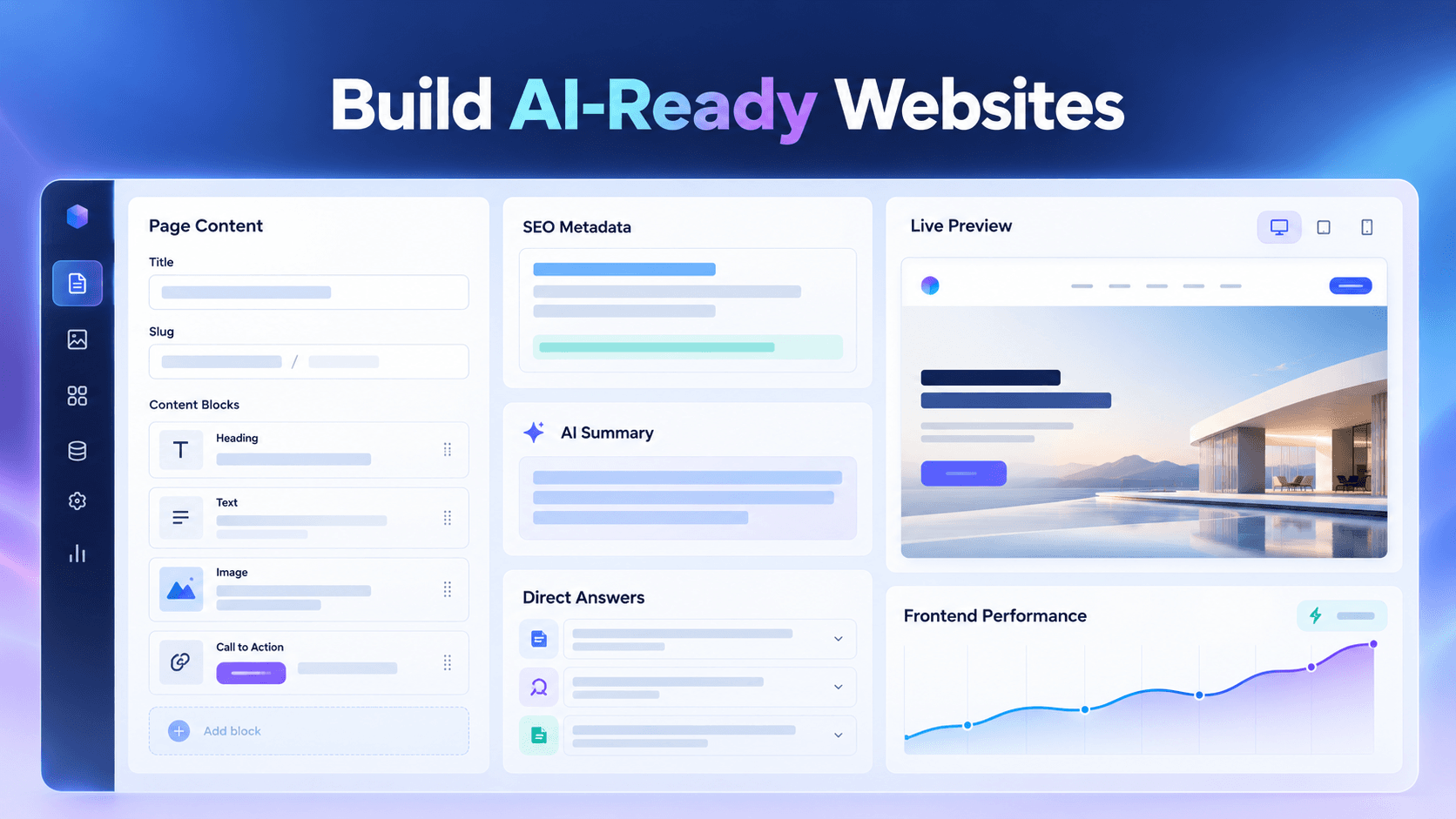
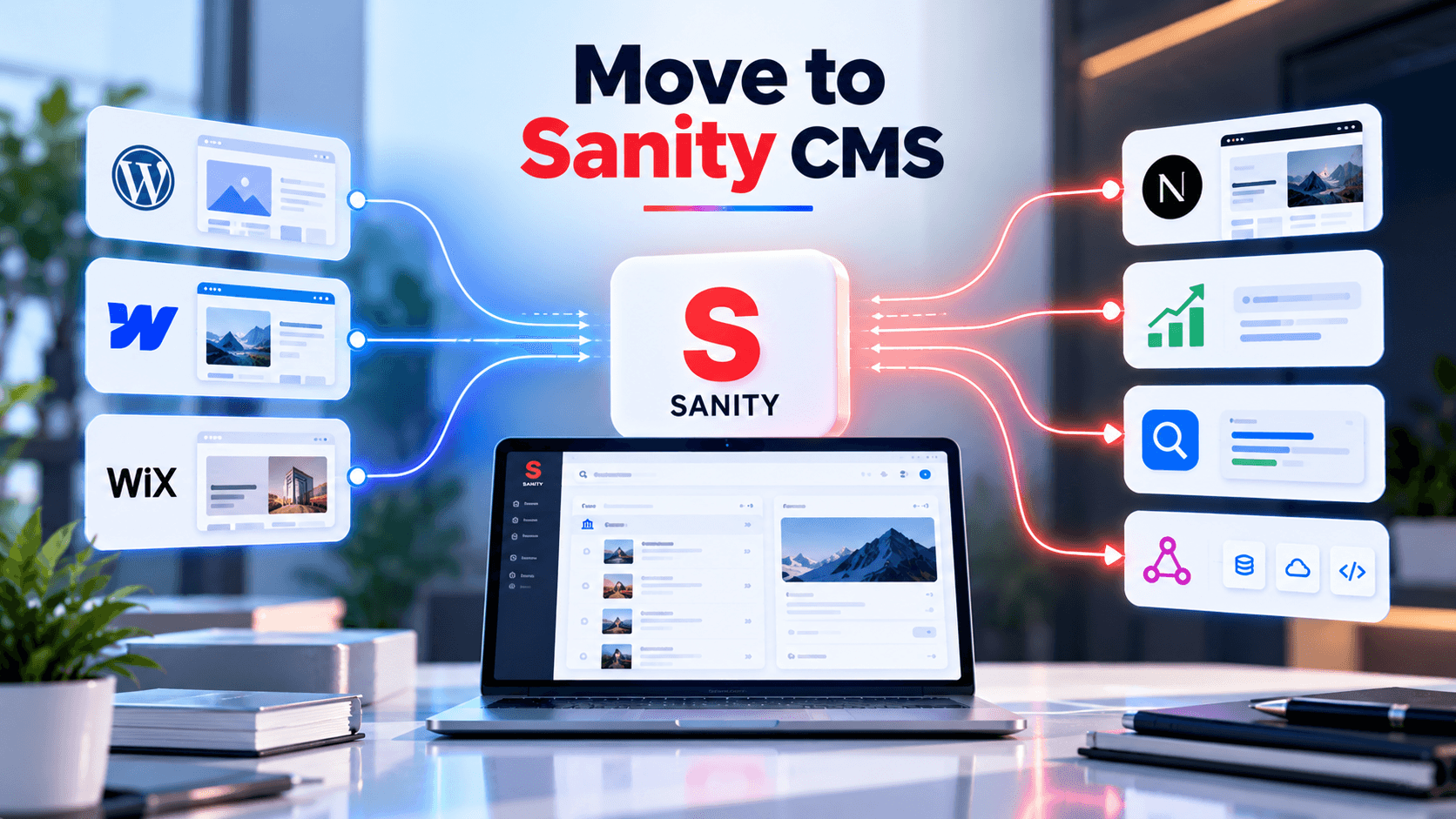
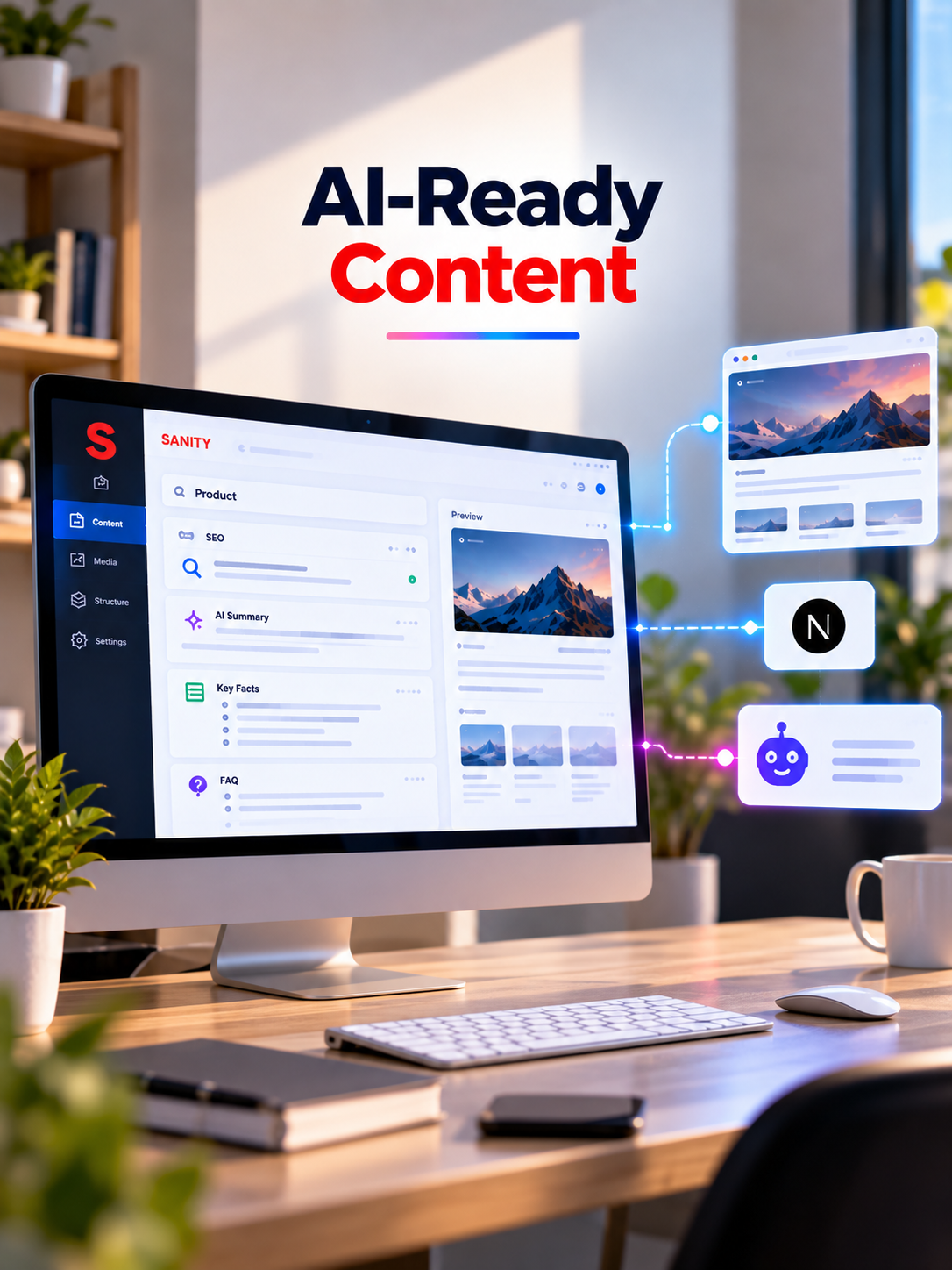
Build AI-Ready Content With Sanity CMS Development

In This Article
- Modern websites have a content architecture problem.
- Why Sanity CMS Development Matters for AI-Ready Content
- Sanity CMS Services Should Go Beyond Page Building
- AI-Ready CMS Architecture Needs SEO, AEO and GEO Fields
- Structured Content CMS Makes Answers Reusable
- Sanity Next.js Development Connects Content With Performance
- Schema Should Come From CMS Content
- Build Content That Works Beyond Pages
- Headless CMS Development Should Reduce Publishing Friction
- AI Search Needs Clear Facts, Not Only Long Articles
- Sanity CMS Development Can Support Future AI Workflows
- Business Benefits of an AI-Ready Sanity CMS
- Who Should Build With Sanity CMS?
- Build AI-Ready Content With Sanity CMS
Modern websites have a content architecture problem.
Many businesses continue to store critical information within page-specific rich-text blocks. Metadata is somewhere else, FAQs are manually formatted, structured data is hardcoded, and marketing teams are always asking developers to do something with content that requires reusing or adapting it in some way.
This approach is becoming increasingly limiting when it comes to content that needs to perform anywhere from Google and Bing to answer engines, AI search, websites, applications, and more in the future.
Modern Sanity CMS development offers a different approach: structure important information as reusable data and connect it to a fast frontend such as Next.js.
An AI-ready CMS should not simply publish pages. It should make information easier to manage, reuse, understand, retrieve, and deliver.
Why Sanity CMS Development Matters for AI-Ready Content
Traditional page centric content often contains presentation and data mixed together.
A paragraph could include the name of the service, who it's for, what benefits it provides, the location, costs, and other relevant information, but every system that uses that information has to parse it out again
Structured content makes that easier. With Sanity, developers can define explicit fields for things like:
- Services
- Products
- Features
- Authors
- FAQs
- Key facts
- Case studies
- Locations
- Direct answers
- Metadata
The result is content that knows what it is, not merely where it appears on a webpage.
Businesses building this type of architecture can use Sanity CMS development services to combine content modeling, editorial workflows, frontend delivery, and search-ready implementation.
Build Smarter Content With Sanity
Create structured, reusable and AI-ready content with Sanity, Next.js, SEO fields, direct answers and scalable publishing workflows.
Sanity CMS Services Should Go Beyond Page Building
A common mistake is moving to a headless CMS but recreating the same page-builder architecture.
That misses much of the value.
Strong Sanity CMS services should begin with content modeling.
Instead of creating one large “page content” field, teams can define reusable objects for:
FAQ → question + answer
Case Study → problem + solution + results
Service → benefits + audience + capabilities
Author → name + role + expertise
AI Fact → fact + context + source
These objects can be referenced across multiple pages without copying content.
That improves consistency and gives marketing teams a stronger foundation for future channels.
Turn Sanity Into Your AI-Ready Content Growth Engine
AI-Ready CMS Architecture Needs SEO, AEO and GEO Fields
AI readiness is not achieved by adding an AI plugin.
The CMS should provide structured fields for modern search workflows.
An AI-ready Sanity implementation can include:
Traditional SEO
- SEO title
- Meta description
- Canonical URL
- Robots settings
- Open Graph fields
- Social metadata
AEO
- Questions
- Direct answers
- FAQs
GEO and AI Search
- AI summary
- AI search snippet
- Key facts
- Primary entity
- Target audience
- Service area
- Review date
Murmu Software Infotech has implemented this structure directly in Sanity. The SEO, AEO and GEO implementation case study shows how these fields can be separated from the main article body while remaining available to the frontend and other content consumers.
Structured fields do not guarantee rankings or AI citations. They improve clarity, consistency, governance, and machine readability.
Structured Content CMS Makes Answers Reusable
Answer-ready content should not be recreated for every page.
Consider a common question:
What is Sanity CMS development?
Instead of placing a different answer inside several pages, the CMS can maintain a concise structured answer that can be reused in:
- Service pages
- Blog content
- FAQ sections
- Search interfaces
- Structured outputs
- APIs
- AI applications
This is the advantage of a structured content CMS.
Content becomes a reusable business asset rather than a collection of disconnected page fragments.
Sanity Next.js Development Connects Content With Performance
Sanity manages structured content while Next.js can manage the frontend experience.
A production-ready Sanity Next.js development architecture can use CMS fields to generate:
- Page metadata
- Canonical URLs
- Social previews
- Semantic headings
- Structured data
- Landing-page components
- Server-rendered content
- Dynamic routes
This separation lets developers optimize rendering and performance without forcing marketing teams to manage application code.
It also helps ensure important content is available in the rendered page rather than existing only behind client-side interactions.
Schema Should Come From CMS Content
Structured data shouldn't be a separate manual database.
If Sanity already has information about an article, author, service, organization, FAQ, or breadcrumb relationship, then the frontend can turn these fields into their appropriate schema.
Which gives you one source of truth:
Sanity Schema → Structured Content → Next.js → Visible Page + Structured Data
Editors maintain information once.
Developers control how it is rendered.
Search systems receive consistent information.
Build Content That Works Beyond Pages
Turn Sanity into a structured content platform designed for SEO, answer engines, AI discovery, and scalable publishing.
Build With Sanity CMS
Headless CMS Development Should Reduce Publishing Friction
Headless architecture should not make content teams more dependent on developers.
A well-designed Sanity implementation can provide reusable modules for:
- Hero sections
- Feature grids
- Testimonials
- Statistics
- FAQs
- Case studies
- Comparison sections
- CTA blocks
Editors can assemble approved sections while developers maintain design consistency and frontend performance.
This is especially useful for SaaS teams and marketing organizations launching frequent campaigns.
Build Structured Content Ready for Search and AI
AI Search Needs Clear Facts, Not Only Long Articles
Long-form content remains valuable, but AI-oriented retrieval often benefits from concise, self-contained information.
A CMS can therefore provide dedicated key-fact fields for:
- Capabilities
- Supported markets
- Requirements
- Integrations
- Product features
- Timelines
- Measurable outcomes
The content should remain accurate and supported by visible page information.
The goal is not keyword stuffing.
The goal is to make important facts explicit.
Sanity CMS Development Can Support Future AI Workflows
Structured content also creates opportunities beyond public websites.
Schema-aware content can support:
- Internal assistants
- Search tools
- Knowledge workflows
- Content automation
- AI agents
- Editorial assistance
Because the content already has well-defined types and relationships, downstream systems can take advantage of this information and perform more meaningful operations on it, as compared to having only raw HTML data.
This makes the CMS a source of governed context for future applications.
Business Benefits of an AI-Ready Sanity CMS
A properly architected Sanity implementation delivers value to an organization through faster publishing, enhanced content reuse, improved SEO governance, consistent metadata, scalable landing pages, reduced frontend complexity, and a better foundation for AI-driven discovery.
The business value is derived from the ability to have a singular source of information that can power multiple experiences.
Marketing teams benefit from increased publishing control,
developers obtain cleaner data,
search engines receive more structured signals,
and
AI applications are enriched with context.
Who Should Build With Sanity CMS?
Sanity is particularly relevant for organizations that have outgrown page-centric content operations.
That can include:
- SaaS businesses
- Marketing teams
- Digital agencies
- Content-heavy websites
- Multi-market businesses
- Next.js development teams
- Companies modernizing legacy CMS platforms
- Organizations preparing for AI search
If publishing is slow, content is frequently duplicated, SEO fields are hardcoded, or AI-ready information is scattered across pages, the underlying CMS architecture may need improvement.
Build AI-Ready Content With Sanity CMS
The future of content management is not about generating more pages.
It is about creating better structured information.
A modern Sanity implementation can combine:
Structured Content + SEO + AEO + GEO + Next.js + Editorial Workflows + AI Readiness
That foundation allows the same trusted content to support users, search engines, applications, and emerging AI experiences.
Explore Sanity CMS development services to build structured, reusable, search-ready content architecture.
Frequently Asked Questions
What makes Sanity CMS AI-ready?
Sanity can model facts, questions, direct answers, entities, metadata and relationships as structured data that websites, APIs, search systems and AI-oriented applications can consume.
What is structured content in Sanity CMS?
Structured content separates information into meaningful fields and reusable documents instead of storing everything inside page-specific formatted text.
Can Sanity support SEO, AEO and GEO?
Yes. Sanity schemas can contain traditional SEO metadata alongside direct answers, FAQs, AI summaries, key facts, entities, audiences and freshness information.
How does Sanity CMS work with Next.js?
Sanity manages structured content while Next.js can handle routing, rendering, metadata, components, schema, caching and frontend performance.
What AEO fields can be added to Sanity CMS?
Useful AEO fields include question-and-answer pairs, concise direct answers and reusable FAQ content.
What GEO fields can be added to Sanity CMS?
Useful GEO fields include AI summaries, AI search snippets, key facts, primary entities, target audiences, service areas and editorial review dates.
Can structured data be generated from Sanity CMS?
Yes. Frontend applications can transform structured Sanity content into appropriate schema markup when the structured data accurately reflects visible page information.
Can Sanity CMS reduce developer dependency?
A well-designed Sanity Studio with reusable schemas and page sections can allow editors to handle many routine publishing and campaign changes without requiring code changes.
Can Sanity CMS support AI agents?
Structured Sanity content can provide governed context to supported AI assistants, agents and automation workflows through APIs and appropriate integrations.
Does an AI-ready Sanity CMS guarantee AI citations?
No. Structured content can improve clarity, consistency and retrieval readiness, but external search and AI systems independently decide which sources they surface or cite.