Development / CMS
Sitecore Docker Setup & Enterprise Deployment Best Practices
PPrem Murmu5 Min Read
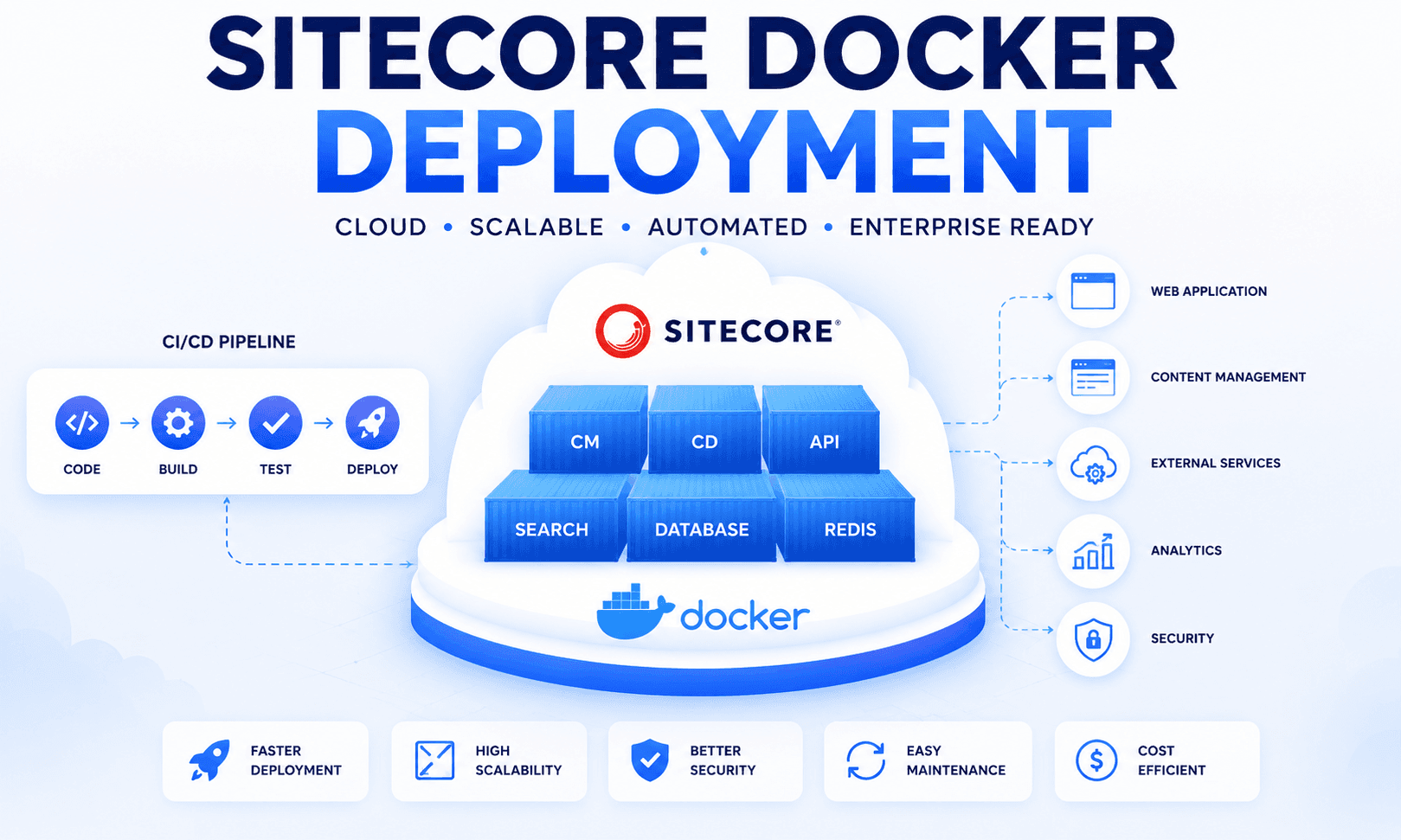
Enterprise digital ecosystems are evolving rapidly.
Modern organizations demand:
Traditional CMS deployment approaches often create major operational bottlenecks that slow innovation and increase infrastructure complexity.
This is why enterprises increasingly adopt Sitecore Docker environments and containerized deployment strategies for modern digital transformation initiatives.
With the rise of:
containerized deployment has become a foundational part of modern enterprise Sitecore ecosystems.
Organizations implementing scalable Sitecore Docker strategies benefit from:
This guide explains how Sitecore Docker works, why enterprises use it, and the best practices for scalable enterprise deployment in 2026.

Modernize Sitecore deployment with Docker, DevOps, CI/CD automation, and cloud-native architecture built for enterprise scalability and reliability.
Many enterprises still rely on traditional deployment workflows that involve manual server configuration and complex infrastructure management.
As digital ecosystems scale, these approaches create significant operational risks.
Traditional CMS deployment often requires:
This slows innovation significantly.
One of the biggest enterprise problems is inconsistent environments across:
This increases deployment failures and troubleshooting complexity.
Modern enterprises require scalable infrastructure capable of supporting:
Traditional infrastructure models often struggle to scale efficiently.
Legacy deployment environments increase:
Traditional deployment systems often make rollback and recovery difficult during release failures.
Modern deployment architecture directly impacts:
Organizations with faster and more reliable deployment ecosystems outperform competitors significantly.
Modern enterprises must rapidly launch:
Scalable deployment workflows accelerate digital transformation.
Cloud-native deployment improves:
Stable infrastructure improves:
Automated deployment workflows improve consistency and reduce human error.
Sitecore Docker enables organizations to run Sitecore environments inside Docker containers.
Containers package:
into portable and consistent environments.
Containerized architecture provides:
Modern versions like Sitecore 10.4 increasingly align with containerized enterprise deployment strategies.
This helps organizations modernize infrastructure and support cloud-native operations.
Docker dramatically reduces environment provisioning time.
Teams can deploy environments faster and more consistently.
Containers ensure consistent behavior across:
This reduces deployment failures significantly.
Modern Sitecore Docker environments integrate well with:
Docker improves CI/CD implementation and deployment automation.
Containers isolate workloads and improve operational reliability.
Containerized environments optimize infrastructure usage more efficiently than traditional VM-based environments.
Modern enterprise deployment requires strategic architecture planning.
Use consistent container configurations across all environments.
This improves:
Modern enterprise ecosystems increasingly rely on:
This accelerates delivery while reducing risk.
Modern deployment ecosystems should use Infrastructure as Code (IaC) for scalability and repeatability.
Enterprise environments should support:
Security best practices should include:
Modern ecosystems require monitoring for:
Modern Sitecore environments often separate:
This improves scalability and maintainability.
Modern Sitecore ecosystems increasingly combine:
This architecture supports scalable enterprise digital experience ecosystems.
Containerized architecture improves:
| Capability | Traditional Deployment | Sitecore Docker |
|---|---|---|
| Environment Consistency | Weak | Strong |
| Deployment Speed | Slower | Faster |
| Scalability | Moderate | High |
| DevOps Automation | Limited | Advanced |
| Infrastructure Agility |
Modern enterprise digital ecosystems increasingly require:
Traditional infrastructure increasingly struggles to support these modern requirements.
The future of enterprise CMS deployment is increasingly:
Modern Sitecore ecosystems align closely with these trends.
SaaS-native architecture reduces operational overhead.
Cloud-native delivery improves release agility.
Modern infrastructure supports enterprise-scale growth more efficiently.
Composable architecture supports long-term modernization strategies.
Enterprise deployment architecture requires deep technical and strategic expertise.
The right implementation partner helps organizations:
Modern deployment increasingly relies on containerized ecosystems.
Cloud-native architecture expertise is critical for future scalability.
Modern enterprise ecosystems require deployment automation expertise.
Modern frontend ecosystems increasingly rely on API-first architecture.
At Murmu Software Infotech, we help enterprises modernize Sitecore infrastructure using scalable cloud-native deployment architecture.
Our expertise includes:
Modern enterprise digital ecosystems increasingly require:
Traditional deployment approaches increasingly create operational bottlenecks and scalability limitations.
Strategic Sitecore Docker implementation helps enterprises build scalable, agile, and future-ready digital experience ecosystems capable of supporting long-term growth and innovation.
For enterprise leaders, modern deployment architecture is no longer just an infrastructure decision — it is a strategic business enabler for digital transformation.
A Sitecore Docker setup runs Sitecore roles and supporting services inside containers, helping development teams create more consistent, repeatable and isolated environments.
Docker helps reduce environment inconsistencies, simplify onboarding, isolate project dependencies and make it easier to start, stop and recreate Sitecore development environments.
A typical Sitecore Docker environment uses Docker Compose configuration, environment variables and Sitecore container images. The exact steps depend on the Sitecore version and supported topology.
Sitecore Docker containers can support containerized production architectures, but Sitecore's supplied non-production development images are explicitly not intended as a production deployment blueprint. Production environments require separate architecture, security, infrastructure and operational planning.
| Weak |
| Strong |
| Recovery & Rollback | Complex | Easier |
| Cloud-Native Readiness | Limited | Advanced |
| Operational Efficiency | Moderate | High |
Depending on the Sitecore version and topology, a Docker environment can include Sitecore application roles, SQL Server, Solr, Redis, identity services, proxy services and other supporting components.
Docker packages applications and dependencies into consistent environments that can be built, tested and promoted through automated CI/CD pipelines, helping reduce configuration drift between stages.
Best practices include using version-controlled infrastructure, secure secrets management, automated testing, environment-specific configuration, health checks, centralized monitoring, immutable release artifacts and tested rollback procedures.
Containerized Sitecore workloads can be orchestrated with Kubernetes when the chosen Sitecore version and architecture support that deployment model. Kubernetes can provide scheduling, scaling and orchestration capabilities for suitable production environments.
Enterprise teams should use trusted images, vulnerability scanning, secret management, least-privilege access, network controls, regular patching, TLS, monitoring and secure container registries.
Development environments prioritize fast local setup and consistency, while production deployments require additional architecture for security, availability, monitoring, backups, scaling, disaster recovery, release governance and operational support.