Step-by-Step Guide to Installing Sitecore 10.4.1 Locally

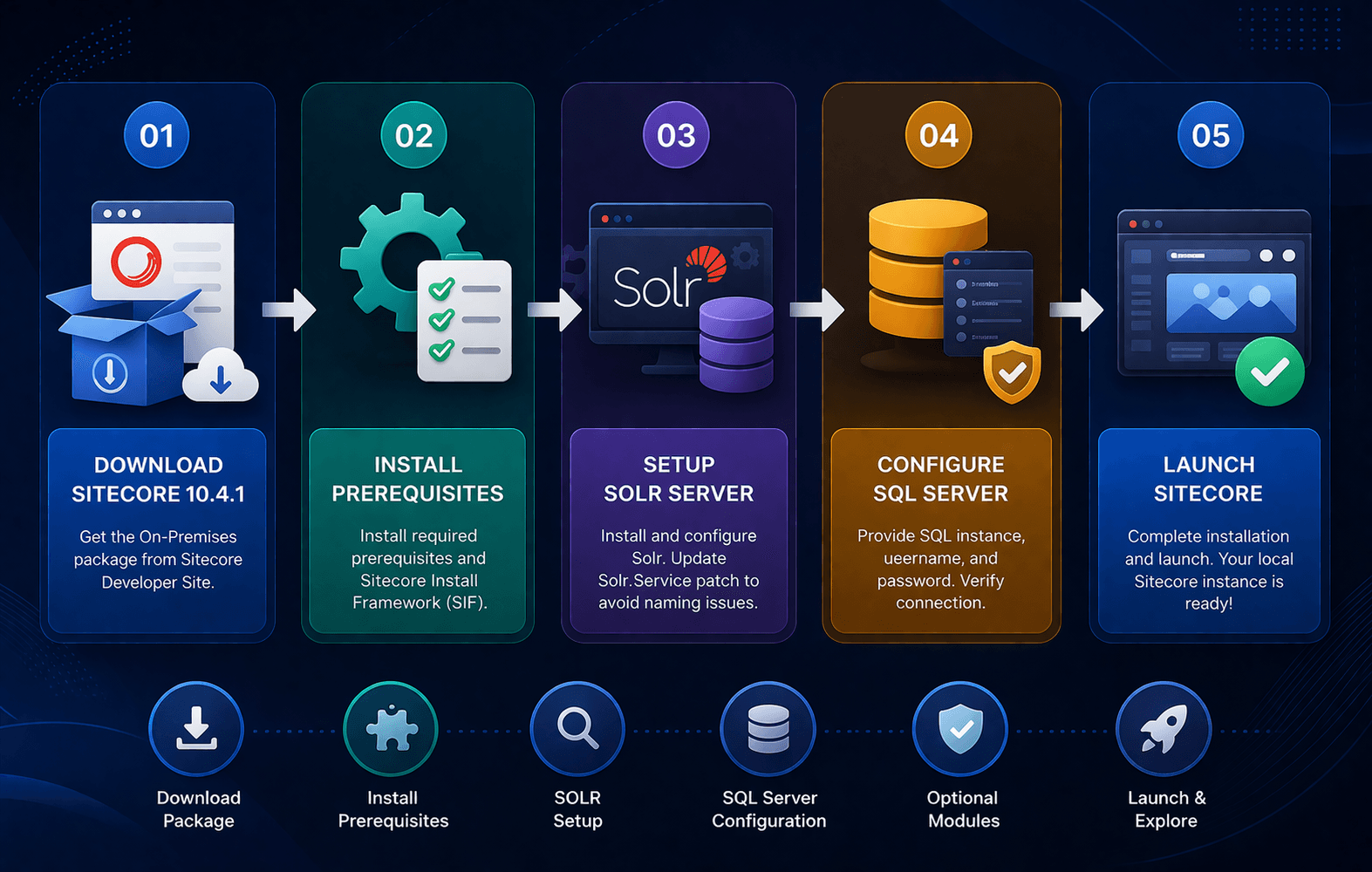
- Download correct package of sitecore 10.4.1 exe file from the sitecore developer site, and download from On Premises deployments. Download highlighted package for sitecore exe setup.



Turn your local Sitecore installation into a powerful, high-performance digital experience with expert guidance and development support.
but I encountered the following issue:
I saw that a lot of people have the same issue. To fix this you should install a new SIF through Powershell and use the next command:
Install-Module SitecoreInstallFramework -SkipPublisherCheck -Force
After installing a new SIF, need to re-run Sitecore installation. The issue should be going.
Your localhost screen will look like this as a plain vanilla instance.
you will encounter a new dashboard, styled reminiscent of XMCloud. Your CMS is look like this.
Thank You!
To install Sitecore 10.4.1 locally, download the correct on-premises package, install the required prerequisites, configure Solr 9.8.1, enter your SQL Server details, update or install Sitecore Installation Framework if required, complete the Sitecore installation wizard, and launch the local CMS.
A typical Sitecore 10.4.1 local installation requires Windows, IIS and required web components, Microsoft SQL Server, Apache Solr, PowerShell, Sitecore Installation Framework, valid certificates, and the appropriate Sitecore installation package.
Sitecore XP 10.4.1 supports and requires Solr 9.8.1 for the updated installation flow. Using the correct Solr version is important for successful indexing and local environment configuration.
If the Solr installation process creates an incorrect or duplicated folder name, review the Solr-SingleDeveloper.json configuration and correct the Solr.Service naming value before running the Sitecore installation again.
A common solution is to update or reinstall Sitecore Installation Framework using PowerShell. For example, the command Install-Module SitecoreInstallFramework -SkipPublisherCheck -Force can install the latest available SIF module, after which the Sitecore installation can be rerun.
During installation, provide the correct SQL Server instance name, administrative username, and password. Ensure SQL Server is running and the selected account has the permissions required to create and configure the Sitecore databases.
Yes, local Sitecore environments commonly require HTTPS and certificate configuration. The installation process can require you to select and attach the appropriate certificate before the local Sitecore instance is configured.
Sitecore Installation Framework, commonly called SIF, is a PowerShell-based framework used to deploy and configure Sitecore environments. It supports automated installation and configuration using Sitecore installation packages and configuration files.
If Sitecore does not start after installation, check whether the installation completed successfully, verify SQL Server and Solr connectivity, confirm certificate bindings, review IIS configuration, and check that the local Sitecore instance URL and services are running correctly.
Yes. Sitecore 10.4.1 can be installed locally for development and testing. A properly configured local environment allows developers to work with Sitecore, SQL Server, Solr, IIS, SIF, and optional modules before deploying to higher environments.