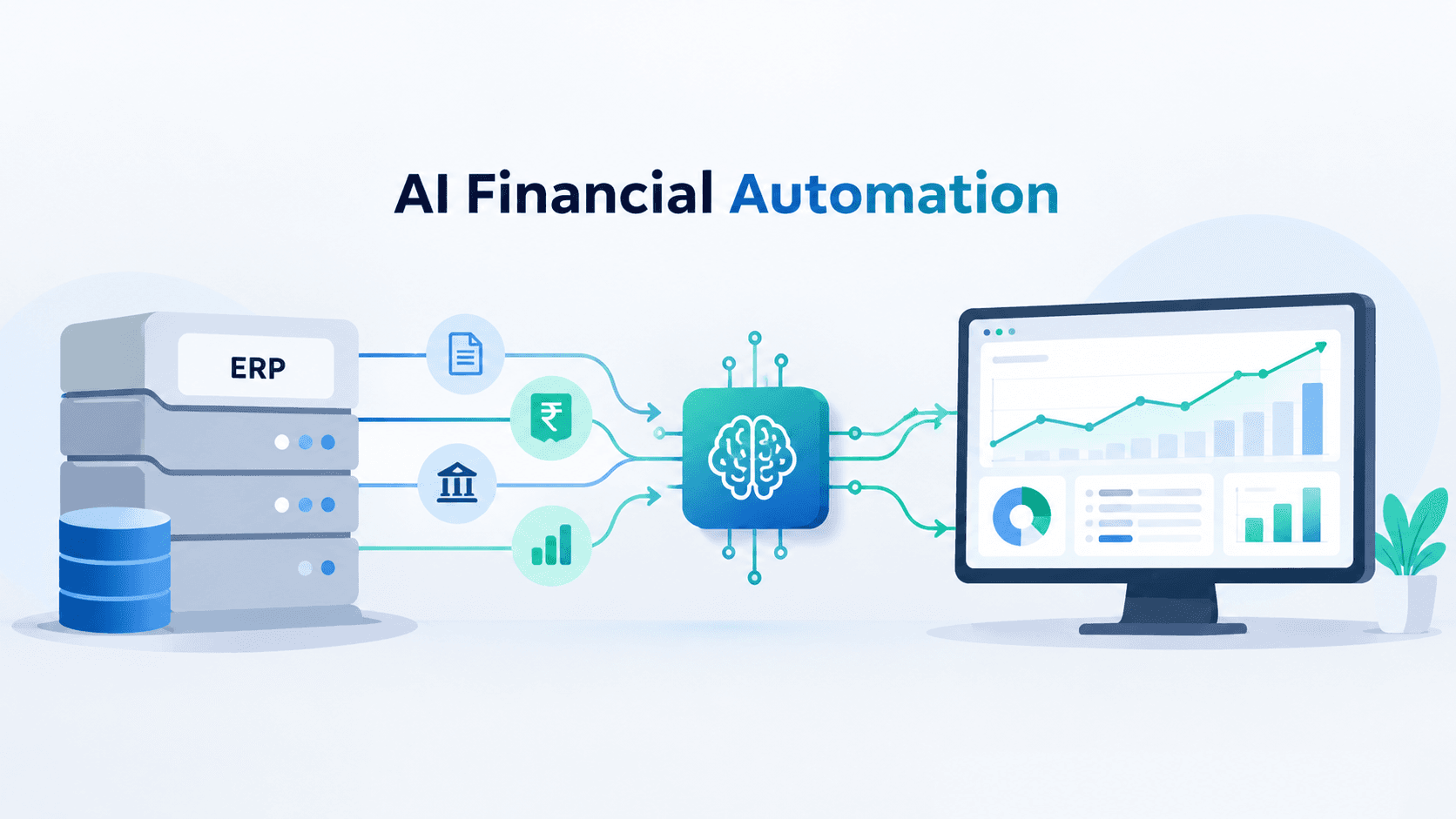
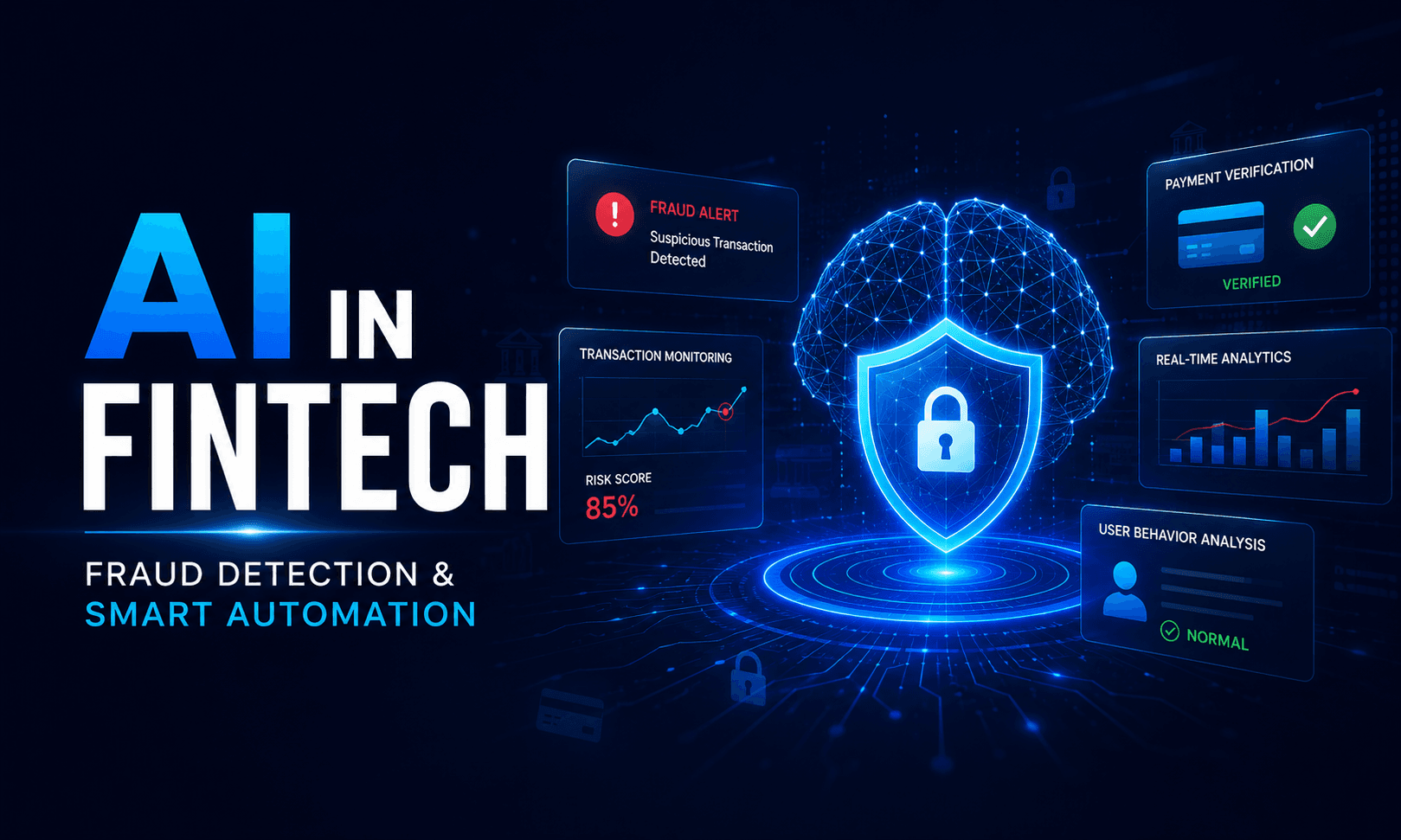
AI in FinTech: Fraud Detection & Smart Financial Automation
In This Article
- What is AI in FinTech?
- Why AI is Becoming Critical in Financial Services
- AI in Fraud Detection: Transforming Financial Security
- How AI Fraud Detection Works
- Key Benefits of AI Fraud Detection
- 1. Real-Time Fraud Monitoring
- 2. Reduced False Positives
- 3. Adaptive Learning Capabilities
- 4. Improved Regulatory Compliance
- 5. Stronger Cybersecurity Posture
- Smart Financial Automation with AI
- Key Areas Where AI Automates Financial Operations
- 1. Loan Processing & Underwriting
- 2. Intelligent Customer Support
- 3. Automated Compliance & Reporting
- 4. Predictive Financial Analytics
- 5. Payment & Transaction Automation
- Business Benefits of AI in FinTech
- 1. Reduced Operational Costs
- 2. Faster Decision-Making
- 3. Enhanced Customer Experience
- 4. Improved Risk Management
- 5. Scalability & Business Growth
- Challenges of Implementing AI in FinTech
- Data Privacy & Security
- Integration Complexity
- Regulatory Compliance
- Model Accuracy & Bias
- Future Trends of AI in Financial Services
- Why Enterprise Leaders Should Prioritize AI in FinTech
- Final Thoughts
The financial industry is undergoing a major transformation powered by Artificial Intelligence (AI). From fraud prevention and risk assessment to intelligent automation and personalized financial services, AI is reshaping how financial institutions operate, compete, and scale.
Today, fintech companies, banks, NBFCs, and digital lenders are dealing with increasing transaction volumes, sophisticated cyber threats, rising customer expectations, and growing regulatory complexity. Traditional systems are no longer enough to handle the speed and intelligence required in modern financial operations.
This is where AI in FinTech is becoming a strategic advantage.
AI-powered financial systems can detect fraud in real time, automate repetitive operations, improve decision-making, reduce operational costs, and deliver highly personalized customer experiences — all while improving scalability and compliance.
In this article, we’ll explore:
- How AI is transforming the fintech industry
- The role of AI in fraud detection
- Smart financial automation use cases
- Benefits for financial institutions and enterprises
- Implementation challenges and future trends
What is AI in FinTech?
AI in FinTech refers to the use of Artificial Intelligence technologies such as machine learning, predictive analytics, natural language processing (NLP), and intelligent automation to optimize financial services and operations.
AI helps financial institutions analyze large volumes of data, identify hidden patterns, automate workflows, and make faster, data-driven decisions.
Modern fintech organizations are using AI across:
- Fraud detection
- Credit risk assessment
- Loan underwriting
- Financial forecasting
- Customer support automation
- Regulatory compliance
- Wealth management
- Payment monitoring
- Intelligent document processing
For CXOs, CTOs, and enterprise leaders, AI is no longer an experimental technology — it is now a business growth enabler.
Why AI is Becoming Critical in Financial Services
The financial sector generates massive amounts of transactional and behavioral data every second. Managing this data manually is nearly impossible at scale.
At the same time, institutions face major challenges such as:
- Increasing financial fraud
- High operational costs
- Complex compliance requirements
- Slow manual processes
- Growing cybersecurity risks
- Customer demand for instant digital experiences
AI addresses these challenges by enabling real-time intelligence, automation, and predictive decision-making.
Organizations that fail to adopt AI-driven fintech solutions risk operational inefficiency and competitive disadvantage.
AI in Fraud Detection: Transforming Financial Security
Ready to Build Smarter FinTech Solutions with AI?
Fraud detection is one of the most impactful applications of AI in FinTech.
Traditional rule-based fraud systems often struggle to detect evolving fraud patterns. AI-driven systems, however, continuously learn from transaction behavior and identify anomalies in real time.
How AI Fraud Detection Works
AI-powered fraud detection systems analyze:
- Transaction patterns
- User behavior
- Device information
- Geographic activity
- Historical spending habits
- Login activity
- Payment behavior
Machine learning algorithms then identify suspicious activities and trigger alerts or automated actions instantly.
Key Benefits of AI Fraud Detection
1. Real-Time Fraud Monitoring
AI systems monitor transactions continuously and identify suspicious activity within milliseconds.
This helps financial institutions prevent fraud before transactions are completed.
2. Reduced False Positives
Traditional fraud systems often block legitimate transactions, creating poor customer experiences.
AI improves accuracy by understanding customer behavior patterns and minimizing unnecessary transaction declines.
3. Adaptive Learning Capabilities
Fraud techniques evolve rapidly.
AI systems continuously learn from new fraud attempts and improve detection models over time without requiring constant manual rule updates.
4. Improved Regulatory Compliance
AI-driven fraud monitoring supports AML (Anti-Money Laundering) and KYC compliance by identifying unusual transaction patterns and suspicious activities automatically.
5. Stronger Cybersecurity Posture
AI helps detect account takeovers, phishing attempts, unauthorized access, and unusual login behavior — strengthening overall financial cybersecurity.
Smart Financial Automation with AI
Beyond fraud detection, AI is revolutionizing financial operations through intelligent automation.
Smart financial automation allows organizations to streamline repetitive workflows, reduce human intervention, and improve operational efficiency.
Key Areas Where AI Automates Financial Operations
1. Loan Processing & Underwriting
AI can automate loan eligibility checks, document verification, credit scoring, and risk assessment.
Benefits include:
- Faster approvals
- Reduced manual processing
- Improved accuracy
- Better risk analysis
- Enhanced customer experience
Financial institutions can process significantly higher loan volumes with fewer operational bottlenecks.
2. Intelligent Customer Support
AI-powered chatbots and virtual assistants provide 24/7 customer support for:
- Balance inquiries
- Transaction tracking
- EMI details
- Loan status updates
- Fraud reporting
- Customer onboarding
This improves response time while reducing support costs.
3. Automated Compliance & Reporting
Compliance management is resource-intensive for financial institutions.
AI helps automate:
- Transaction monitoring
- Regulatory reporting
- Audit preparation
- KYC verification
- Risk assessments
This minimizes compliance risks and operational overhead.
4. Predictive Financial Analytics
AI enables organizations to forecast:
- Customer behavior
- Loan default probability
- Revenue trends
- Cash flow risks
- Market fluctuations
Executives can make smarter strategic decisions using predictive insights.
5. Payment & Transaction Automation
AI improves payment processing by:
- Detecting anomalies
- Optimizing transaction routing
- Automating reconciliation
- Monitoring transaction risks
This enhances transaction speed and reliability.
Business Benefits of AI in FinTech
1. Reduced Operational Costs
AI-driven automation significantly reduces manual workloads, repetitive tasks, and administrative expenses.
Organizations can scale operations without proportionally increasing workforce costs.
2. Faster Decision-Making
AI analyzes large datasets instantly, enabling real-time business intelligence and faster executive decisions.
This is especially valuable in lending, fraud monitoring, and financial forecasting.
3. Enhanced Customer Experience
Modern customers expect personalized and seamless digital experiences.
AI enables:
- Personalized financial recommendations
- Faster support responses
- Intelligent onboarding
- Predictive customer engagement
Better experiences improve customer retention and trust.
4. Improved Risk Management
AI helps institutions proactively identify:
- Fraud risks
- Credit risks
- Market risks
- Operational anomalies
This improves portfolio quality and financial stability.
5. Scalability & Business Growth
AI-powered systems can handle growing transaction volumes and operational complexity efficiently.
This allows fintech companies and financial institutions to expand faster without operational disruption.
Challenges of Implementing AI in FinTech
While AI offers major advantages, implementation also comes with challenges.
Data Privacy & Security
Financial data is highly sensitive. AI systems must comply with strict data protection and cybersecurity standards.
Integration Complexity
Many financial organizations still operate legacy systems that are difficult to integrate with modern AI platforms.
Regulatory Compliance
AI systems must align with financial regulations and maintain transparency in automated decision-making.
Model Accuracy & Bias
AI algorithms must be trained carefully to avoid inaccurate predictions or biased financial decisions.
Future Trends of AI in Financial Services
The future of AI in FinTech is evolving rapidly.
Key emerging trends include:
- Generative AI for financial operations
- AI-powered robo-advisors
- Hyper-personalized banking
- Intelligent fraud prevention systems
- Autonomous financial workflows
- Voice-enabled banking assistants
- AI-driven investment platforms
- Predictive compliance systems
Organizations investing early in AI transformation will gain long-term competitive advantages in operational efficiency and customer acquisition.
Why Enterprise Leaders Should Prioritize AI in FinTech
For CEOs, CTOs, CIOs, founders, and technology leaders, AI adoption is no longer just an IT initiative — it is a core business strategy.
AI enables organizations to:
- Improve operational resilience
- Reduce fraud losses
- Accelerate digital transformation
- Increase profitability
- Enhance customer trust
- Scale financial operations efficiently
The fintech industry is becoming increasingly AI-driven, and organizations that modernize early will lead the next generation of digital financial services.
Final Thoughts
AI is redefining the future of financial services through intelligent fraud detection and smart automation.
From securing digital transactions and automating loan processing to improving customer engagement and predictive decision-making, AI-powered fintech solutions are enabling organizations to operate smarter, faster, and more securely.
For financial institutions looking to remain competitive in a rapidly evolving digital economy, investing in AI-driven fintech infrastructure is no longer optional — it is essential.
Frequently Asked Questions
What is AI in FinTech: Fraud Detection & Smart Financial Automation?
Discover how AI in FinTech helps banks, NBFCs, and fintech companies automate financial operations, detect fraud in real time, reduce risk, and improve customer experience.