AI-Ready CMS: How Sitecore, Sanity and Headless CMS Can Support AI Search
In This Article
- AI search is changing what businesses should expect from a content management system.
- AI Visibility Starts With CMS Architecture
- Technical SEO Still Matters
- How Sitecore Can Support AI Search
- How Sanity Can Become an AI-Ready CMS
- Why Headless CMS Architecture Fits AI Search
- Direct Answers Should Be CMS Fields
- Key Facts Improve Citation Readiness
- Schema Should Be Generated From CMS Data
- Governance Is Part of AI Readiness
- Build CMS Modernization and AI Search Together
AI search is changing what businesses should expect from a content management system.
A CMS can no longer be viewed as just a channel for publishing web pages. Brands now need content that extends beyond traditional search, supporting AI-generated answers, internal search, apps, APIs, personalization, and new digital experiences.
This is why AI-ready CMS development is now a strategic priority in modernizing CMS.
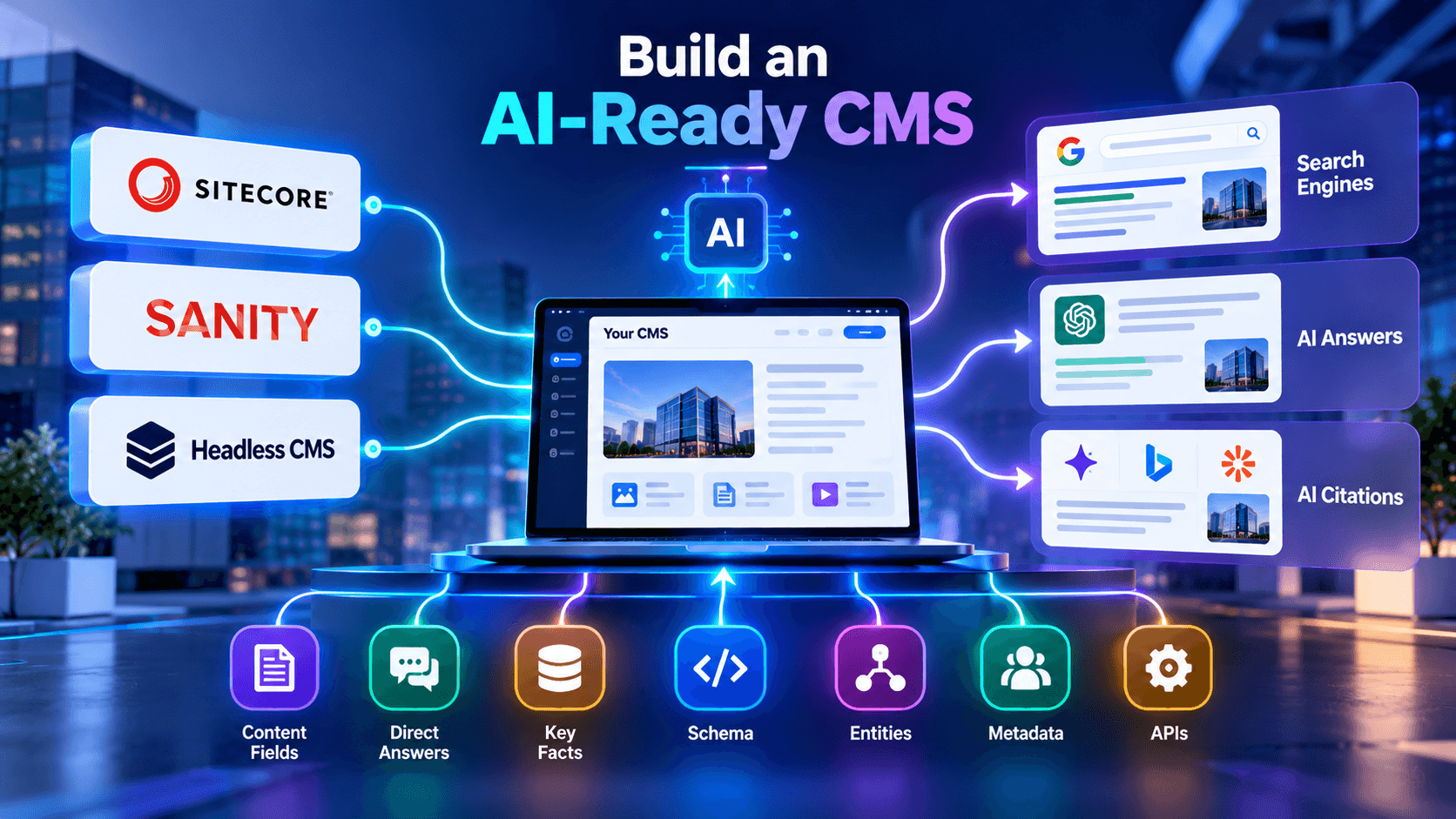
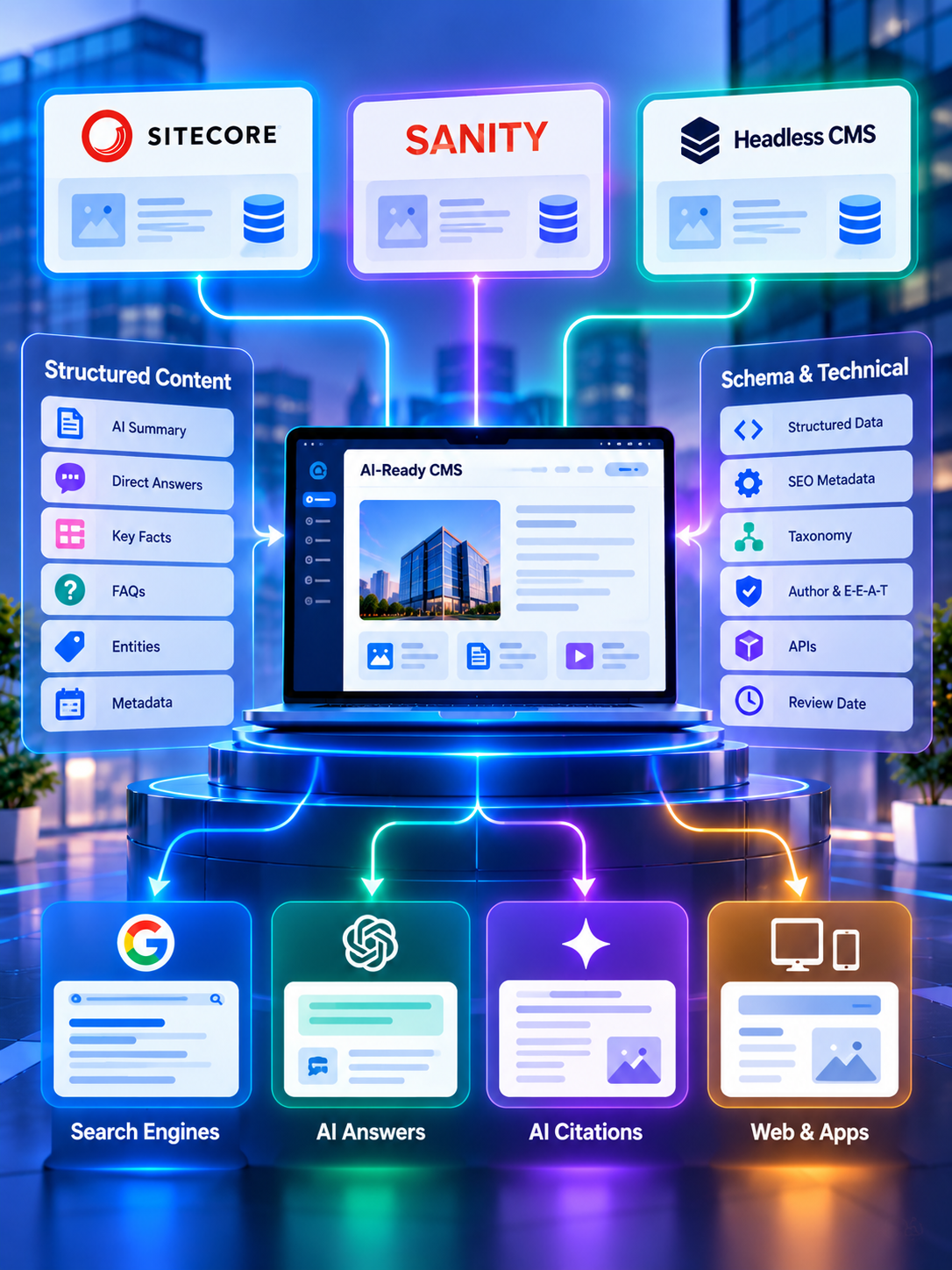
An AI-ready CMS brings together structured content, technical access, schema, direct answers, factual information, entity information, and reusable data models to enable search engines and AI to better find, understand, retrieve, and reuse the information.
AI Visibility Starts With CMS Architecture
AI visibility goes beyond content-writing.
A well-written article may still suffer from being buried inside big rich-text fields, rendered poorly, difficult to crawl, or impossible to reuse outside one webpage.
An AI-ready content architecture should expose important information explicitly using fields such as:
- SEO title and meta description
- AI summary
- AI search snippet
- Key facts
- Direct answers
- FAQs
- Primary entity
- Service area
- Target audience
- Author credentials
- Schema type
- Last reviewed date
This gives content teams a structured way to manage information while giving developers predictable data for websites, APIs, search, and AI experiences.
Brands planning this type of modernization can begin with an AI search optimization strategy that connects CMS structure with SEO, AEO, GEO, and AI visibility.
Technical SEO Still Matters
An AI-ready CMS still needs strong technical foundations.
Search engines and AI retrieval systems need to access the content reliably.
That means checking:
- Crawlability
- Indexability
- Canonical URLs
- XML sitemaps
- Internal linking
- Page speed
- Core Web Vitals
- Rendering
- Robots directives
- Structured data
The headless can help decouple content from presentation, delivering content via API; but the front end implementation will determine if essential content is rendered accessibly
Current advice on headless CMS includes the use of
structured content
APIs
omnichannel
reusable content
faster front-end development
SEO related capabilities such as metadata and structured data.
Build Content for AI Discovery
Modernize your CMS with structured data, direct answers, schema, reusable content, and technical foundations built for AI search visibility.
How Sitecore Can Support AI Search
Some enterprise Sitecore environments have complex content models, multilingual content, personalization, taxonomy, components, workflows, and integrations.
Those capabilities may be able to help with Sitecore AI search if important information is structured intentionally.
For example, Sitecore content types may be able to be separated:
- Service details
- Product information
- Expert profiles
- FAQs
- Case studies
- Locations
- Certifications
- Metadata
- Key facts
- AI summaries
Rather than being trapped inside presentation-centric fields (as has been traditional), these items can be represented as reusable content objects.
These can then be used to simultaneously power webpages, structured data, internal search, AI discovery, and more.
Organizations modernizing Sitecore can use Sitecore CMS development services to connect content architecture, frontend development, technical SEO, and AI readiness.
You can also review this Sitecore XM Cloud healthcare AI search case study for a more practical enterprise implementation perspective.
How Sanity Can Become an AI-Ready CMS
Sanity is particularly well suited to structured content because its schema system allows developers to define content fields explicitly.
A Sanity AI-ready CMS can include fields for:
- AI summaries
- Direct answers
- Key facts
- Questions
- Entities
- Locations
- Audiences
- SEO metadata
- Schema types
- Review dates
This creates a more consistent editorial workflow.
Instead of asking content teams to manually format AI-ready content inside page copy, the CMS can enforce the structure.
Businesses planning this type of implementation can explore Sanity CMS development services.
Structured Sanity content can also support more advanced AI integrations. This guide to Sanity AI agents and MCP shows how structured CMS context can support intelligent applications beyond ordinary publishing.
Why Headless CMS Architecture Fits AI Search
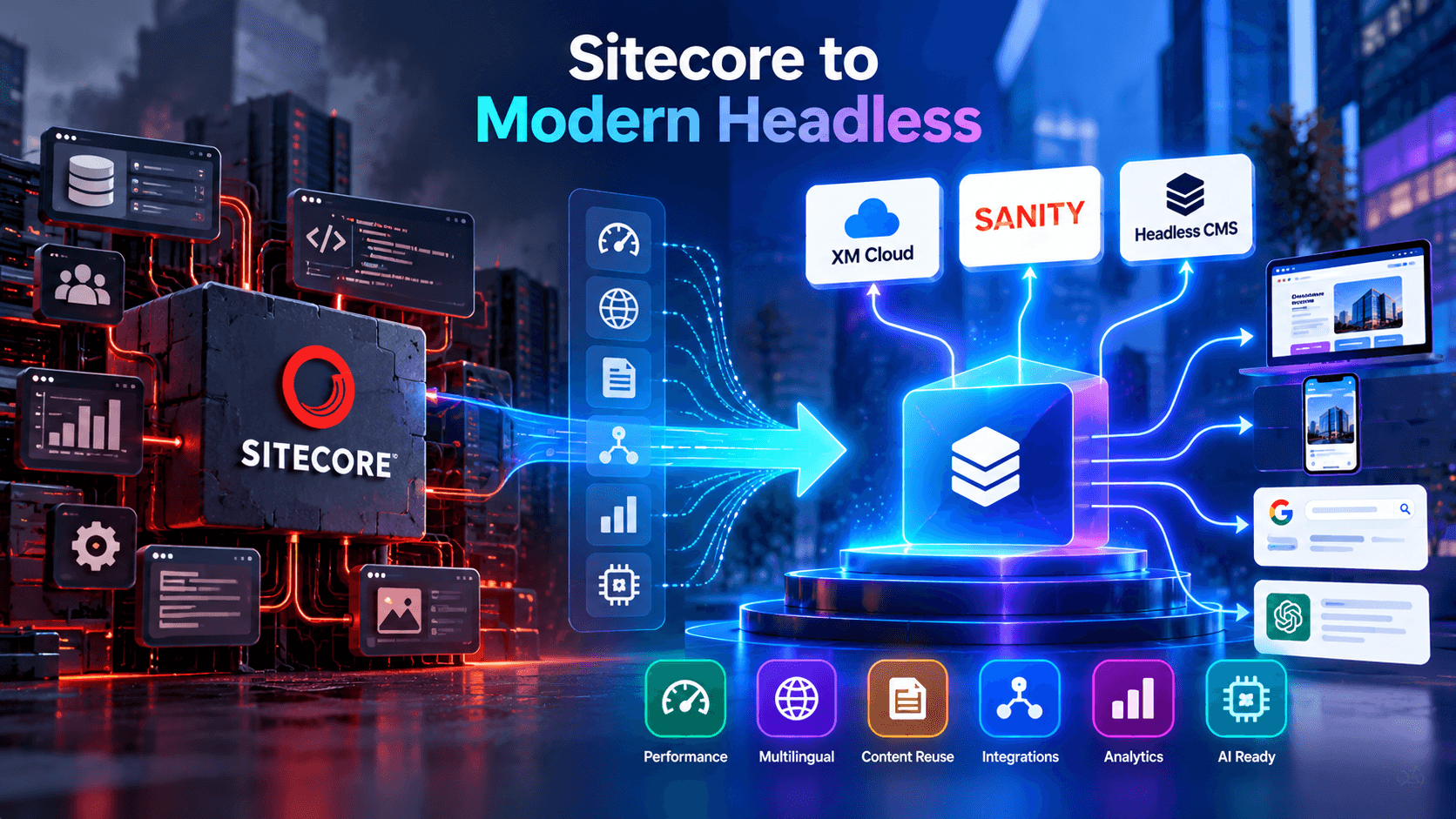
A headless CMS separates content management from the presentation layer.
That matters because AI-ready content should not belong exclusively to one page.
A product fact, service description, expert profile, or FAQ may need to appear in:
- Websites
- Mobile apps
- Internal search
- AI assistants
- Knowledge systems
- Product interfaces
- Customer portals
- Future channels
With a headless CMS, the same structured content can be delivered through APIs to different frontends and systems.
This “create once, deliver everywhere” model is one of the major advantages of headless architecture. Sitecore
Businesses planning this architecture can explore headless CMS development services.
Our headless CMS migration case study using Sanity and Next.js also demonstrates how structured content and a decoupled frontend can work together.
Turn Your CMS Into an AI-Ready Content Engine
Direct Answers Should Be CMS Fields
Answer Engine Optimization is most effective when answers are simple and portable.
Instead of hiding an answer within a lengthy article, an enterprise can distill an answer into a structured set of fields including:
Question
Direct Answer
Supporting Explanation
Related Entity
This information can be re-used across services, FAQs, AI interfaces, schema, knowledge bases, and APIs.
Much better than manually structuring every answer.
Key Facts Improve Citation Readiness
AI systems often need short, precise facts.
Useful key-fact fields may include:
- Supported markets
- Platform capabilities
- Technical requirements
- Delivery models
- Implementation timelines
- Certifications
- Measurable case-study results
These facts should be accurate, specific, and regularly reviewed.
Structured content does not guarantee AI citations, but it makes important information easier to retrieve and reuse.
Schema Should Be Generated From CMS Data
Schema works best when it reflects visible content.
For example:
- Article content can populate Article schema
- Service content can populate Service schema
- FAQ objects can populate FAQ-related markup where appropriate
- Author records can populate Person information
- Organization fields can support company-level structured data
Generating schema from structured CMS data reduces duplication and improves consistency.
Governance Is Part of AI Readiness
AI-ready content architecture also needs governance.
Enterprise teams should define:
- Content owners
- Approval workflows
- Review frequency
- Fact-checking responsibility
- Author credentials
- Localization rules
- Content retirement
- Taxonomy standards
Structured content that is outdated can still be easy for machines to retrieve.
That makes freshness and governance essential.
Build CMS Modernization and AI Search Together
The strongest modernization projects treat AI visibility as an architectural requirement from the beginning.
A practical model is:
Technical SEO + structured content + direct answers + key facts + schema + entities + APIs + governance
Headless CMS, Sanity, Sitecore or other enterprise platforms are viable options if implemented right.
The software itself will not make it AI-ready.
The architecture will.
If you are looking to upgrade your CMS and prepare for AI search at the same time, start by assessing the degree to which your platform of choice accommodates structured fields, reusable content, machine-readable data, technical accessibility and AI-ready presentation.
Explore AI search optimization services to connect CMS modernization with AI visibility, AEO, GEO, and technical SEO.
An AI-ready CMS should do more than publish pages.
It should create trusted, structured information that can move wherever discovery goes next.
Frequently Asked Questions
What is an AI-ready CMS?
An AI-ready CMS stores content in structured, reusable and machine-readable fields while supporting technical SEO, direct answers, schema, entities, key facts and APIs.
Can Sitecore support AI search optimization?
Yes. Sitecore can support AI search through structured content models, reusable components, taxonomy, metadata, multilingual content, schema and technically accessible frontend delivery.
Is Sanity CMS suitable for AI-ready content?
Yes. Sanity allows developers to create explicit schema fields for AI summaries, direct answers, key facts, entities, audiences, locations, metadata and other structured content.
Why is headless CMS architecture useful for AI search?
A headless CMS separates content from presentation and delivers structured data through APIs, making it easier to reuse the same information across websites, apps, search systems and AI experiences.
What fields should an AI-ready CMS include?
Useful fields include AI summary, AI search snippet, key facts, direct answers, FAQs, primary entity, target audience, service area, schema type, author information and last reviewed date.
Does structured content guarantee AI citations?
No. Structured content can improve machine understanding and retrieval, but AI citations also depend on relevance, authority, credibility, accessibility and platform-specific retrieval behavior.
How do direct answers improve AI search readiness?
Direct answers provide concise responses to important questions, making useful information easier for search engines and AI systems to identify and retrieve.
How does schema markup support an AI-ready CMS?
Schema markup clarifies page types, entities and relationships. It is most reliable when generated from structured CMS data that matches visible content.
Does an AI-ready CMS still need technical SEO?
Yes. Crawlability, indexability, rendering, internal links, canonical URLs, sitemaps, performance and accessible HTML remain essential foundations for AI search visibility.
When should a business hire an AI-ready CMS developer?
Hire specialist help when your CMS needs structured AI fields, schema automation, headless APIs, search integrations, CMS migration, answer-ready content models or frontend changes for better technical accessibility.