Murmu Software Infotech Mobile App Development vs a General Software Agency
In This Article
- A mobile app can look impressive in a demo and still fail when customers start using it.
- 10 Questions to Ask Before Hiring a Mobile App Development Company
- Mobile App Agency vs Freelancer vs Dedicated Development Team
- Native Android and iOS vs React Native vs Flutter
- What Is Included Beyond Mobile App UI Development?
- Mobile App Development Cost and Commonly Missed Expenses
- AI-Powered Mobile Apps: When Does AI Add Value?
- Mobile App Security, Accessibility and Store Submission
- Source Code Ownership and Mobile App Handover Checklist
- Real Mobile App Development Experience at Murmu Software Infotech
- Choosing the Right App Development Engagement
A mobile app can look impressive in a demo and still fail when customers start using it.
The screens may be attractive, but what happens when payments fail, notifications stop, APIs become unreliable or a new Android or iOS update creates problems?
For businesses investing in mobile applications, these questions matter as much as design.
If you're wondering how to choose a mobile app development company, evaluate the complete engineering, delivery and support process—not just the initial development quotation.
10 Questions to Ask Before Hiring a Mobile App Development Company
Before selecting your Android or iOS development partner, ask:
- Have you developed applications similar to our business needs?
- Who will design the user journeys and technical architecture?
- Will you develop our backend, database and APIs?
- How will you choose between native and cross-platform development?
- What authentication, authorization and security controls are included?
- Which real devices and operating-system versions will you test?
- Who handles app-store submissions and review issues?
- Who owns the source code and developer accounts?
- What happens after launch when defects or updates are required?
- Which deliverables, integrations and support services are included in the estimate?
Ask for written answers and relevant project demonstrations.
Build Apps Beyond Beautiful Screens
Connect intuitive mobile experiences with secure APIs, reliable testing, and ongoing support to launch confidently and serve customers better.
Mobile App Agency vs Freelancer vs Dedicated Development Team
A freelancer can be suitable for a smaller application or a clearly defined technical task.
A general software agency may offer broader delivery capabilities, depending on its specialization and team.
A dedicated mobile engineering team becomes valuable when the product requires coordinated frontend, backend, security, testing, deployment and ongoing development.
Your Mobile App Deserves More Than Beautiful Screens Alone
Review business workflows, API integrations, platform requirements and support needs before committing your development budget.
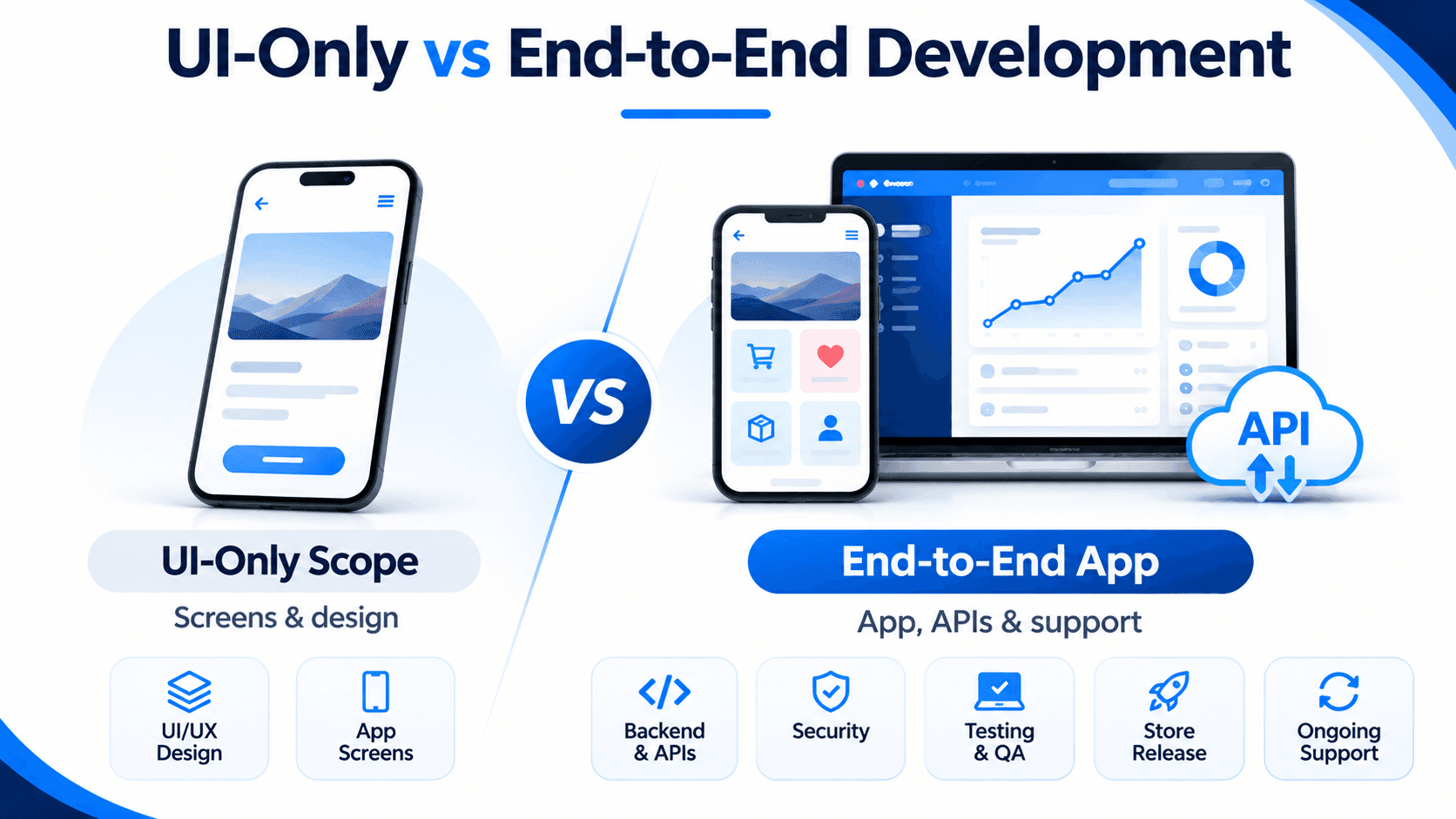
Compare the actual scope:
| Evaluation | Limited development scope | End-to-end engineering scope |
|---|---|---|
| Requirements | Screens and basic features | Workflows, roles and acceptance criteria |
| Backend | Existing service or simple API | Designed APIs, data storage and integrations |
| Security | Requires separate verification | Defined controls and security testing |
| QA | Basic functional testing | Agreed device coverage and regression checks |
| Launch | App build delivered | Submission and release responsibilities defined |
| Support | Separate arrangement | Planned maintenance and enhancement options |
Both models can work. The important issue is whether responsibilities are clearly defined.
Native Android and iOS vs React Native vs Flutter
Choosing the right technology affects development effort, user experience and long-term maintenance.
Native Android and iOS: Kotlin and Swift are suitable when deep platform integration, device-specific features or specialized performance requirements justify separate implementations.
React Native: A shared-codebase approach that can support Android and iOS while accommodating native integrations where needed.
Flutter: Another cross-platform option, useful when a consistent interface and shared development approach suit the application.
Neither native nor cross-platform development is automatically superior.
At Murmu Software Infotech, we assess the platforms, device features, integrations and maintenance requirements before recommending a stack.
Explore our React Native Development Services.
What Is Included Beyond Mobile App UI Development?
More features may be required.
Authentication, APIs, databases, payments, push notifications, geolocation, analytics, admin tools and deployment to a cloud solution may all be required.
In a marketplace application, users must be listed, searched and communicated with. It should allow for moderation and control of operations.
In a healthcare booking application, users must be able to book appointments, check providers’ availability, securely manage information and have integrated admin processes.
The backend and operational requirements should be included in the original architecture discussion.
Planning a mobile product?
Request a Mobile App Scope & Estimate to review the complete application, not just the visible screens.
Mobile App Development Cost and Commonly Missed Expenses
The cost of mobile application development depends on platforms, features, design complexity, integrations, security requirements and testing.
Ask your development company to separate:
Initial costs: Discovery, UI/UX, frontend, backend, testing and deployment.
Recurring costs: Hosting, messaging services, payment processing, third-party APIs and maintenance.
Future costs: Operating-system compatibility, security updates, enhancements and additional platform support.
Two app development quotations cannot be compared fairly if one excludes backend integration, store submission or post-launch fixes.
Explore MSI's Project Cost Calculator for a starting point.
AI-Powered Mobile Apps: When Does AI Add Value?
AI can support mobile experiences such as guided assistance, document processing, personalized recommendations and operational automation.
However, AI is not necessary for every application.
Before integrating it, establish the actual user problem, data requirements, model limitations, API costs and appropriate human oversight.
Sensitive customer information must be handled through suitable security and privacy controls.
Know Your App's Total Cost Before Development Begins
Understand development, integrations, testing, infrastructure and maintenance requirements with a scope-based estimate.
Mobile App Security, Accessibility and Store Submission
Security should be considered from the design stage.
Important controls include secure authentication, API authorization, protected data storage, input validation and appropriately limited permissions.
Accessibility should address readable interfaces, screen-reader support, contrast and practical navigation.
Both Android and iOS have platform-specific quality, privacy and submission requirements.
App-store approval should never be treated as guaranteed. Responsibilities for preparing builds, store metadata, testing accounts and resolving review feedback should be agreed upon.
Source Code Ownership and Mobile App Handover Checklist
Before signing, confirm ownership of the source code, designs, documentation and intellectual property.
Clarify access to repositories, cloud infrastructure, signing credentials, developer accounts and third-party licences.
A complete handover should make the application maintainable, even if your development arrangement changes.
Real Mobile App Development Experience at Murmu Software Infotech
Our published portfolio demonstrates connected mobile and backend engineering across different industries.
DOC247: Healthcare workflows involving doctor discovery, appointments, real-time clinic queues, virtual waiting rooms and video consultations.
TribalShaadi: A React Native mobile experience with backend APIs, subscriptions, real-time communication and AI-assisted features.
GAXA: A local marketplace application involving listings, user verification, buyer-seller workflows and administrative control.
Explore our Mobile App Development Portfolio, DOC247 Case Study and TribalShaadi Case Study.
These examples show relevant implementation experience, not guaranteed outcomes for every project.
Choosing the Right App Development Engagement
A fixed-scope project suits defined requirements and agreed deliverables.
A dedicated team can support evolving products requiring continuing engineering capacity.
A white-label partnership may suit agencies that need mobile development capabilities alongside their client-facing services.
MSI supports scoped application development, React Native engineering, backend integration and ongoing maintenance arrangements.
Frequently Asked Questions
How do I choose the best mobile app development company?
Look for relevant app development experience, clear discovery processes, backend and integration skills, security practices, real-device testing, transparent estimates and post-launch support. Ask for demonstrations of comparable applications and written deliverables.
How much does Android and iOS mobile app development cost?
Costs depend on platforms, features, design, authentication, backend APIs, integrations, testing, deployment and support. A quotation should distinguish initial engineering from hosting, third-party services and ongoing maintenance.
Should I hire a mobile app agency, freelancer or dedicated development team?
Freelancers may suit small, well-defined tasks. Agencies can coordinate multiple disciplines, while dedicated teams suit evolving products requiring sustained development capacity. Compare technical responsibility, continuity, scope and total cost.
Which is better for my app: React Native, Flutter or native development?
The right choice depends on device-specific requirements, user experience, performance, team expertise and maintenance needs. React Native and Flutter support shared-codebase delivery, while native Kotlin or Swift may suit deeper platform-specific requirements.
Can one mobile app work on both Android and iOS?
Yes. Cross-platform frameworks such as React Native and Flutter can share much of the application code across Android and iOS. Platform-specific testing, permissions, integrations and deployment work may still be required.
What services should an end-to-end mobile app development company provide?
Depending on project scope, services may include product discovery, UI/UX design, mobile frontend, backend development, APIs, authentication, payments, analytics, quality assurance, app-store deployment and ongoing support.
How long does it take to develop a mobile application?
Development time varies with platform choice, feature complexity, integrations, data readiness, approvals and quality requirements. A realistic schedule should follow requirements discovery and include testing and release preparation.
What security measures should a business mobile app include?
Appropriate controls may include secure authentication, authorization, encrypted communications, protected storage, restricted permissions, input validation, dependency management and security testing. Requirements depend on the application and data sensitivity.
Who owns the mobile app source code and developer accounts?
Ownership and access depend on the signed agreement. Businesses should explicitly define intellectual-property transfer, source-code repositories, signing credentials, app-store accounts, infrastructure access, documentation and handover responsibilities.
Does mobile app development include app-store submission and maintenance?
Not automatically. Confirm whether the proposal includes Google Play and Apple App Store submissions, review responses, bug fixes, operating-system updates, monitoring and enhancement support. App-store acceptance is subject to the platform's review process.