Custom ERP vs SAP Business One vs Dynamics 365 Business Central
In This Article
- Features, Cost & ROI
- What Are the Differences Between Custom ERP, SAP B1 and Business Central?
- Which ERP Fits Small, Medium and Complex Manufacturers?
- ERP Modules: Finance, Inventory, Procurement, BOM and Production
- Custom ERP vs Configuration vs Add-On Development
- Manufacturing ERP: Simple vs Multi-Stage Production
- ERP Implementation Cost: Licences, Migration and Support
- ERP Security, Deployment and Data Ownership
- Integrating ERP With CRM, eCommerce, POS and Warehouses
- Before vs After an Integrated Manufacturing Workflow
- Murmu Software Infotech's ERP & Integration Experience
- When Should You Avoid Building Custom ERP?
- Request an ERP Platform & Cost Assessment
Features, Cost & ROI
Should your factory change its processes to fit an ERP, or should software adapt to your existing operations?
Synchronisation issues – Sales confirmations have not been reflected in stock. Invoicing is delayed, spreadsheets used in procurement and different systems used in production. Delayed information for finance.
Choosing the right ERP solution is very important to avoid customisation costs, inefficient processes and ongoing issues.
If you're evaluating custom ERP vs SAP Business One or Microsoft Dynamics 365 Business Central, compare the complete business workflow not just software features or licence prices.
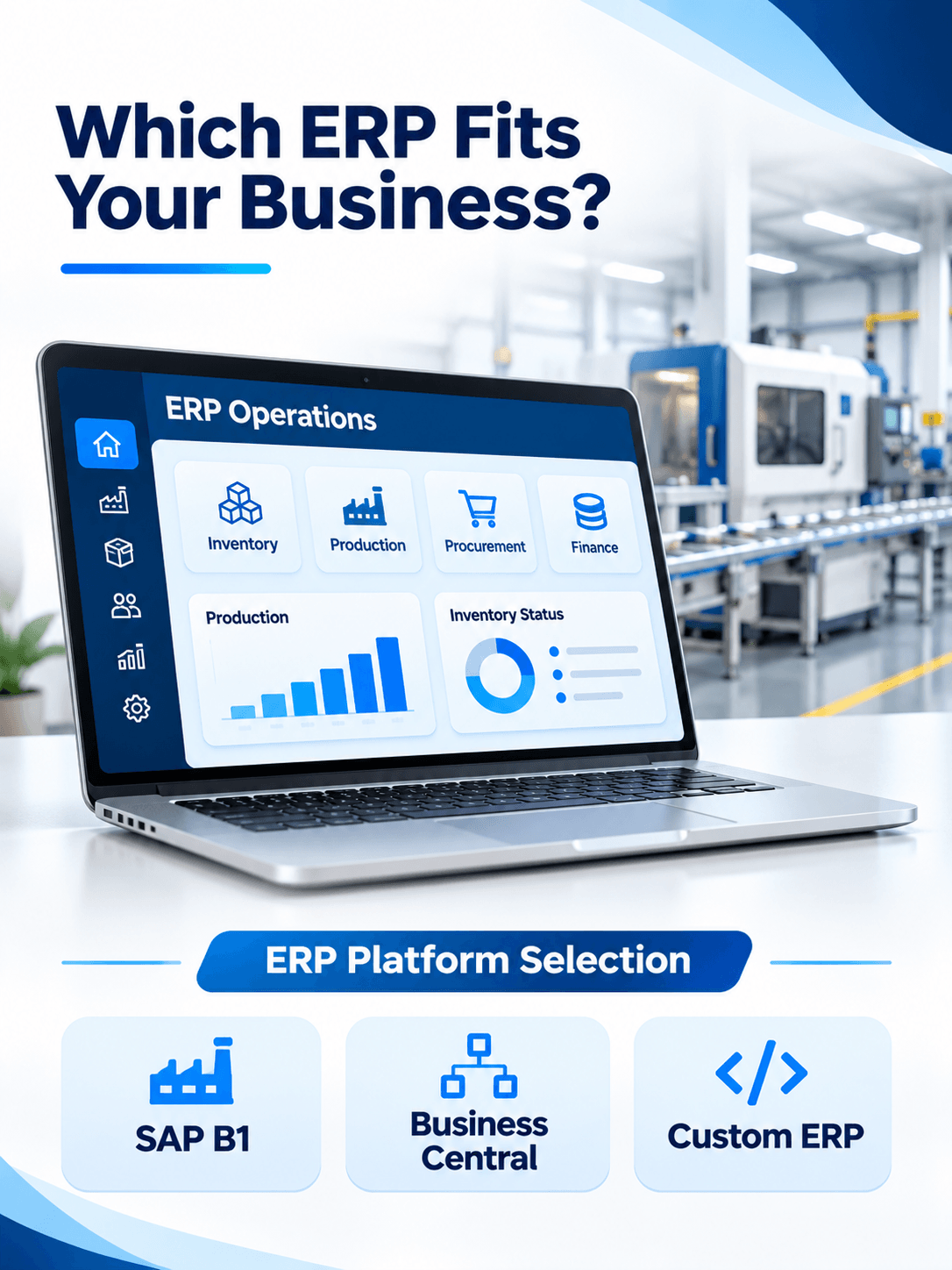
Choose ERP That Fits Operations
Compare manufacturing workflows, integrations, implementation costs and long-term support needs before investing in packaged or custom ERP software.
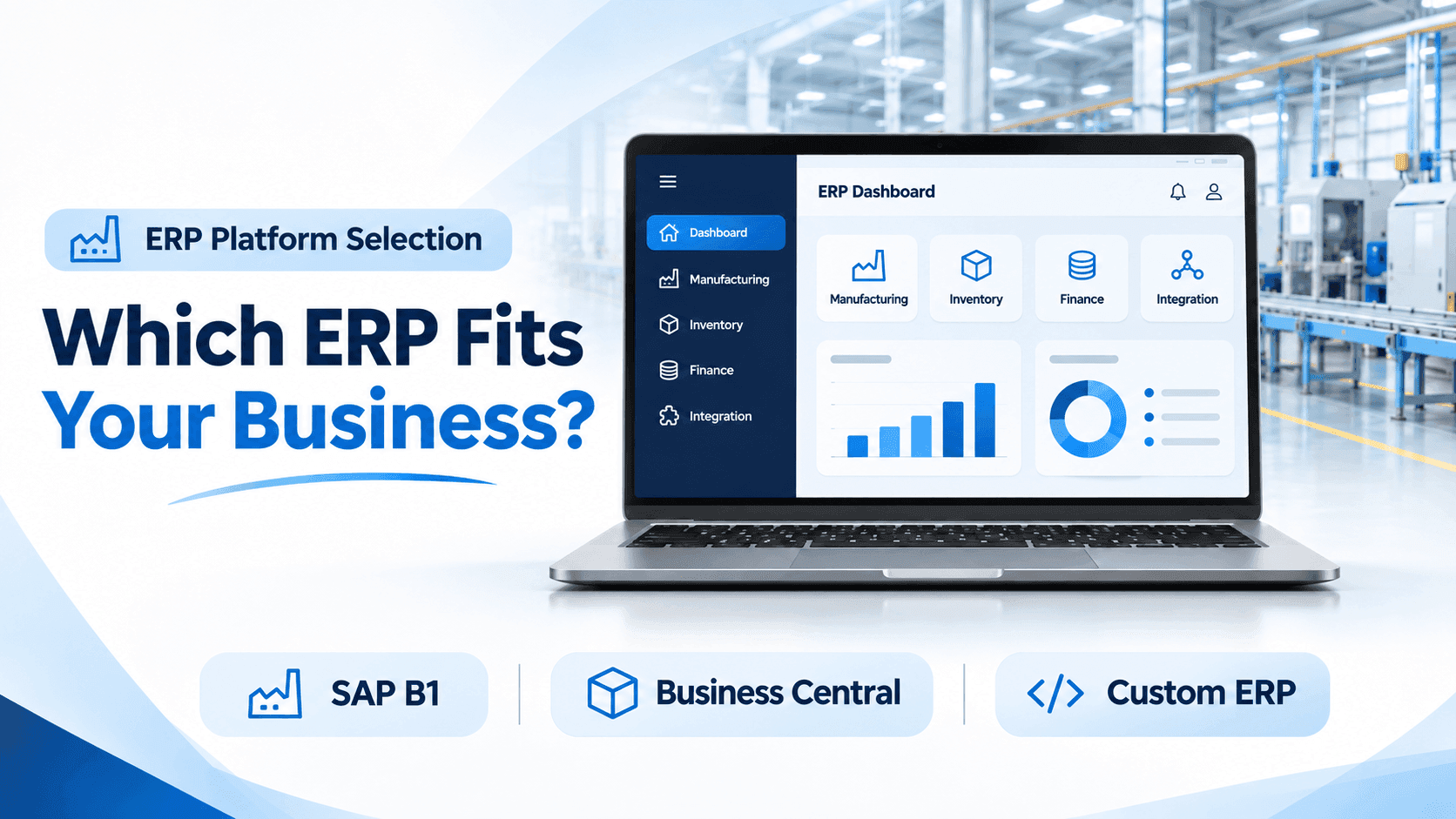
What Are the Differences Between Custom ERP, SAP B1 and Business Central?
| ERP approach | Main strength | Key consideration |
|---|---|---|
| SAP Business One | Established finance, purchasing, inventory and production workflows | Licences, implementation, add-ons and support |
| Dynamics 365 Business Central | Connected finance, supply chain and Microsoft ecosystem | Editions, subscriptions, extensions and integration |
| Custom ERP | Purpose-built operational workflows | Engineering, testing, hosting and maintenance |
| Existing ERP plus extensions | Retains working systems while adding required functions | API availability and integration complexity |
Both established ERPs already support manufacturing. Custom development is valuable when business-specific requirements justify it.
Which ERP Fits Small, Medium and Complex Manufacturers?
SAP Business One may suit SMEs needing integrated finance, purchasing, stock, production orders and material planning.
Business Central may suit growing organizations wanting connected business operations and Microsoft ecosystem integration. Its manufacturing functionality should be evaluated under the appropriate Premium licence.
Custom ERP This may be a good option for businesses with specific processes, pricing structures, or industry processes.
However complex a manufacturing process is, it may still be possible to use a standard ERP solution. It is important to compare what is required with what can be delivered.
Choose the Right ERP Before Making an Expensive Commitment
Compare packaged ERP, custom development and integration options against your workflows, budget and operating requirements.
ERP Modules: Finance, Inventory, Procurement, BOM and Production
An ERP selection should begin with the workflows that matter most:
- Finance, tax and reporting
- Purchasing, suppliers and approvals
- Inventory and warehouse movements
- Bills of materials and production orders
- Job costing and production planning
- Customer orders, dispatch and returns
Evaluate these capabilities using sample transactions.
Confirm whether each function is standard, requires configuration, needs a paid add-on or must be developed separately.
Custom ERP vs Configuration vs Add-On Development
There are three ways to meet a specialized ERP requirement.
Configuration: Adjust an existing platform's settings, workflows, roles and reporting.
Extension: Build an additional module, dashboard or integration around the existing ERP.
Custom ERP: Develop a purpose-built application covering agreed business processes.
Configuration is usually worth evaluating first. Extensions can preserve existing investments. Full custom development is most appropriate when important requirements cannot be addressed economically through established solutions.
Manufacturing ERP: Simple vs Multi-Stage Production
Bills of material, stock usage and basic production order functionality will be required.
Work centres, sub-contracting, quality inspections, machine capacity, wastage and specific production costings may also be required.
Depending on complexity, the appropriate product edition, set-up or add-on within SAP Business One and/or Business Central may be required.
It is recommended to get a realistic demo of the products to match your production processes.
ERP Implementation Cost: Licences, Migration and Support
ERP costs extend beyond the initial quotation.
| Cost component | Packaged ERP | Custom ERP |
|---|---|---|
| Software | Licences or subscriptions | Development investment |
| Implementation | Configuration and deployment | Discovery, design and engineering |
| Changes | Configuration, extensions or add-ons | Custom feature development |
| Infrastructure | Depends on deployment | Depends on architecture |
| Upgrades | Platform updates and extension testing | Application and dependency updates |
| Support | Agreed vendor or partner services | Agreed engineering and maintenance |
For a realistic three-to-five-year total cost of ownership (TCO), include training, migration, integrations, testing, security, recurring support and future enhancements.
No universal pricing comparison is reliable without the same scope and assumptions.
ERP Security, Deployment and Data Ownership
Every option requires appropriate access controls, backups, audit logs and data governance.
Before committing, verify deployment options, user permissions, change approvals, data exports and recovery procedures.
For custom development, agree on source-code ownership, documentation and maintenance responsibilities.
For packaged ERP, understand licensing conditions, extension dependencies and migration options.
Integrating ERP With CRM, eCommerce, POS and Warehouses
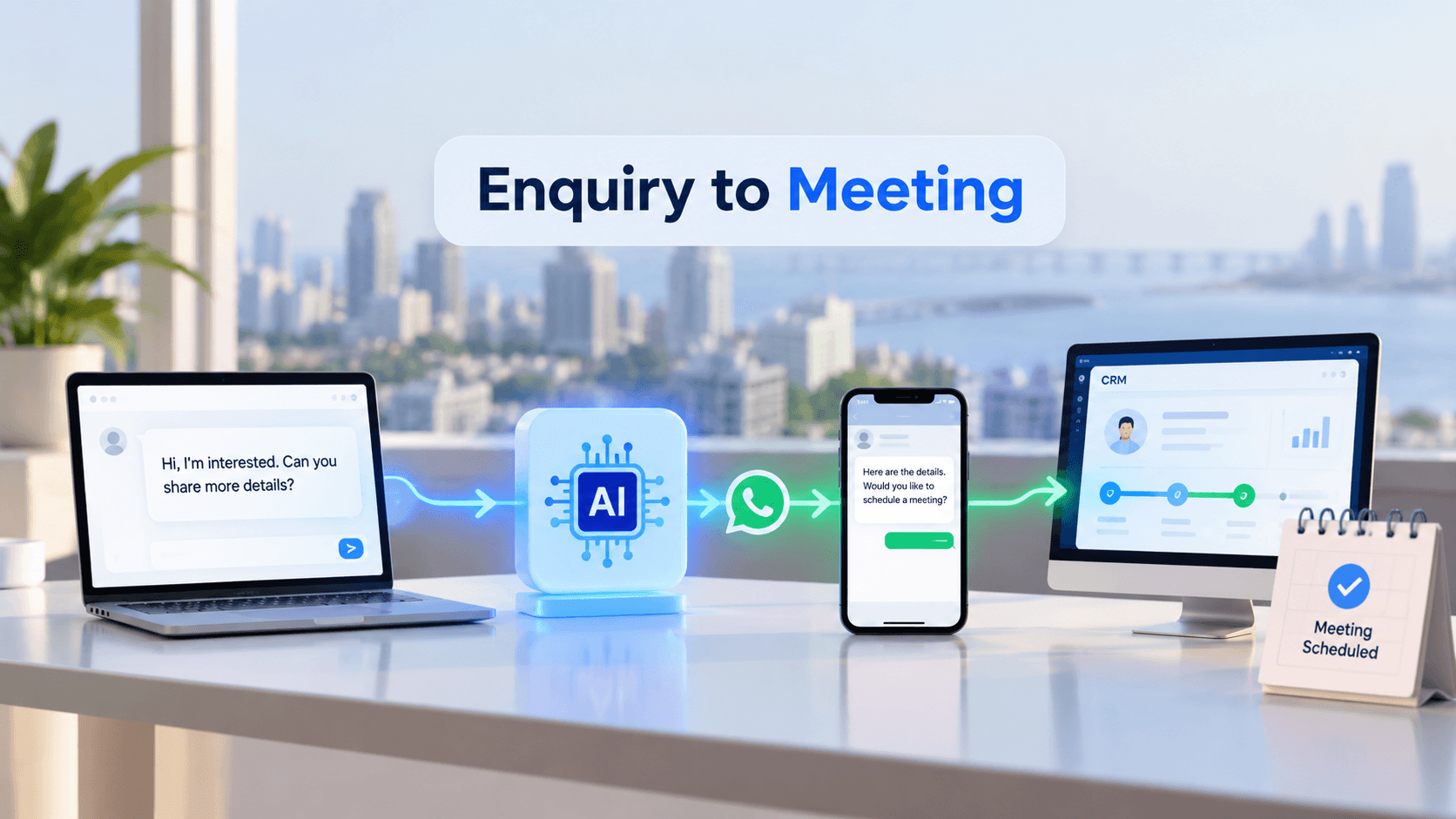
Orders from web/CRM systems can be passed into the ERP system, stock levels updated across multiple inventory systems, and invoice information passed to Finance.
Ownership of data needs to be clear, API access provided, and reconcilliation and error handling procedures put in place.
Murmu Software Infotech offers ERP development and integration services to help organizations evaluate such requirements.
Unsure whether to replace your ERP or connect existing systems?
Request ERP Platform Assessment
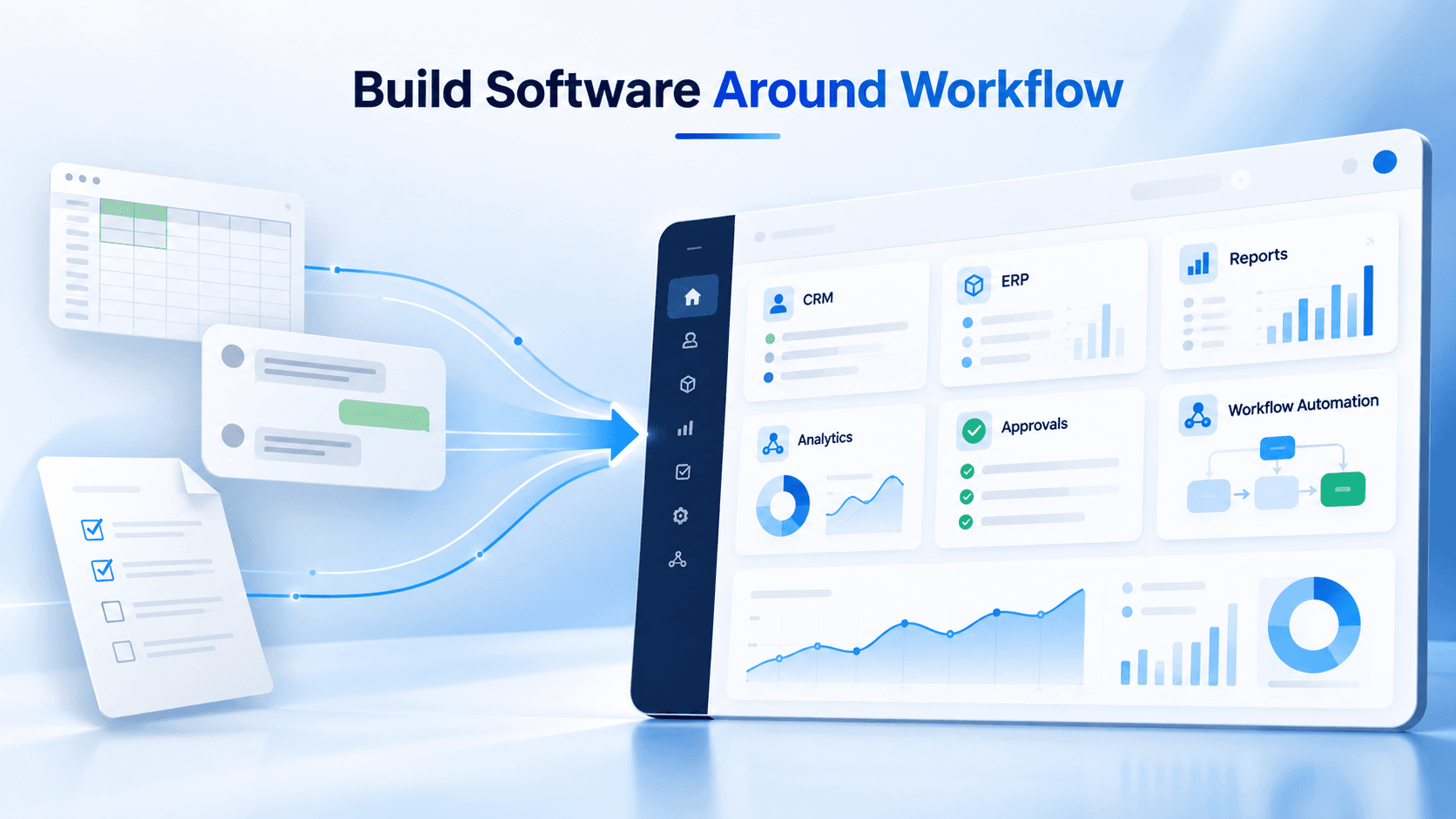
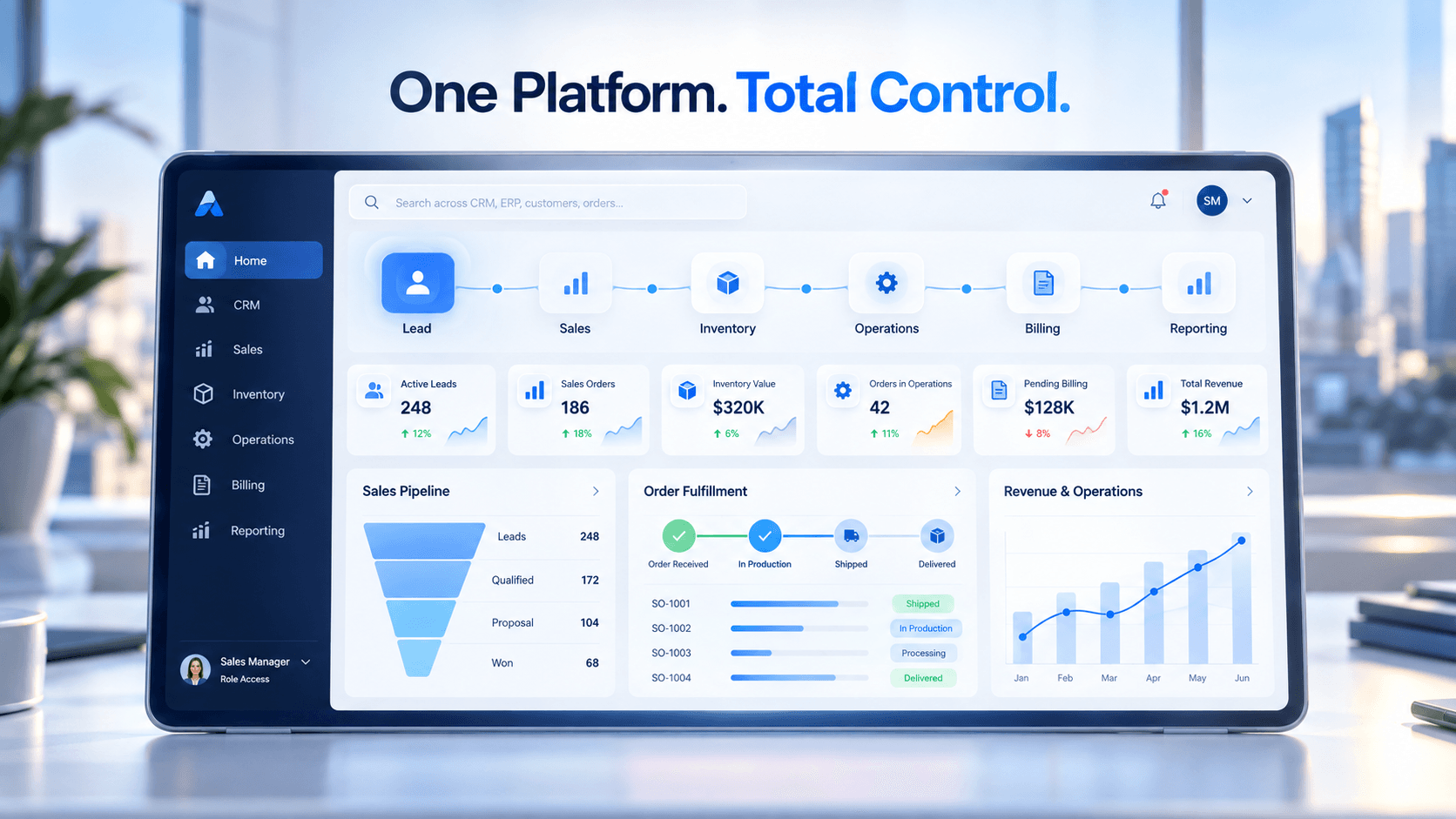
Stop Managing Disconnected Systems. Build a Connected Manufacturing Operation.
Explore production workflows, inventory visibility and CRM–ERP integrations before considering a costly replacement project.
Before vs After an Integrated Manufacturing Workflow
Disconnected workflow:
Sales order → separate stock spreadsheet → manual purchase request → production update → delayed financial reporting.
Target integrated workflow:
Sales order → inventory validation → approved procurement → production tracking → dispatch → accounting and reporting.
Connected operations can improve visibility and reduce duplicate entry. Actual benefits depend on implementation quality, business rules and data accuracy.
Murmu Software Infotech's ERP & Integration Experience
Murmu Software Infotech provides custom ERP development, operational workflow integration, modernization and enterprise software engineering.
Its published Salesforce–SAP Integration Case Study describes bidirectional data synchronization through custom middleware.
That project demonstrates relevant CRM–ERP integration engineering; it should not be presented as a full SAP Business One or Business Central deployment.
Explore MSI Enterprise Software Platform Services for related integration capabilities.
When Should You Avoid Building Custom ERP?
Do not build new if ERP has most of required functionality.
Responsibility
Developing a new system could mean taking on more responsibility relating to security, upgrading, support and future compatibility.
If the current ERP is working for you, but missing out on a particular feature (warehouse dashboard, client portal, specific reports), it may be cheaper to integrate or add onto your current system.
Only invest in bespoke software if it will add enough value to justify the running costs.
Request an ERP Platform & Cost Assessment
Choose the ERP approach that fits your operations, budget and growth plans.
We help organizations analyze their existing business processes to understand what needs to be integrated, configured and developed within custom application solutions.
Understand what can be reconfigured, integrated, enhanced or substituted.
Frequently Asked Questions
Which is better: custom ERP or SAP Business One?
SAP Business One offers established finance, purchasing, inventory, production and MRP capabilities. Custom ERP can support specialized processes but requires development, testing and maintenance. The better choice depends on workflow fit, integration needs and total ownership cost.
What is the difference between SAP Business One and Dynamics 365 Business Central?
Both provide finance, purchasing, inventory and manufacturing-related capabilities for small and midsize businesses. SAP Business One has its own application and partner ecosystem, while Business Central integrates with Microsoft's business software ecosystem. Buyers should compare editions, production workflows, implementation and add-ons.
Does SAP Business One support manufacturing and MRP?
Yes. SAP Business One includes bills of materials, production orders, inventory management and material requirements planning. More specialized manufacturing requirements may involve configuration or additional applications.
Does Dynamics 365 Business Central include manufacturing?
Yes. Business Central supports manufacturing operations such as production orders, routings, work centers, machine centers and planning. Microsoft's manufacturing capabilities are associated with Business Central Premium licensing.
When should a manufacturing business build a custom ERP?
Custom ERP may be appropriate when critical production, costing, approval or data workflows cannot reasonably be implemented through standard ERP functions, configuration or extensions. The business must also be prepared for ongoing engineering and support.
How much does custom ERP development cost in India?
Cost depends on modules, users, process complexity, integrations, deployment, security, migration, reporting, testing and support. An accurate estimate requires a documented scope rather than a universal per-company price.
What is the total cost of ownership of an ERP system?
ERP total ownership cost includes software or development fees, implementation, migration, hosting, integrations, training, support, upgrades and future changes. Compare options over the same three-to-five-year period.
Can a business connect CRM, eCommerce and warehouse software to ERP?
Yes, where compatible interfaces and suitable permissions exist. Integration planning should define data ownership, field mapping, synchronization, error handling and security. Actual compatibility requires technical validation.
Should a company replace its existing ERP or extend it?
Evaluate extensions first when the ERP already meets most critical requirements. Additional dashboards, integrations, portals or specialized workflows may solve the business problem without replacing the complete system.
What ERP services does Murmu Software Infotech provide?
Murmu Software Infotech offers custom ERP development, operational workflows, software modernization and enterprise integration services. Its published Salesforce–SAP case study demonstrates CRM–ERP synchronization engineering, not a verified full SAP Business One or Business Central implementation.