Manufacturing Cost Calculator vs Quotation Software: BOM, AI, Margins & ROI
In This Article
- Generating a quotation is easy. Knowing whether that price protects your manufacturing margin is the hard part.
- Why Quotation Software Alone May Not Solve Manufacturing Costing
- Quotation Generator vs Cost Estimation vs CPQ vs ERP
- How to Calculate the True Cost of a Manufactured Product
- BOM Costing: Materials, Machine Time, Labour and Wastage
- Where AI Helps Manufacturing RFQ Cost Estimation
- Before vs After: A Structured Manufacturing Quotation Workflow
- Scenario Analysis: When Material Prices Change
- Standard SaaS vs Custom Manufacturing Cost Calculator
- Integrating Cost Estimation With ERP, Inventory and Procurement
- Implementation Cost and Manufacturing Costing ROI
- Murmu Software Infotech's Manufacturing Costing Approach
- Request an AI Manufacturing Cost Calculator Demo
Generating a quotation is easy. Knowing whether that price protects your manufacturing margin is the hard part.
This quote is required urgently. Engineering are verifying BOM details, purchasing are verifying costs from suppliers and production are performing machine hour calculations.
Even if we create a quotation there is no guarantee that all production costs are accounted for in this quotation at factory level.
This is the key buying decision in manufacturing cost calculator vs quotation software.
Why Quotation Software Alone May Not Solve Manufacturing Costing
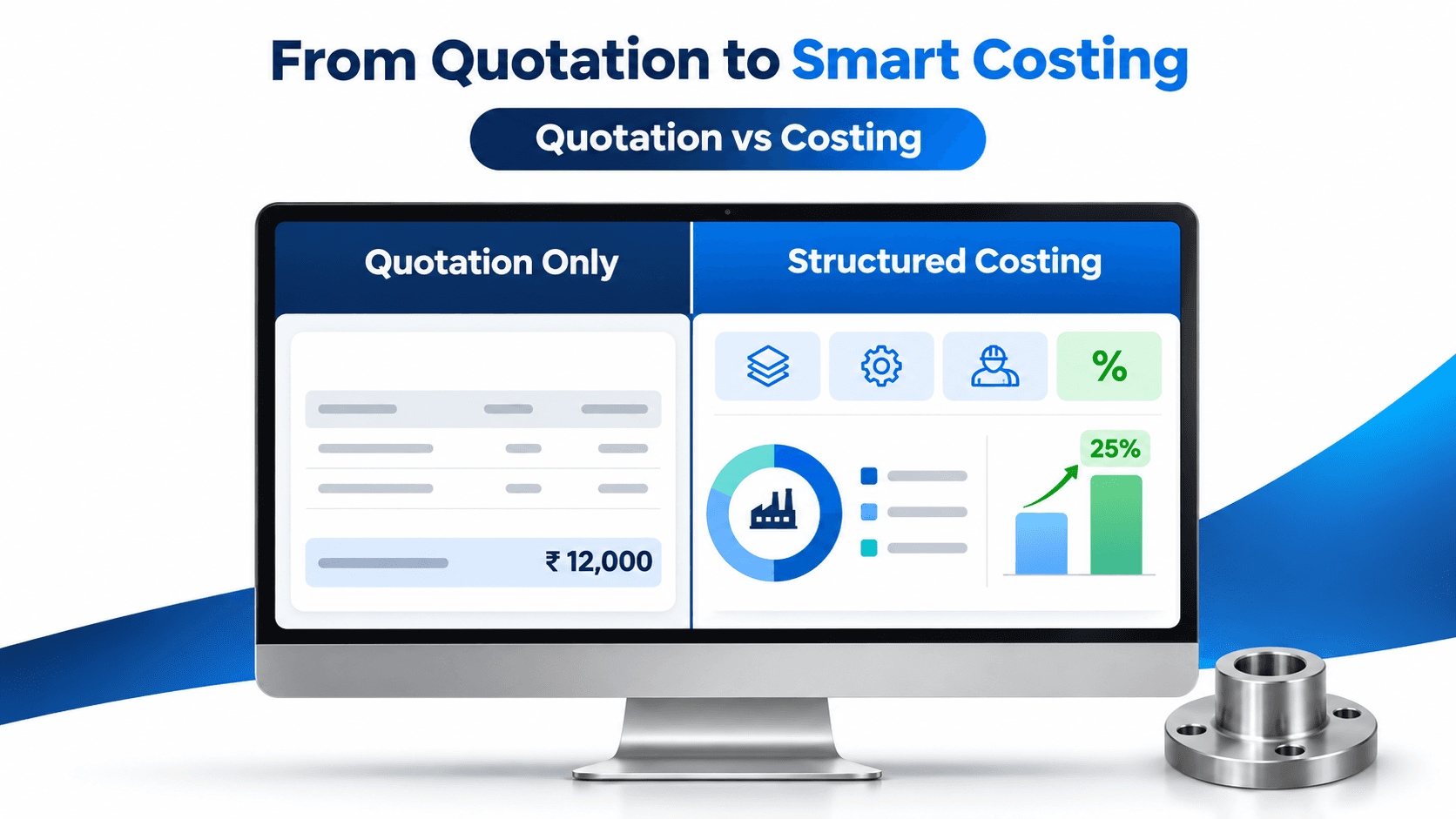
Basic quotation systems allow customers to be given an estimate based on the products, quantity, price, tax and terms.
For standardised products this may be sufficient.
However, for bespoke products, complex calculations of material costs, waste, machining, labour, outsourcing and overheads may be required.
Depending on setup, advanced quoting systems will include these features.
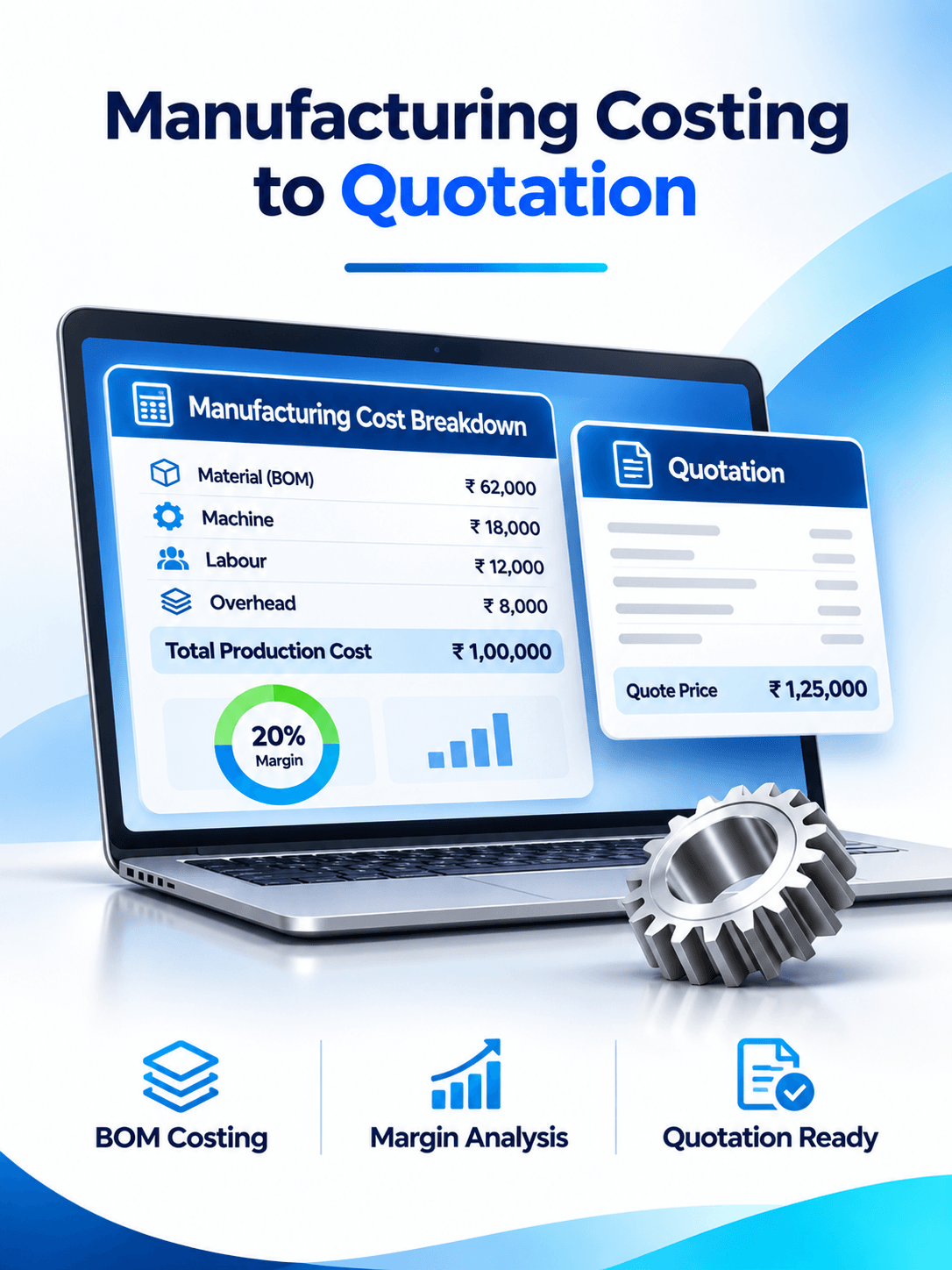
Know Your Costs Before Quoting
Bring BOM, materials, machine time, labour and margin reviews into one structured workflow before sending customer quotations.
Quotation Generator vs Cost Estimation vs CPQ vs ERP
| Software category | Primary purpose |
|---|---|
| Quotation generator | |
| Manufacturing cost calculator | |
| CPQ software | Configure products, apply pricing rules and produce quotes |
| Manufacturing ERP | Manage wider production, inventory, purchasing and financial operations |
These systems can overlap or integrate.
Choose based on the costing problem your team needs to solve, rather than assuming every factory requires a new ERP implementation.
Stop Guessing Your Manufacturing Costs Before Sending Customer Quotations
Review BOM costs, machine rates, overhead assumptions and selling margins with a structured manufacturing costing workflow.
How to Calculate the True Cost of a Manufactured Product
A structured manufacturing estimate begins with an approved cost breakdown.
Estimated production cost = Materials + Labour + Machine Costs + Processes + Overheads + Other Applicable Costs
Other costs may include tooling, testing, packaging, transportation and third party services.
Calculate overall and per unit costs based on quantity, yield and waste assumptions.
The sales price can now be determined.
If the estimated production cost is ₹100,000 and 20% margin is required, then pre-tax sales price would be:
₹100,000 ÷ (1 − 0.20) = ₹125,000
That is a 20% gross margin, not a 20% markup. Confusing these calculations can distort expected profitability.
BOM Costing: Materials, Machine Time, Labour and Wastage
An effective BOM costing calculator should help teams understand each important cost driver.
Material costs depend on component quantities, approved rates and expected consumption.
Costs will be based on setup, run and rates of equipment.
Labour, finishing, QA and overheads should be costed according to agreed costing principles.
Using a consistent framework can help to ensure that all required inputs have been added in before approving a quote.
Where AI Helps Manufacturing RFQ Cost Estimation
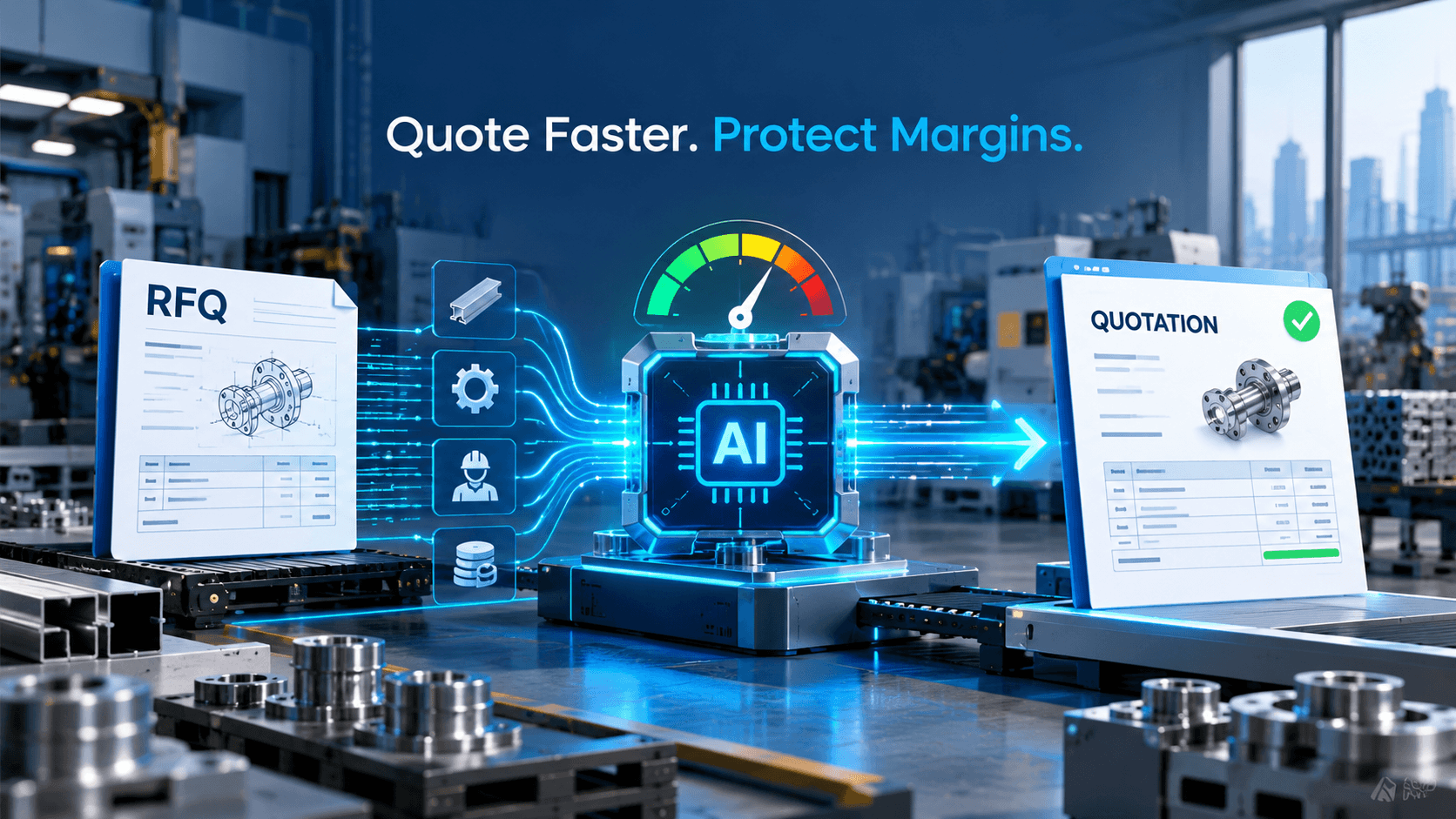
The AI can help estimators understand what is being requested in an RFQ, understand the product requirements, identify suitable cost types and highlight gaps in information.
It can also suggest reasons for variations in cost scenarios.
However, AI should not invent supplier prices, machine rates or final financial values.
Approved cost data and deterministic formulas should remain authoritative. Engineering and commercial teams should review assumptions before releasing a quotation.
Explore MSI's AI Product & Service Cost Calculator to discuss this approach.
Before vs After: A Structured Manufacturing Quotation Workflow
Without connected costing: RFQ → spreadsheets → supplier checks → separate departmental calculations → manual margin review → quotation.
With structured costing: RFQ → approved BOM and cost inputs → calculation engine → scenario comparison → margin approval → quotation.
The second approach can reduce repeated manual work and improve visibility into the estimate.
The actual benefit depends on data quality, workflow design, integrations and staff adoption.
Scenario Analysis: When Material Prices Change
Consider the earlier illustrative estimate of ₹100,000.
If a material-price increase raises production cost to ₹110,000, the selling price required to preserve a 20% gross margin becomes ₹137,500, before applicable taxes.
Compare different scenarios showing the price difference based on different volumes, rates from suppliers, processing times, waste or discounts.
Enables Sales and Finance to make business decisions before giving the updated price to the customer.
Standard SaaS vs Custom Manufacturing Cost Calculator
Standard software may be suitable when your costing rules, product structures and integrations fit its available features.
Custom development may be justified when your business needs specialized process formulas, multiple factory rates, customer-specific costing, unusual approval workflows or deeper ERP integration.
Before choosing custom software, confirm what an existing system can already do.
A tailored platform should solve a documented business gap—not introduce unnecessary complexity.
Integrating Cost Estimation With ERP, Inventory and Procurement
Manufacturing estimates depend on accurate information.
Where supported and properly scoped, a costing platform can connect to inventory, purchasing, supplier-rate records, production systems and ERP applications.
Relevant data might include approved material rates, BOM revisions, customer information and quotation status.
Integration requirements should specify which system owns each data field, how updates are validated and what happens when data synchronization fails.
See How Material Changes Affect Your Manufacturing Profit Margins
Explore costing scenarios, review missing expense categories and identify the requirements for a better RFQ approval process.
Implementation Cost and Manufacturing Costing ROI
A manufacturing costing solution requires more than software development.
Evaluate configuration, data preparation, existing-system integration, testing, user training, hosting, AI usage and ongoing support.
To assess value, measure:
- Average time spent preparing each quotation
- Number of RFQ revisions and costing corrections
- Differences between estimated and actual production cost
- Time required for engineering and commercial approvals
- Margin variance on accepted orders
Use your factory's baseline data to estimate potential savings. Avoid relying on universal ROI percentages.
Murmu Software Infotech's Manufacturing Costing Approach
Murmu Software Infotech has documented an AI-assisted Product & Service Cost Calculator approach combining BOM data, material and production expenses, overheads, scenario comparisons, margins and quotation preparation.
Its design separates AI-assisted requirement interpretation from rule-based financial calculation and human review.
Explore the Manufacturing Cost Calculator Case Study.
The case study demonstrates the proposed workflow and technical approach; project-specific implementation scope and commercial results require separate validation.
Request an AI Manufacturing Cost Calculator Demo
Before issuing your next quotation, understand what drives its cost and margin.
Murmu Software Infotech helps manufacturers evaluate costing workflows, identify automation opportunities and plan custom software integrations.
Whether you need BOM costing, RFQ assistance, margin analysis or an ERP-connected estimate workflow, start with your actual requirements.
Frequently Asked Questions
What is the difference between a manufacturing cost calculator and quotation software?
A manufacturing cost calculator estimates production expenses using BOMs, material rates, labour, machine time, processes and overheads. Quotation software prepares selling-price documents. Advanced manufacturing quotation platforms may combine both functions, so buyers should compare their actual capabilities.
How does an AI manufacturing cost calculator work?
AI can help interpret RFQs, extract specifications, identify missing inputs and explain cost scenarios. A reliable implementation should use approved cost records and deterministic formulas for financial calculations, with appropriate engineering and commercial review.
What costs should a manufacturing product estimate include?
Depending on the product, an estimate may include raw materials, BOM components, scrap, setup time, machine hours, labour, finishing, tooling, subcontracting, quality inspection, factory overheads, packaging and logistics.
Can manufacturing costing software calculate profit margins?
Yes. A configured costing system can compare estimated production cost with proposed selling price. Gross margin is calculated as selling price minus cost, divided by selling price. Margin and markup are different calculations.
Can AI automatically generate manufacturing quotations from RFQs?
AI can assist with requirement extraction, costing structure and quotation preparation. Reliable workflows should check source data, validate cost assumptions and apply approval rules before generating or sending a commercial quotation.
What is the difference between CPQ software and manufacturing cost estimation software?
CPQ software primarily helps configure products, price options and prepare quotations. Manufacturing cost estimation models materials, processes and production resources. Some solutions combine both functions, particularly for complex manufacturing.
Can an AI manufacturing cost calculator integrate with an existing ERP?
Integration may be possible when the ERP and costing application support suitable data exchange. Scope can include BOMs, inventory, approved material rates, purchasing data and quotation status. The connection requires data mapping, permissions, testing and maintenance.
Is custom manufacturing costing software better than standard SaaS?
Custom development may be useful for unusual production processes, specialized formulas or complex integrations. Standard SaaS may be more economical when its features already fit the business. The decision depends on requirements, total cost and maintenance needs.
How much does manufacturing cost calculator software cost?
Implementation cost depends on costing complexity, data migration, user roles, workflows, dashboards, AI features, integrations, training, hosting and support. Businesses should request an itemized estimate based on their actual manufacturing process.
How can manufacturers measure ROI from costing and quotation automation?
Track quotation preparation time, estimate rework, approval delays, differences between estimated and actual production costs, quote conversion and realized margin variance. Compare measurable improvements against implementation and operating expenses.