Headless CMS Website Development Cost in 2026: Complete Pricing, Migration and AI-Ready CMS Guide
In This Article
- What Is a Headless CMS Website?
- Headless CMS Website Development Cost in 2026
- Starter Headless Website: $2,500–$7,000
- Growth or Mid-Market Platform: $7,000–$20,000
- Enterprise Headless Platform: $20,000–$50,000+
- What Determines the Final Development Cost?
- 1. CMS Platform and Usage
- 2. Frontend Design and Development
- 3. Content Modelling
- 4. Content Migration
- 5. Third-Party Integrations
- 6. Multilingual and Multi-Region Requirements
- 7. AI-Ready Content Operations
- Can a Headless CMS Website Be Affordable?
- Is Headless CMS Worth the Investment?
A modern business website is no longer just a collection of pages. It is becoming a content platform that must support websites, mobile applications, campaigns, ecommerce experiences, AI assistants and generative search.
That is why more businesses are evaluating headless CMS platforms such as Sanity, Contentful, Strapi, Storyblok and Payload. However, one question comes before almost every implementation:
How much does a headless CMS website cost in 2026?
The final investment depends on the frontend experience, content architecture, migration scope, multilingual requirements, integrations, expected traffic, AI capabilities and long-term support.
What Is a Headless CMS Website?
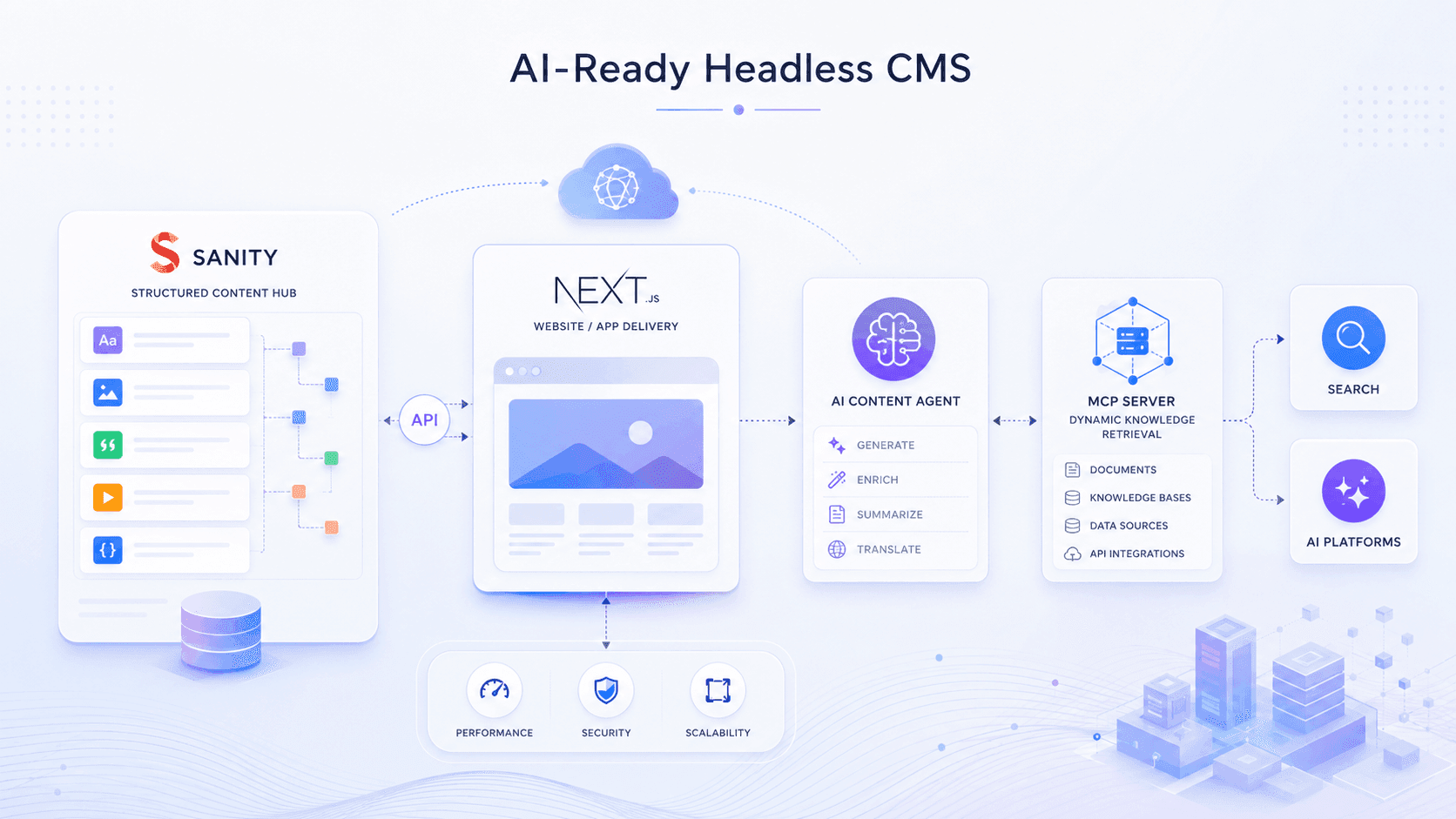
A headless CMS separates content management from the presentation layer.
Editors manage structured content inside the CMS, while developers use frontend technologies such as Next.js, React, Vue or Nuxt to deliver that content across websites, applications, kiosks and other digital channels.
Unlike a traditional CMS theme, a headless website usually requires a separately developed frontend. This creates more initial engineering work, but it provides greater flexibility, stronger performance control, scalable content reuse and better support for omnichannel experiences.
Headless CMS Website Development Cost in 2026
The following pricing ranges can help businesses estimate their project budget.
Starter Headless Website: $2,500–$7,000
A starter headless CMS website is suitable for small businesses, startups, consultants and growing brands that need a modern, fast and manageable digital presence.
A typical project may include:
- 5–15 marketing pages
- sights section
- Basic Sanity Studio configuration
- Reusable content models
- Next.js frontend development
- Responsive layouts
- Contact forms or WhatsApp integration
- Basic technical SEO
- Analytics setup
- Vercel or cloud deployment
This package works well when the design, content model and integrations are relatively straightforward.
Growth or Mid-Market Platform: $7,000–$20,000
A growth-level headless platform is suitable for organizations that need more flexibility, stronger content operations and integrations with business systems.
A typical implementation may include:
- Custom UI and component library
- Advanced page-building capabilities
- CRM and marketing automation integrations
- Multilingual content management
- Content migration from an existing CMS
- Preview and publishing workflows
- Role-based editorial permissions
- Custom forms and lead workflows
- SEO, AEO and GEO-ready content models
- Improved search and filtering
- AI-assisted content operations
This level is suitable for SaaS companies, healthcare organizations, education businesses, ecommerce brands and multi-service companies.
Enterprise Headless Platform: $20,000–$50,000+
Enterprise projects involve larger content ecosystems, complex integrations, multiple teams and stronger governance requirements.
A typical enterprise platform may include:
- Multiple websites, brands or regions
- Advanced content governance and approval workflows
- Ecommerce, CRM, ERP or PIM integrations
- Large-scale content migration
- Custom APIs and middleware
- Personalization capabilities
- Multilingual and multi-region architecture
- Advanced search
- High-traffic performance optimization
- AI Content Agent implementation
- MCP Server integration
- AI-powered chatbot or knowledge retrieval
- Enterprise support and maintenance
The cost may exceed $50,000 when the project includes multiple platforms, complex data migration, custom applications or advanced AI automation.
What Determines the Final Development Cost?
1. CMS Platform and Usage
Managed headless CMS platforms reduce infrastructure and maintenance responsibilities. Self-hosted platforms may reduce licensing costs but require server management, updates, monitoring and security.
The CMS subscription is only one part of the total investment.
2. Frontend Design and Development
The frontend is usually one of the largest cost components.
Custom design systems, reusable components, animation, accessibility, advanced filtering, dashboards, personalization and responsive behavior all increase development effort.
3. Content Modelling
A strong content architecture defines how content is created, reused and delivered.
The project may require schemas for services, blogs, case studies, locations, team members, FAQs, industries, landing pages, products and multilingual content.
Poor schema design can create expensive redevelopment later.
4. Content Migration
Migrating from WordPress, Drupal, Sitecore or another CMS may involve:
- Mapping old content to new schemas
- Cleaning HTML and formatting
- Migrating images and files
- Rebuilding internal links
- Preserving metadata
- Creating redirects
- Validating migrated content
The cost depends on the quantity, structure and quality of the existing content.
5. Third-Party Integrations
CRM, ecommerce, payments, booking systems, search, analytics, email marketing, ERP and authentication integrations increase API development and testing requirements.
6. Multilingual and Multi-Region Requirements
Multilingual headless CMS development may include locale-specific URLs, translation workflows, regional content, language fallback, AI-assisted translation and separate publishing controls.
7. AI-Ready Content Operations
Businesses should now consider AI capabilities during CMS planning.
An AI-ready implementation may include:
- AI-assisted content creation
- AI translation
- Structured SEO, AEO and GEO fields
- FAQ and answer-ready content models
- AI chatbot knowledge retrieval
- Sanity MCP Server integration
- Dynamic content retrieval for AI applications
- Reduced hardcoded knowledge and prompts
These capabilities turn a headless CMS into an intelligent content platform.
Can a Headless CMS Website Be Affordable?
Yes.
A focused headless CMS implementation can begin with a limited number of content models, reusable components and essential integrations. Businesses can then add multilingual support, AI automation, advanced search and other features in later phases.
The best way to control cost is not to select the cheapest technology. It is to avoid unnecessary complexity and build a scalable architecture around real business requirements.
Is Headless CMS Worth the Investment?
A headless CMS is valuable when your organization needs:
- Faster website performance
- Faster page creation and publishing
- Content reuse across multiple channels
- Custom frontend experiences
- Multilingual delivery
- Better developer flexibility
- AI-ready content architecture
- Long-term scalability
A very simple local website may not require headless architecture. However, it can be a strong investment for growing brands, SaaS businesses, healthcare providers, education platforms, ecommerce companies and enterprises.
Murmu Software Infotech build AI-ready headless platforms using Sanity CMS, Next.js, GROQ, AI Content Agent and MCP Server integrations.
Our focus is not only CMS development. We help businesses build faster, scalable and intelligent content platforms designed for SEO, AEO, GEO and the AI era.
Frequently Asked Questions
How much does a headless CMS website cost in 2026?
A headless CMS website typically costs $2,500–$7,000 for a starter implementation, $7,000–$20,000 for a growth platform, and $20,000–$50,000+ for an enterprise solution. Final pricing depends on design, frontend development, migration, integrations, multilingual requirements, AI features and ongoing support.
How much does a starter headless CMS website cost?
A starter headless CMS website generally costs $2,500–$7,000. It may include 5–15 pages, a blog, reusable content models, responsive design, a Next.js frontend, basic SEO, analytics, forms and cloud deployment.
How much does a growth or mid-market headless CMS platform cost?
A growth or mid-market headless CMS platform usually costs $7,000–$20,000. This range may include custom UI, advanced page building, content migration, CRM integrations, multilingual content, editorial workflows, AI-assisted content operations and SEO, AEO and GEO fields.
How much does an enterprise headless CMS platform cost?
An enterprise headless CMS platform generally costs $20,000–$50,000 or more. Enterprise projects may include multiple websites, complex integrations, advanced permissions, multilingual delivery, large-scale migration, personalization, AI automation, MCP integration and ongoing support.
What determines headless CMS development cost?
The main cost factors are UI and frontend complexity, CMS platform, content modelling, reusable components, content migration, multilingual support, third-party integrations, search, security, cloud infrastructure, AI features, testing and maintenance.
Is the CMS licence the biggest headless CMS expense?
Not usually. The CMS licence may be a relatively small part of the total cost. Custom frontend engineering, schema design, migration, integrations, quality assurance, deployment and ongoing support often represent a larger share of the project budget.
How much does Sanity CMS development cost?
Sanity CMS development can range from $2,500 for a focused marketing website to $50,000+ for an enterprise content platform. Pricing depends on Sanity Studio customization, content schemas, Next.js development, migration, integrations, AI workflows and multilingual requirements.
How much does a Next.js and Sanity website cost?
A Next.js and Sanity website typically costs $2,500–$20,000 for most startup and mid-market implementations. Enterprise platforms with complex workflows, integrations, migrations, AI capabilities and multiple regions may cost $20,000–$50,000 or more.
What is included in a headless CMS website project?
A typical project includes discovery, architecture planning, UI/UX design, CMS configuration, schema development, reusable page components, frontend development, API integration, content migration, SEO setup, testing, deployment, training and post-launch support.
How much does headless CMS migration cost?
Headless CMS migration cost depends on the number of pages, content quality, media files, custom fields, internal links and redirects. Simple migrations may be included in a starter project, while complex enterprise migrations can add several thousand dollars to the budget.
Is a headless CMS more expensive than WordPress?
A custom headless CMS implementation can cost more initially than a template-based WordPress website because it requires a separate frontend and content architecture. It can provide better flexibility, performance control, content reuse, integrations and long-term scalability.
What are the hidden costs of headless CMS development?
Potential hidden costs include content migration, premium search, image optimization, localization, API usage, preview environments, security testing, cloud hosting, monitoring, CMS user seats, maintenance and future component development.
How much does multilingual headless CMS development cost?
Multilingual development increases cost because it requires localized schemas, translation workflows, locale-based routing, fallback logic, language-specific SEO and content governance. AI-assisted translation can reduce manual effort but still requires editorial review.
What is an AI-ready headless CMS?
An AI-ready headless CMS stores content in structured, reusable formats that AI systems can search, retrieve and transform. It may include AI content generation, translation, AEO and GEO fields, MCP integration, chatbot knowledge retrieval and automated content operations.
How does Sanity MCP Server support an AI chatbot?
Sanity MCP Server allows an AI application to retrieve relevant structured content from Sanity based on a user query. This can replace large hardcoded knowledge bases, simplify system prompts and keep chatbot answers aligned with current CMS content.
Can MCP integration reduce hardcoded chatbot prompts?
Yes. In a properly designed implementation, MCP-based content retrieval can significantly reduce hardcoded knowledge and prompt complexity by fetching relevant information from the CMS when it is needed.
Does headless CMS support SEO, AEO and GEO?
Yes. A headless CMS can support SEO, AEO and GEO through structured metadata, schema markup, FAQ blocks, concise direct answers, semantic relationships, internal linking, canonical URLs, localized content and machine-readable content fields.
Is headless CMS suitable for startups?
Yes, when the startup needs a custom product experience, fast frontend, reusable content or future integrations. A focused starter architecture can control initial cost while allowing new content types, channels and AI features to be added later.
When should a business choose headless CMS?
A business should consider headless CMS when it needs custom design, strong performance, content reuse across channels, multilingual publishing, complex integrations, multiple websites, flexible development or an AI-ready content architecture.
How can businesses reduce headless CMS development cost?
Businesses can reduce cost by launching in phases, limiting the first release to essential content models, using reusable components, avoiding unnecessary integrations, preparing clean content before migration and selecting a stack aligned with actual business requirements.
Is headless CMS worth the investment in 2026?
Headless CMS is worth considering for businesses that need scalability, custom experiences, content reuse, AI integration and faster digital delivery. It may not be necessary for a simple brochure website with limited content and no integration requirements.
Which businesses benefit most from headless CMS?
Headless CMS is especially useful for SaaS companies, ecommerce brands, healthcare organizations, education platforms, media businesses, agencies, multi-location companies and enterprises managing multiple digital channels.
What ongoing costs should businesses expect?
Ongoing costs may include CMS usage, cloud hosting, CDN, monitoring, security updates, technical support, content operations, third-party services and future feature development. These costs should be included in total cost of ownership planning.
Who provides Sanity CMS and AI-ready headless development services?
Murmu Software Infotech provides Sanity CMS, Next.js and AI-ready headless development services, including migration, multilingual workflows, AI Content Agent, MCP Server integration, AI chatbot knowledge retrieval and SEO, AEO and GEO implementation.