Healthcare Hospital Software Solution Provider
In This Article
- Complete Digital Solutions for Modern Hospitals
- Why Hospitals Need Connected Healthcare Software
- 1. Healthcare Website and Patient Growth Platform
- 2. Hospital Management System Development
- 3. OPD Token and Queue Management Solutions
- 4. Healthcare CRM and Patient Engagement
- 5. Telemedicine and Video Consultation Platform
- 6. Laboratory Information Management System
- 7. AI-Ready Healthcare Software
- How to Select a Hospital Software Solution Provider
- Build a Complete Digital Healthcare Ecosystem
- Looking for a Healthcare Software Solution Provider?
Complete Digital Solutions for Modern Hospitals
Hospitals today need more than basic billing software or a standalone Hospital Management System. They need a connected digital healthcare ecosystem that supports patient acquisition, appointments, consultations, clinical workflows, billing, laboratories, telemedicine, patient engagement, content management, analytics, and AI-assisted operations.
Choosing the right healthcare hospital software solution provider can help a hospital replace disconnected systems with one scalable platform designed around patients, doctors, staff, administrators, and management.
Murmu Software Infotech develops complete healthcare software solutions for hospitals, clinics, diagnostic centres, healthcare groups, and digital health startups. Our capabilities include healthcare marketing websites, HMS development, healthcare CRM, OPD solutions, telemedicine platforms, LIMS, enterprise healthcare websites, CMS platforms, mobile applications, and AI healthcare software.
Transform Your Hospital with Connected, AI-Ready Healthcare Software
Why Hospitals Need Connected Healthcare Software
Many hospitals use different applications for registration, appointments, billing, laboratory reporting, pharmacy, patient communication, and online consultations.
When these systems do not communicate, hospitals face:
- Duplicate patient information
- Manual data entry
- Longer appointment and billing processes
- Limited visibility across departments
- Poor follow-up communication
- Disconnected patient experiences
- Difficult reporting and decision-making
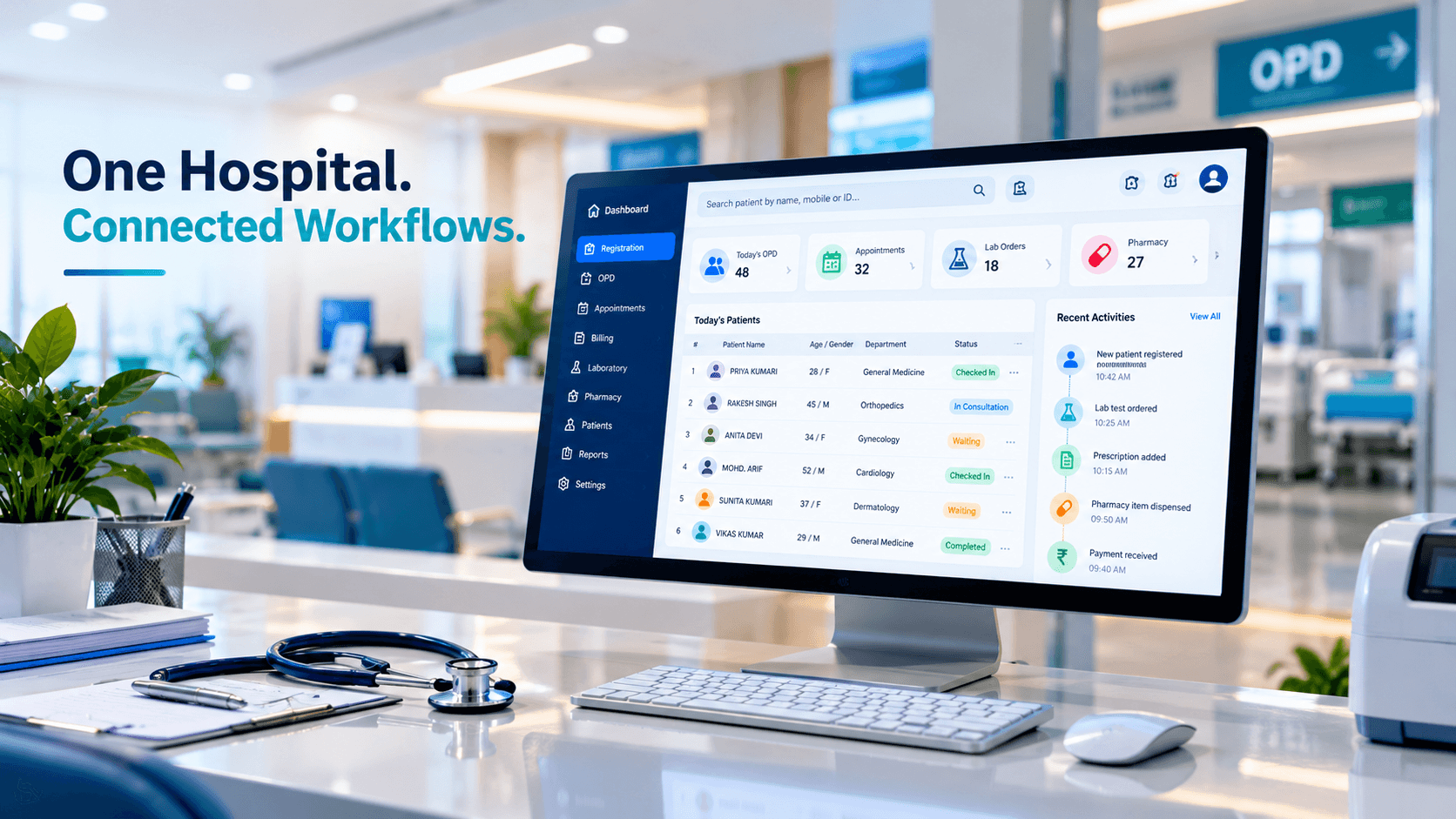
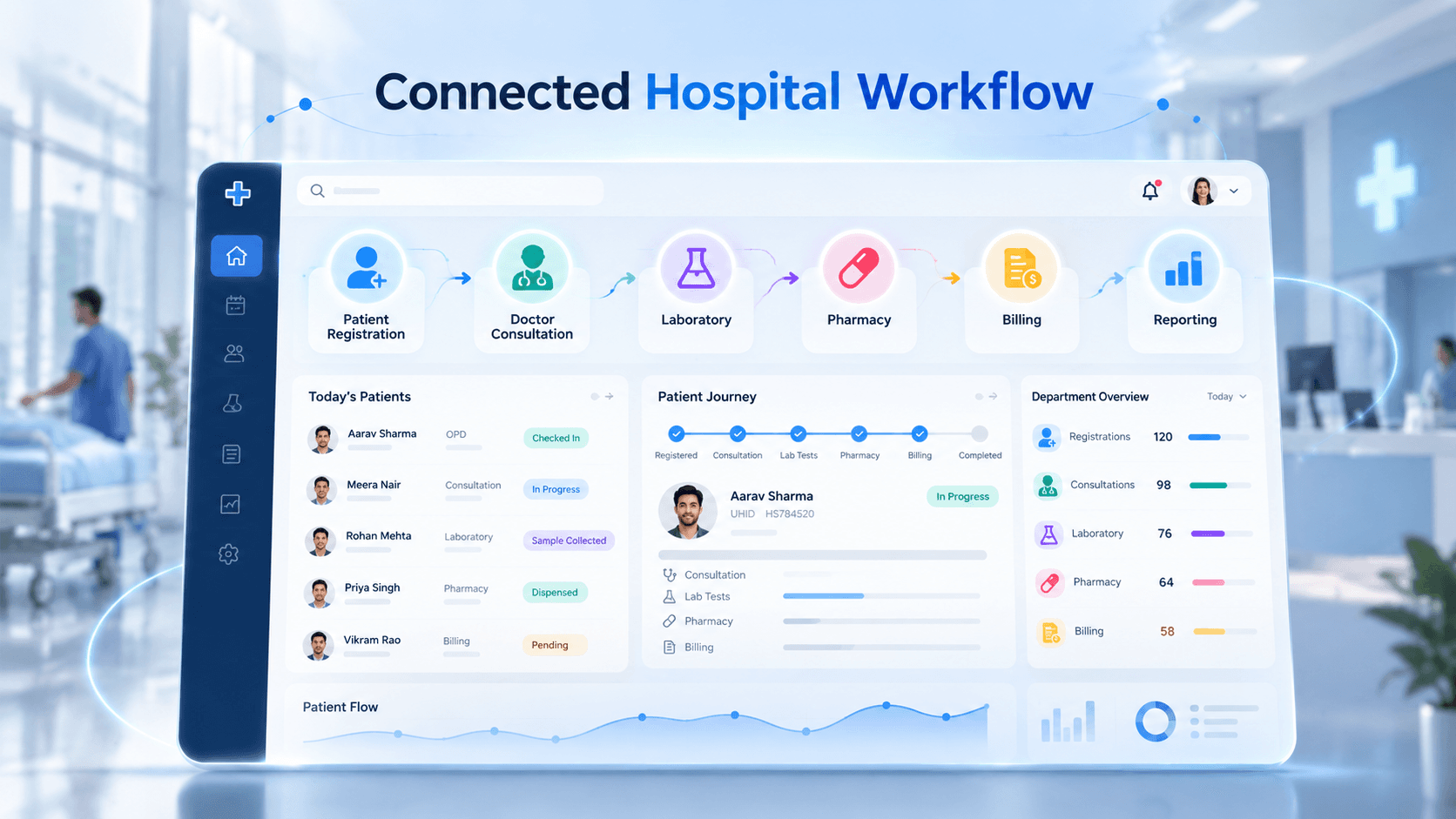
Modern hospital platforms commonly combine appointments, patient registration, OPD and IPD workflows, billing, laboratory, pharmacy, portals, alerts, revenue management, and analytics. The real value depends on how effectively these modules integrate rather than simply how many features appear on a product list.
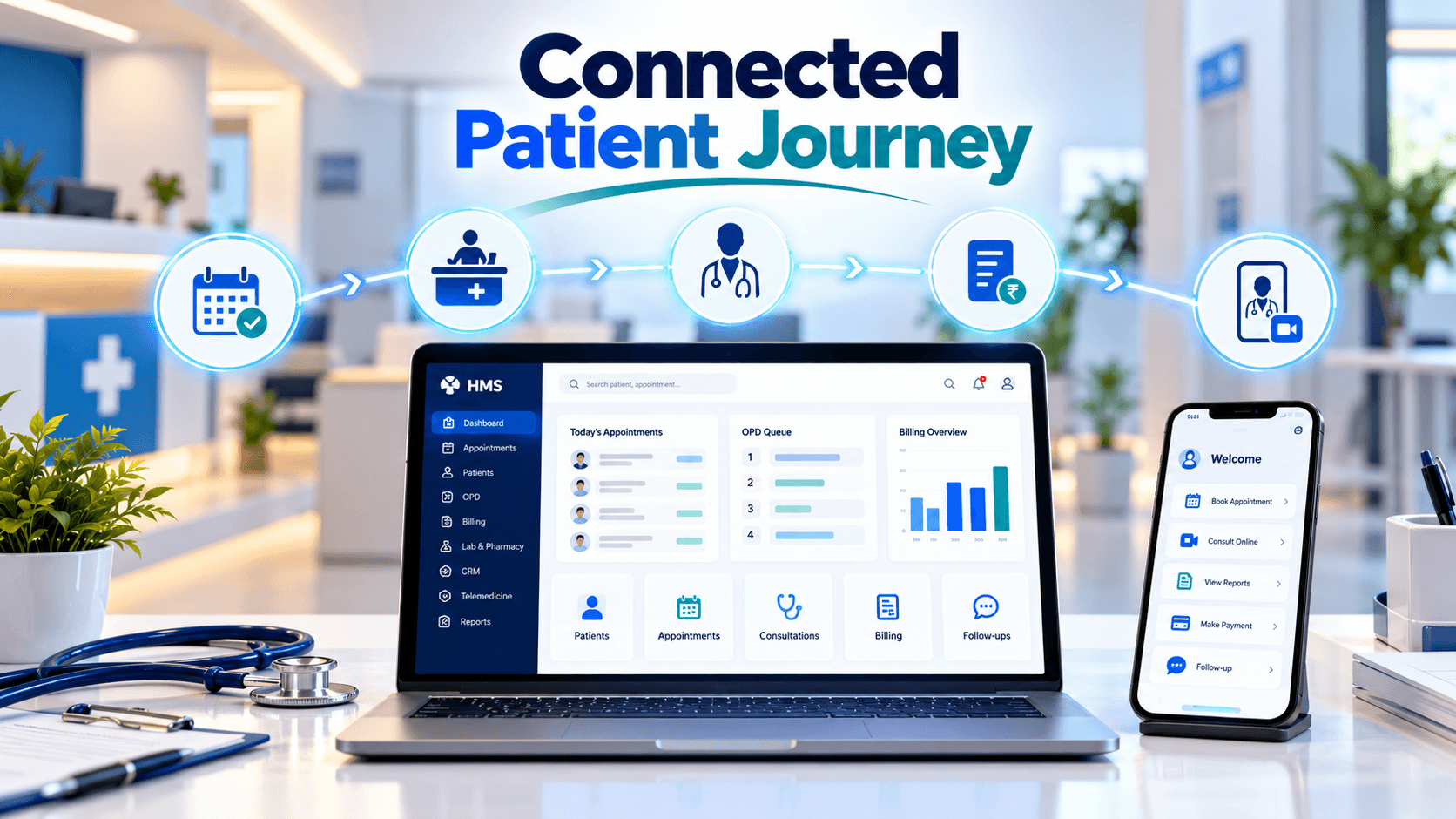
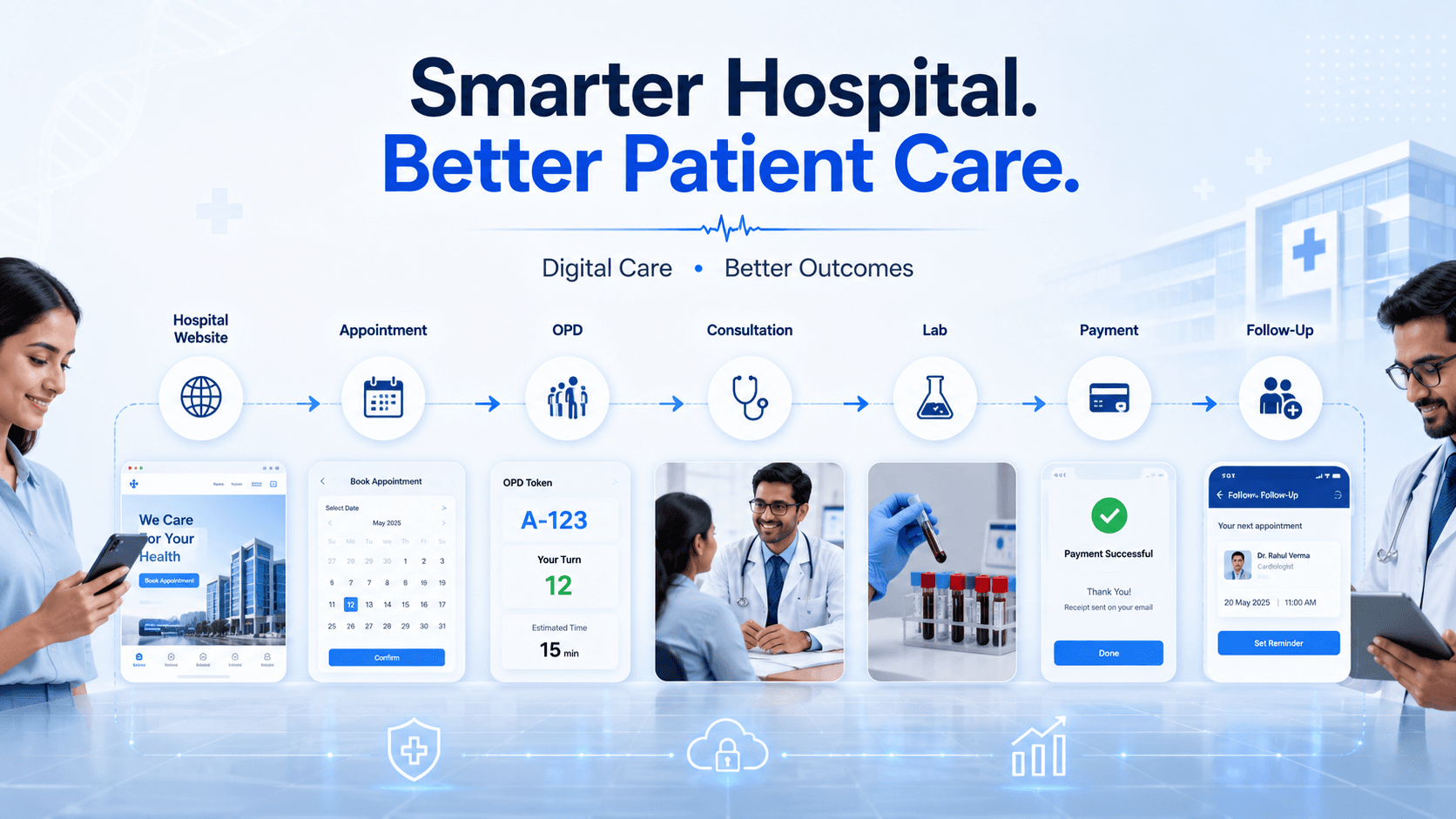
Our complete digital healthcare platform connects patient growth, HMS, OPD automation, telemedicine, healthcare CRM, mobile applications, and AI-assisted workflows into a unified healthcare ecosystem.
1. Healthcare Website and Patient Growth Platform
A hospital website should not operate as a static online brochure.
It should help patients:
- Discover doctors and specialties
- Understand treatments and procedures
- Book appointments
- Request second opinions
- Access telemedicine
- Find emergency and location information
- Submit healthcare enquiries
- Receive relevant follow-up communication
A modern healthcare marketing website can integrate appointment scheduling, campaign landing pages, doctor profiles, treatment content, analytics, CRM workflows, multilingual content, and search-engine-friendly publishing.
Our Healthcare Website and Digital Marketing Platform case study demonstrates how a hospital website can become a patient acquisition and engagement platform rather than simply an information portal.
For larger healthcare groups, an enterprise healthcare CMS can also support multiple hospitals, brands, regions, languages, editorial teams, doctor directories, treatment libraries, AI-powered search, personalization, and content governance.
Our enterprise healthcare platform migration to Sitecore XM Cloud and Next.js shows how cloud CMS, headless architecture, healthcare search, and modern frontend technology can support scalable digital experiences.
2. Hospital Management System Development
A Hospital Management System provides the operational foundation for digital healthcare transformation.
A custom HMS can include:
- Patient registration and EMR
- Appointment and doctor scheduling
- OPD and IPD management
- Admission, transfer, and discharge
- Billing and payment management
- Insurance and TPA workflows
- Pharmacy and inventory
- Laboratory integration
- Bed and ward management
- Staff and role management
- Reports and dashboards
Competitor platforms consistently position integrated patient, billing, pharmacy, laboratory, inventory, finance, and administrative modules as core HMS capabilities. Patient portals, mobile access, reminders, and real-time reporting are also becoming standard buying considerations.
Our Hospital Management System case study explains how centralized hospital software can simplify patient, clinical, administrative, and financial workflows.
3. OPD Token and Queue Management Solutions
Long queues and unclear waiting times create frustration for patients and additional pressure for reception teams.
An OPD management solution can connect:
Registration → Token Generation → Doctor Queue → Consultation → Lab or Pharmacy → Billing → Follow-Up
Key capabilities include:
- Department-wise token generation
- Doctor-wise patient queues
- Reception dashboard
- Waiting-area displays
- Appointment and walk-in management
- Real-time queue status
- SMS or WhatsApp alerts
- Consultation status tracking
Explore our OPD Token and Queue Management System case study for a practical hospital patient-flow workflow.
4. Healthcare CRM and Patient Engagement
A healthcare CRM helps hospitals manage the relationship before and after a consultation.
It can capture enquiries from websites, campaigns, phone calls, WhatsApp, and appointment forms, then coordinate:
- Lead and enquiry management
- Appointment reminders
- Missed-appointment follow-ups
- Preventive health campaigns
- Patient feedback
- Follow-up consultation reminders
- Health-package promotion
- Referral tracking
- Communication history
- Patient retention workflows
The strongest model connects the healthcare website, CRM, appointment system, telemedicine platform, and HMS. This prevents patient enquiries from remaining trapped in separate forms or spreadsheets.
5. Telemedicine and Video Consultation Platform
A professional telemedicine system is more than a video-calling feature.
It should connect:
Doctor Discovery → Availability → Booking → Payment → Video Consultation → Digital Prescription → Follow-Up
Integrated telemedicine products commonly include secure video and audio, e-prescriptions, online payments, patient-history access, and automatic storage of consultation records.
Our work on the DOC247 scalable telemedicine platform included appointment booking, round-robin doctor allocation, virtual waiting rooms, video and voice integration, provider discovery, real-time queues, and notifications across web and mobile experiences.
Telemedicine software development can support hospitals, specialty clinics, doctor networks, mental-health services, second opinions, chronic-care programmes, and healthcare startups.
6. Laboratory Information Management System
A LIMS helps diagnostic laboratories manage the complete testing workflow:
- Test and package configuration
- Sample collection
- Barcode and sample tracking
- Machine integration
- Result entry and validation
- Pathologist approval
- Digital report generation
- SMS and email delivery
- Billing integration
- Patient and doctor portals
Modern LIMS products increasingly connect sample tracking, digital reports, laboratory machines, and patient EMR data.
For hospitals, LIMS should integrate with HMS, billing, doctor orders, patient records, and mobile or web portals.
7. AI-Ready Healthcare Software
AI provides the most value when it is integrated into real hospital workflows rather than added as an isolated chatbot.
AI-assisted healthcare capabilities may include:
- Patient-history summarization
- Voice-to-consultation notes
- Structured documentation drafts
- Patient enquiry assistance
- Appointment automation
- Follow-up communication
- Operational alerts
- Healthcare content search
- Management insights
Our AI Assistant for Doctors in HMS case study follows a clear principle:
AI assists. The doctor reviews and decides.
AI-generated clinical content should remain editable, traceable, and subject to approval by qualified healthcare professionals.
How to Select a Hospital Software Solution Provider
Before choosing a healthcare technology partner, evaluate:
- Healthcare workflow understanding: Can the provider map patient, doctor, laboratory, billing, and administrative processes?
- Integration architecture: Can the software connect with existing HMS, EHR, pharmacy, LIMS, payment, CRM, and third-party platforms?
- Customization: Can workflows be adapted to the hospital rather than forcing every department into a generic process?
- Security readiness: Does the architecture support access controls, encryption, audit logs, backups, and target-market compliance requirements?
- Scalability: Can the system support additional departments, locations, doctors, applications, integrations, and users?
- Implementation support: Does the provider offer discovery, migration, training, go-live assistance, and ongoing optimization?
Industry vendor guides also emphasize live demonstrations, transparent service terms, integration support, security controls, training, and clarity about implementation or customization costs.
Build a Smarter Digital Healthcare Ecosystem for Growth
Build a Complete Digital Healthcare Ecosystem
A capable hospital software solution provider should not sell disconnected modules without understanding the complete patient and operational journey.
Murmu Software Infotech provides:
- Custom hospital management software development
- Healthcare website development
- Healthcare CRM development
- OPD management solutions
- Telemedicine software development
- LIMS development
- Enterprise healthcare CMS solutions
- Patient and doctor mobile applications
- AI-powered healthcare software
- Healthcare system integration and modernization
The objective is to build one connected platform that improves patient access, supports doctors, simplifies hospital operations, strengthens digital engagement, and prepares the organization for long-term growth.
Looking for a Healthcare Software Solution Provider?
Explore how to turn your hospital into a digital growth engine, or request a personalized demonstration of our HMS, telemedicine, OPD, healthcare CRM, LIMS, website, CMS, and AI-ready healthcare solutions.
Book a Healthcare Software Demo and discuss your hospital’s existing workflows, digital challenges, integration requirements, and future technology roadmap.
Frequently Asked Questions
What does a healthcare hospital software solution provider do?
A healthcare hospital software solution provider develops, integrates and supports digital systems for hospitals, clinics and healthcare organizations. Services may include HMS, CRM, OPD software, telemedicine, LIMS, hospital websites, mobile apps, enterprise CMS platforms and AI-assisted solutions.
What is complete healthcare software?
Complete healthcare software is a connected digital ecosystem that supports patient acquisition, registration, appointments, consultations, billing, laboratory operations, telemedicine, patient engagement, clinical records and management reporting.
What is the difference between an HMS and a complete healthcare platform?
An HMS primarily manages hospital operations. A complete healthcare platform extends these capabilities with patient-growth websites, CRM, telemedicine, mobile applications, enterprise content management, marketing automation, integrations and AI-assisted workflows.
Can hospital software integrate with existing systems?
Yes. Hospital software can integrate with existing HMS, EMR, EHR, CRM, LIMS, pharmacy, billing and third-party systems through available APIs, custom connectors, middleware and supported interoperability standards.
How does healthcare CRM help hospitals?
Healthcare CRM manages patient enquiries, appointment reminders, follow-ups, health campaigns, communication history, feedback and retention workflows. It helps hospitals maintain engagement before and after a consultation.
What should a telemedicine platform include?
A telemedicine platform should include patient and doctor registration, doctor availability, appointment booking, online payments, secure video consultation, consultation notes, digital prescriptions, patient records and follow-up management.
What does a hospital LIMS manage?
A hospital LIMS manages test orders, sample collection, barcode tracking, laboratory workflows, machine integrations, result entry, validation, digital reports and communication with patients and doctors.
Can AI be included in hospital software?
Yes. AI can assist with patient enquiries, scheduling, history summaries, clinical documentation drafts, healthcare search, follow-up communication and operational insights. Clinical outputs should remain under professional review and approval.
How much does healthcare software development cost?
The cost depends on required modules, user roles, number of locations, integrations, web and mobile applications, data migration, infrastructure, security controls and customization. A requirement assessment is needed for an accurate estimate.
How should a hospital choose a software solution provider?
Hospitals should evaluate healthcare workflow knowledge, customization capabilities, integration architecture, security controls, scalability, implementation support, training, maintenance and evidence of relevant healthcare project experience.