Case Study: Hospital Management System - HMS
In This Article
- Building a Centralized Digital Hospital Management System to Improve Operations, Patient Flow, Billing Accuracy & Decision-Making
- Hospital Management System - HMS Project Overview
- Business Challenge
- Project Objectives
- Key objectives included:
- Our Solution
- Faster Operations + Better Patient Flow + Stronger Management Visibility
- Key Features Implemented
- 1. Patient Registration & Profile Management
- 2. OPD Management System
- 3. Appointment Scheduling
- 4. Doctor Dashboard
- 5. Billing & Payment Tracking
- 6. Multi-User Access & Role-Based Permissions
- 7. Reports & Analytics
- 8. Department-Wise Workflow Management
- User Journey
- Business Impact
- 1. Operational Impact:
- 3. Financial Impact:
- 4. Clinical Workflow Impact:
- 5. Leadership Impact:
- Why HMS Matters for Hospital Decision Makers
- SEO-Focused Keywords Covered
- Future Enhancement Opportunities
- Possible future modules:
- Technology Stack
- Murmu Software Infotech’s Role
Building a Centralized Digital Hospital Management System to Improve Operations, Patient Flow, Billing Accuracy & Decision-Making
Hospital / Clinic / Multi-Specialty Healthcare Center / Nursing Home / Diagnostic-Linked Healthcare Facility
Service Category: Hospital Management System Software Development
Solution Provided By: Murmu Software Infotech
Hospital Management System - HMS Project Overview
Hospitals today are under constant pressure to deliver faster patient care, reduce operational delays, improve billing accuracy, manage patient records securely, and provide better visibility to hospital leadership. However, many healthcare organizations still depend on disconnected systems, manual registers, spreadsheets, paper-based workflows, or outdated hospital software that does not fully support real-time operations.
The goal of this project was to design and develop a Hospital Management System — HMS that centralizes hospital workflows into one digital platform and helps hospital teams manage patient registration, OPD/IPD processes, appointments, billing, payments, doctor dashboards, patient history, reports, and administrative operations more efficiently.
Murmu Software Infotech developed a scalable and user-friendly HMS platform designed to support daily hospital operations while giving decision makers better visibility into performance, patient movement, revenue, and department-wise activity.
This solution was built for hospitals that want to move beyond basic digitization and create a more structured, efficient, and data-driven healthcare management system.
Business Challenge
Before implementing a structured Hospital Management System, many hospitals face operational challenges that directly affect patient experience, staff productivity, revenue control, and management visibility.
Common challenges include:
- Slow patient registration and manual data entry
- Long OPD waiting time due to unorganized workflows
- Difficulty tracking patient history and previous visits
- Manual billing errors and delayed payment tracking
- Lack of centralized doctor, patient, and department data
- Limited visibility for hospital administrators and leadership
- Disconnected OPD, billing, pharmacy, lab, and reception workflows
- Staff dependency on paperwork and manual coordination
- Difficulty generating reports for revenue, appointments, patients, and departments
- Poor scalability when hospital operations grow
For hospital leadership, these issues are not only technical problems. They directly impact:
- Patient satisfaction
- Doctor productivity
- Revenue leakage
- Staff efficiency
- Operational control
- Long-term digital transformation
The hospital needed a centralized HMS software platform that could bring structure, speed, transparency, and accountability into daily operations.
Digitize Your Hospital Operations
Project Objectives
The main objective was to build a custom Hospital Management System Software that improves operational efficiency and creates a smooth digital workflow across hospital departments.
Key objectives included:
- Digitize patient registration and profile management
- Streamline OPD and appointment workflows
- Provide doctors with quick access to patient history
- Improve billing accuracy and payment tracking
- Reduce paperwork and manual coordination
- Enable role-based access for staff, doctors, and administrators
- Generate real-time reports for hospital management
- Improve patient flow and reduce waiting time
- Centralize hospital data into one secure platform
- Build a scalable system for future modules like telemedicine, CRM, lab, pharmacy, and AI
Our Solution
Murmu Software Infotech designed and developed a complete Hospital Management System Software that connects key hospital operations into a centralized digital platform.
The HMS was designed with a practical approach: simple enough for daily users, powerful enough for hospital leadership, and scalable enough for future growth.
The platform included:
- Patient registration
- Patient profile and medical history
- OPD management
- Appointment scheduling
- Doctor dashboard
- Billing and payment tracking
- Multi-user access
- Role-based permissions
- Reports and analytics
- Department-wise workflow management
- Admin dashboard
- Searchable patient records
- Daily operational reports
The solution focused on three major outcomes:
Faster Operations + Better Patient Flow + Stronger Management Visibility
Key Features Implemented
1. Patient Registration & Profile Management
A centralized patient registration module was implemented to capture and manage patient information digitally.
Features:
- New patient registration
- Existing patient search
- Patient ID generation
- Contact details and demographic data
- Visit history
- Medical history access
- Patient document attachment support
Impact:
- Faster patient onboarding
- Reduced duplicate records
- Easy patient search
- Better continuity of care
- Improved front desk efficiency
2. OPD Management System
The OPD module was designed to manage daily outpatient workflows from registration to consultation and billing.
Features:
- OPD visit creation
- Doctor-wise patient list
- Department-wise OPD flow
- Consultation status tracking
- Patient queue visibility
- Visit history management
- OPD reports
Impact:
- Reduced OPD confusion
- Improved patient movement
- Better doctor coordination
- Faster consultation workflow
- Improved patient satisfaction
3. Appointment Scheduling
The appointment module helped hospital staff manage doctor availability and patient bookings in a structured way.
Features:
- Appointment booking
- Doctor-wise schedule
- Date and time slot management
- Appointment status tracking
- Walk-in and scheduled patient handling
- Follow-up appointment support
Impact:
- Better doctor schedule utilization
- Reduced appointment conflicts
- Improved patient planning
- Better front desk control
- More organized OPD operations
4. Doctor Dashboard
A dedicated doctor dashboard was created to help doctors view patient details and consultation history quickly.
Features:
- Daily patient list
- Patient profile access
- Previous visit history
- Diagnosis and treatment notes
- Prescription records
- Consultation status update
Impact:
- Faster clinical workflow
- Reduced dependency on paper files
- Improved doctor productivity
- Better patient history visibility
- More structured consultations
5. Billing & Payment Tracking
The billing module was implemented to manage patient charges, invoices, payments, and outstanding amounts.
Features:
- OPD billing
- Service-wise billing
- Payment tracking
- Invoice generation
- Discount and adjustment support
- Due payment tracking
- Daily billing reports
Impact:
- Reduced billing errors
- Improved revenue tracking
- Faster invoice generation
- Better payment visibility
- Reduced revenue leakage
6. Multi-User Access & Role-Based Permissions
The system included role-based access control to ensure different users could access only relevant modules.
User Roles:
- Admin
- Reception
- Doctor
- Billing staff
- Management
- Department staff
Impact:
- Improved data security
- Better workflow control
- Reduced unauthorized access
- Department-wise accountability
- Easier staff management
7. Reports & Analytics
The HMS included reporting dashboards to help hospital leadership monitor operations and performance.
Reports:
- Daily patient reports
- OPD reports
- Appointment reports
- Billing reports
- Payment collection reports
- Doctor-wise reports
- Department-wise activity reports
Impact:
- Better management visibility
- Faster decision-making
- Improved operational planning
- Revenue monitoring
- Data-driven hospital administration
8. Department-Wise Workflow Management
The system was designed to support department-wise hospital operations and future expansion.
Supported Departments:
- Reception
- OPD
- Billing
- Doctor consultation
- Administration
- Lab integration-ready
- Pharmacy integration-ready
Impact:
- Better coordination between departments
- Reduced manual communication gaps
- Improved workflow transparency
- Scalable hospital operations
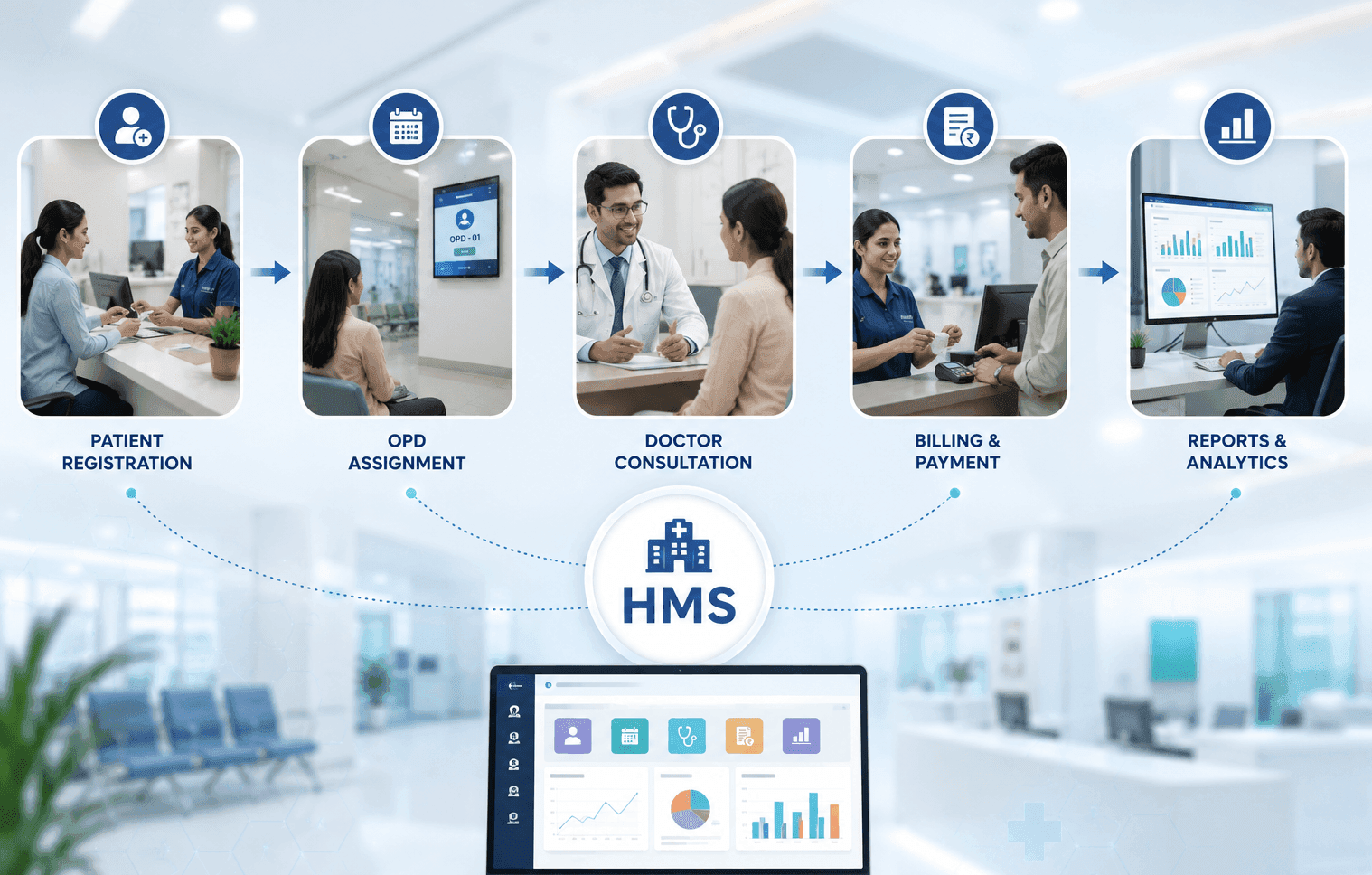
User Journey
The HMS was designed around a practical hospital workflow:
- Patient arrives at reception
- Staff registers patient or searches existing profile
- OPD visit or appointment is created
- Patient is assigned to doctor/department
- Doctor views patient details and consultation history
- Consultation is completed and updated
- Billing is generated
- Payment is recorded
- Reports are available for management
This journey helped the hospital move from scattered manual processes to a centralized digital workflow.
Business Impact
The Hospital Management System helped improve multiple areas of hospital operations.
1. Operational Impact:
- Faster patient registration
- Better OPD management
- Reduced paperwork
- Improved staff productivity
- Better department coordination
- More organized patient flow
3. Financial Impact:
- Improved billing accuracy
- Better payment tracking
- Reduced revenue leakage
- Daily collection visibility
- Faster invoice processing
4. Clinical Workflow Impact:
- Faster access to patient history
- Better doctor dashboard
- Reduced manual record searching
- More structured consultations
5. Leadership Impact:
- Real-time operational visibility
- Better reports and analytics
- Improved decision-making
- Scalable digital foundation
- Better control over hospital workflows
Why HMS Matters for Hospital Decision Makers
For hospital administrators, CIOs, CEOs, medical directors, and operations heads, a Hospital Management System is not just software. It is a core operational backbone.
A strong HMS helps leadership answer critical questions:
- How many patients visited today?
- Which departments are busiest?
- Which doctors have the highest patient load?
- What is today’s revenue collection?
- Where are delays happening in OPD?
- How much payment is pending?
- How efficiently is the hospital operating?
Without a centralized HMS, these answers often depend on manual reports, staff follow-ups, and delayed information.
With a modern HMS, decision makers get better visibility, control, and confidence.
SEO-Focused Keywords Covered
This case study is optimized around high-intent healthcare software keywords such as:
- Hospital Management System
- HMS Software
- Hospital Management System Software
- Hospital Software Development
- Hospital Software India
- HMS for Hospitals
- OPD Management Software
- Patient Management System
- Healthcare Software Solutions
- Hospital Billing Software
- Hospital Digital Transformation
- Custom HMS Software Development
Future Enhancement Opportunities
The HMS platform can be extended into a complete digital healthcare ecosystem.
Possible future modules:
- AI Assistant for Doctors
- Telemedicine & video consultation
- OPD token and queue management
- Lab Management System — LIMS
- Pharmacy management
- Healthcare CRM
- Patient mobile app
- Doctor and staff mobile app
- WhatsApp reminders
- Online payment integration
- ABDM-ready health record workflows
- Advanced analytics dashboard
- Multi-location hospital management
This makes HMS the foundation for long-term healthcare digital transformation.
Technology Stack
Depending on client requirements, the HMS can be developed using modern and scalable technologies such as:
- .NET Core
- Node.js / NestJS
- PHP / Laravel
- React.js
- Next.js
- Angular
- React Native
- MySQL
- PostgreSQL
- Firebase
- AWS / Cloud Hosting
- VPS Hosting
- REST APIs
- WhatsApp/SMS integrations
- Payment gateway integrations
Murmu Software Infotech’s Role
Murmu Software Infotech handled the complete solution lifecycle:
- Requirement discovery
- Hospital workflow analysis
- UI/UX planning
- HMS module design
- Software development
- Database architecture
- Role-based access setup
- Testing and deployment
- Staff training support
- Maintenance and enhancement planning
Our approach focused on building a practical, scalable, and hospital-friendly HMS that supports real-world healthcare operations.
A modern Hospital Management System is essential for hospitals that want to improve patient flow, reduce manual workload, strengthen billing accuracy, and gain better operational visibility.
This HMS project demonstrates how healthcare organizations can move from fragmented processes to a centralized digital system that supports patients, doctors, staff, and leadership.
For hospital decision makers, HMS is not only a technology investment. It is a strategic foundation for operational excellence, patient experience, revenue control, and future AI-powered healthcare transformation.
Frequently Asked Questions
What is Case Study: Hospital Management System - HMS?
Explore how Murmu Software Infotech builds Hospital Management System software to help hospitals improve patient flow, OPD management, billing accuracy, doctor productivity, reports, and operational efficiency.