Development / MVP Application Development
How to Launch an ROI-Driven MVP Application in 30 Days or Less
PPrem M.3 Min Read
In today’s fast-moving digital economy, launching a product quickly is no longer a competitive advantage — launching the right product is.
Many organizations invest heavily in software development, only to discover months later that their product fails to generate traction, revenue, or real business impact.
The biggest mistake?
Building without ROI focus.
If you’re a CEO, CTO, or Founder, your priority isn’t just launching an MVP — it’s launching an ROI-driven MVP application that validates your idea, reduces risk, and starts generating value from day one.

Turn your idea into an ROI-driven MVP, validate real demand, reduce risk, and create a scalable product foundation in 30 days.
Most MVP projects fail not because of poor development — but because of misaligned business strategy.
Organizations often:
➜ The result?
High cost. Low adoption. Zero ROI.
Time is not just money — it’s market opportunity.
Every delayed launch:
A delayed or poorly built MVP doesn’t just waste budget — it delays growth.
The solution is simple but powerful:
Build an MVP that is focused, fast, and revenue-driven
At Murmu Software Infotech, we follow a proven framework to help businesses launch ROI-driven MVP applications in 30 days or less — without compromising scalability or performance.
We don’t start with features — we start with business outcomes.
This stage eliminates 70% of unnecessary development.
Instead of building everything, we focus on:
This ensures your MVP is:
✔ Lean
✔ Fast
✔ Purpose-driven
We build using scalable technologies, not temporary solutions.
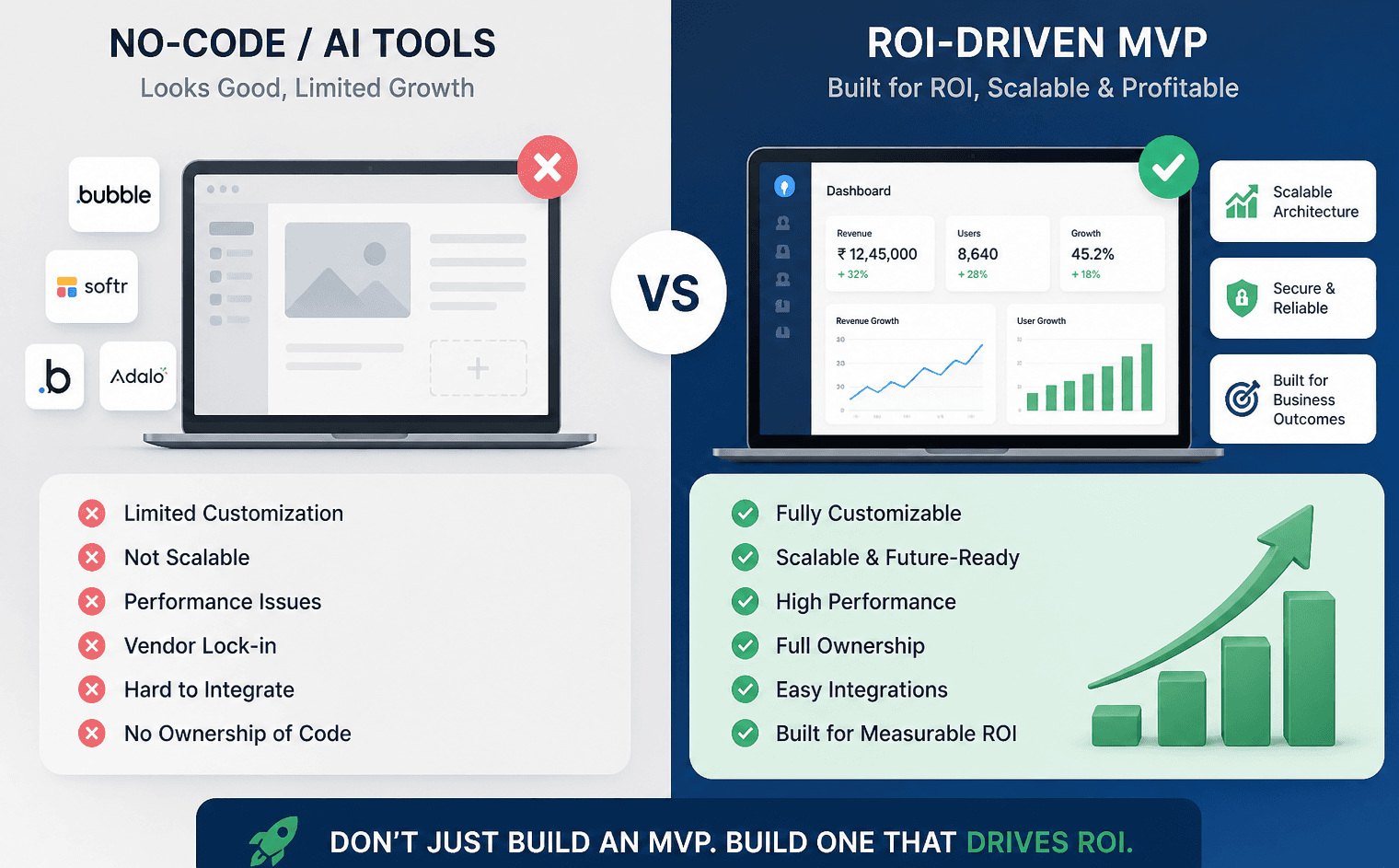
Unlike no-code tools, which often:
Our approach ensures:
✔ Enterprise-grade architecture
✔ Performance-ready systems
✔ Long-term scalability
Your MVP is launched into the real market:
By Day 30, you have:
Let’s address a common trend:
➜ A no-code MVP may look good.
➜ A ROI-driven MVP works and earns.
Building an MVP is not just a technical task — it’s a business decision.
An experienced development partner ensures:
✔ Strategic feature prioritization
✔ Faster time-to-market
✔ Reduced development risk
✔ Scalable product foundation
✔ ROI-focused execution
At Murmu Software Infotech, we combine:
Leaders choose this approach because it:
It transforms MVP from an expense into an investment
When done right, an MVP is not just a prototype.
It becomes:
We don’t just build MVPs — we build ROI-driven digital products.
✔ Delivery in 30 days or less
✔ Scalable architecture from Day 1
✔ Focus on business outcomes
✔ Cost-effective development approach
✔ Trusted by startups and businesses globally
🔗 Learn more:
https://murmusoftwareinfotech.com/roi-driven-mvp-software-development
If your MVP is not designed to generate ROI, it’s just another project.
➜ The goal is not to launch fast.
➜ The goal is to launch smart and profitably.
An ROI-driven MVP is a minimum viable product designed around measurable business outcomes rather than simply delivering features. It focuses on validating a real problem, testing user demand, reducing development risk, supporting revenue or efficiency, and creating a foundation for future growth.
Yes, a focused MVP can potentially be launched in 30 days when the product scope is limited to a clearly defined business problem, essential user journey, core functionality, and measurable validation goals. Complex products may require additional time.
A practical 30-day approach includes defining the core business problem in week one, prioritizing essential features in week two, developing and testing the product in week three, and launching to collect real user feedback in week four.
Many MVPs fail because teams build too many features, develop without validating user demand, focus on code instead of business outcomes, delay market testing, or create technology that is difficult to scale and integrate later.
An MVP should include the minimum functionality required to solve the primary user problem and validate the main business assumption. This typically includes one core feature, an essential user journey, a validation mechanism, and the infrastructure needed for reliable testing.
MVP ROI can be measured through business outcomes such as revenue, leads, conversion rate, user adoption, time saved, operational efficiency, customer retention, reduced manual work, or other metrics directly connected to the original business goal.
No-code tools can be useful for simple prototypes and early validation. Custom development is generally more suitable when an MVP requires custom workflows, integrations, advanced security, high performance, scalable architecture, complex business logic, or long-term code ownership.
Startups can reduce MVP costs by focusing on one core problem, defining the most important user journey, avoiding unnecessary features, validating assumptions early, using suitable technology, and expanding the product only after real users demonstrate demand.
A prototype demonstrates how a product may look or work, while an MVP is a functional version designed to be used by real users. An MVP is intended to validate market demand, user behavior, business assumptions, and potential product value.
Yes. A well-architected MVP can become the foundation for a larger product. After validation, teams can expand features, users, integrations, automation, analytics, mobile capabilities, and enterprise functionality based on real market evidence.