Lab Management Software
In This Article
- Build a Faster, Accurate and Connected Diagnostic Workflow
- What Is Lab Management Software?
- LIS vs LIMS: What Does Your Laboratory Need?
- Core Features of Modern Lab Management Software
- 1. Patient Registration and Test Booking
- 2. Barcode-Based Sample Tracking
- 3. Technician and Department Workflows
- 4. Analyzer and Instrument Integration
- 5. Result Validation and Report Approval
- 6. Digital Report Delivery
- 7. Lab Billing and Revenue Management
- 8. Inventory, Reagents and Equipment
- Complete Diagnostic Workflow
- Integration With HMS and Healthcare Platforms
- AI Opportunities in Laboratory Software
- Cloud or On-Premise Lab Software?
- What Affects Lab Management Software Cost?
- Choosing a Lab Management Software Development Company
- Build a Connected Digital Laboratory
- What Is Lab Management Software?
- LIS vs LIMS: What Does Your Laboratory Need?
- Core Features of Modern Lab Management Software
- 1. Patient Registration and Test Booking
- 2. Barcode-Based Sample Tracking
- 3. Technician and Department Workflows
- 4. Analyzer and Instrument Integration
- 5. Result Validation and Report Approval
- 6. Digital Report Delivery
- 7. Lab Billing and Revenue Management
- 8. Inventory, Reagents and Equipment
- Complete Diagnostic Workflow
- Integration With HMS and Healthcare Platforms
- AI Opportunities in Laboratory Software
- Cloud or On-Premise Lab Software?
- What Affects Lab Management Software Cost?
- Choosing a Lab Management Software Development Company
- Build a Connected Digital Laboratory
Build a Faster, Accurate and Connected Diagnostic Workflow
Diagnostic centres, pathology laboratories and hospital labs manage thousands of interconnected activities—from patient registration and test booking to sample collection, processing, report approval, billing and digital report delivery.
When these workflows depend on paper registers, spreadsheets or disconnected software, laboratories face sample-tracking gaps, repeated data entry, reporting delays, billing errors and limited operational visibility.
Modern lab management software brings these processes into one connected platform. It helps laboratories track every sample, standardize workflows, automate reporting, integrate analyzers and give patients faster access to diagnostic results.
For healthcare organizations planning digital transformation, a custom Laboratory Information Management System, or LIMS, can become the operational foundation for efficient and scalable diagnostic services.
What Is Lab Management Software?
Lab management software is a digital platform used to manage laboratory samples, tests, workflows, reports, inventory, equipment, billing and operational data.
Depending on the type of laboratory, the platform may include:
- Patient and test registration
- Sample collection and barcode tracking
- Technician assignments
- Test-processing workflows
- Instrument or analyzer integration
- Result entry and verification
- Report approval
- Digital report generation
- Billing and payment management
- Inventory and reagent tracking
- Quality-control records
- Dashboards and analytics
Modern laboratory platforms increasingly combine LIMS, inventory management, workflow automation, equipment management and centralized data access within one system.
LIS vs LIMS: What Does Your Laboratory Need?
The terms LIS and LIMS are often used interchangeably, but they can describe different operating models.
A Laboratory Information System, or LIS, is generally patient-centric and commonly used by clinical and pathology laboratories. It manages patient demographics, test orders, results, billing and clinical reporting.
A Laboratory Information Management System, or LIMS, is commonly sample-centric and can support healthcare, pharmaceutical, biotechnology, research, food-testing and industrial laboratories.
In practice, modern platforms increasingly combine elements of both. A diagnostic center may need patient registration and billing from an LIS, together with barcode tracking, inventory, workflow automation and auditability traditionally associated with a LIMS.
Core Features of Modern Lab Management Software
1. Patient Registration and Test Booking
The platform should allow reception or collection teams to register patients, select individual tests or diagnostic packages and create test orders.
Important capabilities include:
- Patient details and history
- Referring doctor information
- Test and package selection
- Home-collection scheduling
- Pricing and discounts
- Booking-status tracking
- Digital receipts
This creates a structured diagnostic workflow from the moment a patient or sample enters the laboratory.
Transform Your Laboratory with Faster, Accurate Digital Workflows
2. Barcode-Based Sample Tracking
Sample visibility is one of the most important reasons to implement laboratory software.
Each sample can receive a unique barcode that follows it through:
Collection → Accessioning → Department Assignment → Processing → Verification → Storage or Disposal
Barcode-driven tracking helps laboratories monitor the sample’s location, processing stage, assigned technician and completion status. Modern LIMS platforms use this workflow to reduce inconsistencies and maintain traceability throughout the sample lifecycle.
3. Technician and Department Workflows
A laboratory may operate across biochemistry, hematology, microbiology, pathology and other departments.
Role-specific dashboards can show technicians:
- Assigned samples
- Pending tests
- Processing queues
- Priority or critical samples
- Completed work
- Reports awaiting verification
Standardized workflows help laboratories maintain consistent processing steps while allowing authorised teams to configure requirements for different test types.
4. Analyzer and Instrument Integration
Manual transfer of results from laboratory machines into software increases workload and introduces avoidable transcription risk.
A connected lab management system can receive results from compatible analyzers, associate them with the correct sample and move them into a controlled verification workflow.
Instrument integration, sample tracking and workflow automation are consistently treated as core capabilities for modern clinical and genomics laboratories. (sapac.illumina.com)
5. Result Validation and Report Approval
Before a report is delivered, authorized doctors, pathologists or laboratory personnel should be able to review and approve the results.
The workflow may include:
- Preliminary result entry
- Reference ranges
- Abnormal or critical-value alerts
- Pathologist review
- Approval status
- Digital verification
- Version history
- Printable and downloadable reports
This provides greater control than generating final reports directly from manually entered values.
6. Digital Report Delivery
Patients and doctors increasingly expect reports without returning to the diagnostic center.
Lab software can support:
- Secure patient access
- PDF report downloads
- Email delivery
- SMS or WhatsApp notifications
- Doctor portal access
- Previous-report history
- Mobile-friendly report viewing
Digital report delivery is now an important buying requirement in India, alongside local-language support, GST-ready billing and integration with commonly used analysers.
7. Lab Billing and Revenue Management
A connected lab billing software module can manage:
- Test and package pricing
- Invoices and receipts
- Payment status
- Discounts
- Doctor or referral tracking
- Outstanding balances
- Daily revenue reports
- Branch-wise financial visibility
Connecting billing with test bookings and reports reduces reconciliation work and gives management clearer insight into diagnostic revenue.
8. Inventory, Reagents and Equipment
Laboratories must monitor reagents, kits, consumables, storage locations and equipment availability.
Inventory capabilities may include:
- Current stock
- Reorder alerts
- Batch and expiry tracking
- Supplier information
- Usage history
- Storage locations
- Purchase requirements
- Equipment maintenance schedules
Inventory management is valuable, but laboratories should also assess whether the platform integrates with purchasing and supplier-management systems as operations scale.
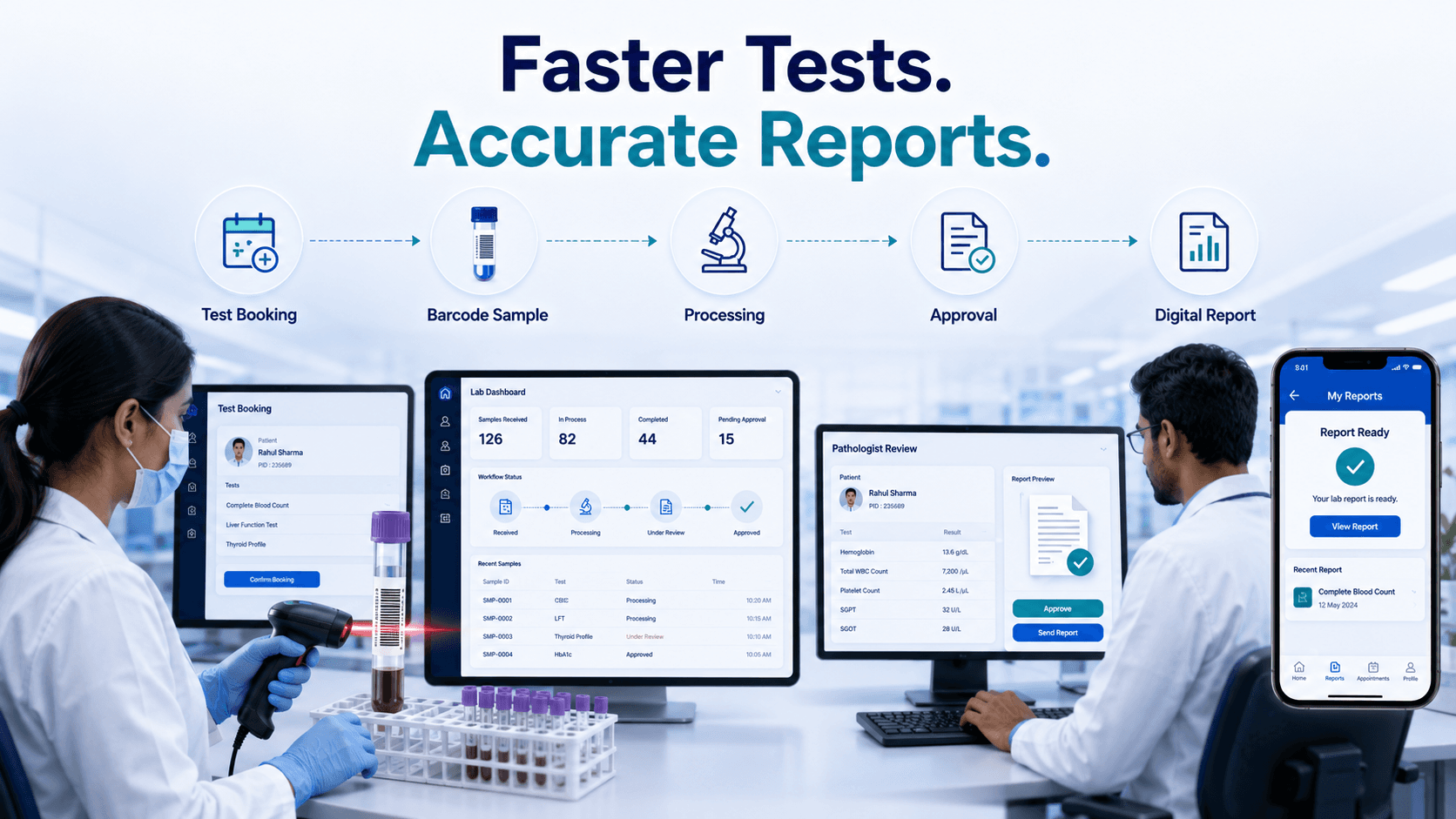
Complete Diagnostic Workflow
A connected laboratory journey can operate as follows:
Patient Registration
↓
Test or Package Booking
↓
Sample Collection and Barcode Generation
↓
Department and Technician Assignment
↓
Test Processing or Analyzer Integration
↓
Result Entry and Validation
↓
Pathologist or Authorized Approval
↓
Billing Completion
↓
Digital Report Delivery
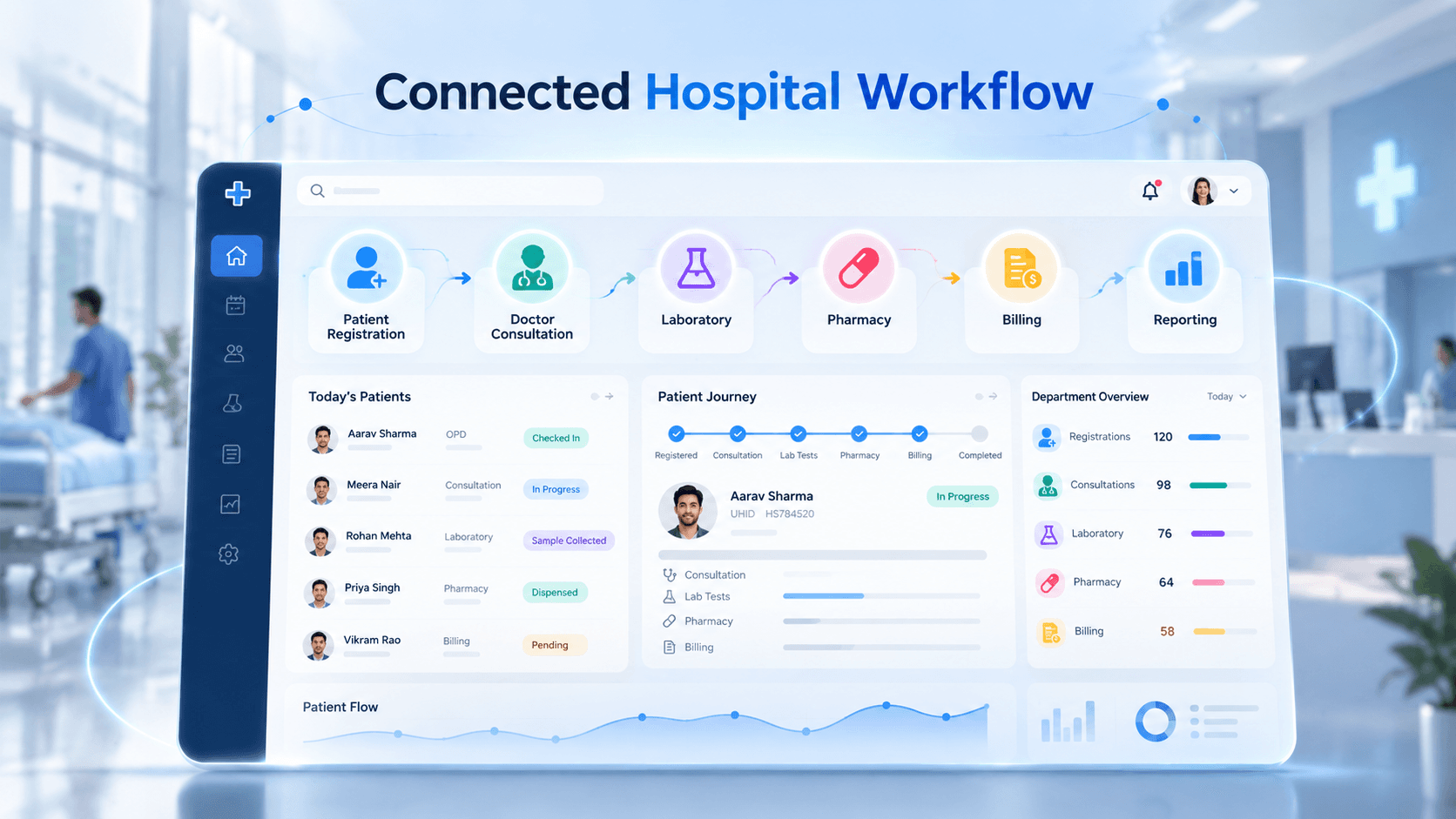
Murmu Software Infotech developed a Lab Management System Software case study covering test booking, sample tracking, technician dashboards, report approvals, billing, diagnostic packages, online report access and management analytics.
Integration With HMS and Healthcare Platforms
A standalone pathology lab may operate its LIMS independently. A hospital laboratory usually needs deeper integration with:
- Hospital Management System
- OPD and IPD workflows
- Doctor consultation records
- Billing and insurance
- Pharmacy
- Patient portal
- Healthcare CRM
- Mobile applications
- Telemedicine platform
For example, a doctor can order a test through the HMS, the laboratory receives the request, the patient’s sample is processed and the approved result becomes available within the patient record.
Explore our Hospital Management System case study and connected Digital Healthcare Management System to understand how laboratory workflows can operate within a broader hospital ecosystem.
AI Opportunities in Laboratory Software
AI can be introduced carefully after the core laboratory workflow and data quality are established.
Possible applications include:
- Identifying operational bottlenecks
- Predicting test volume
- Prioritizing critical workflow alerts
- Detecting unusual processing patterns
- Summarizing laboratory performance
- Supporting inventory forecasting
- Assisting with report-formatting workflows
AI should support laboratory professionals rather than independently approve diagnostic findings. Final verification and clinical interpretation must remain with authorized professionals.
Cloud or On-Premise Lab Software?
Cloud-based platforms can simplify remote access, centralized updates and multi-branch management. On-premise deployment may suit organizations requiring greater local infrastructure control.
The choice should consider:
- Internet reliability
- Data and security policies
- Number of branches
- Integration requirements
- Internal IT capabilities
- Backup and recovery
- Total operating cost
There is no single deployment model suitable for every laboratory.
What Affects Lab Management Software Cost?
The cost of custom LIMS software development depends on:
- Number of branches and users
- Test and department complexity
- Barcode and sample workflows
- Analyzer integrations
- Patient and doctor portals
- Billing and referral requirements
- Inventory management
- HMS or EHR integration
- Data migration
- Cloud or on-premise deployment
- Mobile applications
- Security, testing and support
Pricing can vary significantly depending on features, customization, integrations and licensing or hosting models.
Choosing a Lab Management Software Development Company
Before selecting a provider, evaluate whether it can:
- Understand clinical laboratory workflows
- Demonstrate a working platform
- Customize tests, reports and approvals
- Integrate compatible analyzers
- Connect with HMS and billing systems
- Support multi-location laboratories
- Migrate existing patient and test data
- Provide role-based access and auditability
- Train laboratory teams
- Offer long-term maintenance
The right lab management software development company should build around your diagnostic workflow - not force your laboratory into a generic process.
Build a Connected Digital Laboratory
Murmu Software Infotech develops custom LIMS, pathology lab software, diagnostic-center software and hospital laboratory integrations.
Our objective is to connect test booking, sample tracking, processing, reporting, billing and patient access within one scalable diagnostic platform.
Planning to digitize your diagnostic center or hospital laboratory? Request a personalized LIMS demo and project assessment. Build a Faster, Accurate and Connected Diagnostic Workflow
Diagnostic centers, pathology laboratories and hospital labs manage thousands of interconnected activities - from patient registration and test booking to sample collection, processing, report approval, billing and digital report delivery.
When these workflows depend on paper registers, spreadsheets or disconnected software, laboratories face sample-tracking gaps, repeated data entry, reporting delays, billing errors and limited operational visibility.
Modern lab management software brings these processes into one connected platform. It helps laboratories track every sample, standardize workflows, automate reporting, integrate analyzers and give patients faster access to diagnostic results.
For healthcare organizations planning digital transformation, a custom Laboratory Information Management System, or LIMS, can become the operational foundation for efficient and scalable diagnostic services.
What Is Lab Management Software?
Lab management software is a digital platform used to manage laboratory samples, tests, workflows, reports, inventory, equipment, billing and operational data.
Depending on the type of laboratory, the platform may include:
- Patient and test registration
- Sample collection and barcode tracking
- Technician assignments
- Test-processing workflows
- Instrument or analyzer integration
- Result entry and verification
- Report approval
- Digital report generation
- Billing and payment management
- Inventory and reagent tracking
- Quality-control records
- Dashboards and analytics
Modern laboratory platforms increasingly combine LIMS, inventory management, workflow automation, equipment management and centralized data access within one system.
LIS vs LIMS: What Does Your Laboratory Need?
The terms LIS and LIMS are often used interchangeably, but they can describe different operating models.
A Laboratory Information System, or LIS, is generally patient-centric and commonly used by clinical and pathology laboratories. It manages patient demographics, test orders, results, billing and clinical reporting.
A Laboratory Information Management System, or LIMS, is commonly sample-centric and can support healthcare, pharmaceutical, biotechnology, research, food-testing and industrial laboratories.
In practice, modern platforms increasingly combine elements of both. A diagnostic center may need patient registration and billing from an LIS, together with barcode tracking, inventory, workflow automation and auditability traditionally associated with a LIMS.
Core Features of Modern Lab Management Software
1. Patient Registration and Test Booking
The platform should allow reception or collection teams to register patients, select individual tests or diagnostic packages and create test orders.
Important capabilities include:
- Patient details and history
- Referring doctor information
- Test and package selection
- Home-collection scheduling
- Pricing and discounts
- Booking-status tracking
- Digital receipts
This creates a structured diagnostic workflow from the moment a patient or sample enters the laboratory.
2. Barcode-Based Sample Tracking
Sample visibility is one of the most important reasons to implement laboratory software.
Each sample can receive a unique barcode that follows it through:
Collection → Accessioning → Department Assignment → Processing → Verification → Storage or Disposal
Barcode-driven tracking helps laboratories monitor the sample’s location, processing stage, assigned technician and completion status. Modern LIMS platforms use this workflow to reduce inconsistencies and maintain traceability throughout the sample lifecycle.
3. Technician and Department Workflows
A laboratory may operate across biochemistry, hematology, microbiology, pathology and other departments.
Role-specific dashboards can show technicians:
- Assigned samples
- Pending tests
- Processing queues
- Priority or critical samples
- Completed work
- Reports awaiting verification
Standardized workflows help laboratories maintain consistent processing steps while allowing authorized teams to configure requirements for different test types.
4. Analyzer and Instrument Integration
Manual transfer of results from laboratory machines into software increases workload and introduces avoidable transcription risk.
A connected lab management system can receive results from compatible analyzers, associate them with the correct sample and move them into a controlled verification workflow.
Instrument integration, sample tracking and workflow automation are consistently treated as core capabilities for modern clinical and genomics laboratories.
5. Result Validation and Report Approval
Before a report is delivered, authorized doctors, pathologists or laboratory personnel should be able to review and approve the results.
The workflow may include:
- Preliminary result entry
- Reference ranges
- Abnormal or critical-value alerts
- Pathologist review
- Approval status
- Digital verification
- Version history
- Printable and downloadable reports
This provides greater control than generating final reports directly from manually entered values.
6. Digital Report Delivery
Patients and doctors increasingly expect reports without returning to the diagnostic center.
Lab software can support:
- Secure patient access
- PDF report downloads
- Email delivery
- SMS or WhatsApp notifications
- Doctor portal access
- Previous-report history
- Mobile-friendly report viewing
Digital report delivery is now an important buying requirement in India, alongside local-language support, GST-ready billing and integration with commonly used analyzers.
7. Lab Billing and Revenue Management
A connected lab billing software module can manage:
- Test and package pricing
- Invoices and receipts
- Payment status
- Discounts
- Doctor or referral tracking
- Outstanding balances
- Daily revenue reports
- Branch-wise financial visibility
Connecting billing with test bookings and reports reduces reconciliation work and gives management clearer insight into diagnostic revenue.
8. Inventory, Reagents and Equipment
Laboratories must monitor reagents, kits, consumables, storage locations and equipment availability.
Inventory capabilities may include:
- Current stock
- Reorder alerts
- Batch and expiry tracking
- Supplier information
- Usage history
- Storage locations
- Purchase requirements
- Equipment maintenance schedules
Inventory management is valuable, but laboratories should also assess whether the platform integrates with purchasing and supplier-management systems as operations scale.
Build Smarter Lab Operations with Connected Management Software
Complete Diagnostic Workflow
A connected laboratory journey can operate as follows:
Patient Registration
↓
Test or Package Booking
↓
Sample Collection and Barcode Generation
↓
Department and Technician Assignment
↓
Test Processing or Analyzer Integration
↓
Result Entry and Validation
↓
Pathologist or Authorised Approval
↓
Billing Completion
↓
Digital Report Delivery
Murmu Software Infotech developed a Lab Management System Software case study covering test booking, sample tracking, technician dashboards, report approvals, billing, diagnostic packages, online report access and management analytics.
Integration With HMS and Healthcare Platforms
A standalone pathology lab may operate its LIMS independently. A hospital laboratory usually needs deeper integration with:
- Hospital Management System
- OPD and IPD workflows
- Doctor consultation records
- Billing and insurance
- Pharmacy
- Patient portal
- Healthcare CRM
- Mobile applications
- Telemedicine platform
For example, a doctor can order a test through the HMS, the laboratory receives the request, the patient’s sample is processed and the approved result becomes available within the patient record.
Explore our Hospital Management System case study and connected Digital Healthcare Management System to understand how laboratory workflows can operate within a broader hospital ecosystem.
AI Opportunities in Laboratory Software
AI can be introduced carefully after the core laboratory workflow and data quality are established.
Possible applications include:
- Identifying operational bottlenecks
- Predicting test volume
- Prioritizing critical workflow alerts
- Detecting unusual processing patterns
- Summarizing laboratory performance
- Supporting inventory forecasting
- Assisting with report-formatting workflows
AI should support laboratory professionals rather than independently approve diagnostic findings. Final verification and clinical interpretation must remain with authorized professionals.
Cloud or On-Premise Lab Software?
Cloud-based platforms can simplify remote access, centralized updates and multi-branch management. On-premise deployment may suit organizations requiring greater local infrastructure control.
The choice should consider:
- Internet reliability
- Data and security policies
- Number of branches
- Integration requirements
- Internal IT capabilities
- Backup and recovery
- Total operating cost
There is no single deployment model suitable for every laboratory.
What Affects Lab Management Software Cost?
The cost of custom LIMS software development depends on:
- Number of branches and users
- Test and department complexity
- Barcode and sample workflows
- Analyzer integrations
- Patient and doctor portals
- Billing and referral requirements
- Inventory management
- HMS or EHR integration
- Data migration
- Cloud or on-premise deployment
- Mobile applications
- Security, testing and support
Pricing can vary significantly depending on features, customization, integrations and licensing or hosting models.
Choosing a Lab Management Software Development Company
Before selecting a provider, evaluate whether it can:
- Understand clinical laboratory workflows
- Demonstrate a working platform
- Customize tests, reports and approvals
- Integrate compatible analyzers
- Connect with HMS and billing systems
- Support multi-location laboratories
- Migrate existing patient and test data
- Provide role-based access and auditability
- Train laboratory teams
- Offer long-term maintenance
The right lab management software development company should build around your diagnostic workflow - not force your laboratory into a generic process.
Build a Connected Digital Laboratory
Murmu Software Infotech develops custom LIMS, pathology lab software, diagnostic-center software and hospital laboratory integrations.
Our objective is to connect test booking, sample tracking, processing, reporting, billing and patient access within one scalable diagnostic platform.
Planning to digitize your diagnostic center or hospital laboratory? Request a personalized LIMS demo and project assessment.
Frequently Asked Questions
What is lab management software?
Lab management software is a digital platform for managing laboratory test orders, patients, samples, processing workflows, results, approvals, billing, inventory and operational reports.
What is the difference between LIS and LIMS?
An LIS is commonly patient-centric and used in clinical or pathology laboratories, while a LIMS is generally sample-centric and supports broader laboratory workflows. Modern systems may combine patient, sample, billing and inventory capabilities.
What features should lab management software include?
Core features can include patient registration, test booking, barcode generation, sample tracking, technician dashboards, analyser integration, result validation, report approval, billing, inventory and patient access.
How does barcode sample tracking work?
The system assigns a unique barcode to each sample. Laboratory teams scan or update it during collection, accessioning, department assignment, processing, approval, storage and disposal to maintain traceability.
Can LIMS integrate with laboratory analysers?
Yes. A LIMS can connect with compatible analysers to receive results and associate them with the correct sample. Feasibility depends on the instrument, communication protocol, middleware and vendor documentation.
Can lab software integrate with an HMS?
Yes. Laboratory software can connect with HMS, OPD, IPD, billing, doctor records and patient portals through available APIs, middleware, custom connectors or supported healthcare interoperability methods.
How are laboratory results approved?
Results can move from entry or analyser import to technical validation and authorised approval. Only approved reports should be released to patients, referring doctors or connected healthcare systems.
Can patients access laboratory reports online?
Yes. Patients can receive secure access through a web portal or mobile application and may also receive report-ready notifications through email, SMS or supported messaging channels.
What does laboratory billing software manage?
Laboratory billing software can manage test prices, diagnostic packages, discounts, invoices, receipts, payment status, referrals, outstanding balances and branch-wise revenue reporting.
Can a LIMS manage inventory?
Yes. LIMS inventory modules can track reagents, kits, consumables, suppliers, batches, expiry dates, storage locations, usage and reorder requirements.
Is cloud or on-premise LIMS better?
Cloud LIMS may simplify remote access, updates and multi-branch management, while on-premise deployment provides greater control over local infrastructure. The choice depends on connectivity, policy, integrations, budget and IT capabilities.
Can AI be integrated into lab management software?
AI can assist with test-volume forecasting, inventory planning, workflow alerts, operational summaries and unusual-pattern detection. Diagnostic validation and final report approval should remain with authorised laboratory professionals.
How much does lab management software cost?
Cost depends on the number of branches, users, tests, workflows, analyser integrations, portals, billing, inventory, HMS connectivity, migration, deployment model and ongoing support.
How should a laboratory choose a LIMS development company?
Evaluate laboratory workflow knowledge, analyser integration experience, customisation, security, multi-branch capabilities, case studies, migration support, staff training, maintenance and transparent project scope.