Development / CMS
__Standard Values in Sitecore
SSaurav Kumar2 Min Read
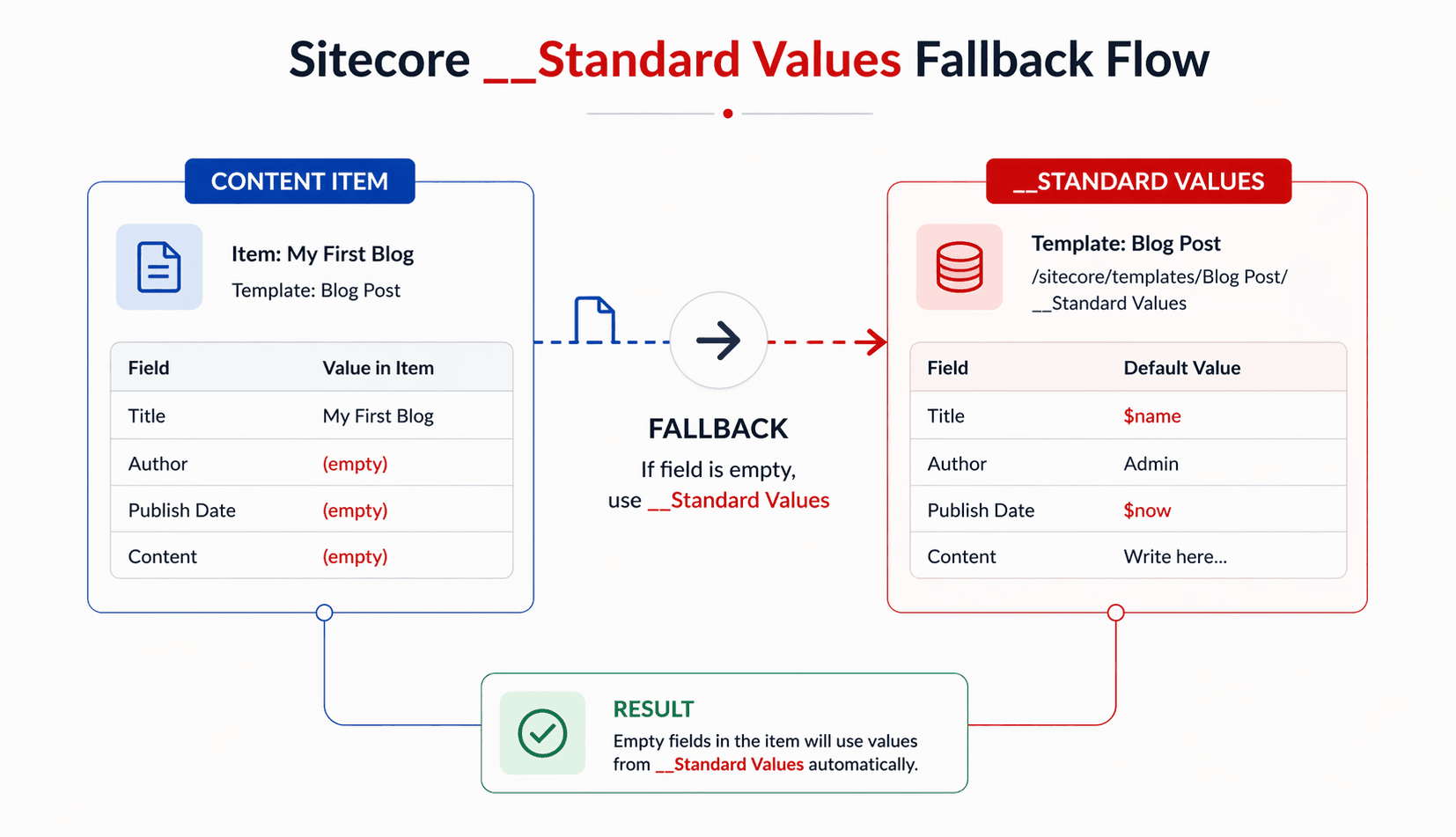
In Sitecore, the __Standard Values item is one of those things that seems simple at first, but ends up being central to how Sitecore manages defaults, templates, and behavior.
Let’s break it down clearly and then walk through a practical example.
Every template in Sitecore can have a special item called:
__Standard Values
It acts as a default configuration + fallback layer for all items created from that template.
Think of it like:

Simplify Sitecore development with smart defaults, fallback behavior, reusable presentation details, and scalable templates that keep every content experience consistent.
When you create a new item from a template:
If a field is not filled in the actual item:
You can define:
in __Standard Values so all items inherit them.
You can use tokens like:
These get dynamically replaced when an item is created.
Inside the template:
/sitecore/templates/YourTemplate/__Standard Values
Template: Blog Post
Fields:
| Field | Value |
|---|---|
| Title | $name |
| Author | Admin |
| Field | Value |
|---|---|
| Publish Date | $now |
| Content | Write here... |
You create:
Item Name: My First Blog
Result:
| Field | Value | Why |
|---|---|---|
| Title | My First Blog | $name replaced |
| Author | Admin | default value |
| Publish Date | current date/time | $now replaced |
| Content | Write here... | default |
Suppose you later:
Sitecore will still show:
Author = Admin
Because:
You can also define layout in __Standard Values:
Example:
Now:
Without __Standard Values, you would need to:
With it, you get:
In code (C#):
item["Author"]
If Author is empty in the item:
No extra logic needed.
Think of it like:
A class constructor with default values in programming
or
A CSS base style applied to all elements unless overridden
Happy Coding!
Standard Values in Sitecore are default field values and settings defined for a data template. They are stored in a special __Standard Values item and provide reusable defaults for items based on that template.
Sitecore Standard Values are stored as a special child item under the data template, typically at a path such as /sitecore/templates/YourTemplate/__Standard Values.
When an item based on a template does not have a value for a field, Sitecore can use the corresponding standard value defined by the template. Standard Values also provide reusable default settings for template-based items.
A blank field and a NULL field are not always the same. By default, a field cleared by a content author can remain blank instead of falling back to Standard Values. The Reset Blank option can reset blank content to NULL so the standard value is used.
Sitecore supports tokens including $name, $date, $time, $now, $id, $parentid, and $parentname. These tokens can be expanded during item creation to generate dynamic default values.
The $name token is replaced with the item's name when the item is created. If the item is renamed later, the original generated field value is not automatically updated.
Yes. Standard Values can centrally define default presentation settings such as layouts and renderings, allowing template-based items to inherit consistent presentation configuration.
Yes. Sitecore recommends using Standard Values to centrally manage settings such as initial workflow and insert options, helping reduce repetitive configuration across individual items.
Standard Values can be inherited through base templates. If multiple templates define a standard value for the same field, the value from the first applicable template in the inheritance list is used.
Standard Values improve content consistency, reduce manual configuration, support reusable templates, centralize default settings, simplify content creation, and help developers avoid repeated fallback logic.