What a Scalable D2C or B2B E-commerce Platform Needs in 2026
In This Article
- 1. Start With the Commerce Model, Not the Technology
- 2. Product Discovery Must Reduce Buying Friction
- 3. Customer Accounts Should Support the Entire Relationship
- 4. Inventory and Fulfilment Must Remain Accurate Across Channels
- 5. Loyalty and Post-Purchase Experience Drive Growth
- 6. CRM, ERP, PIM and POS Cannot Be Afterthoughts
- 7. Mobile Commerce Must Be a Core Experience
- 8. Choose Headless Commerce for the Right Reasons
- 9. Analytics and AI Need Connected, Trustworthy Data
- How Much Does E-commerce Platform Development Cost?
- Build Commerce That Supports the Next Growth Stage
Launching an online store is easier than ever. Building a commerce platform that continues performing as products, customers, orders, channels and markets grow is much harder.
A basic store may support product listings, a cart and checkout. A scalable platform must connect product discovery, customer accounts, inventory, fulfilment, loyalty, CRM, ERP, mobile commerce and business reporting.
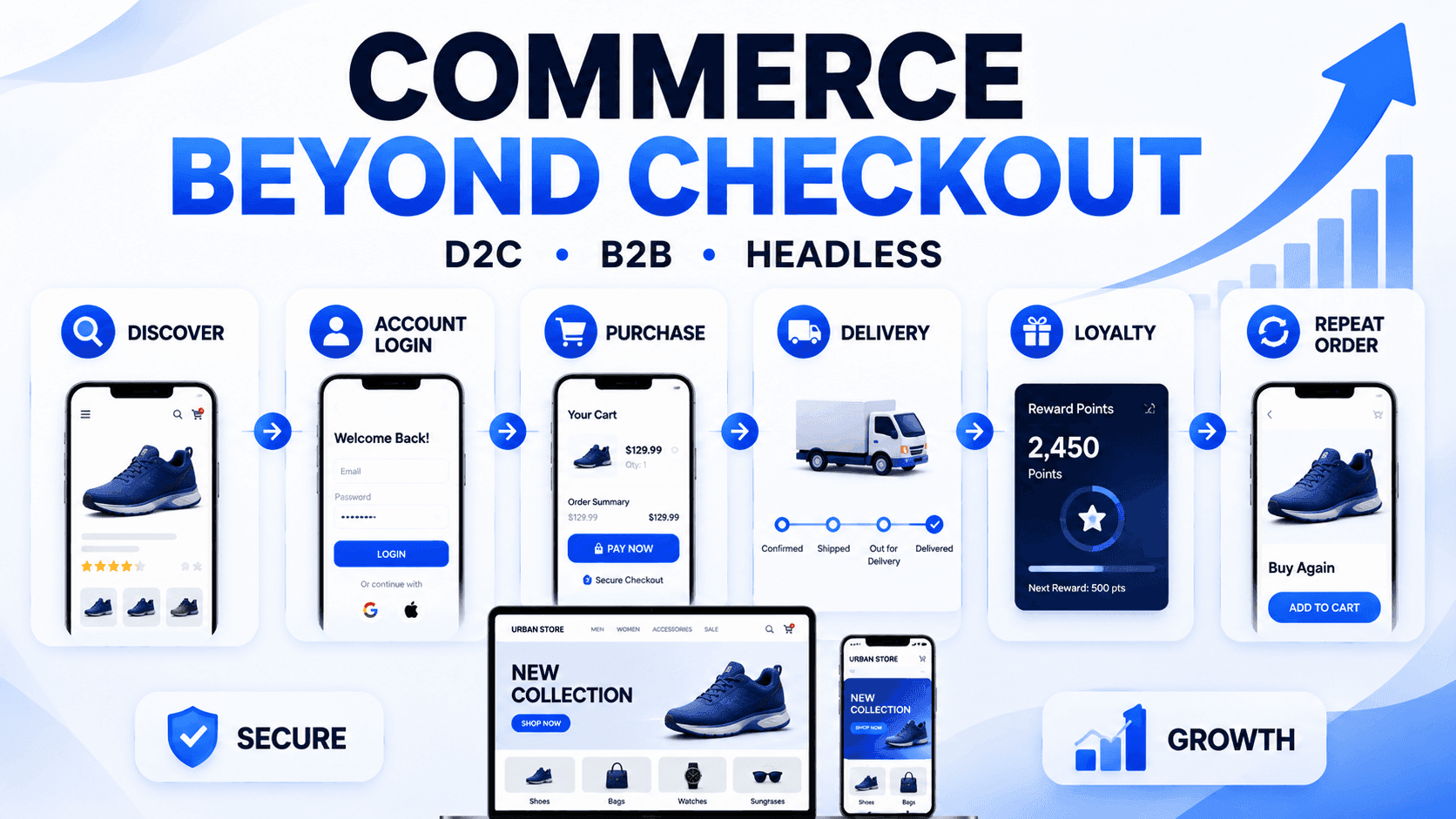
The central principle for 2026 is straightforward: build commerce around the complete customer experience not only the transaction.
Businesses planning a new platform or modernising an existing store should work with a D2C and e-commerce development company that understands both conversion and commerce operations.
1. Start With the Commerce Model, Not the Technology
The correct architecture depends on how the business sells.
A D2C brand may need personalised discovery, social-commerce integrations, subscriptions, loyalty and fast fulfilment. A distributor may require account-specific catalogues, credit terms, bulk ordering and reordering. A manufacturer operating both D2C and B2B channels may need different prices, workflows and fulfilment rules within one platform.
Businesses should therefore define:
- Who buys from the platform
- How pricing is calculated
- Where inventory is stored
- How orders are fulfilled
- Which systems hold customer and operational data
- Which channels will be added later
Trying to support D2C, wholesale, marketplaces, subscriptions and physical stores through disconnected tools often creates inventory conflicts, duplicated customer records and manual reconciliation. Research across the reviewed industry sources consistently emphasises unified operations, accurate inventory and architecture matched to the business model.
2. Product Discovery Must Reduce Buying Friction
Customers cannot buy products they cannot confidently find or understand.
A scalable commerce platform needs structured categories, intelligent filters, strong site search, product comparisons, recommendations and clear availability information. Complex catalogues may also require product information management, variant relationships, technical specifications, downloadable documents and compatibility data.
For D2C brands, discovery should communicate value through product stories, videos, reviews, bundles and relevant recommendations.
For B2B buyers, discovery may need to recognise part numbers, industry terminology, account-specific catalogues and repeat-order patterns. AI-assisted search can improve discovery, but it depends on complete and accurate product data.
Build a Commerce Platform Ready for Your Next Growth Stage
3. Customer Accounts Should Support the Entire Relationship
An account should offer more than saved addresses.
D2C customers may expect wish lists, rewards, subscriptions, saved payments, personalised offers, return requests and order tracking.
B2B accounts require deeper functionality, including:
- Multiple users under one organisation
- Purchasing roles and permissions
- Negotiated or tiered pricing
- Credit limits and payment terms
- Quote and approval workflows
- Invoice access and rapid reordering
Modern B2B commerce platform development should enable buyers to complete routine tasks independently while allowing sales representatives to assist with quotes, orders and account management when necessary. Self-service should strengthen the customer relationship rather than remove the human element.
4. Inventory and Fulfilment Must Remain Accurate Across Channels
Inventory problems quickly become customer-experience problems.
A customer who completes checkout and later discovers that the product is unavailable will not care which integration failed. They will remember that the brand broke its promise.
A scalable platform should connect inventory across warehouses, retail locations, websites, mobile apps and marketplaces. It should also support low-stock alerts, backorders, delivery zones, shipping rules, returns and intelligent order routing.
Growing retailers can explore a unified retail, POS, inventory and e-commerce platform to bring online sales, physical stores, stock, orders and delivery operations into one connected environment.
Unified inventory and fulfilment visibility helps reduce overselling, manual reconciliation and inconsistent order information as the business expands.
5. Loyalty and Post-Purchase Experience Drive Growth
Checkout is not the end of the customer journey.
Order confirmation, shipping communication, delivery tracking, support, returns and replenishment all influence whether a buyer returns.
D2C platforms should be able to support:
- Loyalty points and rewards
- Referral programmes
- Personalised coupons
- Subscriptions and scheduled orders
- Abandoned-cart recovery
- Email, SMS and WhatsApp automation
- Review and feedback requests
Communication must remain consistent across email, messaging, live chat and customer support. Transactional platforms alone are insufficient when customer conversations are fragmented across different teams and tools.
6. CRM, ERP, PIM and POS Cannot Be Afterthoughts
The commerce platform should not become another isolated system.
CRM integration connects browsing, enquiries, orders and customer-service history. ERP integration provides dependable pricing, inventory, invoices, credit terms and fulfilment data. PIM systems support complex product information, while POS integration connects online and in-store transactions.
These integrations are especially critical for manufacturers and distributors. Incorrect prices, delayed inventory updates or mismatched account terms reduce trust and create extra work for sales and support teams.
Real-time or carefully designed event-based integrations are preferable to fragile manual imports and disconnected spreadsheets. The reviewed B2B sources consistently identify ERP integration, customer-specific pricing and real-time inventory as foundational capabilities rather than optional enhancements.
7. Mobile Commerce Must Be a Core Experience
Customers increasingly discover, compare, reorder and track purchases through mobile devices.
A responsive website is the minimum requirement. Depending on purchase frequency and customer behaviour, a business may also need a Progressive Web App or dedicated Android and iOS applications.
The website, application and physical-store experience should use the same product, inventory, order and customer data. Maintaining separate backends for every channel creates inconsistent experiences and expensive operational work.
Turn Disconnected Commerce Operations Into One Scalable Customer Experience
8. Choose Headless Commerce for the Right Reasons
Headless commerce separates the customer-facing experience from the commerce engine. It can enable faster storefronts, richer content, mobile applications and new customer touchpoints through APIs.
It is valuable when a business needs:
- Multiple storefronts or markets
- Content-led product experiences
- Mobile and web channels using one backend
- Custom checkout or customer journeys
- Integration with CRM, ERP or external platforms
- Greater frontend performance and design control
However, headless architecture adds integration and operational complexity. It should be selected because the business needs flexibility not because it is fashionable.
Our Sanity and Next.js headless platform case study demonstrates how structured content, APIs and a decoupled frontend can improve publishing speed, scalability and team independence. The same principles can support content-rich headless e-commerce development.
9. Analytics and AI Need Connected, Trustworthy Data
Commerce reporting should extend beyond page views and total sales.
Leadership teams need visibility into conversion, average order value, repeat purchases, fulfilment performance, stock movement, returns, customer lifetime value and digital order adoption.
AI can then support recommendations, product discovery, customer assistance, demand forecasting and merchandising. But adding AI to fragmented data does not make a platform intelligent. Accurate product, inventory, transaction and customer data must come first.
How Much Does E-commerce Platform Development Cost?
Under Murmu Software Infotech’s current Limited Digital Product Launch Offer 2026, e-commerce platform development starts from $4,500 for a defined core scope.
A core platform may include product and category management, search, customer accounts, cart, checkout, payment integration, order management, promotions, shipping configuration, analytics and technical SEO.
Advanced D2C, B2B, headless, multi-store, subscription, marketplace or ERP-integrated platforms receive a customised milestone-based proposal. The published amount is a starting price, and the offer is available for eligible projects confirmed before 6 August 2026.
Build Commerce That Supports the Next Growth Stage
A scalable e-commerce platform is not defined by how many features it contains. It is defined by how effectively it connects the customer journey with the operational systems required to deliver that experience.
The right custom e-commerce development partner will not begin with a preferred platform. It will begin with customers, products, pricing, fulfilment, integrations and growth plans.
Build beyond checkout. Create a connected D2C or B2B commerce platform that helps customers discover, purchase, receive, return and reorder with less friction.
Frequently Asked Questions
What is a scalable D2C or B2B e-commerce platform?
A scalable commerce platform supports increasing products, customers, transactions, locations and sales channels without requiring the entire system to be rebuilt. It connects the customer-facing storefront with inventory, fulfilment, payments, customer accounts, CRM, ERP and reporting.
What features does a growing D2C brand need?
A growing D2C brand typically needs product discovery, fast search, customer accounts, personalised offers, loyalty, subscriptions, order tracking, returns, marketing automation and mobile-friendly commerce. These capabilities help the brand improve conversion, retention and repeat purchases.
How is a B2B e-commerce platform different from a D2C store?
B2B platforms often support organisation accounts, multiple buyers, approval workflows, customer-specific catalogues, negotiated pricing, bulk orders, credit limits, payment terms, quotations and rapid reordering. D2C platforms usually prioritise individual consumers, brand storytelling, conversion and loyalty.
When should a business choose custom e-commerce development?
Custom development is appropriate when standard templates cannot support the required pricing rules, ordering workflows, customer roles, integrations, subscriptions, multi-store operations or user experience. It is also valuable when commerce is central to the organisation’s long-term business model.
When should a company use headless commerce?
Headless commerce is suitable when a business needs multiple storefronts, international markets, mobile applications, content-rich product journeys or deeper frontend customisation. It also helps when several customer experiences need to use the same commerce, product and inventory services.
Why are CRM and ERP integrations important for e-commerce?
CRM integration connects customer activity, enquiries, sales and service history. ERP integration helps synchronise pricing, inventory, invoices, credit terms, fulfilment and financial information, reducing manual work and inconsistent business data.
How should inventory be managed across multiple sales channels?
Inventory should be connected through a central system that synchronises stock across websites, mobile applications, marketplaces, warehouses and physical stores. The platform should also support reservations, backorders, low-stock alerts, returns and order-routing rules.
Does a scalable e-commerce platform need a mobile application?
Not every business needs a dedicated application immediately. A mobile app or Progressive Web App becomes valuable when customers purchase frequently, track orders, manage subscriptions, earn loyalty rewards or need fast access to account-specific services.
How much does a custom e-commerce platform cost?
Murmu Software Infotech currently lists e-commerce development from $4,500 for a defined core scope. Advanced D2C, B2B, multi-store, subscription, marketplace, ERP-integrated and headless commerce requirements receive a customised proposal based on features, integrations, architecture and delivery requirements.
How should a business choose an e-commerce development partner?
Choose a partner that understands customer experience, commerce operations, integrations, security, analytics and scalability—not only storefront design. The partner should define the architecture, milestones, responsibilities, launch scope and long-term expansion plan before development begins.