AI Healthcare Software Development
In This Article
- Custom Solutions for Smarter Patient Care and Hospital Operations
- What Is AI Healthcare Software Development?
- High-Value Applications of AI in Healthcare Software
- 1. AI Assistants for Doctors
- 2. AI-Powered Patient Engagement
- 3. Predictive Healthcare and Operational Analytics
- 4. Administrative and Workflow Automation
- 5. Medical Imaging and Clinical Decision Support
- Integrating AI With Existing Healthcare Software
- AI Healthcare Software Development Process
- 1. Define the problem and intended outcome
- 2. Assess data readiness
- 3. Build a focused MVP
- 4. Integrate with healthcare systems
- 5. Test and validate
- 6. Monitor after deployment
- Security, Privacy and Responsible AI
- The Future of AI in Healthcare Software Development
- Choose the Right AI Healthcare Software Development Company
- Build an AI-Ready Healthcare Platform
Custom Solutions for Smarter Patient Care and Hospital Operations
Healthcare organisations generate enormous volumes of clinical, operational and patient-engagement data. Yet much of that information remains distributed across hospital management systems, electronic medical records, laboratory platforms, telemedicine applications, spreadsheets and disconnected administrative tools.
AI healthcare software development helps hospitals, clinics, medical businesses and digital health startups transform this fragmented information into practical tools that support doctors, automate repetitive work, improve patient engagement and strengthen operational decision-making.
However, successful healthcare AI is not created by adding a generic chatbot to existing software. It requires clearly defined workflows, reliable healthcare data, human oversight, secure integrations, clinical validation and continuous performance monitoring. Competitor research consistently identifies machine learning, natural language processing, predictive analytics, intelligent automation and computer vision as important AI technologies for healthcare software.
What Is AI Healthcare Software Development?
AI healthcare software development is the process of designing, building and integrating intelligent applications for healthcare providers, patients, administrators, laboratories, insurers and medical businesses.
Depending on the intended use, a custom AI healthcare solution may include:
- AI assistants for doctors
- Clinical documentation automation
- Patient-history summarisation
- Appointment and patient-support agents
- Predictive operational analytics
- Remote patient monitoring
- Medical image analysis
- Intelligent hospital dashboards
- Healthcare search and knowledge assistants
- Billing and administrative automation
- Patient engagement and follow-up systems
The right solution begins with a specific healthcare or business problem - not with an AI model. Development teams must understand the target users, data sources, workflow risks, measurable objectives and level of clinical responsibility before choosing the technology.
High-Value Applications of AI in Healthcare Software
1. AI Assistants for Doctors
Doctors frequently spend valuable consultation time reviewing patient history, preparing notes, entering structured information and updating records.
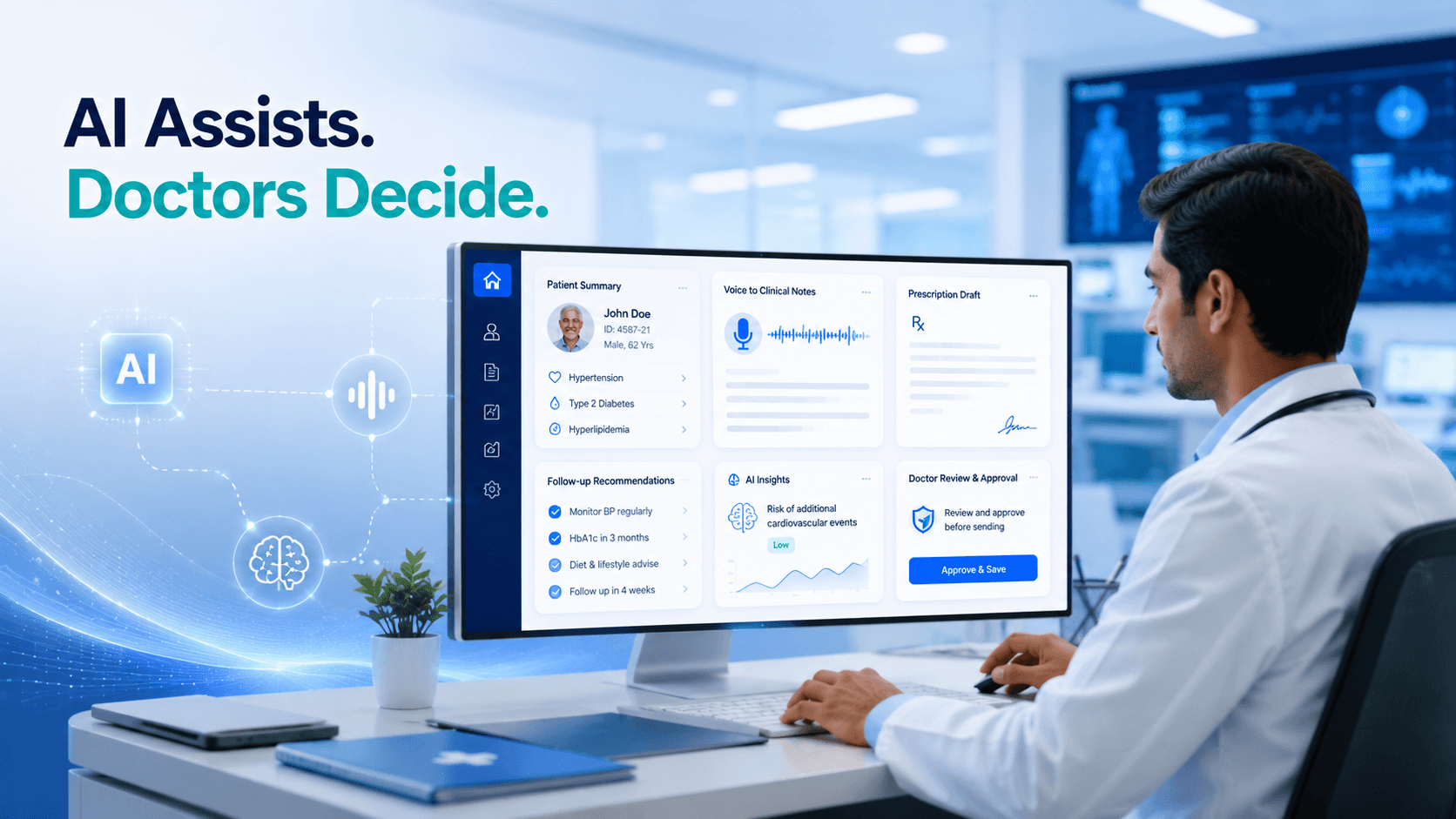
An AI assistant embedded inside an HMS or EMR can help with:
- Voice-to-text consultation input
- Patient-history summaries
- Structured clinical-note drafts
- Follow-up instruction generation
- Prescription-drafting assistance
- One-click record updates
Our AI Assistant for Doctors in Hospital Management System case study demonstrates how AI can be integrated directly into the OPD consultation workflow.
The guiding principle is clear: AI assists; the doctor reviews and decides. Diagnosis, prescription approval and patient-care decisions remain with qualified healthcare professionals.
Build Secure AI Healthcare Software That Improves Patient Care
2. AI-Powered Patient Engagement
Healthcare AI assistants can guide patients through common digital interactions such as finding a department, identifying an appropriate doctor, requesting an appointment, accessing service information or receiving follow-up reminders.
These systems can be connected with a healthcare website, patient portal, mobile application or CRM. More advanced implementations may support multilingual conversations, authenticated patient journeys and handover to hospital staff.
For broader implementation requirements, our AI solutions development services cover custom AI assistants, automation, generative AI applications and business-system integrations.
3. Predictive Healthcare and Operational Analytics
Predictive models can analyse historical information to identify patterns related to patient demand, hospital admissions, resource requirements, follow-up risk or operational bottlenecks.
Hospitals may use these insights to support:
- OPD capacity planning
- Doctor scheduling
- Patient-flow forecasting
- Bed and resource allocation
- Appointment no-show prediction
- Inventory planning
- Follow-up prioritisation
The quality of the result depends heavily on data completeness, relevance and representativeness. AI predictions should therefore support informed decisions rather than operate as unquestioned instructions.
4. Administrative and Workflow Automation
Many of the fastest AI opportunities are operational rather than diagnostic.
Healthcare organisations can automate or assist:
- Appointment scheduling
- Patient enquiry classification
- Medical-document processing
- Insurance and eligibility workflows
- Billing-data extraction
- Report generation
- Internal knowledge retrieval
- Patient communication
- Clinical and administrative summaries
Competitor analysis repeatedly highlights administrative automation as a practical route to reducing repetitive work and allowing healthcare staff to focus on higher-value activities.
5. Medical Imaging and Clinical Decision Support
Machine learning and computer vision can support specialised use cases involving radiology, pathology, ophthalmology and other image-intensive disciplines.
These solutions require a much higher level of data validation, clinical testing, risk management and regulatory review than a general administrative assistant. In the United States, AI software intended to perform medical-device functions may fall within FDA oversight. The FDA emphasises safety, effectiveness, transparency and risk management throughout the total product lifecycle of AI-enabled device software.
Integrating AI With Existing Healthcare Software
AI creates more value when it works inside existing healthcare workflows rather than requiring doctors and staff to switch to another disconnected application.
A custom solution may integrate with:
- HMS, EMR and EHR platforms
- Healthcare CRM
- LIMS and diagnostic systems
- Telemedicine platforms
- Pharmacy and inventory software
- Patient and doctor mobile apps
- Enterprise healthcare CMS
- Medical devices and remote-monitoring systems
- Billing and insurance applications
FHIR is a widely used API-focused standard for representing and exchanging health information. Standards-based APIs can help healthcare applications exchange data more consistently, although actual integration still depends on the capabilities and data quality of the connected systems.
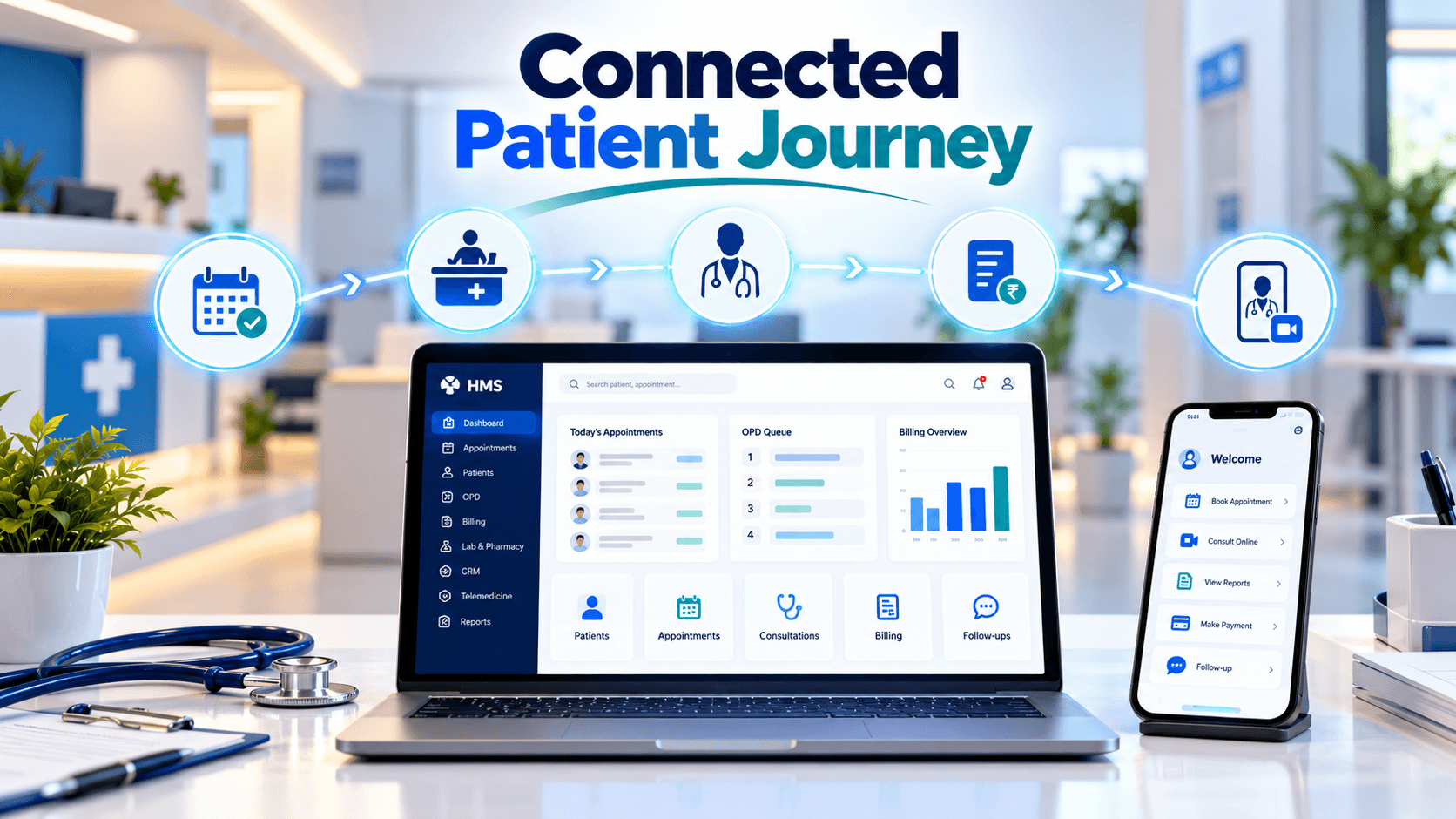
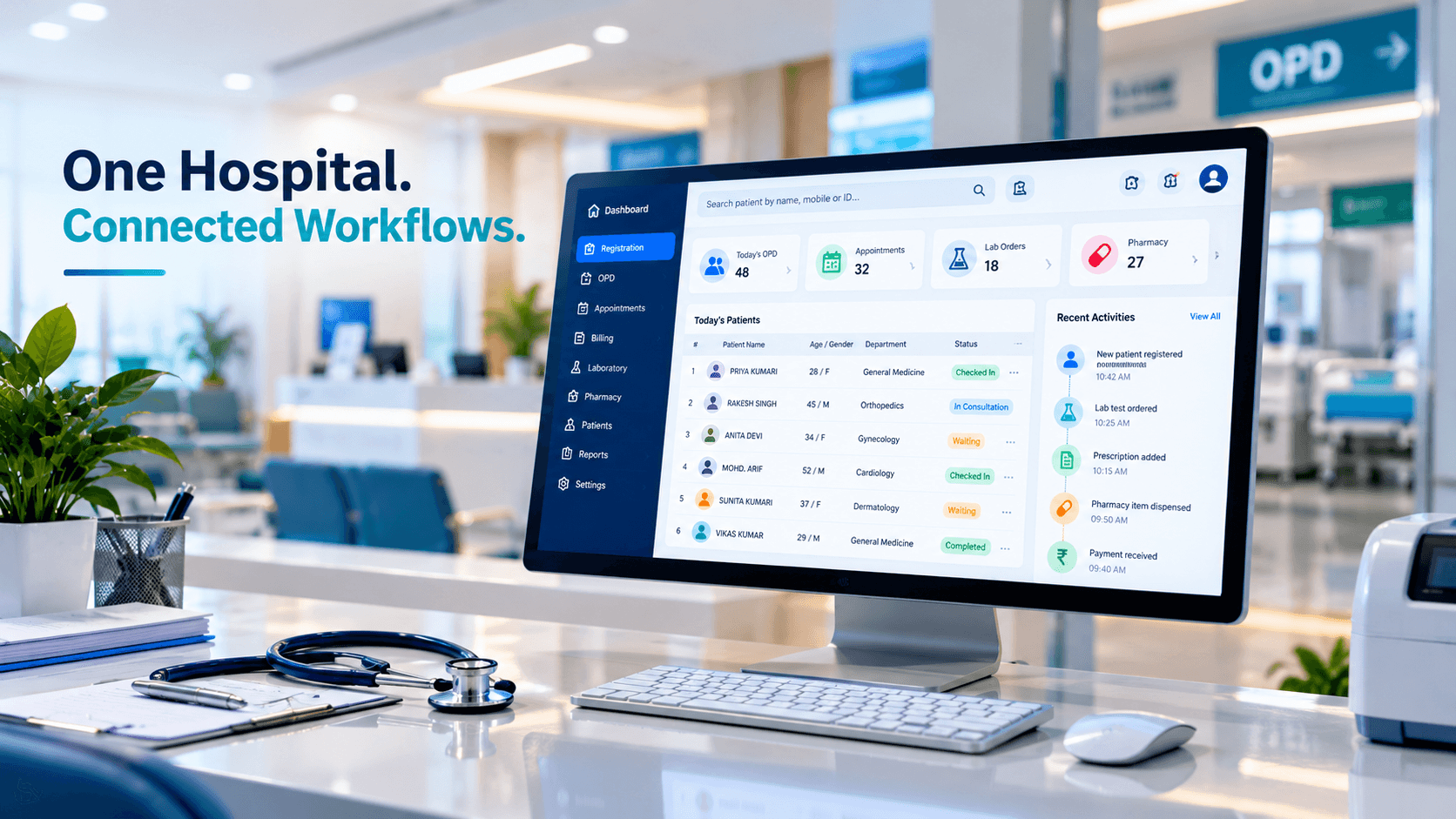
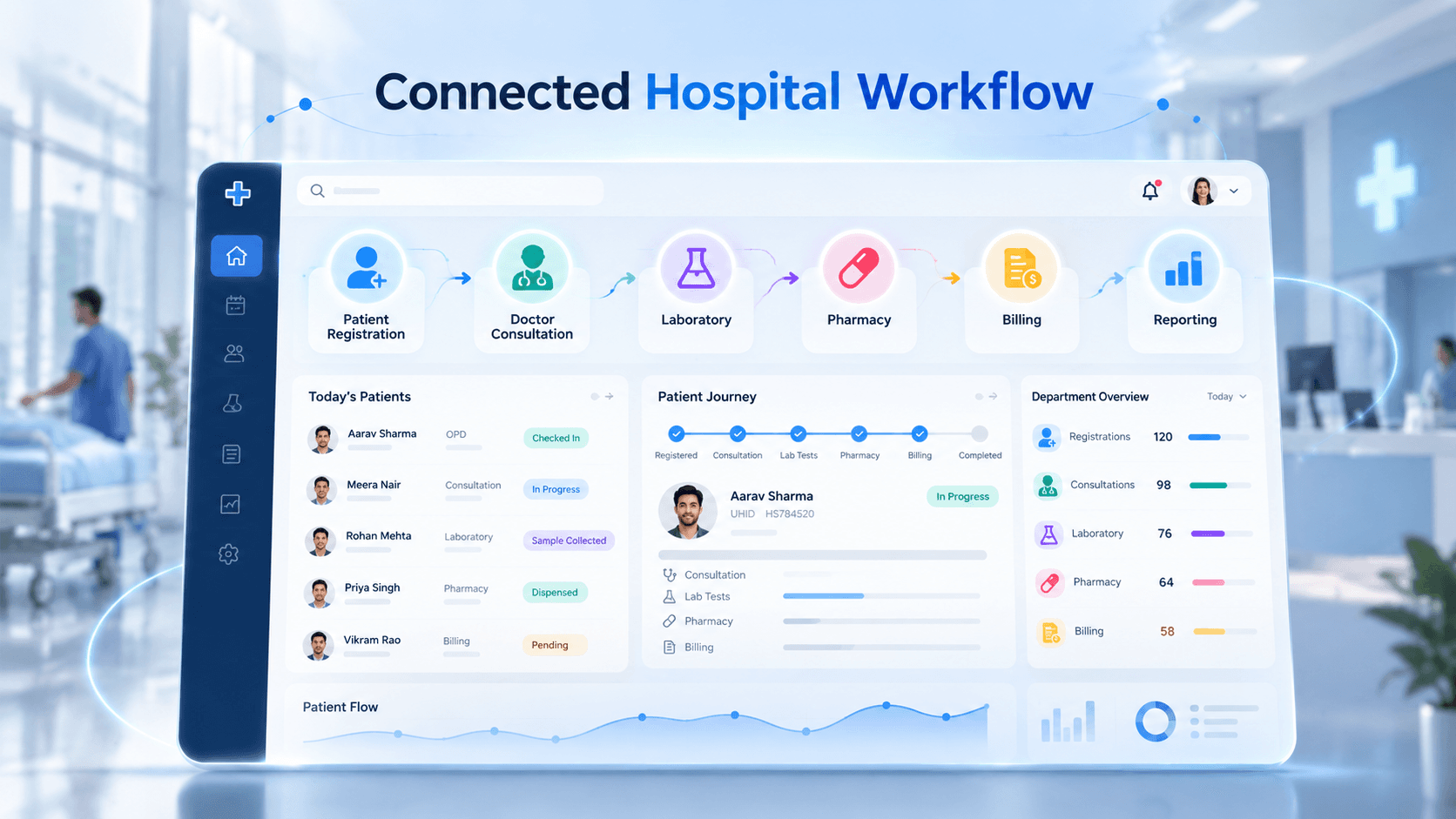
Murmu Software Infotech’s complete digital healthcare platform combines HMS, telemedicine, healthcare CRM, OPD automation, patient applications and AI-assisted workflows within a connected healthcare ecosystem.
AI Healthcare Software Development Process
A reliable development process should include six stages.
1. Define the problem and intended outcome
Identify the user, workflow, risk level and measurable business or clinical objective.
2. Assess data readiness
Review data availability, quality, ownership, consent, labelling requirements and potential bias before selecting or training a model.
3. Build a focused MVP
Start with one valuable workflow, such as patient-history summarisation, consultation-note drafting or appointment automation.
4. Integrate with healthcare systems
Connect the AI application with relevant HMS, EHR, CRM, telemedicine or diagnostic platforms through secure APIs.
5. Test and validate
Conduct functional, integration, security, usability and model-performance testing. Clinical use cases may require evaluation by qualified medical specialists.
6. Monitor after deployment
Track accuracy, latency, user feedback, model drift, security events and workflow outcomes. AI healthcare software requires ongoing monitoring and improvement rather than one-time deployment.
Transform Healthcare Workflows with Custom AI-Powered Software Solutions
Security, Privacy and Responsible AI
Healthcare AI may process highly sensitive patient information. Security planning should therefore include encryption, strong authentication, role-based permissions, audit logs, secure API access, controlled data retention, incident management and vendor-risk assessment.
For applicable US organisations, the HIPAA Security Rule requires administrative, physical and technical safeguards to protect electronic protected health information. HIPAA compliance depends on the complete technical and organisational environment; it is not guaranteed by a software feature alone.
Responsible AI implementation must also address bias, explainability, accountability, model limitations and human oversight. Healthcare professionals should understand when an AI output can be trusted, when it requires further review and who remains responsible for the final decision.
The Future of AI in Healthcare Software Development
The next phase of healthcare AI will increasingly combine generative AI, ambient documentation, multimodal models, intelligent agents, remote-monitoring data and enterprise healthcare systems.
AI agents may coordinate controlled tasks across scheduling, patient communication, clinical documentation and operational reporting. Multimodal systems may process combinations of text, voice, images and structured healthcare data. However, greater capability will require stronger governance, testing and lifecycle management.
The future is therefore not AI operating independently from healthcare teams. It is AI working inside governed clinical and operational workflows, with clear permissions, reliable data and human accountability. McKinsey similarly argues that organisations developing software as a medical device must combine delivery speed with regulatory-grade quality rather than treating quality as a downstream activity.
Choose the Right AI Healthcare Software Development Company
A capable development partner should offer more than general AI expertise. Evaluate its ability to provide:
- Healthcare workflow discovery
- Custom AI application development
- HMS, EHR, CRM and LIMS integrations
- Data engineering and model evaluation
- Human-in-the-loop workflows
- Healthcare security architecture
- Web and mobile application development
- Cloud deployment and AI monitoring
- Relevant healthcare case studies
- Maintenance and long-term optimisation
Portfolio evidence, system-integration capability, security practices and post-launch support are important selection criteria for an AI healthcare development partner.
Murmu Software Infotech provides AI-powered application development for hospitals, healthcare startups and medical businesses seeking intelligent, integrated and scalable software.
Build an AI-Ready Healthcare Platform
The strongest healthcare AI solutions do not begin by attempting to automate everything.
They begin with one high-value problem, integrate AI into the existing workflow, keep professionals in control and measure whether the solution creates practical value.
Whether your priority is AI for doctors, patient engagement, hospital automation, telemedicine intelligence or healthcare analytics, the foundation should remain the same:
Reliable data. Secure integration. Human oversight. Measurable outcomes.
Watch the Digital Healthcare Management System demonstration or request a personalised consultation for your AI healthcare software project.
Planning an AI healthcare application? Book a live demo and AI solution assessment.
Frequently Asked Questions
What is AI healthcare software development?
AI healthcare software development is the process of designing and building intelligent applications for healthcare providers, patients and administrators. Solutions may include doctor assistants, patient-support agents, predictive analytics, workflow automation and healthcare system integrations.
What AI solutions can be developed for hospitals?
Hospitals can develop AI assistants for doctors, patient-engagement agents, clinical documentation tools, appointment automation, predictive dashboards, medical knowledge search, operational analytics and intelligent hospital-management workflows.
How can AI assist doctors?
AI can assist doctors by summarizing patient history, converting speech into structured notes, drafting consultation summaries, preparing follow-up instructions and reducing repetitive documentation. Doctors should review and approve all clinical outputs.
Can AI integrate with an existing HMS or EHR?
Yes. AI healthcare applications can integrate with HMS, EMR, EHR, CRM, LIMS, telemedicine and pharmacy platforms through available APIs, middleware, custom connectors or supported interoperability standards.
What are the benefits of AI in healthcare app development?
AI can reduce repetitive work, improve information access, support patient engagement, assist clinical documentation, strengthen operational visibility and help healthcare teams identify relevant patterns in available data.
How can AI improve patient engagement?
AI can help patients find doctors, understand healthcare services, request appointments, receive reminders, access frequently asked information and move through multilingual digital journeys with escalation to hospital staff when necessary.
Can AI automate hospital workflows?
AI can automate or assist administrative workflows such as enquiry classification, appointment communication, document extraction, reporting, internal knowledge retrieval and patient follow-up. High-risk clinical decisions should remain under professional control.
What should an AI healthcare MVP include?
An AI healthcare MVP should focus on one valuable workflow, defined users, reliable data, secure integration, human review, measurable success criteria and monitoring. Examples include consultation-note drafting, patient-history summaries or appointment assistance.
How much does AI healthcare software development cost?
Cost depends on the use case, platforms, integrations, data preparation, model selection, security requirements, user roles, validation, cloud infrastructure and ongoing monitoring. A discovery and data-readiness assessment is required for an accurate estimate.
How long does AI healthcare software development take?
The timeline depends on workflow complexity, data availability, integrations, model evaluation, security controls and clinical validation. A focused AI MVP can be delivered faster than a multi-module enterprise healthcare AI platform.
What security controls should healthcare AI software include?
Healthcare AI software may require encryption, strong authentication, role-based permissions, audit logs, secure APIs, consent management, data-retention controls, backup, monitoring and vendor-risk assessment.
How should hospitals choose an AI healthcare development company?
Hospitals should evaluate healthcare workflow knowledge, AI engineering experience, system integration capability, security practices, human-in-the-loop design, model evaluation, relevant case studies and post-deployment monitoring and support.
What is the future of AI in healthcare software development?
Healthcare AI is moving toward ambient clinical documentation, multimodal applications, intelligent workflow agents, remote-monitoring intelligence and deeper integration with healthcare systems while maintaining governance and human accountability.