Trusted Technology Partner vs Project-Based Software Vendor
In This Article
- Your software project is complete. But your business is still evolving. Who owns the technology roadmap after launch?
- Software Vendor vs Technology Partner: What's the Difference?
- When Is a Fixed-Price Software Project the Better Choice?
- When Does a Long-Term Software Development Partner Add Value?
- Dedicated Developers vs Retainer vs Managed Delivery
- What Should the First 90 Days of a Technology Partnership Look Like?
- Who Owns the Roadmap, Architecture and Integrations?
- Security, Intellectual Property and Business Continuity
- Comparing Total Cost: Vendors, Internal Hiring and Partners
- How Murmu Software Infotech Helps Existing Software Evolve
- Technology Partnership for Agencies and Global Businesses
- Choose a Technology Model That Fits Your Next Stage
Your software project is complete. But your business is still evolving. Who owns the technology roadmap after launch?
Integrate with your ERP system. Improve your website. Provide a mobile experience for customers. Provide some AI automation for your team. But your original developer may no longer be maintaining it.
This is why understanding technology partner vs software vendor matters before making your next technology investment.
The right engagement model should match your business priorities, operational needs and available budget not simply the lowest development quotation.
Software Vendor vs Technology Partner: What's the Difference?
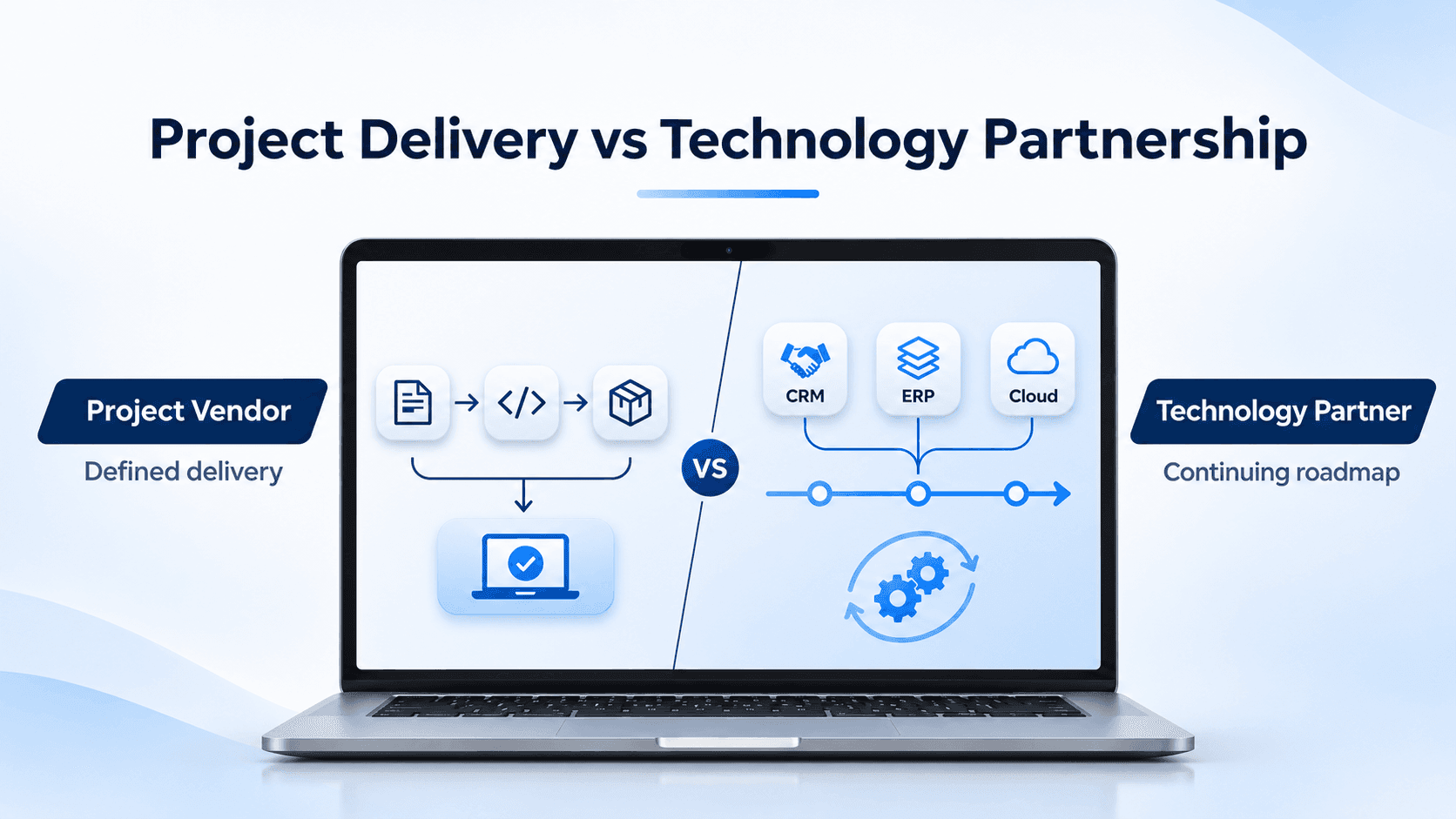
A project-based software vendor delivers agreed work within a defined scope, timeline and commercial arrangement.
A long-term technology partner supports an agreed continuing relationship that may include architecture, development, integrations, maintenance and future improvements.
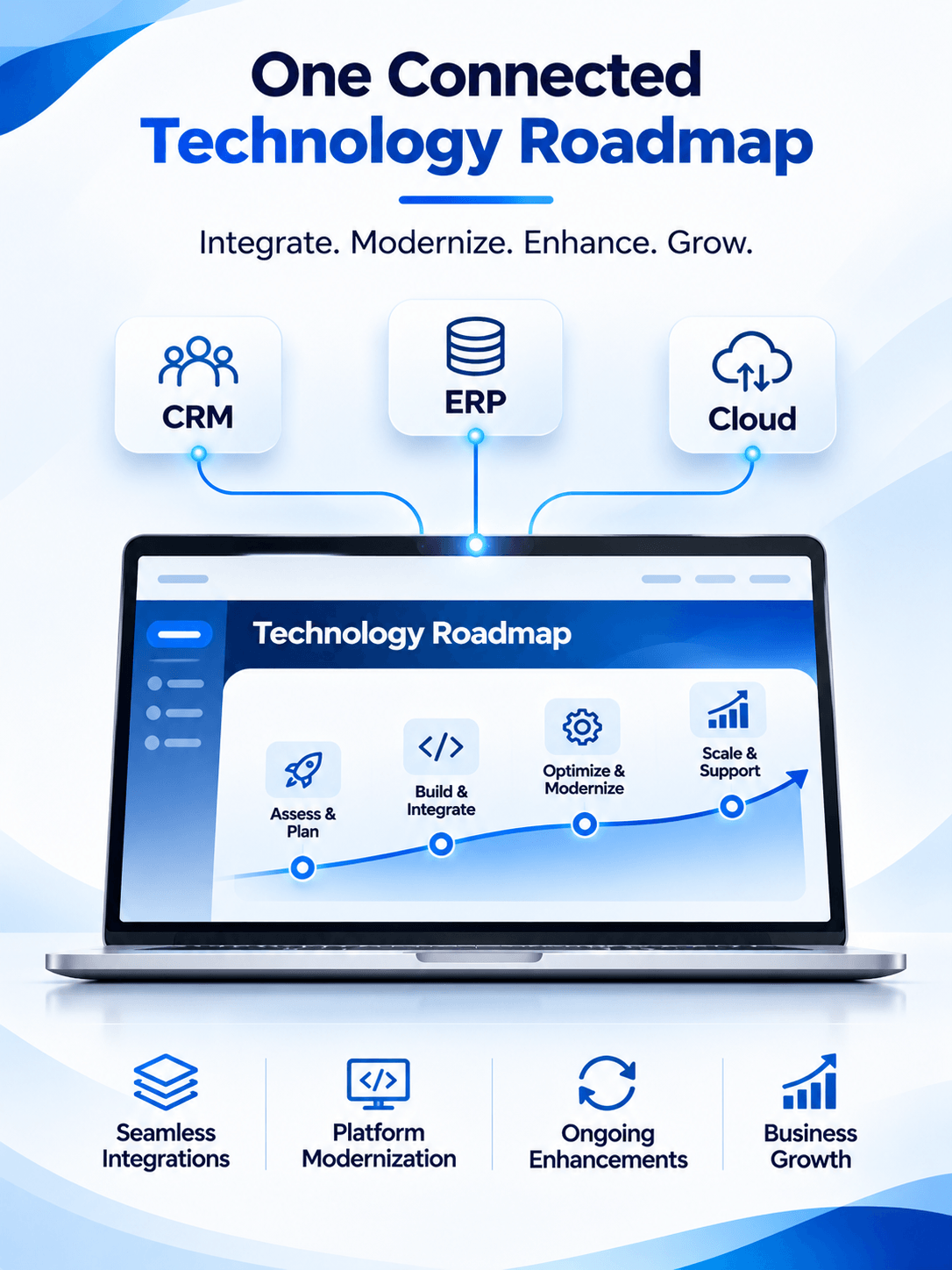
Build Beyond Your Next Project
Connect your software roadmap, integrations, modernization and ongoing engineering with a trusted team focused on your evolving business priorities.
Neither model is automatically better.
| Decision factor | Project-based vendor | Ongoing technology partner |
|---|---|---|
| Engagement | Defined deliverables | Continuing priorities and responsibilities |
| Budget | Fixed quote or milestones | Retainer, dedicated capacity or phased work |
| Knowledge | Transferred during handover | Potential continuity across projects |
| Support | Separate or optional | Defined in an ongoing agreement |
| Changes | New scope and quotation | Prioritized within agreed capacity |
| Best fit | Stable, standalone project | Evolving business-critical software |
A strong vendor can provide excellent engineering. A long-term partnership adds value when the business benefits from continuing technical knowledge and accountability.
When Is a Fixed-Price Software Project the Better Choice?
Best used where the requirements are set and the outputs can be easily validated.
Examples of this type of project might be enhancements to a site, dedicated reporting dashboards or limited integration.
Ensure acceptance criteria, code ownership, testing, documentation, deployment responsibilities and guarantee/support are all confirmed ahead of signing.
You do not need a long-term retainer for every software requirement.
The right choice depends on whether continuing engineering work is genuinely expected.
Stop Managing Multiple Vendors. Start Building One Technology Roadmap.
Review your existing applications, integration priorities and recurring development needs with a scope-based technology consultation.
When Does a Long-Term Software Development Partner Add Value?
An ongoing partner may be useful when your organization operates multiple connected applications or maintains an active improvement roadmap.
Consider this model when:
- CRM, ERP, websites and mobile applications need regular integration work.
- Existing software requires upgrades, fixes or modernization.
- AI-assisted workflows must be tested, introduced and monitored.
- New business requirements regularly affect the product backlog.
- Your internal team needs specialist engineering capacity.
A reliable partnership should connect technical priorities to business objectives, while leaving strategic decisions and system ownership with the customer.
Dedicated Developers vs Retainer vs Managed Delivery
Different collaboration models provide different levels of responsibility.
Dedicated developers provide agreed engineering capacity under a defined working arrangement. Product decisions and delivery management may remain largely with your internal team.
Development retainers reserve a specified amount of capacity for maintenance, enhancements or recurring technical tasks.
Managed delivery Including planning, delivery, testing, reporting and coordination in an agreement.
Within a good partnership agreement consideration should be given to hours, resource levels, escalation processes, expected response time, approval of changes and commercial terms.
Explore Murmu Software Infotech's Technology Partnership Services for engagement options.
What Should the First 90 Days of a Technology Partnership Look Like?
An initial 90-day framework can establish whether the relationship works before expanding it.
Days 1–30: Assess and prioritize
Review existing applications, architecture, integrations, operational risks and business priorities. Agree on access, responsibilities and an initial backlog.
Days 31–60: Deliver targeted improvements
Address agreed high-priority issues, implement a limited enhancement or integration, and test the reporting and review process.
Days 61–90: Evaluate and plan
Based on the review of completed tasks, current risks, budget burn down, quality and stakeholder feedback, the decision can be made to proceed, scale-up or alter.
(Note: This is an example engagement plan and may not apply to all projects.)
Need an engineering roadmap instead of another isolated quotation?
Request a Technology Partnership Consultation.
Who Owns the Roadmap, Architecture and Integrations?
Your technology partner should help document the architecture and identify dependencies, but your organization should retain appropriate control over its systems and priorities.
Important responsibilities include:
- Documenting business workflows and technical dependencies.
- Maintaining API and integration specifications.
- Prioritizing improvements by operational and commercial value.
- Reviewing security, performance and maintainability.
- Establishing decision-making and escalation responsibilities.
For example, connecting CRM and ERP may deliver more value than immediately replacing both systems.
A partner should evaluate integration, modernization and replacement as separate options.
Security, Intellectual Property and Business Continuity
A trusted technology partnership requires clear contractual protections.
Define intellectual-property ownership, source-code access, repositories, cloud accounts, credentials, documentation and data-handling responsibilities.
Where relevant, agree on confidentiality, access reviews, backups, incident escalation and applicable security or privacy requirements.
For white-label work, client communication, branding, confidentiality and deliverable ownership should be defined in the agreement.
A long-term relationship should improve continuity not create unnecessary vendor lock-in.
Expand Your Engineering Capacity Without Expanding Permanent Hiring Commitments
Explore dedicated development or white-label delivery with clearly defined responsibilities, communication and confidentiality arrangements.
Comparing Total Cost: Vendors, Internal Hiring and Partners
The cheapest initial quotation is not always the lowest total cost.
Compare each model using:
Total ownership cost = Development + Integration + Infrastructure + Maintenance + Future Changes + Transition Costs
Internal hiring may offer direct control but requires recruitment, management and retention.
A project vendor can offer pricing clarity for bounded work but may require fresh onboarding for additional projects.
An ongoing partner may improve continuity but can create unused capacity if the workload is inconsistent.
Choose based on workload, management capacity, commercial flexibility and expected software changes not unsupported savings percentages.
How Murmu Software Infotech Helps Existing Software Evolve
Custom Application Development | Enterprise Integration | Headless CMS | AI Solutions | Engineering
Identify what to retain, integrate and upgrade. Then recommend a replacement solution.
Two published examples illustrate relevant engineering capabilities:
Salesforce–SAP Integration: MSI developed custom middleware supporting bidirectional synchronization between CRM and ERP systems. This demonstrates integration engineering relevant to businesses managing connected enterprise platforms.
Read the Salesforce–SAP Integration Case Study.
Sanity + Next.js Website Modernization: MSI migrated its own website to a structured headless CMS architecture while retaining Next.js frontend delivery. The project demonstrates content-platform modernization and integration capabilities.
Explore the Sanity + Next.js Case Study.
These case studies demonstrate project work; they do not establish guaranteed savings, revenue growth or specific long-term contract outcomes.
Technology Partnership for Agencies and Global Businesses
Digital agencies may need development capacity without expanding permanent internal teams.
MSI offers White-Label Software Development Partnership options for agreed software, web, mobile and AI engineering work.
Businesses seeking continuing improvements can also explore Managed Software Development & Support.
Confidentiality, project governance, working hours and support commitments should be agreed before delivery.
Choose a Technology Model That Fits Your Next Stage
Define requirements and responsibilities.
If you have a limited requirement consider a smaller scope of work. If you require continuous improvements, integrations and management, consider working with us on an ongoing basis.
Murmu Software Infotech helps organizations plan, build, connect, modernize and support the applications their businesses depend on.
Frequently Asked Questions
What is the difference between a technology partner and a software vendor?
A project-based software vendor delivers agreed work within a defined scope, budget and timeline. A technology partner operates under an agreed continuing relationship that may include architecture, software development, integrations, maintenance and future improvements. Either model can deliver high-quality results.
When should a business choose a long-term technology partner?
A continuing partnership may suit businesses with evolving software platforms, recurring feature requests, multiple system integrations, modernization needs or ongoing maintenance requirements. Companies with stable, one-time requirements may be better served by a fixed-scope project.
Is a technology partner more cost-effective than hiring a project vendor?
Not automatically. Total cost depends on workload, team capacity, onboarding, infrastructure, support, contract flexibility and future enhancements. Compare equivalent responsibilities and expected usage before deciding.
What services does a long-term software development partner provide?
Depending on the contract, services can include technical discovery, custom development, API integrations, architecture reviews, application modernization, quality assurance, cloud operations, maintenance and planned enhancements.
What is the difference between dedicated developers and managed software development?
Dedicated developers provide agreed engineering capacity, often under the customer's management. Managed delivery may additionally include planning, coordination, testing, reporting and delivery responsibility. The actual scope depends on the agreement.
How much does a technology partnership cost?
Pricing may use fixed milestones, monthly dedicated capacity, retainers or phased statements of work. Cost varies by skills, workloads, integrations, service hours and delivery responsibilities. Request an estimate that separates recurring capacity from additional project expenses.
Who owns the source code and intellectual property in a technology partnership?
Ownership is determined by the signed agreement. Define rights to source code, custom development, documentation, infrastructure, licences and reusable components. The customer should also agree on repository access, credentials and handover procedures.
Can a technology partner maintain existing software without rebuilding it?
Often yes. A technical assessment may identify opportunities for bug fixing, integration, upgrades, performance improvements and partial modernization. Rebuilding should be considered only when the current system's condition or requirements justify it.
Can offshore technology partners support US, UK and UAE businesses?
Yes, subject to agreed working arrangements. Buyers should verify relevant engineering experience, communication processes, time-zone overlap, confidentiality, security requirements and contractual support coverage.
Why consider Murmu Software Infotech as a technology partner?
Murmu Software Infotech offers custom software engineering, integrations, CMS modernization, AI development and managed support arrangements. Published project examples include Salesforce–SAP integration and Sanity–Next.js modernization. Buyers should review its relevant project work and agree on a suitable delivery model.