How to Build a Profitable E-Commerce Website in 2026 (Step-by-Step)
In This Article
- The Complete Business Guide for Building a Scalable & Revenue-Driven E-Commerce Platform
- Why E-Commerce is More Profitable Than Ever in 2026
- Step 1: Choose the Right Business Model
- B2C (Business-to-Consumer)
- B2B (Business-to-Business)
- D2C (Direct-to-Consumer)
- Marketplace Model
- Step 2: Select the Right E-Commerce Platform
- Step 3: Invest in Professional UI/UX Design
- Step 4: Build a Mobile-First E-Commerce Experience
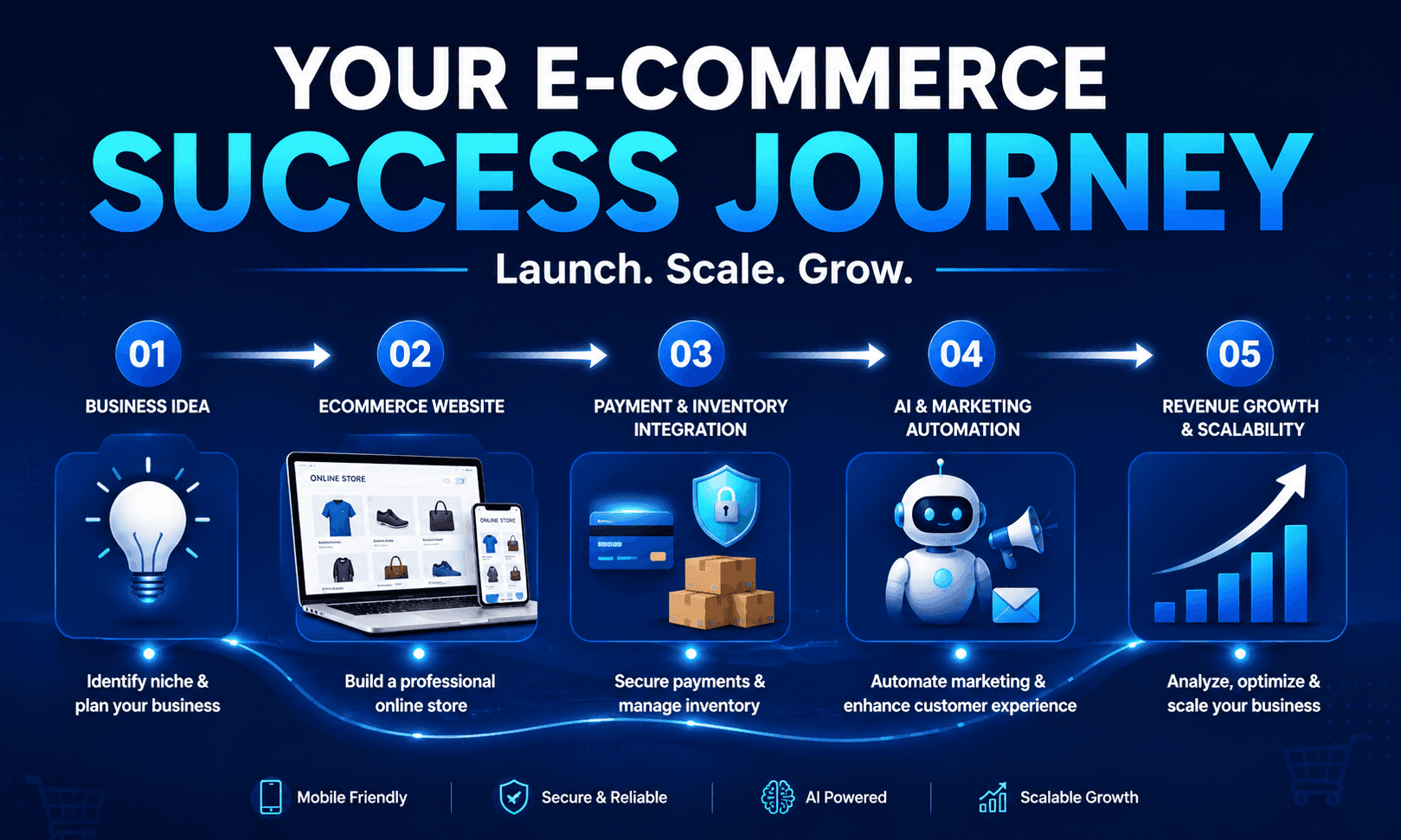
- Step 5: Integrate Secure Payment Gateways
- Step 6: Optimize Product Pages for Conversions
- Step 7: Implement Inventory & Order Management Systems
- Step 8: Use AI & Automation to Increase Profitability
- Step 9: Focus on SEO & Organic Traffic
- Step 10: Leverage Data & Analytics
- Step 11: Build an Omnichannel Commerce Strategy
- Step 12: Invest in Cloud Infrastructure & Scalability
- Common Mistakes Businesses Should Avoid
- Future Trends in E-Commerce for 2026
- Why Business Leaders Must Prioritize Digital Commerce
- Final Thoughts
The Complete Business Guide for Building a Scalable & Revenue-Driven E-Commerce Platform
The global e-commerce industry is evolving faster than ever. In 2026, building an online store is no longer just about selling products — it is about creating intelligent, scalable, customer-centric digital commerce ecosystems that drive long-term profitability.
From startups and D2C brands to manufacturing companies and enterprise retailers, businesses across industries are investing heavily in modern e-commerce platforms to increase revenue, improve customer experience, and expand into global markets.
However, launching an online store alone does not guarantee success.
To build a profitable e-commerce website in 2026, businesses need:
- Strategic planning
- Scalable technology
- Strong user experience
- AI-powered personalization
- Mobile-first architecture
- Secure payment systems
- Data-driven marketing
- Automation & analytics
For CEOs, CTOs, Managing Directors, Founders, IT Heads, Co-Founders, VPs, and business leaders, e-commerce is now a strategic growth engine rather than just a sales channel.
This step-by-step guide explains how businesses can build profitable, scalable, and future-ready e-commerce platforms in 2026.
Why E-Commerce is More Profitable Than Ever in 2026
Consumer behavior has changed dramatically over the last few years.
Modern customers expect:
- Fast online shopping experiences
- Mobile-friendly websites
- Personalized recommendations
- Secure digital payments
- Faster delivery
- Omnichannel engagement
As digital commerce adoption continues to rise globally, businesses with strong online ecosystems gain major advantages:
- Wider customer reach
- Lower operational costs
- Better customer insights
- Automated sales processes
- Scalable growth opportunities
This is why investing in a profitable e-commerce website is now a critical business strategy.
Step 1: Choose the Right Business Model
Before building your e-commerce website, define your business model clearly.
Common e-commerce business models include:
B2C (Business-to-Consumer)
Selling products directly to customers through an online store.
Best for:
- Retail brands
- Fashion businesses
- Electronics
- FMCG companies
B2B (Business-to-Business)
Selling products or services to other businesses.
Best for:
- Manufacturers
- Wholesalers
- Distributors
- Industrial suppliers
D2C (Direct-to-Consumer)
Brands selling directly without intermediaries.
Best for:
- Emerging consumer brands
- Lifestyle companies
- Product startups
Marketplace Model
Platforms connecting multiple vendors and customers.
Best for:
- Aggregator businesses
- Multi-vendor ecosystems
- Industry marketplaces
Choosing the right business model impacts platform architecture, pricing strategy, and operational workflows.
Step 2: Select the Right E-Commerce Platform
Build an E-Commerce Website That Drives Real Business Growth
The foundation of your online business depends on selecting the right technology platform.
Popular e-commerce platforms in 2026 include:
- Shopify
- WooCommerce
- Magento
- BigCommerce
- Custom enterprise solutions
- Headless commerce platforms
Business leaders should evaluate:
- Scalability
- Security
- ERP integration
- Cloud infrastructure
- Mobile performance
- Customization capabilities
- AI support
- Omnichannel capabilities
You can also explore our:
- [E-Commerce Development Services]
- [Custom Enterprise Software Solutions]
Step 3: Invest in Professional UI/UX Design
A profitable e-commerce website must deliver exceptional user experience.
Modern customers expect:
- Fast loading speed
- Clean product navigation
- Simple checkout processes
- Mobile responsiveness
- Visually engaging interfaces
Poor design directly impacts:
- Conversion rates
- Customer trust
- Bounce rates
- Sales performance
Professional UI/UX design improves engagement and customer retention significantly.
Step 4: Build a Mobile-First E-Commerce Experience
In 2026, mobile commerce dominates online shopping behavior.
Businesses must optimize for:
- Mobile responsiveness
- Touch-friendly navigation
- Faster mobile checkout
- Mobile payment systems
- App-like browsing experiences
A mobile-first strategy improves customer accessibility and conversion performance.
Step 5: Integrate Secure Payment Gateways
Payment security is critical for customer trust and transaction success.
Modern e-commerce platforms should support:
- UPI payments
- Credit & debit cards
- Wallet integrations
- International payments
- Buy Now Pay Later (BNPL)
- Subscription billing
Security technologies should include:
- SSL encryption
- Fraud detection
- PCI compliance
- Secure checkout systems
A seamless payment experience directly improves revenue generation.
Step 6: Optimize Product Pages for Conversions
Product pages play a major role in purchasing decisions.
High-converting product pages include:
- High-quality images
- Detailed descriptions
- Customer reviews
- Pricing transparency
- Clear CTAs
- Delivery information
- Product videos
AI-powered personalization can also recommend related products and improve average order value.
Step 7: Implement Inventory & Order Management Systems
As operations grow, manual inventory tracking becomes inefficient.
Modern e-commerce businesses use:
- Real-time inventory systems
- Automated order processing
- Warehouse management
- ERP integration
- Supply chain tracking
These systems improve operational efficiency and reduce fulfillment errors.
For enterprise businesses, integrated ERP systems are essential for scaling operations.
Step 8: Use AI & Automation to Increase Profitability
AI is transforming modern e-commerce ecosystems.
Businesses are using AI for:
- Personalized recommendations
- Customer segmentation
- Predictive analytics
- Automated email marketing
- Chatbots & customer support
- Dynamic pricing
Automation reduces manual workload while improving customer engagement and sales efficiency.
Step 9: Focus on SEO & Organic Traffic
SEO remains one of the most profitable long-term growth strategies for e-commerce businesses.
High-ranking e-commerce websites optimize:
- Product keywords
- Technical SEO
- Mobile performance
- Site speed
- Product schema
- Content marketing
- Internal linking
- Blog strategy
Strong SEO visibility helps businesses reduce customer acquisition costs over time.
Step 10: Leverage Data & Analytics
Data-driven decision-making is essential for scaling profitable e-commerce operations.
Business leaders should monitor:
- Customer acquisition costs
- Conversion rates
- Cart abandonment
- Product performance
- Customer lifetime value
- Traffic sources
- Revenue analytics
Modern analytics platforms provide real-time business intelligence for continuous optimization.
Step 11: Build an Omnichannel Commerce Strategy
Customers interact across multiple digital channels.
Successful businesses integrate:
- Websites
- Mobile apps
- Social commerce
- Online marketplaces
- Physical retail operations
Omnichannel commerce creates seamless customer experiences across every touchpoint.
Step 12: Invest in Cloud Infrastructure & Scalability
Scalability is critical for long-term e-commerce growth.
Cloud-native commerce platforms offer:
- Faster performance
- High uptime
- Better security
- Global scalability
- Flexible infrastructure
Cloud commerce helps businesses handle traffic spikes and rapid growth efficiently.
Common Mistakes Businesses Should Avoid
Many businesses fail due to poor strategic planning.
Common mistakes include:
- Choosing the wrong platform
- Ignoring mobile optimization
- Weak SEO implementation
- Poor inventory management
- Slow website speed
- Lack of analytics tracking
- Weak customer support
- Limited scalability planning
Avoiding these issues significantly improves long-term profitability.
Future Trends in E-Commerce for 2026
The future of e-commerce is intelligent, automated, and customer-centric.
Key trends include:
- AI-powered commerce
- Voice shopping
- AR/VR shopping experiences
- Headless commerce
- Hyper-personalization
- Social commerce
- Predictive analytics
- Subscription commerce
- Faster logistics automation
Businesses that adopt these technologies early will gain a strong competitive advantage.
Why Business Leaders Must Prioritize Digital Commerce
For CEOs, CTOs, Founders, Managing Directors, and IT leaders, e-commerce is no longer optional.
Modern consumers expect seamless digital experiences, and businesses that fail to adapt risk losing market relevance.
A professionally built e-commerce platform helps organizations:
- Increase revenue
- Expand market reach
- Improve operational efficiency
- Build customer loyalty
- Scale globally
Digital commerce is now directly linked to business growth and long-term competitiveness.
Final Thoughts
Building a profitable e-commerce website in 2026 requires much more than launching an online store. Businesses need scalable technology, customer-focused experiences, operational automation, AI-driven personalization, and long-term digital strategies.
Whether you are a startup, manufacturing company, retail brand, enterprise organization, or growing business, investing in the right e-commerce infrastructure can unlock significant revenue opportunities.
The businesses that succeed in 2026 will be those that combine technology, user experience, automation, and data-driven decision-making into one intelligent commerce ecosystem.
Frequently Asked Questions
What is How to Build a Profitable E-Commerce Website in 2026 (Step-by-Step)?
Learn how to build a profitable ecommerce website in 2026 with this complete step-by-step guide. Discover the best ecommerce platforms, AI-powered features, SEO strategies, payment integrations, and scalable solutions for business growth.